
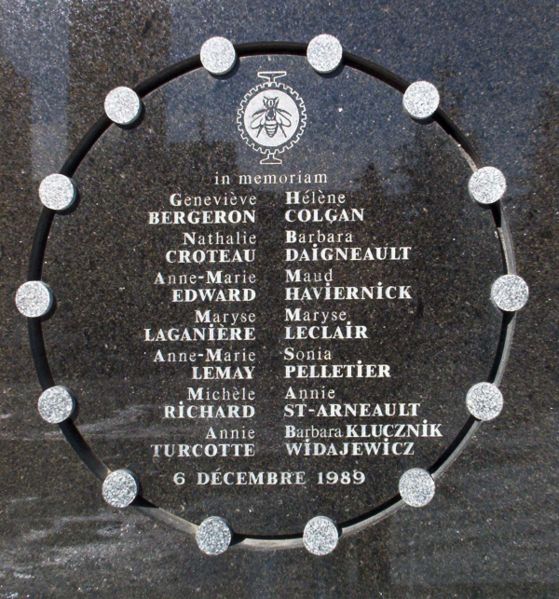
 I’m probably already reprinting to much, but frack it. This shit is too important not to repeat. Go to the Ottawa Citizen’s webpage and read the entire article by Shelly Page.
“I was 24, sent by the Toronto Star to write about the slaughter of female engineering students, all around my age; fourteen of them.
Looking back, I fear I sanitized the event of its feminist anger and then infantilized and diminished the victims, turning them from elite engineering students who’d fought for a place among men into teddy-bear loving daughters, sisters and girlfriends.
Twenty-five years later, as I re-evaluate my stories and with the benefit of analysis of the coverage that massacre spawned, I see how journalists— male and female producers, news directors, reporters, anchors — subtly changed the meaning of the tragedy to one that the public would get behind, silencing so-called “angry feminists.” We were “social gatekeeping,” as filmmaker Maureen Bradley later asserted in her 1995 film, Reframing the Montreal Massacre: A media interrogation.”
[…]
“That evening, I thawed my feet in my hotel and watched the late Barbara Frum, one of Canada’s most respected journalists, refuse to admit that the massacre was indeed an act of violence toward women.
“Why do we diminish it by suggesting that it was an act against just one group?” Frum asked on CBC’s The Journal.
Frum was puzzled that so many women insisted the massacre was a result of a society that tolerates violence against women.
“Look at the outrage in our society,” Frum said. “Where is the permission to do this to women?
“If it was 14 men would we be having vigils? Isn’t violence the monstrosity here?”
She refused to even utter the word feminist. But then, her neutralizing of feminist anger must have resonated, and perhaps was reflexive. Bradley, in her documentary, wondered about Frum’s stance: “Was it necessary to deny any shred of feminism in herself in order to get where she was in this bureaucratic, media institution, boys’ club?”
Bradley also pointed out that the national media did not cover an emotional vigil the day after the massacre, where there was an angry confrontation between Montreal feminists and male students from the Université de Montréal. It would have made great content. Intelligent women voicing their outrage. But the story didn’t make it out of campus newspapers and local TV coverage onto a national stage. This story was not allowed to resonate with angry women.
When I review the stories I wrote, I almost never used the word feminist; I never profiled the achievements of one of the slain engineering students or the obstacles she’d toppled. I never interviewed a single woman who was angry, only those who were merely sad. Why? No one told me what not to write, but I just knew, in the way I knew not to seem strident in a workplace where I’d already learned how to laugh at sexist jokes and to wait until a certain boss had gone for the day before ripping down Penthouse centrefolds taped on the wall near his desk.
My stories were restrained, diligent and cautious. For years, I remembered one of my sentences with particular pride. Reading it now, it shows everything that was wrong with how I covered the event:
They stood crying before the coffins of strangers, offering roses and tiger lilies to young women they never knew.
I turned the dead engineering students into sleeping beauties who received flowers from potential suitors.
I should have referred to the buildings they wouldn’t design, the machines they wouldn’t create and the products never imagined.
They weren’t killed for being daughters or girlfriends, but because they were capable women in a male-dominated field.
I should have written that then.”











 bleatmop
 Mystro
 The Arbourist


 Dead Wild Roses
8 comments
December 7, 2015 at 6:06 am
roughseasinthemed
It’s a good article. But nothing’s changed. I’ve half-written a list about women authors (for roughseas not Clouds) where I look at the same portrayal of women authors. One of the intros in the reports I’m looking at immediately refer to her ability to bake a great cake in the intro. Says it all …
I’m wondering how I worded things in the 80s as a junior reporter? But my chief reporter (and very good too) was a woman, as was the deputy chief reporter. Later, on another paper, times had moved on and so had I, we discussed the appropriate term for the female chair of the parish council that wouldn’t send the editor apoplectic. On the same paper I remember covering the funeral and murder trial of an old woman who was beaten to death. Her sex wasn’t relevant, rather the sad ending to someone’s life, from a murderer (who she knew) who stole a few quid for drugs.
But it’s very difficult to escape what society pushes onto us. The only way to really question how we write, whether as bloggers or as journalists, is to ask, would I write the same thing about the opposite sex?
LikeLiked by 1 person
December 7, 2015 at 7:47 am
The Arbourist
@RSitM
Do they teach attention to patriarchal nuance in Journalism school?
From the sample of male reporting I’ve seen, it seems that many missed that day…
LikeLike
December 7, 2015 at 7:57 am
carmen
That phrase, “…capable women in a male-dominated field” resonates with me, as two of our three daughters are in this position. And I’m STILL hearing the kinds of things, from those daughters, that one imagines should have been eradicated … After all, it is 2015. Change takes time; big sigh.
LikeLiked by 2 people
December 7, 2015 at 7:58 am
roughseasinthemed
Not that I noticed. I went to post grad college so, it was just a couple of months (fortunately). In fact some of the lecturers were patriarchal in attitude. But I was with a couple of newspaper colleagues and we were there to pass exams, nothing more. Sad reflection.
I felt I learned a lot more on the job. It was a basic apprenticeship training though, indentures etc, where you learn from qualified tradespeople. Luck of the draw how good your seniors were. Journalism, in my time at least, did attract left-wing feminists. Women (including me) were often Union delegates (Mother of the Chapel) too.
LikeLike
December 7, 2015 at 8:20 am
The Arbourist
@Carmen
I sympathize with you Carmen. The bullshite men, via institutionalized patriarchy, think they can get away with is fucking atrocious. :/
LikeLike
December 7, 2015 at 8:27 am
The Arbourist
@RSitM
Sort of an OT question. How have your editors positioned politically on the spectrum compared with more front-line journalists? One of the ripostes that I have used when dealing with the noise-chamber that are right-wing commentators while debating “the liberal media” is that, well yes Journalists do tend to be more liberal, but the people who edit and run the stories tend to be much more conservative, hence the constructions of boogy-man known as “liberal media-bias” is axiomatically, incorrect.
Sources – Manufacturing Consent, What Liberal Media, Necessary Illusions, 20 similar titles.
LikeLike
December 7, 2015 at 9:05 am
roughseasinthemed
Actually editors were probably politically right of centre, but would often write leader columns about anything to inspire controversy, and largely left reporters to get on with it.
One award I won was for a campaign I didn’t agree with (a road thing, hit my environmental nerve), but when we sign up for journalism, we sign up to write whatever. However, we do not have to write something we consider inaccurate, wrong, discriminatory, biased etc. or in the case of one colleague, we do not disclose sources. And she went to prison for refusing to disclose a source to the police.
I did have an argument with a news editor (woman) and another reporter who sometimes worked as news editor. I’d reported on some political activists in a council meeting. The male reporter wanted to describe them as ragamuffins or a rabble or some such, which I said was totally ridiculous. The news editor backed me in the end. Bet she got grief when she got home because they lived together, but it’s a good example of not letting a political bias sway you – he was right wing.
Obviously I have no idea about North America. In a way, an editor is an a difficult position, balancing the needs of a board of directors and shareholders with a team of reporters and sub-editors who are striving for professionalism in their craft trade. The day we got a lecture from one editor about working for shareholders was the day I started filling out application forms.
LikeLike
December 7, 2015 at 9:07 am
roughseasinthemed
PS. I should have said that standards in journalism have slipped since I left. The two are not necessarily linked.
LikeLike