
Paul Street writes a foreboding analysis of what the TPP is on Counterpunch.
“Lawyers and lobbyists for giant multinational corporations have been working up the TPP and promoting it for nearly a decade. The measure would join the United States along with 11 other nations along the Pacific Rim (Australia, Brunei, Canada, Chile, Japan, Malaysia, Mexico, New Zealand, Peru, Singapore, and Vietnam) in a “free-trade zone” covering nearly 40 percent of the world’s economy. Obama and his largely Republican “free trade” allies say the TPP will open foreign markets to American goods and “level the playing field by forcing Asian competitors to improve labor and environmental standards.”
But that’s just blatantly deceptive business propaganda. The measure isn’t really about trade and it certainly isn’t about improved standards. Its real thrust is to strengthen corporations’ ability to protect and extend their intellectual property rights (drug patents, movie rights, and the like) and to guarantee that they will be compensated by governments for any profits they might lose from having to meet decent public labor and environmental (and other) standards – something certain to discourage the enactment and enforce of such standards. Key parts of the TPP permit foreign capital to freely and easily enter a country and for profits to be just as easily removed. The TPP would ban capital controls, which let nations block disruptive inflows of ‘hot money’ from speculative investors and then escape before the bubble they create explodes. It would also block the passage of financial transaction taxes, a method for checking speculation and generating public revenue. The measure also legitimizes the extensive privatization of public enterprises.
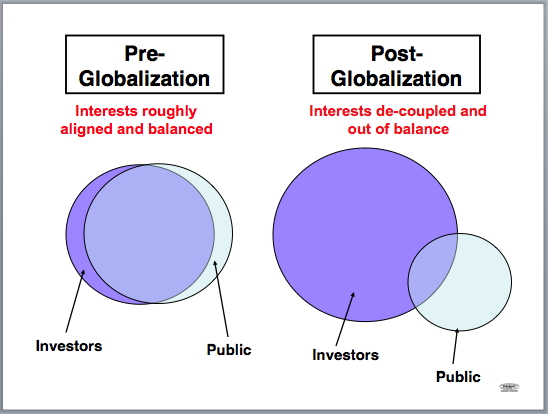
The TPP is designed to help big multinational businesses attain special deals they would be unable to get through existing political processes, considered excessively democratic by the global deep state of capital. A foreign corporation could sue and receive damages for anticipated profit losses resulting from an increase in the minimum wage (federal, state, or local) in the United States. A U.S. state or Canadian province (or any other member-state jurisdiction) would have to compensate oil and gas companies for anticipated profits lost to bans on the environmentally disastrous practice of hydraulic fracturing (fracking). Big Pharma and the big corporate media firms would be granted stronger and longer-lasting patent and copyright protections across the “free trade” zone. Big multinational banking and investment firms would have to be paid by TPP governments that wanted to keep their nations’ financial systems safe through responsible regulation. Food, chemical, consumer goods, and pesticide industries will be able to able to limit the ability of TPP governments to impose safety and environmental regulations on the things they sell and how they make them. The giant global and U.S.-based consumer packaged goods firm Procter & Gamble could demand compensation from any TPP nation (including the U.S.) that dared to subject its products and workplaces to basic social and environmental standards. (One could go on and on with such examples.)
“Level playing field”? The TPP is about a race to the capitalist bottom, a levelling down of people and government’s capacity to impose limits on business behavior. Like its regressive predecessor the North American Free Trade Agreement (NAFTA), it’s about what the New York Times calls “investor protection.”
Of critical and dark significance, the TPP constructs a new legal structure that transcends the existing, nation-based legal system.
Phone, write, send smoke signals to your MP’s fellow Canadians. We do not want this for our country, NAFTA is bad enough.











 bleatmop
 Mystro
 The Arbourist


 Dead Wild Roses
7 comments
January 19, 2016 at 7:49 am
robert browning
These trade deals further escalate today’s feudal system. We need a new Magna Carta.
LikeLiked by 1 person
January 19, 2016 at 2:48 pm
bleatmop
The TPP is going to be unspeakably bad. The TPP and its associate TTIP are the USA attempting to maintain the world in it’s uni-polar power structure and to cripple China’s rising power. These deal, in no uncertain terms, outright and completely erode sovereignty and create an new corporate government. Governments will do as they are told by the corporations or they will pay through the nose as dictated by kangaroo courts to make up for their “lost profits”. Canada is already the most sued nation involved in NAFTA and it will be even more so under TPP.
The sad part is that as unbelievably bad it will be under the TPP, it will be even worse not under it. This is economic warfare and if we aren’t with the US on this one, we will be against them. They say negotiating trade deals is like an engagement and ratifying them is like a marriage. However backing out is like a divorce, and I rarely see those go well.
LikeLiked by 2 people
January 19, 2016 at 3:46 pm
thnkfryrslf
Canada saying no to the TPP is saying no to Neoliberalism, particularly the US Neoliberalism. Harpers pathetic rush to sign the TPP, during an election, was because he was/is a committed Neoliberal.Changing Canada’s government from a democracy to a Market state was a goal he wasn’t able to fully achieve because of his election loss in Oct. 2015, but still implementing Neoliberal policy could continue without him by his signing of the TPP, I don’t think people realize how malevolent Harper really was.Saying no to the US however, will create enormous unforseen consequences. It would take a Prime Minister with alot of knowledge, confidence and guts to say no. It will never happen.
LikeLike
January 19, 2016 at 3:47 pm
thnkfryrslf
I forgot to say this was a really good article. Thx for posting.
LikeLiked by 1 person
January 19, 2016 at 5:28 pm
The Arbourist
@thnkfryslf
The pressure will be great on JT to maintain the status quo, but I’m thinking if he wants to govern a second term, he won’t sign the TPP. Of course, if the US congress scuttles it in the US we won’t have to worry about it. :>
LikeLike
January 19, 2016 at 5:29 pm
The Arbourist
@bleatmop
Well said sir. :>
LikeLike
January 23, 2016 at 12:15 pm
VR Kaine
Hillary “loved” the TPP. Anyone wondering “good or bad?” has to only look that far to find the answer – bad.
LikeLike