
You are currently browsing the monthly archive for June 2017.
Well, folks let me tell you, listening the the choral finale of Mahler 2 is inspiring, but singing it… Next level experience. We had the Calgary Youth Orchestra and 3 other choirs join my choir to tackle this monumental piece. Every chorister should have the opportunity to sing in this iconic musical experience.
Original German
Aufersteh’n, ja aufersteh’n
Wirst du, Mein Staub,
Nach kurzer Ruh’!
Unsterblich Leben! Unsterblich Leben
wird der dich rief dir geben!
Wieder aufzublüh’n wirst du gesät!
Der Herr der Ernte geht
und sammelt Garben
uns ein, die starben!
—Friedrich Klopstock
O glaube, mein Herz, o glaube:
Es geht dir nichts verloren!
Dein ist, ja dein, was du gesehnt!
Dein, was du geliebt,
Was du gestritten!
O glaube
Du wardst nicht umsonst geboren!
Hast nicht umsonst gelebt, gelitten!
Was entstanden ist
Das muss vergehen!
Was vergangen, auferstehen!
Hör’ auf zu beben!
Bereite dich zu leben!
O Schmerz! Du Alldurchdringer!
Dir bin ich entrungen!
O Tod! Du Allbezwinger!
Nun bist du bezwungen!
Mit Flügeln, die ich mir errungen,
In heißem Liebesstreben,
Werd’ ich entschweben
Zum Licht, zu dem kein Aug’ gedrungen!
Sterben werd’ ich, um zu leben!
Aufersteh’n, ja aufersteh’n
wirst du, mein Herz, in einem Nu!
Was du geschlagen
zu Gott wird es dich tragen!
—Gustav Mahler
In English
Rise again, yes, rise again,
Will you My dust,
After a brief rest!
Immortal life! Immortal life
Will He who called you, give you.
To bloom again were you sown!
The Lord of the harvest goes
And gathers in, like sheaves,
Us together, who died.
—Friedrich Klopstock
O believe, my heart, O believe:
Nothing to you is lost!
Yours is, yes yours, is what you desired
Yours, what you have loved
What you have fought for!
O believe,
You were not born for nothing!
Have not for nothing, lived, suffered!
What was created
Must perish,
What perished, rise again!
Cease from trembling!
Prepare yourself to live!
O Pain, You piercer of all things,
From you, I have been wrested!
O Death, You conqueror of all things,
Now, are you conquered!
With wings which I have won for myself,
In love’s fierce striving,
I shall soar upwards
To the light which no eye has penetrated!
Die shall I in order to live.
Rise again, yes, rise again,
Will you, my heart, in an instant!
That for which you suffered,
To God shall it carry you!
—Gustav Mahler
 :)
:)
The idea that spanking is somehow a valid parenting practice is disturbing enough. What is more troubling is that people who practice spanking are likely to justify it within their own moral framework and not change their views on the subject.
“To find answers, I looked at violence across cultures and history with my colleague Alan Fiske of the University of California, Los Angeles. We analyzed records of all kinds of violence, ranging from war to torture to genocide to homicide. While this was rather depressing work, it also led to some very interesting findings. We identified a pattern in that violence that was both predictive and explanatory.
The commonality was that the primary motivations were moral. This means that the perpetrators of violence felt like what they are doing was morally right. In fact, when they were committing the act, they perceived that not acting would be morally wrong. It wasn’t about a breakdown in moral sensibilities, but more that their sense of morality was different. They viewed violence as the fundamentally right thing to do even if no one else could see any possible justification for it.
With this lens, let’s go back to that spanking scenario. A child disobeys his mother, who spanks him because she believes it is her duty to protect him from himself and ensure that he becomes a responsible adult. She sees it as her obligation as a parent.
Similarly, drill sergeants and gang leaders often haze new recruits, as they believe it is their duty to create lifelong bonds and instill obedience, which are required in battle. We can even see this mentality with terrorists. ISIL members believe they are morally justified and obligated to commit acts of terror, while US soldiers accept some loss of civilian lives to achieve the deaths of those terrorists. In all of these scenarios, the violent act is perceived by the perpetrator as virtuous. As details emerge about the California shootings, we will begin to see more about the shooters; whether they felt their violence was something they had an obligation to do, and if so, why.
The general pattern we saw in the cases we studied was that violence was intended to regulate social relationships and sustain a moral order. The perpetrators are in control of their actions—they know they are hurting fellow human beings, and that is exactly what they intend to do.”
–Tage Rai Lecturer, MIT Sloan School of Management
Consider this conversation and then juxtaposition it with all the chatter one hears about ‘gender identity’ and ‘gender expression’. Add to your lens the notion of male privilege and how it often plays out when it comes to respecting the boundaries of females.
(not) Funny how that works.
http://auntiewanda.tumblr.com/post/160517895825/cecaeliawitch-this-was-a-pretty-grand-moment-and
Gail Dines is an amazing feminist. She lectures worldwide and has written many an article as well as few really good books. She sums up the slide toward liberal feminism in three meagre slides.
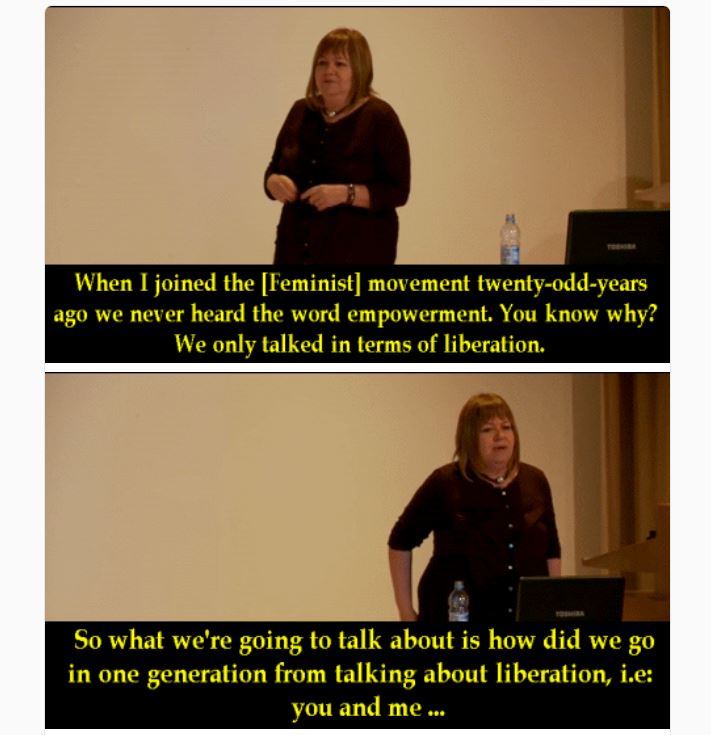
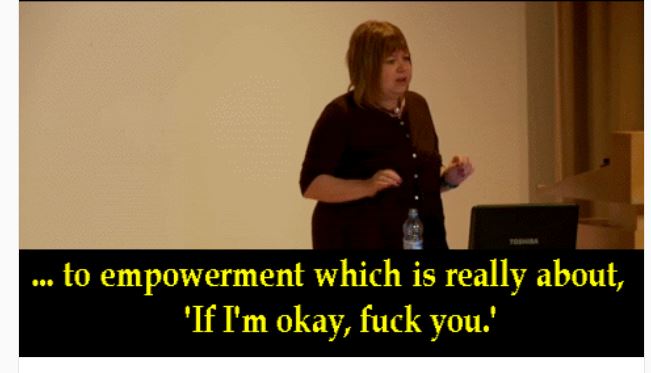
Let’s move away from the neo-liberal/libertarian ‘I’ve got mine, fuck you’ trend that has dominated much of recent popular feminist discourse.

Rae Story reflects on how when male artists create works that dehumanise women it is taken to be a comment on society as a whole, while women’s resulting brutalisation, isolation and objectification is seen as little more than a sideshow. She compares this with the powerful art of Suzzan Blac who mines her own traumatic memories of abuse and prostitution to create a blistering commentary on pornographic, female objectification and paedophile culture.
View original post 2,135 more words











 bleatmop
 Mystro
 The Arbourist


 Dead Wild Roses
Your opinions…