
You are currently browsing the monthly archive for November 2018.
The epidemic needs to stop. The solution needs to address the socialization boys and girls receive, teaching mutual respect for both sexes cannot start at too early and age. Otherwise, we as a society, will pay the very real costs.
“Let us take the case of Dr Ford, who had to put her mental, emotional, and physical safety on the line to report the sexual assault she suffered. During her testimony she was asked to discuss the short and long-term impacts of being a survivor. Dr Ford mentioned her first two “disastrous” years as an undergrad at University of North Carolina. Although she went on to earn a PhD, those disastrous times could have cost her academic career.
Imagine all the women who experienced life-long economic disadvantage from the devastating trauma brought on by assault. Perhaps due to the resulting anxiety and post-traumatic stress disorder (PTSD), they are unable to go back to work or complete college, or even if they do, they subsequently struggle financially or are unable to advance in their careers.
In the simplest of terms, survivors and the subsequent decrease in accumulation of wealth they experience is lost human capital. As has been proven time and time again, the more capital that’s funneled into an economy, the more robust that economy. By allowing “boys to be boys” with impunity, we’re not only compromising on a social contract of civility, we’re actually preventing a third of the female population from fulfilling their economic potential, which is handicapping the American economy, plain and simple.
The research findings that are offered about the costs of sexual assault are in no way exhaustive, but they do offer a slice of the pie. For example, according to the Bureau of Justice Statistics, the total cost survivors incurred as a result of sexual assault was $18m in 2002. Adjusted to today, that number would probably be significantly higher.
The National Alliance to End Sexual Violence states “survivors who were sexually assaulted during adolescence have been found to have reduced income as adults, with an estimated lifetime income loss of $241,600.”
The twitter thread is here.
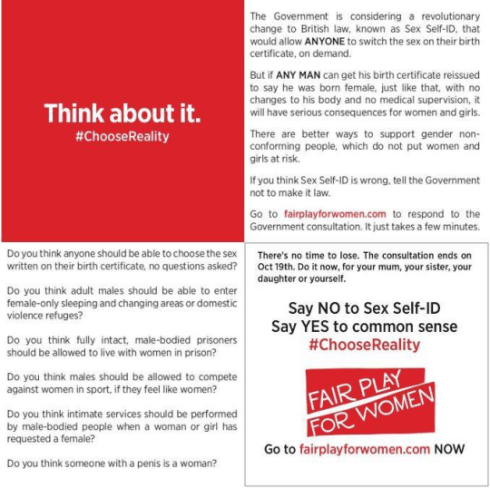
Memo. Radical feminist women never “deny the existence” of blokes who say they are women. It’s impossible. You’re right there. In a wig and a frock performing woman for us. We don’t just think “JFC I’m drunk and seeing things!” You’re clearly there. You’re just not female.
And your dress and wig and lippy and heels are perfectly fine. Crack on. You can sit at my table. Chat with me. Ride a bike with me. You just can’t cross my boundaries and call yourself me. We are different. Woman is different to man. You cannot be in women’s space.
And there’s no “But I can use your loo … I’ll do it quietly … no one will notice … that will be ok..?” No that is not ok. The line is clear. Women need concede no ground on this. We aren’t unkind. We don’t hate or fear you. We have boundaries. For our safety and dignity.
You cannot demonise us or bully us or threaten or coerce us to make us say you are women. We cannot say untruths. We will not lie or pretend. That isn’t hatred. It is respect for ourselves and acknowledgment of our own intellectual capacity to determine the meaning of woman.
So … be yourself. Enjoy your life. Continue to exist. Enjoy all the “womanny” clothes and shoes. I’ll happily smile in my boots and jeans as you totter by in your heels and lace. And we can all get along. Fight for space away from other men if you need it.
But do not expect us to harbour you in our limited and hard-won safe spaces. Women shed blood to get them. You are male. They are your people. Their violence is yours. Women are fighting to stay alive. We do not have resources to help you with that as we are the sex most at risk.
The dead bodies are ours. The raped bodies are ours. The abused bodies are ours. Overwhelmingly. The violence is male on female. So …. we don’t deny your existence. We are simply clinging to our own. We are keeping women alive when we define “woman” and our needs.
And we are not ashamed.

From Act two of Gluck’s Orfeo ed Euridice
Act 1
Illustration from a 1764 edition of the score
A chorus of nymphs and shepherds join Orfeo around the tomb of his wife Euridice in a solemn chorus of mourning; Orfeo is only able to utter Euridice’s name (Chorus and Orfeo: “Ah, se intorno”/”Ah! Dans ce bois”). Orfeo sends the others away and sings of his grief in the aria “Chiamo il mio ben”/”Objet de mon amour”, the three verses of which are preceded by expressive recitatives. This technique was extremely radical at the time and indeed proved overly so for those who came after Gluck: Mozart chose to retain the unity of the aria. Amore (Cupid) appears, telling Orfeo that he may go to the Underworld and return with his wife on the condition that he not look at her until they are back on earth (1774 only: aria by Amour, “Si les doux accords”). As encouragement, Amore informs Orfeo that his present suffering shall be short-lived with the aria “Gli sguardi trattieni”/”Soumis au silence”. Orfeo resolves to take on the quest. In the 1774 version only he delivers an ariette (“L’espoir renaît dans mon âme”) in the older, showier, Italian style, originally composed for an occasional entertainment, Il Parnaso confuso (1765), and subsequently re-used in another one, Le feste d’Apollo (1769).[1]
Act 2
In a rocky landscape, the Furies refuse to admit Orfeo to the Underworld, and sing of Cerberus, its canine guardian (“Chi mai dell’Erebo”/”Quel est l’audacieux”). When Orfeo, accompanied by his lyre (represented in the opera by a harp), begs for pity in the aria “Deh placatevi con me”/”Laissez-vous toucher”, he is at first interrupted by cries of “No!”/”Non!” from the Furies, but they are eventually softened by the sweetness of his singing in the arias “Mille pene”/”Ah! La flamme” and “Men tiranne”/”La tendresse”, and let him in (“Ah, quale incognito affetto”/”Quels chants doux”). In the 1774 version, the scene ends with the “Dance of the Furies” (No. 28).[8]
The second scene opens in Elysium. The brief ballet of 1762 became the four-movement “Dance of the Blessed Spirits” (with a prominent part for solo flute) in 1774. This is followed (1774 only) by a solo which celebrates happiness in eternal bliss (“Cet asile”), sung by either an unnamed Spirit or Euridice, and repeated by the chorus. Orfeo arrives and marvels at the purity of the air in an arioso (“Che puro ciel”/”Quel nouveau ciel”). But he finds no solace in the beauty of the surroundings, for Euridice is not yet with him. He implores the spirits to bring her to him, which they do (Chorus: “Torna, o bella”/”Près du tendre objet”).
Act 3
On the way out of Hades, Euridice is delighted to be returning to earth, but Orfeo, remembering the condition related by Amore in act 1, lets go of her hand and refusing to look at her, does not explain anything to her. She does not understand his action and reproaches him, but he must suffer in silence (Duet: “Vieni, appaga il tuo consorte”/”Viens, suis un époux”). Euridice takes this to be a sign that he no longer loves her, and refuses to continue, concluding that death would be preferable. She sings of her grief at Orfeo’s supposed infidelity in the aria “Che fiero momento”/”Fortune ennemie” (in 1774, there is a brief duet before the reprise). Unable to take any more, Orfeo turns and looks at Euridice; again, she dies. Orfeo sings of his grief in the famous aria “Che farò senza Euridice?”/”J’ai perdu mon Eurydice” (“What shall I do without Euridice?”/”I have lost my Euridice”) Orfeo decides he will kill himself to join Euridice in Hades, but Amore returns to stop him (1774 only: Trio: “Tendre Amour”). In reward for Orfeo’s continued love, Amore returns Euridice to life, and she and Orfeo are reunited. After a four-movement ballet, all sing in praise of Amore (“Trionfi Amore”). In the 1774 version, the chorus (“L’Amour triomphe”) precedes the ballet, to which Gluck had added three extra movements.











 bleatmop
 Mystro
 The Arbourist


 Dead Wild Roses
Your opinions…