
You are currently browsing the monthly archive for December 2019.
When the economy is down, and the money is tight, and a recession looms in the near future what would be the best course of action for the government of Alberta? Apparently, firing 6000 people from their jobs is the correct answer according to Jason Kenny and his merry band of right-wing ideologues. The raging boner the UCP has for austerity and the gutting of the public sector has never been more apparent.
“Nearly 6,000 Alberta public-sector jobs could be eliminated as the UCP government tries to cut costs and find efficiencies, the provincial government signalled to Alberta’s largest union in letters released late Friday afternoon.
The union received the letters in advance of bargaining for 2020 collective agreements. The letters are not formal notices of layoffs, but as required under the collective bargaining process, outline cuts the provincial government might make.
The potential cuts would impact 2,500 Government of Alberta positions across several ministries, as well as the following positions at Alberta Health Services:
- 1,000 to 2,000 housekeepers;
- 350 administrative support and medical transcription employees;
- 250 general support staff, such as maintenance employees;
- 235 laundry and linen operations staff;
- 200 auxiliary nursing employees, such as licensed practical nurses and health-care aides;
- 200 home care services staff;
- 165 foodservice employees.
“The [Government of Alberta] will continue to guarantee employment security until March 30, 2020, for permanent bargaining unit employees using attrition, vacancy management and redeployment to meet employer needs,” states a Thursday letter to the Alberta Union of Provincial Employees from Alberta Public Service Commissioner Tim Grant.”
Because having 6000 fewer breaking even, paying their bills without assistance, and supporting the floundering local economy isn’t sound economic policy.
The mass layoffs will put people who have to use our health care system at risk. Never fear though, these public employee’s may be partially replaced by private workers and companies who will charge more for the same job, while providing inferior service and products.
“If further contracting out initiatives are to be considered in future, we will advise as required,” the letter states.
“AHS will continue to consider all options available to meet our organizational needs including changes to staff mix, service redesign, including changes and repurposing of sites, relocating services, reducing or ceasing the provision of services,” it says.
Notley said it is clear the UCP government intends to further privatize public services.
“Albertans will pay the price for this. And again, it’s entirely unnecessary. This has gone from prudent fiscal management to an extreme ideological vendetta.”
The ‘fuck you, I’ve got mine’ crowd has been crowing about trimming the fat and reducing bloat in the public sector. They never seem to connect the idea that the people working these jobs: nurses, teachers and those who support them, are more likely that not, providing services that benefit the fat trimmers.
See also the standard neo-liberal ploy of hollowing out public institutions, then decrying said institutions for not being effective, and then turning to privatization as the magical panacea that will fix the systems they just sabotaged.
The problem is that this strategy never works for the benefit of the end users – the public – as they inevitably will be saddled with less efficient, more expensive private services. Who this benefits, of course, is the businesses and corporations who will make handsome profits while immiserating the populace.
Thank you UCP voters…

We have to dispel the notion that the US, UK, and Canada are on always on the side of justice and that we can do no wrong. If this was the case, we would happily welcome the scrutiny of the ICC in our wars and international affairs, as we would (in theory) have nothing to hide. Vijay Prashad writing for Counterpunch disagrees.
Clearly, this is not the case.
“The United States is not a party to the International Criminal Court (ICC). It had helped establish the Court, but then reversed course and refused to allow itself to be under the ICC’s jurisdiction. In 2002, the U.S. Congress passed the American Service-Members’ Protection Act, which allows the U.S. government to “use all means” to protect its troops from the ICC prosecutors. Article 98 of the Rome Statute does not require states to turn over wanted personnel from a third party if these states had signed an immunity agreement with the third party; the U.S. government has therefore encouraged states to sign these “article 98 agreements” to give its troops immunity from prosecution.
The enormity of evidence of war crimes by U.S. troops and U.S.-affiliated troops in Afghanistan and Iraq weighed on the credibility of the ICC. In 2016, after a decade of investigation, the ICC released a report that offered hope to the Afghan people. The ICC said that there is “a reasonable basis” to pursue further investigation of war crimes by various forces inside Afghanistan—such as the Taliban, the Haqqani network, and the United States military forces alongside the Central Intelligence Agency. The next year, the ICC went forward with more detailed acknowledgment of the possibility of war crimes. Pressure on the ICC’s prosecutor mounted.
Pressure on the Court
This is where everything seemed to end. The Trump administration, via John Bolton and Mike Pompeo, made it clear to the ICC that if they pursued a case against the U.S., then the Trump administration would go after the ICC prosecutor and judges personally. An application for a U.S. visa by Fatou Bensouda, the ICC prosecutor, was denied; she had intended to come to the U.S. to appear before the United Nations. This was a shot across the bow of the Court. The U.S. was not going to play nice. Not long thereafter, in April 2019, the ICC said that it would not go ahead with a war crimes case against the United States, or indeed against any of the belligerents in Afghanistan. The Court said it would “not serve the interests of justice” to pursue this investigation.
Trump responded to this decision by calling the ICC “illegitimate” and—at the same time—that the ICC’s judgment was “a victory, not only for these patriots, but for the rule of law.”
Staff at the ICC were dismayed by the ICC’s decision. They were eager to challenge it, fearing that if they let the U.S. mafia tactics prevent their own procedures then the ICC would lose whatever shred of legitimacy remains. As it is, the ICC is seen as being deployed mainly against the enemies of the United States; there have been no serious investigations of any power that is closely aligned with the United States.”
We have one set of rules for the rest of the world and another version that we apply to ourselves. The exceptionalism that is portrayed in our media and repeated by our political classes needs to be dispelled. We should not be above the ICC’s reach, nor should we be impeding the investigations that it undertakes. Yet it is the reality we inhabit.
Most nations will act with a certain level of impunity when it comes to their interests at home and abroad. We in the West need to acknowledge that through our actions, are no better or worse then the countries we seek to censure through the ICC and the war crimes it prosecutes.
A quick click at Canadahelps.org gets you to the donation page for a 15 dollar membership, follow the instructions so you can get a proxy and a vote to ensure that the Bread & Roses Women’s Centre remains a safe female only space. Holly will guide you through the rest of the process.

Thank you to all who follow up and support Canadian Women.
Unfamiliar with the Logical Problem of Evil? Here’s a quick breakdown:
- There are events in our world — such as an animal’s dying an agonizing death in a forest fire, and a child’s undergo lingering suffering and eventual death due to cancer — such that the actions of allowing those events, when one could prevent them, both (a) have very serious, known wrongmaking characteristics, and (b) have no rightmaking characteristics of which we are aware that are sufficient to balance out the known wrongmaking properties.
Therefore it is likely that:
- For any such action, the totality of the wrongmaking properties, both known and unknown, outweighs the totality of the rightmaking properties, both known and unknown.
- Any action whose wrongmaking properties outweigh its rightmaking properties is morally wrong.
Therefore, from (2) and (3) :
- Such actions are morally wrong.
- For any action whatever, an omnipotent and omniscient being is capable of not performing that action.
Therefore, from (4) and (5):
- If there is an omnipotent and omniscient being, then that being performs some morally wrong actions.
- A being that performs morally wrong actions is not morally perfect.
Therefore, from (6) and (7):
- If there is an omnipotent and omniscient being, that being is not morally perfect.
- God is by definition an omnipotent, omniscient, and morally perfect person.
Therefore, from (8) and (9):
- God does not exist.
And now the promised riff on said notion:
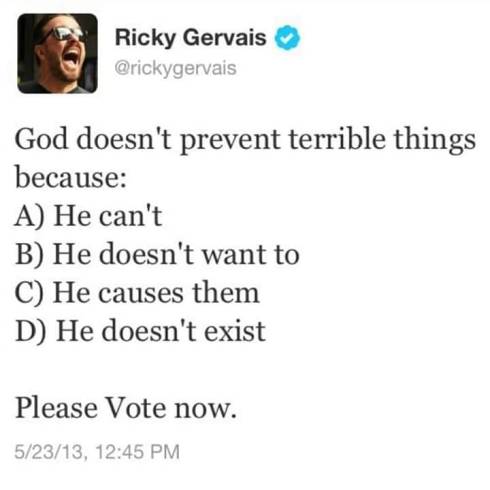
Hard choices for the believers. Not much to do but hand-wave away the pernicious conclusions one is forced to draw when looking at what God does.











 bleatmop
 Mystro
 The Arbourist


 Dead Wild Roses
Your opinions…