
You are currently browsing the monthly archive for November 2021.
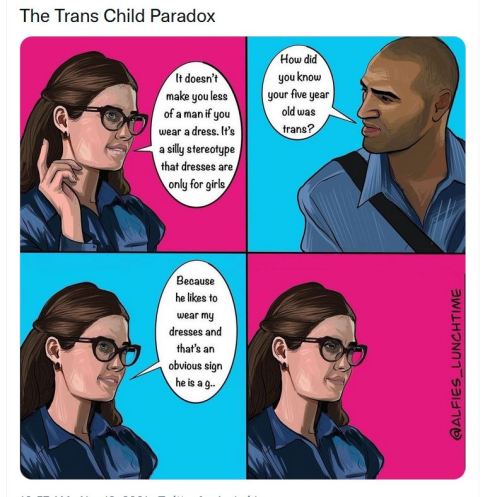
Transgender ideology is rife with paradox. This is one of the more important aspects because it illustrates the friction between a supposedly liberating dogma and its actual effects.
Gender stereotypes are, for the most part, harmful for the women and men that follow them. Like the cartoon above – the stereotype is that dresses are worn by women. Well we all know that clothing for the most part, has no gender and can be worn by anyone. But men are ‘not supposed’ to wear dresses because they are for women – men will feel social pressure not to wear a dress because of the arbitrary gender stereotypes.
So what is transgender ideology to do when it argues that wearing a dress, in fact, makes you a woman. Transgender ideology reinforces the stereotypical notion of gendered clothing and who is allowed to wear what. It maintains the status quo and is no way revolutionary.
Contrast this with the gender abolitionist radical feminist position – Let’s dispense with the notion of gender stereotypes altogether and celebrate gender non conforming behaviour because clothes are for people – the end. A woman in a suit or a man in a dress are simply that, a female and a male with clothing that matches their personality and goals for the day. Easy peasy lemon squeezy.
Liz Theoharis writing for Tom’s Dispatch on poverty and the solidarity and ingenuity of the American people when it came to helping the poor in their country. The underclasses in the USA have begun to organize again, I just hope it isn’t too late because the road before them is steep and filled with many pitfalls. The recent addition of social media to the mix with it’s tendency to fragment and cause division among groups will provide a significant challenge for those organizations that wish to once again reform and reforge the poor into a political force in the US. I hope they succeed as the survival of their nation is dependent on them achieving their goals.
“Another example was the transformative work of the Black Panther Party, whose legacy still impacts our political life, even if the image of the party remains distorted by myths, misrepresentations, and racist fearmongering. This October marked the 55th anniversary of its founding. For many Americans, its enduring image is still of ominous looking men in black berets and leather jackets carrying guns. But most of their time was spent meeting the needs of their community and building a movement that could transform life for poor Black people.
In a recent interview, Fredericka Jones, a Black Panther herself and the widow of the party’s co-founder, Huey Newton, explained that among their projects,
“the most famous and most notable would be the free breakfast the Panthers offered to thousands of children in Oakland and other cities, providing basic nutrition for kids from poor families, long before the government took on this responsibility. We knew that children could not learn if they were hungry, but we also had free clinics. We had free clothing. We had a service called SAFE (Seniors Against a Fearful Environment) where we would escort seniors to the bank, or, you know, to do their grocery shopping. We had a free ambulance program in North Carolina. Black people were dying because the ambulance wouldn’t even come and pick them up.”
Before his murder in 1989, Newton himself characterized their work this way:
“The Black Panther Party was doing what the government should’ve done. We were providing these basic survival programs, as we called them, for the Black community and oppressed communities, when the government wasn’t doing it. The government refused to, so the community loved the Party. And that was not what you saw in the media. You didn’t see brothers feeding kids. You saw a picture of a brother who was looking menacing with a gun.”
As Newton pointed out, the Panthers bravely stepped into the void left by the government to feed, educate, and care for communities. But they were also clear that their survival programs were not just about meeting immediate needs. For one thing, they purposefully used those programs to highlight the failures of President Lyndon Johnson’s War on Poverty and the contradictions between America’s staggering wealth and its staggering poverty and racism, which existed side by side and yet in separate universes. In those years, the Panthers quite consciously tried to shine a light on the grim paradox of a nation that claimed there was never enough money to fight poverty at home, even as it spent endless billions of dollars fighting a war on the poor in Southeast Asia.
Their programs also gave them a base of operations from which to organize new people into a human-rights movement, which meant that all of their community work would be interwoven with political education, highly visible protest, cultural organizing, and a commitment to sustaining leaders for the long haul. While deeply rooted in poor black urban communities, the Panthers both inspired and linked up to similar efforts by Latino and poor-white organizations.
These were, of course, the most treacherous of waters. At the time, J. Edgar Hoover’s FBI listed the Black Panthers and their breakfast program as “the greatest threat to internal security in the country.” Government officials recognized that such organizing could potentially catch fire across far wider groups of poor Americans at a moment when the War on Poverty was being dismantled and the age of neoliberal economics was already on the rise.”
Sounds about right… 
The COP26 Summit, like other climate initiatives will be remembered as yet another paving stone laid on the path of collective good intentions by the nations of the world (excluding Russia and China…).
“GLASGOW, Scotland — Climate activist Greta Thunbergsaid Friday that the COP26 climate summit is a failure, lambasting the U.N.-brokered talks for turning into a public relations exercise.
“It is not a secret that COP26 is a failure. It should be obvious that we cannot solve the crisis with the same methods that got us into it in the first place,” Thunberg said.
“The COP has turned into a PR event, where leaders are giving beautiful speeches and announcing fancy commitments and targets, while behind the curtains governments of the Global North countries are still refusing to take any drastic climate action.”
Well, there looks to be a little substance behind all of the green washing:
“Here’s a reminder of what has been happening today at COP26 – where there has been a focus on energy.
- More than 40 countries agreed a pledge to shift away from coal but some of the world’s major coal burners, including the US and China, did not sign up
- Critics said that because of that, the announcement fell short of what is needed
- However the US, Canada and the UK were among the signatories to a joint statement on ending international public financing for fossil fuels
- COP26 president Alok Sharma said coal was “no longer king” but admitted more needed to be done
- The influential International Energy Agency said that promises made at the conference would keep the world to a 1.8C degree rise in temperatures
- However that would depend on all promises being kept and delivered – which experts say is far from certain”
Glad to see all those promises being rolled out. I think that a lukewarm response is justified as such promises, once they hit the reality of country’s national politics and ‘interests’ will be quickly ignored and the business will return to usual.
I think many, including myself, are now entertaining their own Dr.Strangelove moment. Presently, renamed to How I Stopped Worrying and Love the Climate-Change.
The forthcoming changes to our way of lives will simply happen.
We will have arable farmland until after the nth season of drought, thenwe will not.
We will have polar vortex events consistently through Canada’s winter at a great pace.
We will have affordable energy and energy infrastructure, until well, we don’t.
Various climate switches are being, and have been thrown, across the world. For instance in the US the involuntary test and stress of its resiliency is already happening –
“Trevor Riggen, the head of the American Red Cross’s domestic disaster program, said the agency is “testing the limits” of its network. This week alone, more than 2,000 staff and volunteers have deployed across 10 states. Many of them are on their second or third crisis of the summer.
“It’s no longer, ‘We have a big event and then there’s time to recover,’” Riggen said. “Disaster has become a chronic condition.”
But the extent of damage wrought by climate change will be determined by how the nation plans for it, and how the communities rebuild.
Almost half of public roadways are currently in poor or mediocre condition, according to the American Society of Civil Engineers — making events like the deadly collapse of a Mississippi highway during Hurricane Ida more likely. The location and condition of some 10,000 miles of levees in the United States are unknown. Chronically underfunded storm water systems are unable to cope with record rainfall. Many electric utilities have not taken steps to ensure the grid keeps functioning amid worsening hurricanes and wildfires.
Communities need to start preparing for the unprecedented, Fugate said. Coastal cities should develop alternative evacuation plans to avoid getting caught off-guard by rapidly intensifying storms — for example, building comfortable, well-equipped shelters for people who don’t have time to flee. Levees and storm-water systems must be built to withstand floods that would have been impossible in a cooler world. Amid unstoppable wildfires, homes at the edge of forests can be made safer with flameproof building materials.
Social systems are also in need of repair, said Arcaya. During heat waves, early warning systems and check-ins from neighbors have been proved to save hundreds of lives. After hurricanes, research shows, people with strong connections to their neighbors experience less trauma and are better able to get back on their feet.
The country will need a robust support system to help thousands of displaced people navigate the bureaucracy required to obtain federal assistance, Arcaya said. And since disasters often destroy affordable housing, the nation will need to invest in building more places for people to live.
These changes will be expensive, Fugate acknowledged. But the cost of responding to disasters already totals more than $81 billion per year. “It’s a choice between spending now or spending more in the future.”
I’m not going to go out on a limb here and state that we are going to choose to spend now aaaand spend more in the future as we try to correct the fuck ups of the present day.
The saving grace of the entire situation is that when the truly calamitous events start, I most likely will be dead. Strangely reassuring I suppose, but honestly, I think it’s the only way the exploitation driven economic system we have ends. When it starts fucking over the ‘important’ people – then and only then – will we move as a collective to ‘save the earth’. Vastly too little too late, but at least the effort will be genuine then.
This from CBC Kamloops. A nice bit of female erasure to start your day.

It would seem our national news broadcaster has mysteriously misplaced the common knowledge that only women have the capacity to be pregnant. This is blatant female erasure from the public sphere, and it must be stopped.
Please follow the link back to the article and report a typo in the headline and correct the headline so it matches the reality we all share.
Thank you.
Half of our society lives a state of vigilance. The other half doesn’t have a fucking clue. Men as a class do not respect the boundaries of females. Do you really think that a man who calls himself a woman and puts on a dress is any different than these creepy specimens? Of course not. So then why are we letting men into female only spaces, sports, services, and prisons?











 bleatmop
 Mystro


 Dead Wild Roses
Your opinions…