
You are currently browsing the monthly archive for June 2025.
An Alternate Theory Worker Exploitation under Capitalism.
Karl Marx argued that capitalists exploit workers by appropriating the surplus value generated by labor, framing profit as the result of systemic theft within the production process. In Marx’s view, capitalists accumulate wealth by paying workers less than the value their labor produces, perpetuating class conflict and portraying profit as inherently unjust. This perspective casts capitalists as parasitic, extracting wealth without contributing equivalent value to the economic system.
Eugen Böhm-Bawerk, a prominent Austrian economist, countered this narrative with his theory of time preference, articulated in works like Capital and Interest (1884). He posited that individuals naturally prefer present goods over future goods, meaning workers value immediate wages over delayed returns. Capitalists, by contrast, provide those wages upfront, investing capital and bearing the uncertainty of future profits. This exchange is not exploitative but a mutually beneficial arrangement where workers receive immediate income, while capitalists assume the risk and delay gratification, hoping their investments yield returns over time.
Böhm-Bawerk’s framework refutes Marx by redefining profit as compensation for time, risk, and strategic planning, rather than exploitation. Capitalists undertake the burden of forgoing present consumption, managing resources, and navigating market uncertainties. Their profit, when realized, reflects the value of their foresight and willingness to wait, not the theft of labor’s output. This perspective shifts the economic narrative from class struggle to a cooperative process where both workers and capitalists fulfill distinct, voluntary roles based on their preferences and economic realities.

Marx’s Theory of Value Refuted.
Karl Marx posited that the value of a commodity is derived from the labor expended in its production, anchoring value in the objective measure of labor time. This labor theory of value underpinned Marx’s economic framework, tying value to the collective effort of workers and framing economic systems as driven by class dynamics and exploitation. Marx’s perspective suggested that the intrinsic worth of goods is measurable through the labor they embody, irrespective of individual perceptions or desires.
In contrast, Carl Menger, a founder of the Austrian School, argued in his seminal work, Principles of Economics (1871), that value originates from individual subjective preferences, not labor. Menger’s theory of subjective value asserts that the worth of a good is determined by the utility it provides to an individual, which varies based on personal needs, circumstances, and scarcity. For instance, a violin holds immense value to a musician who cherishes its utility, yet it may be worthless to someone indifferent to music. Similarly, food is far more valuable to a starving person than to someone satiated, illustrating that value is not fixed but contingent on human desires and context.
Menger’s emphasis on subjective valuation directly refutes Marx’s labor-centric model by demonstrating that labor alone does not dictate a good’s worth. Instead, value emerges from the interplay of individual needs and the marginal utility of goods—how much additional satisfaction a person gains from consuming one more unit. This insight shifts the focus from collective labor to individual choice, undermining Marx’s framework by highlighting that economic value is a dynamic, human-driven phenomenon, shaped by personal priorities rather than an objective labor metric.
Reading long threads on X sucks, so I asked Grok to combine a great threat into an “essential read” essay on what is happening in California.

The recent riots in Los Angeles, as depicted in a post by Wokal Distance on X (dated June 9, 2025), reveal a level of organization that challenges the notion of spontaneous public unrest. The accompanying images show protesters strategically using barricades made from traffic cones and benches, suggesting premeditated planning rather than an impromptu reaction to the Immigration and Customs Enforcement (ICE) raids. Wokal Distance argues that these riots are “designed to look chaotic to cover up the fact that they’re well funded, exceptionally organized, and carried out by well-trained activists using intelligent, highly developed tactics.” This perspective is supported by the visible preparation, including the distribution of shields and the use of coordinated tactics, which indicate a structured effort rather than a random outburst of anger.
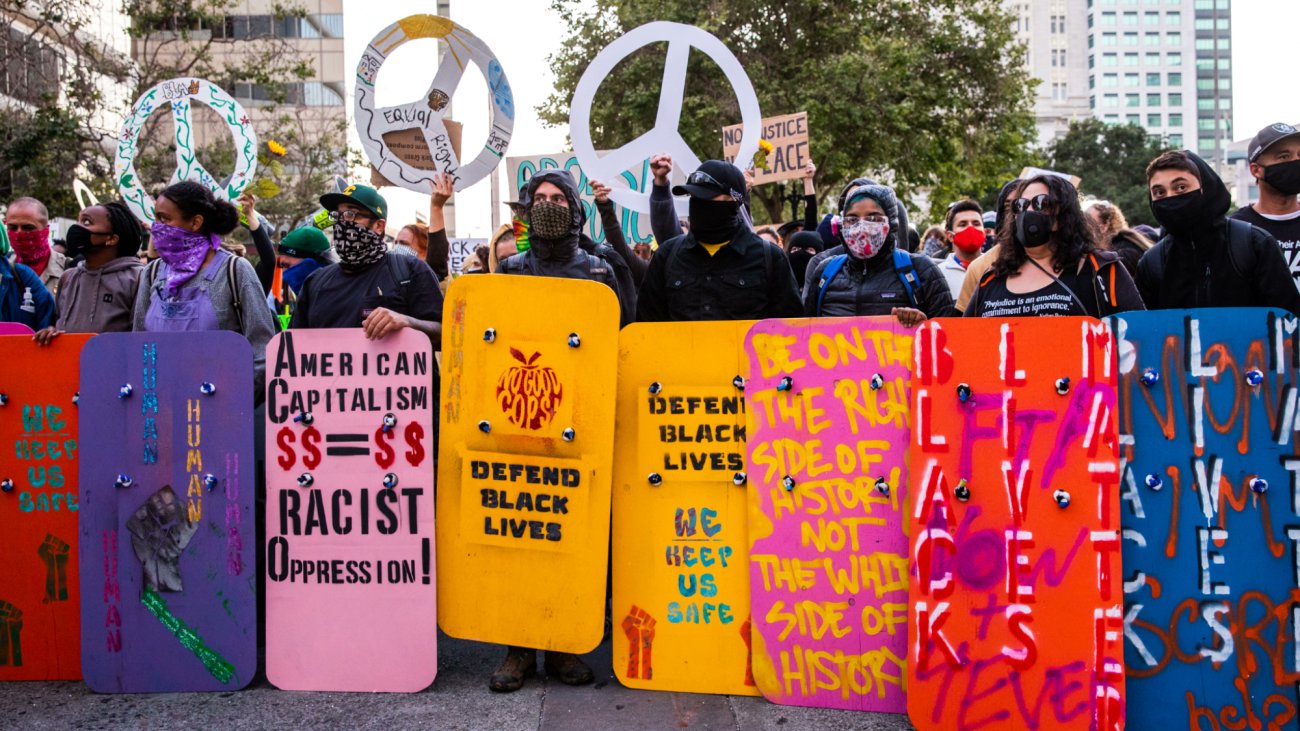
The tactical use of shields, as highlighted in the post, further underscores the organized nature of these protests. The images reveal protesters equipped with plywood shields disguised as cardboard signs, a method previously employed during the 2020 Black Lives Matter protests and the 2024 pro-Hamas riots. Wokal Distance notes that crafting each shield requires approximately three hours, a process that involves activists dedicating entire days to preparation. This level of commitment and resource allocation points to a well-funded operation, possibly linked to broader activist networks. The presence of a Home Depot bucket in the imagery suggests a centralized supply chain, reinforcing the idea that these materials are systematically distributed to participants, a tactic also observed in past organized protests.
Beyond physical preparation, the riots employ sophisticated strategies aimed at manipulating public perception and pressuring authorities. Wokal Distance outlines a “decision dilemma” tactic, where protesters create situations—such as blocking roads with barricades—that force authorities into no-win scenarios, regardless of their response. This is complemented by the “real action is your target’s reaction” approach, where any overreaction by police is leveraged to portray protesters as sympathetic underdogs. The inclusion of a baby in the protest, as mentioned, serves as a calculated move to heighten this sympathy, placing law enforcement in an impossible position where any use of force could be spun as an attack on the vulnerable. These tactics are designed to play to an external audience, shaping the narrative through media coverage and social platforms.
The theoretical foundation for these strategies, as explained by Wokal Distance, draws from radical academic works and activist training manuals, such as “Beautiful Trouble.” This book, co-authored by individuals with whom Wokal Distance has personal experience, provides a blueprint for using violence and disruption to gain political leverage. The post references historical examples, like the 2000 Summit of the Americas protests with their color-coded zones (Green, Yellow, Red) for varying levels of action, illustrating a long-standing tradition of planned escalation. This intellectual backing, combined with the practical execution seen in Los Angeles, suggests a movement informed by decades of activist theory and real-world application.
In conclusion, the Los Angeles riots, as analyzed by Wokal Distance, are far from spontaneous; they are a meticulously orchestrated campaign with roots in both funding and ideology. The involvement of well-trained activists, the use of pre-fabricated tools, and the application of strategic theories highlight a concerted effort to influence political outcomes. While the immediate trigger may be the ICE raids, the deeper structure points to broader networks, potentially involving figures like Neville Singham, as suggested in related threads by @DataRepublican. As the situation unfolds, understanding these dynamics is crucial for crafting an effective response that avoids the traps set by these calculated tactics.
**Reference:** Wokal Distance. (2025, June 9). [Post on X]. https://x.com/wokal_distance/status/1931953269775188449
 il
il
No so gentle reminder of the reality of the situation.

Israel faces a tough reality with enemies on nearly every side who openly call for its destruction, making secure borders an absolute necessity. Countries like Iran and groups such as Hezbollah and Hamas have not only talked about wiping Israel out but have acted on it with rocket attacks, border raids, and coordinated assaults like the one on October 7, 2023, which killed over 1,200 people. Some argue that walls and checkpoints hurt Palestinians by restricting their movement, and that’s a real concern. But these measures have proven effective, cutting down on terrorist attacks since the Second Intifada. Israel has to balance keeping its people safe with minimizing harm to others, and while it’s not perfect, strong borders with high-tech surveillance and intelligence are the best way to protect a nation under constant threat.
Taking out Hamas’s ability to wage war is crucial, not just for Israel’s safety but for any hope of a better future for Palestinians. Hamas has run Gaza since 2007, and its founding documents reject Israel’s existence entirely. They’ve fired thousands of rockets, over 12,000 since 2005, and built tunnels for attacks, often hiding among civilians. Critics say targeting Hamas risks innocent lives and could push more people toward extremism, which is a serious issue. But letting Hamas keep its weapons and control means more violence, less chance for peace, and Gaza staying stuck as a war zone instead of a place where people can build better lives. A focused effort to dismantle their military setup, alongside global help to rebuild Gaza with leaders who prioritize peace, is the tough but necessary path forward.
Keeping a strong security presence in Gaza is vital to stop new terrorist groups from taking root and to protect Israel’s way of life as a free, democratic nation in a region full of authoritarian regimes. Israel stands out with its open elections, independent courts, and free press, unlike many of its neighbors where power is tightly controlled. Some worry that staying involved in Gaza could make Israel look less democratic or anger Palestinians further, and that’s a valid point. But a smart security strategy, focused on gathering intelligence and stopping threats without overstepping, keeps Gaza from becoming a launchpad for attacks again, like it was under Hamas. Pairing this with efforts to support Palestinian self-rule and economic growth shows Israel’s commitment to both its values and stability, even when surrounded by those who want it gone.

“This song makes me feel like I could 1v1 the Sun” – An apt quote on the how potent music can be.
“The Only Thing They Fear Is You” is a track composed by Mick Gordon for the soundtrack of the video game *DOOM Eternal* (2020). It is one of the most iconic pieces from the game, known for its intense, aggressive, and adrenaline-pumping sound that perfectly complements the fast-paced, demon-slaying action of the *DOOM* franchise. Below is a summary of the song’s key aspects:
Overview
– **Composer**: Mick Gordon
– **Album**: *DOOM Eternal (Original Game Soundtrack)*
– **Release Date**: March 20, 2020
– **Genre**: Industrial metal, electronic, video game soundtrack
– **Length**: Approximately 6:52 (full version)
– **Context**: The track is featured during high-intensity combat sequences in *DOOM Eternal*, enhancing the player’s experience as the Doom Slayer battles demonic forces.
Musical Characteristics
– **Style and Tone**: The song is characterized by its heavy, aggressive sound, blending industrial metal with electronic elements. It features pounding drums, distorted guitar riffs, and pulsating synths, creating a relentless and chaotic atmosphere that mirrors the game’s brutal combat.
– **Structure**: The track builds dynamically, starting with ominous, low-frequency drones and gradually escalating into a high-energy, riff-driven onslaught. It incorporates breakdowns, tempo shifts, and layered instrumentation to maintain intensity and momentum.
– **Signature Elements**: The song uses distorted, low-tuned guitar chugs, rapid-fire drum patterns, and glitchy electronic effects, creating a sense of urgency and power. The absence of vocals keeps the focus on the instrumental ferocity, aligning with the Doom Slayer’s silent, unstoppable persona.
Thematic Connection
– The title, “The Only Thing They Fear Is You,” is a direct reference to the Doom Slayer, the game’s protagonist, who is a near-mythical figure feared by the demons of Hell. The track embodies his relentless, destructive force, serving as an auditory representation of his dominance over his enemies.
– The music amplifies the game’s themes of power, vengeance, and survival, immersing players in the mindset of an unstoppable warrior.
Technical Notes
– Mick Gordon’s production techniques, such as using chainsaw sounds and unconventional recording methods, add a gritty, visceral texture to the track, enhancing its raw energy.
– The song is designed to sync with the game’s combat mechanics, with musical cues aligning with enemy waves and player actions, creating a seamless integration of sound and gameplay.
In summary, “The Only Thing They Fear Is You” is a masterfully crafted piece of music that encapsulates the raw power and intensity of *DOOM Eternal*. Its aggressive instrumentation, dynamic structure, and thematic alignment with the game’s narrative make it a standout track in both gaming and music culture.
A more detailed anaylsis:











 bleatmop
 Mystro


 Dead Wild Roses
Your opinions…