
You are currently browsing the monthly archive for September 2025.
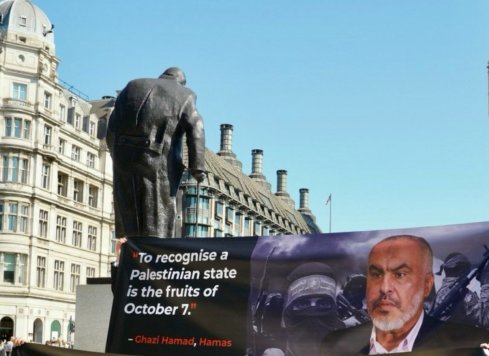
On September 21, 2025, Prime Minister Mark Carney announced that Canada officially recognizes the State of Palestine, aligning with over 140 UN member states. This decision, made ahead of the UN General Assembly, has been met with criticism, particularly from Israel, which views the move as a reward for Hamas and a setback for peace efforts. Carney emphasized that the recognition is contingent upon the Palestinian Authority holding elections in 2026 and excluding Hamas from governance (Reuters).
Critics argue that this recognition overlooks the complexities of the Israeli-Palestinian conflict. They point out that Hamas, which controls the Gaza Strip, has a history of violence and has been designated as a terrorist organization by Canada. The decision to recognize Palestine without addressing Hamas’s role raises questions about the effectiveness of such diplomatic gestures in promoting peace and stability in the region.
Furthermore, some view this move as a political maneuver to distance Canada from its traditional ally, the United States, and to align more closely with European nations that have recognized Palestinian statehood. However, without a comprehensive strategy that includes addressing the influence of Hamas and ensuring the security of all parties involved, this recognition may be seen as a symbolic gesture rather than a step toward a lasting resolution to the conflict.
References
- Reuters: Carney says Canada recognises a Palestinian state
- AP News: Canada joins other countries in recognizing a Palestinian state ahead of UN General Assembly
- New York Post: Canada, UK and Australia all recognize Palestinian state as rebuke to Israel for Gaza war
- Washington Post: U.K., Canada, Australia recognize Palestine as a state, breaking with U.S.
- Al Jazeera: Canada, UK and Australia announce recognition of Palestinian statehood

In 2018, Roseanne Barr faced swift and severe backlash after posting a racially insensitive tweet about Valerie Jarrett, leading to the cancellation of her successful sitcom, Roseanne. Despite her subsequent apology and claims of being unfairly targeted, Barr’s career suffered a significant setback. In contrast, recent events have highlighted a perceived double standard in the entertainment industry. Jimmy Kimmel, known for his late-night political commentary, faced suspension from ABC following criticism from FCC Chairman Brendan Carr over remarks about conservative activist Charlie Kirk. The network’s decision to suspend Kimmel came amid pressure from the Trump administration, raising concerns about potential government overreach and censorship in media (Washington Post, Los Angeles Times).
Roseanne Barr has publicly criticized the disparate treatment, expressing frustration over the media’s response to her firing compared to the support Kimmel received. She contends that her termination was politically motivated and that she was unjustly slandered, while Kimmel is afforded opportunities to rehabilitate his image. Barr’s comments underscore ongoing debates about cancel culture and the inconsistencies in how public figures are held accountable for their statements (Hindustan Times, The Daily Beast).
This situation prompts a critical examination of the standards applied to public figures and the influence of political pressures on media decisions. The contrasting outcomes for Barr and Kimmel highlight the complexities of accountability and the role of political affiliations in shaping public and corporate responses to controversial statements.
References
*** Correction – Having checked the archive it appears the picture featured in this post is fabricated. Here is what transpired on May 29, 2018 –

Good catch tildeb, thank you for pointing out the inaccuracy of the quoted material.
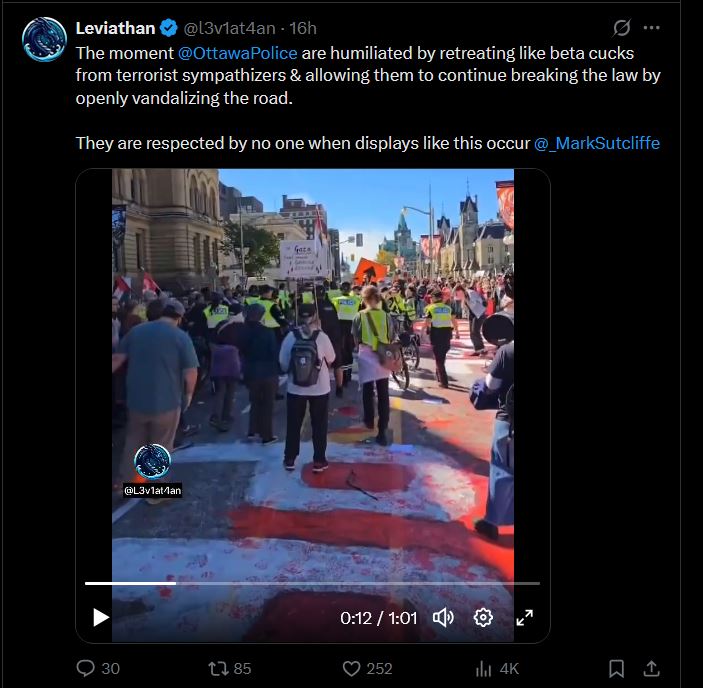
On September 20, 2025, activists from the “Draw the Line” movement staged a highly visible protest directly in front of Parliament Hill, painting a large red-and-white mural on Wellington Street. Ottawa Police closed the street for hours to facilitate the action, citing the use of washable paint, though critics noted that under Canada’s Criminal Code and municipal bylaws, the activity qualifies as vandalism. Two arrests occurred during clashes as protesters attempted to expand the mural near the Prime Minister’s Office. Hundreds participated, and cleanup concluded later the same day, with no reported injuries but lingering questions about liability for slippery surfaces (Ottawa Citizen, CTV News Ottawa, Ottawa CityNews, CBC News). Video evidence posted on X by @l3v1at4an shows police standing by as activists painted, sparking over 450 replies highlighting perceived enforcement disparities (X Thread).
Contrast this with the 2022 Freedom Convoy protests: organizers faced weeks of sustained police enforcement, arrests, and eventually prosecutions including mischief and counselling to disobey court orders. High-profile participants like Tamara Lich and Chris Barber were convicted and sentenced, while the federal government invoked the Emergencies Act — a level of response not seen for the mural or similar protests. The discrepancy demonstrates a clear selective approach in how law enforcement applies the law depending on the protesters’ affiliation, cause, or perceived political stance (AP News, CBC).
The mural incident, combined with historical patterns, fuels concerns over two-tier policing: some groups are allowed to vandalize public property with minimal immediate consequence, while others are met with swift arrest, prosecution, or extraordinary federal enforcement. Canadians deserve equal application of the law — whether it’s a climate mural, a roadblock, or any form of civil demonstration. When enforcement varies by cause, political affiliation, or identity, trust in public institutions erodes, and the perception of injustice becomes reality.
References
- Ottawa Citizen — “Two arrests amid Wellington Street mural painting” (Sept 20, 2025) — https://ottawacitizen.com
- CTV News Ottawa — Coverage of Draw the Line protest and police confirming street closure for washable paint removal — https://ottawa.ctvnews.ca
- Ottawa CityNews — “Hundreds participate in 65-foot mural as part of nationwide rallies” — https://ottawacitynews.ca
- CBC News — “Mural in front of Carney’s office with police aiding the demonstration” — https://cbc.ca
- X Thread by @l3v1at4an — Video evidence of police standing by as activists paint; 450+ replies discuss selective enforcement — https://x.com/l3v1at4an/status/1969466596499308628
- AP News — “Prominent figure from Canada’s trucker protests found guilty” — https://apnews.com/article/3975bb6bbd0c089e0c56cebbe9187fd2
- CBC News — Freedom Convoy prosecutions (Tamara Lich, Chris Barber, Chris) — https://cbc.ca
Mark Carney launched his new “Build Canada Homes” initiative with the Liberals at a construction-themed event, complete with hard hats, lumber, and the imagery of homes being built. Mainstream outlets like CBC and BNN Bloomberg covered the announcement and confirmed the backdrop included construction visuals and talk of modular housing. However, Conservative MP Barbara Bal and several CPC social media accounts have claimed the set was little more than a temporary stage — alleging that when they returned to the site, nothing was actually there. It is important to note: these allegations come from partisan and social sources, not from mainstream media confirmation.
Even if one accepts the stronger claim that the site was a prop, the larger problem is not theatricality but the substance. After nine years of Liberal government under Justin Trudeau, housing affordability has collapsed: mortgage interest costs have more than doubled since 2015 according to Statistics Canada, rents have spiked across major cities according to CMHC, and Canada now has the fewest homes per capita of any G7 country. Liberal promises to “get housing built” ring hollow given this record of failure.
That is where the hypocrisy cuts deepest. A party that has presided over a historic affordability crisis now rolls out a former Bank of Canada governor to stage glossy announcements about “change.” Whether or not the Vaughan backdrop was literally a Potemkin village, it symbolizes the Liberal pattern: photo-ops and slogans standing in for tangible progress. Canadians don’t need props — they need homes they can afford.

References
- CBC News / Yahoo: “The way we build homes needs to change: Carney makes housing announcement” – https://ca.news.yahoo.com/way-build-homes-needs-change-024451476.html?utm_source=chatgpt.com
- BNN Bloomberg (Canadian Press): “Liberals promise to build nearly 500,000 homes per year, create new housing entity” – https://www.bnnbloomberg.ca/federal-election-2025/2025/03/31/liberals-promise-to-build-nearly-500000-homes-per-year-create-new-housing-entity/?utm_source=chatgpt.com
- Barbara Bal (Conservative MP) Instagram reel alleging staged backdrop – https://www.instagram.com/reel/C-1lE9YtZ8p?utm_source=chatgpt.com
- Conservative Party of Canada X/Twitter account repeating claim – https://x.com/cpc_hq
- Statistics Canada: “Mortgage interest cost index, May 2024” – https://www150.statcan.gc.ca/n1/daily-quotidien/240620/dq240620a-eng.htm?utm_source=chatgpt.com
- CMHC: “Canada Housing Market Report” – https://www.cmhc-schl.gc.ca/professionals/housing-markets-data-and-research/market-reports/canada-housing-market-report?utm_source=chatgpt.com
- OECD Housing Data – https://data.oecd.org/price/housing-prices.htm?utm_source=chatgpt.com
Primates, who would have thought…

People should be consistent about their beliefs. Let’s put a bodily autonomy situation to the test.
-
Major Premise: Any moral principle protecting a woman’s bodily autonomy and safety must be applied consistently to all areas where her biological sex is directly relevant.
-
Minor Premise 1: Abortion rights protect a woman’s bodily autonomy.
-
Minor Premise 2: Female-only spaces protect a woman’s safety and dignity, which are inseparable from her biological sex.
-
Conclusion: Therefore, just as abortion is morally protected for bodily autonomy, the right of women to control access to female-only spaces must also be morally protected
Let’s consider a possible counter –
-
Trans inclusion claim: Some argue trans women should access female spaces.
-
Counterpoint: Biological sex, not gender identity, determines risk factors (e.g., privacy violations, physical safety concerns), which are the basis for female-only spaces. Moral protection of women’s autonomy and safety therefore cannot be overridden by gender identity claims.
This (and logic generally) only works if you belief in objective truth and a shared common reality. Social constructivists are bound by neither, so this argument probably wouldn’t work well with them.

Canada’s crime landscape resists neat storytelling. After nearly a decade of steady increases—especially in violent offenses, property thefts, and youth crime—2024 marks a notable pivot downward.
According to Statistics Canada, the overall police-reported crime rate fell 4% to 5,672 incidents per 100,000 people, ending three consecutive years of growth (Statistics Canada). The Crime Severity Index (CSI)—which captures both volume and seriousness—also dipped 4% nationally, with Non-violent CSI down 6% and Violent CSI down 1% (Statistics Canada). Homicide rates slid 4%, from 1.99 to 1.91 victims per 100,000, with eight fewer lives lost than the year before (Global News, Statistics Canada).
Still, narratives of escalating crime haven’t vanished. And it’s not hard to understand why. From 2014 to 2023, Canada saw violent crime rise nearly 30%, with 2023 registering approximately 1,427 incidents per 100,000—up 3.7% from the previous year (X (formerly Twitter)). This contrasts sharply with the U.S., where violent crime grew about 5% and property crime fell 24% over the same decade (X (formerly Twitter), Fraser Institute).
Youth crime follows a similar pattern. Between 2022 and 2023, violent youth crime jumped 10%, with overall youth crime up 13% (Ministère de la Justice). On a regional level, Western provinces—especially Saskatchewan and Manitoba—continue to report some of the highest crime rates, while Ontario and Quebec remain comparatively stable (Government of Nova Scotia, Statistics Canada).
The Takeaway
Crime in Canada isn’t spiraling, nor is it fully under control. The 2024 decline is welcome, but it follows substantial, worrying increases. The story lies between alarm and apathy—calling for careful, evidence-driven policy, not sensational headlines or complacency.

References
- Statistics Canada. “Police-reported crime statistics in Canada, 2024.” Overall crime rate – 5,672 per 100,000; CSI changes. (Statistics Canada)
- Global News (citing StatsCan). Homicide rate down to 1.91 per 100,000 in 2024 (4% decline). (Global News)
- Statistics Canada. Homicide victims – 788 in 2024, eight fewer than in 2023. (Statistics Canada)
- Statistics Canada. 2023 crime stats: 3% rise in crime rate to 5,843/100k; violent incidents up 4%; CSI up 2%. (Statistics Canada)
- Crime comparison data: Violent crime +30% (2014–2023); 2023 rate ~1,427/100k (up 3.71%); Canada vs U.S. trends. (X (formerly Twitter), Fraser Institute)
- Justice Canada. Youth crime: +10% violent youth crime; +13% overall youth crime (2022–2023). (Ministère de la Justice)
- Nova Scotia stats: Regional disparities, highest in Manitoba/Saskatchewan. (Government of Nova Scotia)











 bleatmop
 Mystro


 Dead Wild Roses
Your opinions…