
Attribution: This essay is a paraphrase-and-critique prompted by James Lindsay’s New Discourses Podcast episode “What Woke Really Means.” Any errors of interpretation are mine. (New Discourses)
“Woke” is a word that now means everything and nothing: insult, badge, shibboleth, brand. That’s why it’s worth defining it narrowly before arguing about it. I’m not using “woke” to mean “progressive,” “civil-rights liberal,” “any activism,” or “anyone who thinks injustice exists.” I mean a specific machine: a moral–political pattern that turns social friction into group-based identity, and then turns group-based identity into a special way of knowing. When that pattern is present, the downstream politics are unusually predictable.
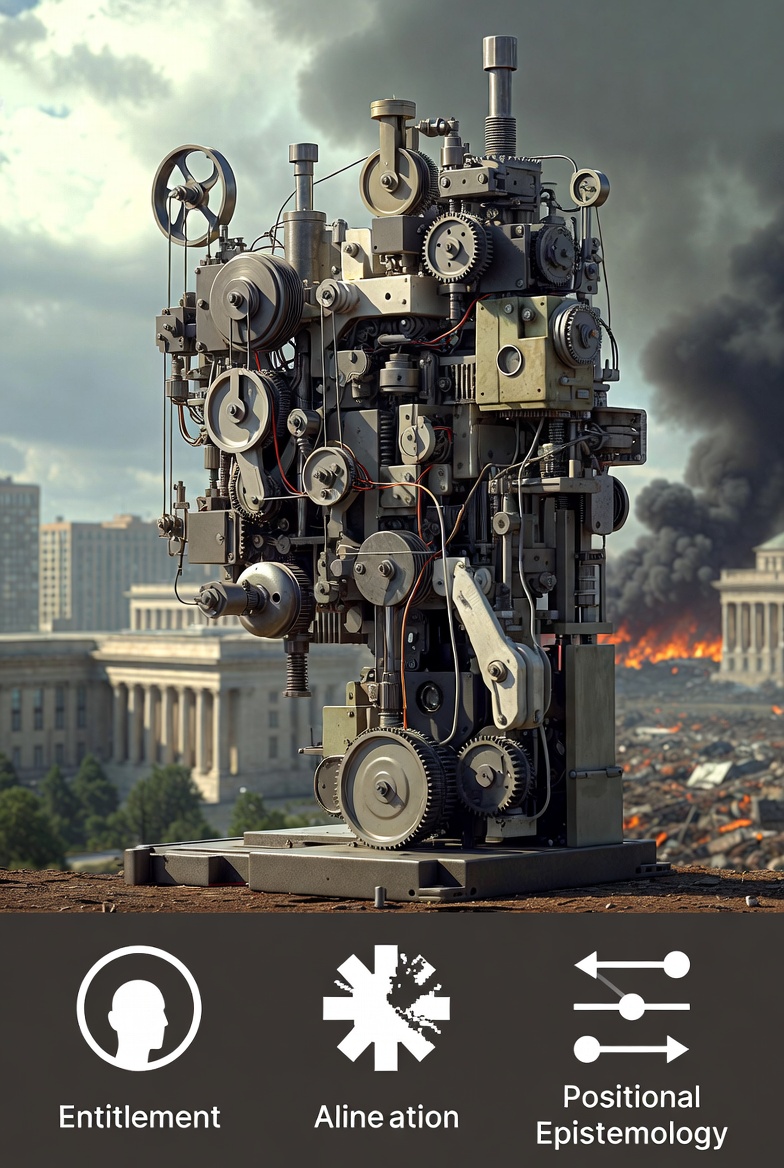
The first engine is entitlement turned into alienation. Start with a felt ought: people like me should be able to live, speak, belong, succeed, and be recognized in a certain way. That ought can be reasonable. Some groups really have been locked out of full participation. Institutions really do gatekeep. Norms really do punish outsiders. The pivot is what you do with the mismatch between “ought” and reality. The woke machine teaches that the mismatch is not mainly a mix of tradeoffs, chance, imperfect policy, individual bad actors, or local failures. It is alienation, a structural condition imposed by an illegitimate power arrangement. Your frustration is not merely about outcomes. It becomes about being denied your proper mode of existence. Once alienation is framed that way, it stops being a problem to solve and becomes an identity to inhabit.
That identity shift is the real move. The self is quietly demoted from “individual with rights and duties” to “representative of a class in conflict.” You begin to think in group nouns first: oppressed/oppressor, marginalized/privileged, normal/deviant, colonized/colonizer. This is why identity politics shows up so reliably. It is a downstream output of a prior decision to interpret the world through group-alienation. It can even masquerade as humility. “I’m just listening to marginalized voices.” But it performs a different operation. Moral standing relocates from argument to position. You don’t merely hold beliefs. You become a bearer of a collective grievance, and that grievance grants a kind of authority in advance.
The second engine is epistemic: knowledge becomes positional. Again, the starting observation can be true enough. Institutions reward certain ways of speaking. Credentialing filters who gets heard. Consensus is sometimes wrong. Lived experience can surface facts that statistics miss. The woke machine turns those observations into a total explanation. The established “knowing field” is not just fallible, but hegemonic. It is treated as a knowledge regime that functions to protect power.
There is an honest version of this impulse. Marginalized people can notice things insiders miss. Testimony can expose local abuses that institutions quietly normalize. Suspicion of official narratives is sometimes warranted. History is full of respectable consensus that later looks like rationalized cruelty. In that sense, privileging marginalized voices can function as a corrective. The problem begins when “corrective” hardens into a standing hierarchy of credibility, and when the moral value of hearing becomes a substitute for the epistemic work of checking. At that point, the method stops being a tool for truth and becomes a tool for power.
Once you accept the hegemonic frame as total, a standing preference follows. “Counter-hegemonic” claims, those said to come from the margins or said to be suppressed, are treated as inherently more trustworthy, or at least more morally protected. The point isn’t always truth. Often it’s leverage. If a claim destabilizes the legitimacy of the system, it gets treated as epistemically special.
You can see how this becomes self-sealing. Consider a common pattern: demographic observation, then a moralized system interpretation, then an appeal to lived experience, then immunity from counterargument. “I notice a space is mostly white.” Fine. “Therefore hiking is racist.” That is not observation but diagnosis. If challenged, the claim can retreat into experience: “I feel unsafe,” “my lived experience says otherwise.” Any dissent is then reclassified as proof of the system’s blindness. The disagreement is not processed as information. It becomes further evidence of hegemony. At that point, you’re no longer arguing about the world. You’re litigating the moral status of who gets to describe it.
Put these two engines together, alienation-as-identity and positional knowing, and the political outputs stop looking like random bad behavior. If your group’s situation is existential, ordinary ethics begin to look like luxuries written by your enemy. Double standards don’t feel like hypocrisy. They feel like “context.” Coercive tactics don’t feel like power-seeking. They feel like self-defense. “Allies” become morally sorted people who accept the frame. “Enemies” become those who refuse it. Because the machine treats knowledge as power, controlling speech and institutions can be rationalized as protecting truth rather than enforcing conformity.
So here’s a clean diagnostic that avoids cheap mind-reading. It’s not “woke” to notice injustice, organize, protest, or advocate. It becomes woke in this sense when three conditions appear together:
- Ontological grievance: your primary identity is a group-based injury story. Who you are is mainly who harmed “your people.”
- Positional epistemology: the status of a claim depends heavily on who says it, not what can be shown. Identity outranks argument.
- Self-sealing reasoning: disagreement is treated as proof of harm or hegemony, making correction impossible.
Any one of these can show up in ordinary politics. “Woke,” in this narrow sense, is when they lock together and become a stable identity system.
That triad is the machine. Once it’s operating, it tends to erode the conditions that let pluralistic societies function: shared standards of evidence, equal moral agency, and the ability to disagree without being treated as morally contaminated. In its best moments, the impulse can push institutions to see what they ignored and to repair what they excused. But a politics that begins as reform can slide into a politics that needs conflict as fuel. Once conflict becomes fuel, the temptation is obvious. Keep the wound open. Keep the epistemic gate locked. Keep the enemy permanent. If the machine ever stops, the identity it built starts to dissolve. 🔥
Glossary 📘
Alienation
A felt separation from what you believe you should rightfully be or have. In this framework: not mere disappointment, but a condition allegedly imposed by an illegitimate system.
Entitlement claim
A “felt ought”: a belief that people like me (or my group) are owed a certain kind of recognition, access, or outcome. Not automatically “spoiled,” just the moral premise that something is due.
Group-based identity
A primary self-concept built around membership in a social category (race/sex/class/nation, etc.), especially when that category is framed as locked in conflict with another.
Identity politics
Politics organized primarily around group membership and group conflict rather than individual rights, shared citizenship, or policy compromise.
Ontology / ontological grievance
Ontology is “what you are.” Ontological grievance is when grievance becomes core to being: the self is primarily defined as an injured member of an alienated group.
Epistemology / positional epistemology
Epistemology is “how we know.” Positional epistemology is when the credibility of claims depends heavily on the speaker’s identity position, rather than evidence and argument.
Hegemony / hegemonic knowledge
The idea that a society’s “common sense” and official knowledge are shaped to preserve existing power. “Hegemonic knowledge” is what the system allegedly allows as legitimate truth.
Counter-hegemonic / marginalized claims
Claims presented as outside the dominant “knowing field,” often treated as morally protected or more trustworthy because they challenge the status quo.
Lived experience
First-person testimony about what life is like. Valuable as evidence of experience; controversial when treated as unquestionable authority on broad causal explanations.
Self-sealing reasoning
A reasoning pattern where counterevidence is reinterpreted as evidence for the claim (for example, “your disagreement proves the system’s bias”), making the claim hard to correct.
Friend–enemy politics
A posture that sorts people into allies and enemies in a moralized way, where dissent feels like threat rather than disagreement.
Exception ethics
A moral logic where ordinary standards like fairness, consistency, and procedural restraint are suspended because the situation is framed as existential.
Endnotes
- James Lindsay, “What Woke Really Means,” New Discourses Podcast (New Discourses, January 21, 2026). (New Discourses)
- “What Woke Really Means,” New Discourses (audio hosting/episode metadata). (SoundCloud)
- Joe L. Kincheloe, Critical Constructivism Primer (Peter Lang, 2005). (Peter Lang)
- Özlem Sensoy and Robin DiAngelo, Is Everyone Really Equal? An Introduction to Key Concepts in Social Justice Education, 2nd ed. (Teachers College Press, 2017). (tcpress.com)
- Helen Pluckrose and James A. Lindsay, Cynical Theories: How Activist Scholarship Made Everything About Race, Gender, and Identity—and Why This Harms Everybody (Pitchstone Publishing, 2020). (ipgbook.com)











 bleatmop
 Mystro


 Dead Wild Roses
1 comment
Comments feed for this article
February 2, 2026 at 9:36 am
The Woke Machine in the Wild | Dead Wild Roses
[…] [This is second in an expository series on how “Woke” works, see here for the foundational essay on what woke is] […]
LikeLike