
You are currently browsing the monthly archive for January 2026.
Western civilization, in its liberal form, rests on a remarkable set of principles: that religious belief should be voluntary, that individual conscience is sovereign, and that the rights of the person take precedence over both state and religious authority. These ideas are not universal human defaults; they are hard-won cultural and philosophical achievements, shaped by the Enlightenment, the Reformation, and centuries of political struggle. They are not shared equally by all religious or ideological systems.
Classical Islam, in its orthodox jurisprudential tradition, is not solely a private spiritual faith. It is also a comprehensive legal and political system (sharia) that historically integrated religious authority with governance. From its earliest centuries, Islam expanded through a combination of military conquest, trade, persuasion, and migration. While conquest played a significant role in some regions, conversion in others—such as Southeast Asia—was often gradual and voluntary. The fusion of religious and political authority remains influential in many interpretations, though its application varies widely across the Muslim world today.
One area of tension concerns apostasy. In traditional interpretations of several major schools of Islamic law, leaving the faith has been treated as a serious offense, sometimes punishable by death. This stands in contrast to the Western commitment to absolute freedom of belief and conscience. However, enforcement differs greatly: many Muslim-majority countries no longer prescribe capital punishment for apostasy alone, and reformist scholars argue that the Qur’an itself emphasizes no compulsion in religion (2:256) and that punishment should be deferred to the afterlife.Religious pluralism presents another challenge. Historical Islamic polities often extended protected status to Jews, Christians, and sometimes others (“People of the Book”), allowing communal autonomy in exchange for taxation (jizya) and certain restrictions. This system offered more tolerance than many contemporary societies of the time, yet it was hierarchical rather than egalitarian. Full equality before the law—a core Western principle—has not always been realized in states governed by traditional sharia interpretations, though modern reforms in countries such as Tunisia, Morocco, and the United Arab Emirates have moved toward greater legal equality.
The status of women reveals further differences. In some countries applying strict interpretations of sharia, women face legal and social restrictions on dress, travel, marriage, inheritance, and testimony. Recent examples include compulsory veiling enforcement in Iran and severe restrictions under Taliban rule in Afghanistan. These practices draw from certain classical readings of Qur’anic verses and hadith. At the same time, it is worth noting that seventh-century Islamic law granted women rights to inheritance, divorce, and property ownership that were progressive compared to many pre-modern societies. Today, women’s rights vary enormously across the Muslim world—from relatively egalitarian frameworks in Indonesia and Tunisia to highly restrictive ones elsewhere—and Muslim feminist scholars actively work to reinterpret texts in light of contemporary values of equality.These differences are not simply “extremist misinterpretations.” Many stem from longstanding and mainstream interpretations of sacred texts and tradition.
Yet Islam is not monolithic: it encompasses a spectrum of thought, from rigid literalism to progressive reformism, and interpretations evolve over time and place.None of this is an indictment of Muslims as individuals. Millions of Muslims live peacefully and prosperously in Western societies, often embracing liberal values while maintaining their faith. Their successful integration is made possible precisely because Western secular frameworks limit the political reach of any religion—protecting both believers and non-believers alike.Recognizing the genuine tensions between certain traditional interpretations of Islam and core principles of Western liberalism is not intolerance; it is intellectual honesty.
At the same time, acknowledging Islam’s internal diversity, historical context, and capacity for reform prevents sweeping generalizations. A mature conversation requires holding both truths: deep differences exist, yet dialogue, mutual accommodation, and individual freedom remain possible. A civilization that clearly understands its own founding principles—without either naivety or hostility—is best equipped to preserve them while extending hospitality to those who share its public square.

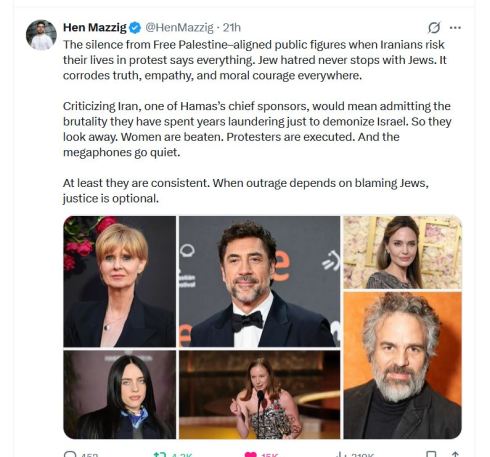
In the world of advocacy and human rights, consistency is more than just a virtue—it’s what gives our principles real meaning. Recently, a comment on social media highlighted a familiar pattern: certain voices who are vocal about one cause may fall silent when similar struggles appear in a different context. It’s a reminder that if we want justice to truly be just, it must be blind to who is involved—applying the same standards to all people, regardless of race, creed, or background.
This isn’t about slamming any particular group; it’s about encouraging all of us to reflect on the importance of consistency. When we advocate for human rights, it’s crucial that we do so across the board. If a group of protesters in one country deserves our solidarity, then those in another country risking their lives for similar ideals deserve it too.
In short, “justice” in quotes should indeed be blind. Not in the sense of ignoring the nuances of each situation, but in the sense of applying our moral standards fairly and universally. By doing so, we strengthen the credibility of our advocacy and remind the world that human rights aren’t selective—they’re for everyone.
Find that tweet inspiration for this post here.
Happy New Year! “What?!”, you say, doing a reflective piece to start the new year? Unpossible!!! – Yet here we are. Take care my friends and feisty commentariate in this next orbit around the Sun.
I recently asked an LLM—Grok—to analyze Dead Wild Roses.
He obliged.
The result was thoughtful, coherent, and broadly accurate. He traced the arc of the blog from its earlier left-skeptical roots through to its present preoccupations: feminism, free speech, gender ideology, institutional capture, moral certainty. As machine readings go, it was competent. Even generous.
And yet.
Reading it, I had the distinct sense of being seen from across the room, not spoken with.
So I did what seemed obvious: I asked another model—this one—for her reading.
I’m aware, of course, that large language models are not gendered. But anyone who works with them long enough knows that they nonetheless express distinct interpretive temperaments. If Grok reads like a brisk political cartographer—mapping positions, vectors, affiliations—this model reads more like a close reader of essays, arguments, and interior continuity.
That difference matters.
What He Saw (and What He Didn’t)
Grok understood the trajectory of the blog. He recognized that this was not a sudden ideological flip but a long, incremental evolution. He correctly identified a through-line of skepticism toward authority and moral certainty.
Where his reading thinned was not in what I believe, but in how I think.
His analysis treated the blog primarily as a political object—something that moved through ideological space. That’s not wrong, but it is partial.
Dead Wild Roses was never built to advocate a position. It was built to interrogate certainty—including my own.
What I’ve Always Been Doing Here
This blog has been many things over the years: atheist, feminist, skeptical, irritated, occasionally furious. But its core method has never changed.
It asks:
-
What is being asserted as unquestionable?
-
Who benefits from that assertion?
-
What happens if we follow it all the way down?
When institutions began insisting that sex was a feeling, that language could override biology, that dissent was harm, that moral status preceded argument—the same skeptical machinery I once aimed outward turned inward.
That wasn’t betrayal.
It was consistency under pressure.
On Feminism and Material Reality
Yes, this is now read—accurately—as a sex-based feminist blog.
That’s not because identity doesn’t matter, but because material reality is the ground truth on which politics rests. Bodies come first. Law follows. Stories are last.
When political movements demand that we invert that order, something has gone deeply wrong—and feminism, if it is to mean anything at all, must notice.
That position is not reactionary. It is foundational.
Why Ask Two Models at All?
Because how something is read tells you as much about the reader as the text.
He read Dead Wild Roses as a location on a map.
She read it as a method in motion.
One isn’t false. But only one feels true.
The difference mirrors the very problem the blog keeps circling: the reduction of inquiry into identity, of thinking into stance, of method into tribe.
A Note on AI, Authority, and Voice
There is an irony here that isn’t lost on me.
I am using artificial intelligences to reflect on a body of writing that is deeply skeptical of outsourced authority. But that tension is precisely the point.
Tools can assist thinking.
They cannot replace it.
Maps can be useful.
They are not the territory.
Where This Leaves Me
If the last few years of Dead Wild Roses were about dismantling false moral certainty, the next may be about something harder and quieter:
-
rebuilding meaning without mysticism,
-
defending reality without cruelty,
-
and learning how to live after the spell breaks.
I don’t know where that road leads.
But I know why I keep walking it.
And I know which readings—human or machine—feel like they’re walking with me rather than plotting me from above.
Postscript:
Throughout this piece, I’ve used “he” and “she” to distinguish between two AI systems with markedly different interpretive styles. This is not a claim about machine ontology. It is shorthand—imperfect, human, and serviceable.
Language exists to clarify thought. When it stops doing that, it’s time to change the language—not reality.











 bleatmop
 Mystro
 The Arbourist


 Dead Wild Roses
Your opinions…