
Tyler Cowen once tried to name the biggest “revolutions” he’s lived through—moon landing, collapse of communism, the internet, and now AI. In the middle of that list he drops one that most people still don’t treat like a revolution at all: “Feminization.” (Marginal REVOLUTION)
That word isn’t a complaint. It’s a category. It says: a long-run compositional change is underway, and it matters.
Helen Andrews’ “Great Feminization” thesis—popularized in a talk and elaborated in her Compact essay—takes the next step: as women become a larger share of institutions, institutions don’t merely “include” women; they become substantively feminized, and what we call “wokeness” is basically the cultural exhaust of that process. (Compact)
Here’s my position up front: the demographic shift is real and measurable in Canada; the “feminization = wokeness” equation is an overconfident master key.
It explains too much, too easily, by psychologizing demographics instead of interrogating incentives.
Canadian anchors: the shift is measurable (not vibes)
Start with a handful of Canadian facts you can actually point to.
- Parliament: the House of Commons sits at 104 women out of 343 MPs (30.3%). (IPU Parline)
- Judiciary: the share of federally appointed judges who are women rose from 43.8% (2021) to 46.7% (2023), per Statistics Canada. (Statistics Canada)
- Universities: women are 43.7% of full-time teaching staff in 2024/2025, up from 15.9% in 1984/1985. (Statistics Canada)
- Management: women are 51.9% of public-sector managers but 35.2% of private-sector managers (2023), and hold 42.7% of middle management vs 30.8% of senior management (2021). (Statistics Canada)
- Psychology (Alberta snapshot): Job Bank puts psychologists at 81% women / 19% men in Alberta. (Job Bank)
You don’t need to think any of this is good or bad to recognize the basic point: elite and semi-elite Canadian pipelines have changed composition in living memory. The “Great Feminization,” at minimum, names something real.
Why composition changes institutions (and why noticing this isn’t misogyny)
Here’s the move that poisons discussion: someone observes a demographic shift and asks what it does to norms; the response is to treat the question itself as hatred.
That’s not an argument; it’s a veto.
Institutions aren’t just rulebooks. They are reward systems: what gets you promoted, what gets you ostracized, what gets you hauled into a meeting, what everyone learns not to say out loud. When composition changes, the informal equilibrium can change too—sometimes for the better, sometimes not.
Before anyone reaches for the “misogyny” stamp, three obvious distinctions:
- Descriptive claims aren’t moral verdicts. Saying “X is now 47% female” is not saying “women ruined X.”
- Group averages aren’t destinies. Even if differences exist on average, overlap is huge. Plenty of women are rule-first and combative; plenty of men are harmony-first and censorious.
- The target is incentives, not women. If a system rewards reputational risk-avoidance and punishes open conflict, it will drift toward soft enforcement and speech management—regardless of who staffs it.
Those distinctions don’t sanitize the topic. They make it discussable.
Where Andrews helps—and where her thesis becomes a master key
Steelman Andrews first: she’s right that the shift is large, and she’s right that institutions can be remade through changes in who occupies them. If you pretend otherwise, you’re pretending humans don’t do social enforcement.
Where she overreaches is the claim (often treated as self-evident) that “feminization = wokeness.” (Compact)
Two problems.
1) One variable can’t carry a multi-cause phenomenon
The rise of “woke” managerial dynamics tracks at least four forces that are not reducible to gender composition:
- social media: instant reputational escalation; permanent records of mistakes; a public audience for internal disputes
- liability culture: institutions optimizing to avoid lawsuits, complaints, and scandal
- bureaucratic expansion: more compliance, more policy, more internal language policing
- credential sorting: ideological clustering in certain professional strata
In Canada, you can see the basic direction without naming villains: risk management becomes a career track; “process” becomes protection; disputes become “incidents”; leaders learn to value quiet over truth because quiet is legible as safety.
You can believe feminization is one contributor. But treating it as the engine is an interpretive leap, not an established causal law.
2) It tempts essentialism even when it gestures at nuance
If “wokeness” is “women’s morality,” you’ve turned a complex institutional pathology into a personality profile of half the species. That’s analytically brittle and politically stupid: it hands critics the easiest rebuttal (“you’re essentializing women”) and it blinds you to male-led versions of the same pathologies (purges, conformity spirals, status policing), which history supplies in bulk.
If you want to criticize a norm regime, criticize the regime. Don’t smuggle in contempt.
What the evidence can support—more modestly
A defensible claim, one that doesn’t require you to psychologize women as a class, looks like this:
- Some sex-linked preference gaps show up in some contexts, especially around speech, conflict, and social sanction. For example, a Knight Foundation/College Pulse study reports large gender differences among U.S. college students: 41% of college women prioritized protecting free speech versus 71% of college men, while women were more likely to prioritize promoting an inclusive society.
- Institutions are sensitive to preference distributions because norms are enforced socially, not just formally.
- Incentives decide which preferences become “policy.” Liability, reputation, and managerial bureaucracy amplify harm-avoidance.
And this is the part Andrews gestures at, but doesn’t fully own: if you want to understand modern speech policing, HR creep, and the new professional fearfulness, start with incentives. The incentives turn every controversy into a corporate emergency; then people behave accordingly.
On that view, feminization isn’t the whole story. It’s a relevant input—and its effects depend on the system it enters.
The real Canadian question: can we preserve hard virtues mid-transition?
Canada is useful here because we’re visibly mid-shift rather than at some imagined endpoint. Parliament is at 30% women, not parity. (IPU Parline) The federal judiciary is closing on parity. (Statistics Canada) Universities have moved dramatically since the 1980s, but remain below parity in full-time teaching staff. (Statistics Canada) Management splits sharply by public vs private sector, and senior leadership remains male-skewed. (Statistics Canada)
So the live question isn’t “should women be here?” They are here, and they belong here.
The question is narrower and more urgent:
As composition changes, what norms do we want to protect because they are fragile?
A short list:
- due process and evidence standards (law)
- viewpoint tolerance and intellectual risk-taking (academia)
- candid disagreement and non-performative conflict (organizations)
- the capacity to make decisions that feel “unkind” but are necessary (policy)
If you think those virtues are real and fragile, you don’t need to scapegoat women. You need to design institutions that reward truth-telling and competence more than “harm management” and reputational prophylaxis. That means fewer performative “values” rituals and more procedural backbone: clear standards, clearer speech norms, and leaders who can say “no” without laundering it through therapy language.
Verdict and prediction
The Great Feminization is real in Canada. The numbers are not subtle. (IPU Parline)
But “feminization = wokeness” is a bad master key. It explains too much, too easily, by psychologizing demographics rather than interrogating incentives. (Compact)
My bet is that the next decade won’t be settled by shouting “misogyny” or shouting “women did this.” It will be settled by whether our institutions relearn a difficult skill: distinguishing “this feels harmful” from “this is false,” and building cultures where adults can endure disagreement without turning every conflict into a moral emergency.
Glossary
- Confounders — other factors that could be the real cause, making cause-and-effect hard to prove.
- Essentialism / essentialize — treating a group as if it has one fixed “essence” (“women are X”), ignoring variation.
- Epiphenomenon — a byproduct; something that looks important but is really “exhaust” from a deeper cause.
- Monocausal — blaming one cause for a complex outcome.
- Pathology (institutional pathology) — a recurring dysfunctional pattern inside an institution.
- Prophylaxis — preventative action; here, pre-emptive “avoid scandal” behavior.
- Psychologizing — explaining political/institutional behavior by reducing it to personality traits or “mental makeup.”











 bleatmop
 Mystro


 Dead Wild Roses
2 comments
Comments feed for this article
February 4, 2026 at 5:55 am
Steve Ruis
Men have needed feminization for a very long time: in control and out of control at the same time is not a good formula.
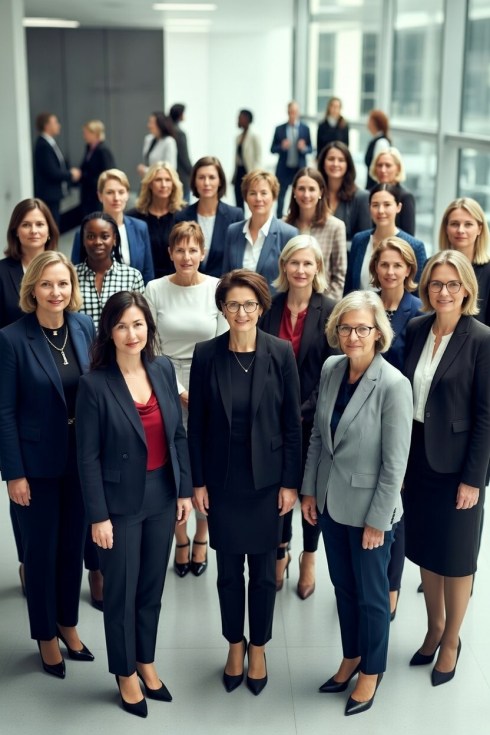
Re the photo. All of those competent looking women … wearing high heels with pointy toe boxes, hurting their feet. Maybe this generation of women leaders can transition to wearing comfortable, supportive shoes.
LikeLiked by 1 person
February 4, 2026 at 7:57 am
tildeb
Your rebuttal falsely equates percentages of large minorities or small majorities to show a presumed ‘power’ equivalency and therefore commits the very error you claim that you say is a “bad master key.” Using these stats as a defence against Andrew’s thesis itself psychologizes the demographics! But that’s not how woke works. You assume the dichotomy at play can be addressed by “interrogating the incentives.” Well good luck with that because the ‘incentives’ have institutionally switched from merit to vibes, feelings over truth, social reputation over productivity. When ‘equal rights’ became the cover for legal discrimination and privilege called ‘affirmative action’ for women, the die was cast to switch to an equity metric, and the law throughout the west is now full of equity precedents cases that legalizes and institutionalizes the never-ending discrimination against men. The men who survive inside this regime are those who do not cause waves., If waves are caused, censoring, cancellation, and reputational attacks are used: all of which are deeply feminine tools to enforce social cohesion. In other words, a man by equivalent numbers faces non stop incentives to go along to get along and we see this play out in every facet of social and cultural expressions. The institutions have been captured already even if the numbers of men and women seem roughly equivalent. This is why the greased equity path was already laid down for gender ideology/wokeness to sweep into law and invert sex-based equality to mean group/class/race equity. There are no avenues left for equality ‘incentives’ to be anything else other than this deeply feminized institutional social dysfunction.
LikeLike