
You are currently browsing the daily archive for March 26, 2026.
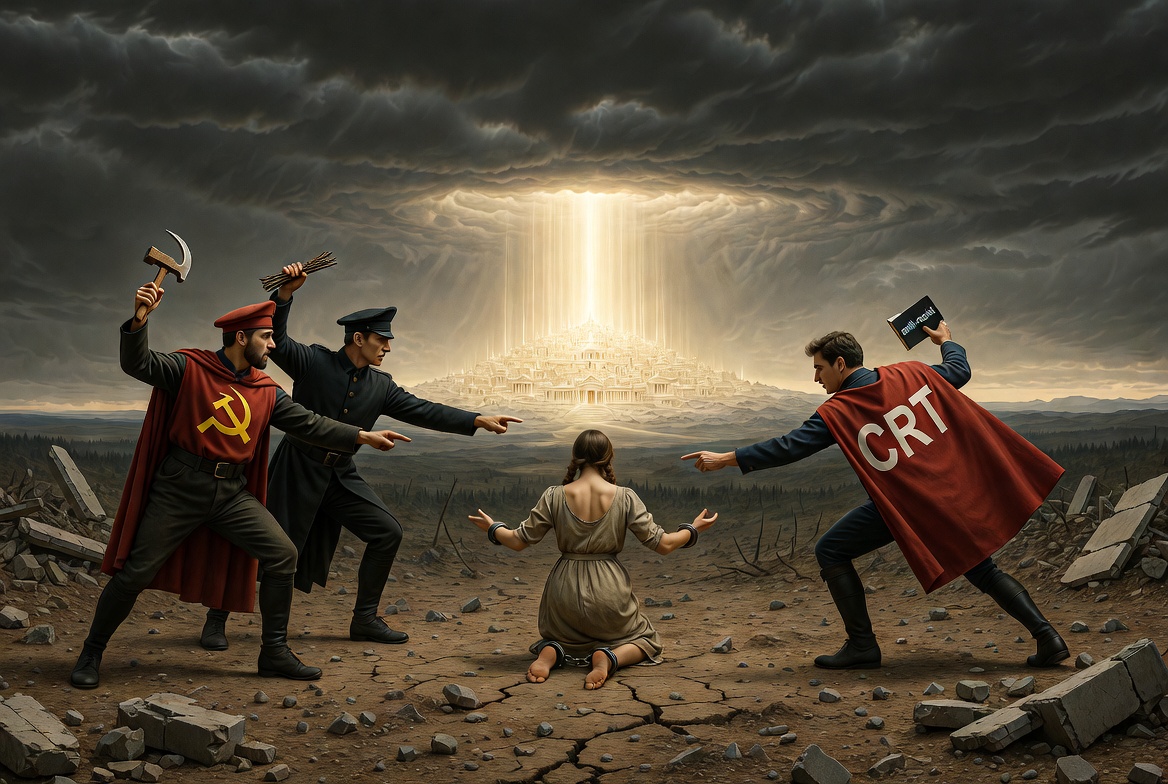
The argument so far has been simple. Some movements define the good less as a workable order to be built than as a stain to be removed. They know with great intensity what must disappear, but with much less clarity what a livable settlement would require, permit, or cost. That is what I have called negative idealism. Its danger does not lie in one doctrine alone. It lies in a recurring structure. A purified horizon is announced. Reality fails to comply. The gap is moralized. The search for the guilty begins.
That structure does not make all radical movements identical. Their moral vocabularies differ. Their goals differ. Their institutions differ. Their body counts differ. Some are more total than others, more lethal than others, more metaphysical than others. The point is not sameness. It is family resemblance. Very different movements can exhibit the same political logic once their ideal collides with reality and failure has to be explained.
Begin with revolutionary communism. Marxism gained its power not because it saw nothing real, but because it saw a great deal: exploitation, class hierarchy, alienation, and the concentration of economic power. Its danger emerged when those insights were fused to a purified horizon, a classless society in which private property, exploitation, and alienation had been abolished. Once that ideal is announced, reality predictably fails to conform. Scarcity persists. Self-interest persists. Coordination problems multiply. Political power concentrates rather than withering away. At that point defenders often retreat to a familiar refrain: the theory was sound, but it was never properly implemented. Yet that defense weakens with repetition. A theory does not remain innocent when its real-world enactments, across countries and decades, repeatedly produce coercion, censorship, prison systems, famine, terror, and death on a scale measured in the tens of millions. Recurrence is evidence. The problem is no longer bad luck, bad leaders, or accidental betrayal. It is that the theory cannot admit the limits it was built to transcend. So the gap between promise and outcome is moralized and blamed on sabotage: the kulak, the wrecker, the bourgeois remnant, the counter-revolutionary. What began as a critique of economic relations ended, again and again, in purges, show trials, and the Gulag. The engine is the same: limits are recoded as betrayal, and the search for the guilty supplies the movement with both explanation and mission.
“A theory does not remain innocent when its real-world enactments, across countries and decades, repeatedly produce coercion, censorship, prison systems, famine, terror, and death on a scale measured in the tens of millions. Recurrence is evidence.”
Fascism is not the same doctrine, and it is not purely negative in the same way. It carried positive mythic content of its own: blood, nation, destiny, rebirth, struggle. Yet a partial but important family resemblance appears once that mythic horizon collides with reality. The nation does not become pure. Decline is not reversed. Social unity remains elusive. The promised restoration fails to arrive in the form imagined. At that point, failure too is personalized. The saboteur, the degenerate, the outsider, the parasite, the internal traitor become the explanation for why renewal has been delayed. The ideal may be clothed in heroic language rather than egalitarian language, but the structure is still recognizable. Limits are not admitted. They are assigned a human face. The result is not compromise but purification.
One sees a softer but still recognizable version of the same dynamic in some activist and institutional descendants of critical race theory. The academic tradition itself is not reducible to slogan or HR catechism, and it would be lazy to pretend otherwise. But once its ideas are translated into bureaucratic and activist practice, a recurring pattern appears. Persistent disparities are treated less as problems requiring multi-causal explanation than as proof that racist obstruction remains embedded everywhere. The stain is no longer merely prejudice in the ordinary sense, but structures coded as whiteness, norms coded as domination, and habits of dissent treated as evidence of complicity. Again, the issue is not that racism is unreal. It is that an explanatory framework built around permanent moralized suspicion has difficulty recognizing limits, tradeoffs, agency differences, or the possibility that some disparities may have causes not fully captured by oppression alone. The purified horizon remains a world without hierarchy, stigma, or unequal outcomes traceable to race. When reality resists, the gap is moralized. Someone, somewhere, must still be carrying the stain forward.
The same temptation now appears in movements of the dissident or woke right as well, which is useful precisely because it shows that the engine is not confined to the left. Here too one often finds an idealized social order imagined as cleansed of decadence, weakness, corruption, betrayal, demographic threat, or liberal softness. Here too disappointment seeks a culprit. The managerial class, the traitor elite, the degenerate, the subversive, the foreign contaminant, the internal enemy: different labels, same explanatory move. What matters is not the formal ideology but the recurring habit of treating the limits of politics as evidence that enemies must be rooted out. Once that habit takes hold, the movement acquires the same dangerous moral convenience. Failure need not falsify the ideal. Failure merely proves that the guilty still obstruct it.
This is why family resemblance matters more than doctrinal content alone. Movements do not need to agree on the good in order to behave similarly when the good fails to arrive. One wants class abolition. Another wants racial purity. Another wants permanent anti-oppression. Another wants civilizational restoration. The language changes. The symbols change. The designated enemies change. But the political logic keeps recurring. A purified horizon is held before the faithful. Reality resists. Limits are refused. Friction is personalized. Scapegoats enter. Purification replaces politics.
The differences still matter. Revolutionary communism, fascism, activist anti-racism, and dissident right populism are not morally or historically interchangeable. Their scales differ. Their claims differ. Their capacities for violence differ. Some culminate in camps and mass graves. Others work through bureaucratic coercion, reputational terror, compelled speech, institutional sorting, and moral denunciation. These are not trivial distinctions. But they do not erase the structural resemblance. The same engine can recur across very different movements once political disappointment becomes impossible to interpret except through guilt.
“Movements do not need to agree on the good in order to behave similarly when the good fails to arrive.”
That is also why the language of unfinished justice or not yet fully realized deserves more suspicion than it often receives. Those phrases can describe real work still left to do. They can also function as shields against correction. If the ideal remains permanently pure, then every failure can be attributed outward. The theory need not be revised. The movement need not be humbled. Reality itself becomes the accused. At that point, dogma begins to wear the mask of moral seriousness.
The deeper lesson is not that ideals are dangerous simply because they are ideals. Politics without ideals collapses into cynicism and management. The danger begins when an ideal cannot survive contact with limits, tradeoffs, tragedy, or rival goods. Then every obstacle looks illegitimate. Every dissenter looks stained. Every failure demands a culprit. The question is no longer what kind of order human beings can actually sustain. It becomes who must be exposed, silenced, excluded, or punished so that the redeemed horizon can remain morally intact.
This is where the next essay begins. Once a movement has learned to interpret failure through enemies rather than limits, the step from moral sorting to coercion becomes much easier. Before the knock on the door comes the explanation for why someone deserves it. Before force comes the story that makes force feel righteous.











 bleatmop
 Mystro


 Dead Wild Roses
Your opinions…