
You are currently browsing the category archive for the ‘Arts’ category.
Handel’s Hallelujah Chorus accessible and full of life and joy; accessible for all. This is a repost, but too bad, the awesome has not lost its glow.
I cannot believe that this is the only recording of this particular song. I apologize for the poor video quality, but then again, the sound is fairly good, as well as the choir and soloist. This piece was also performed in Kaslo, and I have the intention to learn the solo and perform it with a choir. :)
**update** – Found a better version, now with harp. :)
For music geeks, the choir tenor part is actually signs higher notes than the soloist, going to all the way to a “A” while the soloist goes as high as “G”. As I’ll probably get the honour singing both parts, I’m doubly lucky…
A little of Gabriel Fauré’s history and his music, thank you Wikipedia.
Gabriel Urbain Fauré (pronounced: [ɡabʁiɛl yʁbɛ̃ fɔʁe]; 12 May 1845[n 1]– 4 November 1924) was a French composer, organist, pianist and teacher. He was one of the foremost French composers of his generation, and his musical style influenced many 20th century composers. Among his best-known works are his Nocturnes for piano, the songs “Après un rêve” and “Clair de lune”, his Pavane and his Requiem.
Born into a cultured but not unusually musical family, Fauré revealed his talent when he was a small boy. He was sent to a music college in Paris, where he was trained to be a church organist and choirmaster. Among his teachers was Camille Saint-Saëns, who became a lifelong friend. In his early years, Fauré earned a modest living as an organist and teacher, leaving him little time for composition. When he became successful, holding the important posts of organist of the Église de la Madeleine and head of the Paris Conservatoire, he still lacked time for composing, retreating to the countryside in the summer holidays to concentrate on composition.
 By his last years, Fauré was recognised in France as the leading French composer of his day. An unprecedented national musical tribute was held for him in Paris in 1922 headed by the President of the Republic. Fauré had many admirers in England, but his music, though known in other countries, took decades more to become widely accepted. His music has been described as linking the end of Romanticism with the modernism of the second quarter of the 20th century. When he was born, Chopin was still composing, and by the time of his death the atonal music of the Second Viennese School was being heard. The Grove Dictionary of Music and Musicians, which describes him as the most advanced composer of his generation in France, notes that his harmonic and melodic innovations affected the teaching of harmony for later generations. In contrast with the charm of his earlier music, his last works, written when increasing deafness had struck him, are elusive and withdrawn in character.
Vocal music
Fauré is regarded as one of the masters of the French art song, or mélodie.[1] In Copland’s view, the early songs were written under the influence of Gounod, and except for isolated songs such as “Après un rêve” or “Au bord de l’eau” there is little sign of the artist to come. With the second volume of the sixty collected songs, Copland judged, came the first mature examples of “the real Fauré”. He instanced “Les berceaux”, “Les roses d’Ispahan” and especially “Clair de lune” as “so beautiful, so perfect, that they have even penetrated to America”, and drew attention to less well known mélodies such as “Le secret”, “Nocturne”, and “Les présents”.[5] Fauré also composed a number of song cycles. Cinq mélodies “de Venise”, Op. 58, was described by Fauré as a novel kind of song suite, in its use of musical themes recurring over the cycle. For the later cycle La bonne chanson, Op. 61, there were five such themes, according to Fauré.[62] He also wrote that La bonne chanson was his most spontaneous composition, with Emma Bardac singing back to him each day’s newly written material.[63]
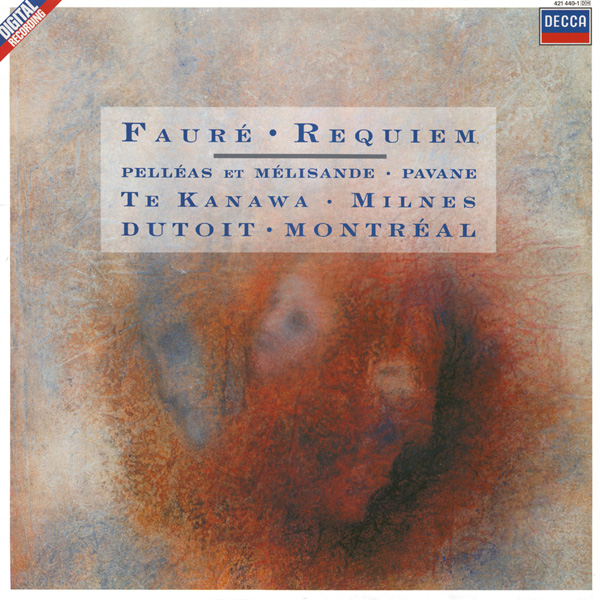
The Requiem, Op. 48, was not composed to the memory of a specific person but, in Fauré’s words, “for the pleasure of it.” It was first performed in 1888. It has been described as “a lullaby of death” because of its predominantly gentle tone.[64] Fauré omitted the Dies Irae, though reference to the day of judgment appears in the Libera me, which, like Verdi, he added to the normal liturgical text.[65] Fauré revised the Requiem over the years, and a number of different performing versions are now in use, from the earliest, for small forces, to the final revision with full orchestra.[66]Fauré’s operas have not found a place in the regular repertoire. Copland called Pénélope a fascinating work, and one of the best operas written since Wagner. He noted, however, that the music is, as a whole, “distinctly non-theatrical.”[5] The work uses leitmotifs, and the two main roles call for voices of heroic quality, but these are the only ways in which the work is Wagnerian. In Fauré’s late style, “tonality is stretched hard, without breaking.”[67]
This Friday’s interlude is a bit different only because I can say that I’ve also sung what you are about to watch. The Scene of the Drunken poet is not only comedic, but musically interesting as well. Listen in the chorus parts while the sopranos, alto’s, tenor’s and basses play with the melody line in quick succession. Let me assure you, it takes a fair amount of practice to get your notes to fall in the right places. :)
I have long filed the 300 under the category of movies that I like. I enjoyed the theme of the many versus the few and of course the super slow motion battle sequences that make killing look like its superawesome cool.
(http://youtu.be/VW4d3Kukcu8 – cut and paste into a another window for the fight scenes)
Superawesomeness aside though I did not think too much of the rest of the movie. It was spectacle, it was special effects and it was most certainly not about the wafer thin plot. Yet, the story itself was somehow familiar and possessed enough of that “different-sameosity” that made the 300 appealing.
The problem is that the familiar tropes and themes are culturally rooted in heteronormativty, ableism and racism. Not so good 300…
The cultural artifacts present in the film still reflect many of the normative standards of our society. When people talk of progress and equality one does need to look very hard to see how much work we still have left to do.
Don Giovanni premiered in Vienna in 1787. The author of the libretto, Lorenzo da Ponte, described it as a dramma giocoso, a work that includes both comic and tragic elements. The comedy includes a variety of mishaps, while the tragedy includes attempted rape, murder, and finally the Don being dragged straight to Hell, complete with a chorus of demons.
The background to the scene above: Don Giovanni happens upon a wedding party. Zerlina, played by Joan Rodgers, is the bride. Giovanni decides he wants Zerlina, and arranges for her to become separated from the rest of the wedding party, including the groom. He tries to seduce her, but the seduction is interrupted when one of Giovanni’s previous victims happens on the scene. In the video clip, Zerlina is re-united with her future husband, who is extremely jealous of the attention Giovanni is paying to her. Zerlina wins his affection back with a combination of flirtation and self-abasement.
I’m currently working on learning this aria. There are a lot of things that make it fun to sing. It’s fun to sing flirtatious characters. The melody is relatively simple, but is entertaining from a technical perspective, with its interesting leaps and runs. Done well, it’s an excellent show-off piece. I hope to get it to that point.
I also hate it. It seems to be a case of Feminism Ruins Everything. To me, a woman who has grown up expecting to be treated as an autonomous human being and the equal of any man, it’s a really disturbing piece. Masetto should be reassuring Zerlina that he will do his best to support and protect her, not blaming her for Giovanni’s unwanted attention! And, given that Masetto is being a jealous prick, Zerlina should be tearing him several new orifices, not offering to stand like an unresisting lamb to be beaten and then kiss his hand. Trying to wrap my emotions around the idea that Zerlina’s behaviour could be realistic for a woman of her social status in that era, is sobering. It’s not really that long ago, after all, that women really did need to get married Or Else. And that any suspicion of non-virginity or infidelity would lead to Or Else. A woman like Zerlina might have been so totalized in her identity that it would never occur to her to expect anything but jealousy from Masetto, and that she would in fact blame herself for having attracted Giovanni’s attention. Unfortunately, when I’m as disturbed as this idea makes me, I don’t sing well. Still working on finding a way of singing this aria musically, without grossing myself out.
The medium is the message. :)











 bleatmop
 Mystro


 Dead Wild Roses
Your opinions…