
You are currently browsing the category archive for the ‘Canada’ category.
Paul Street writes a foreboding analysis of what the TPP is on Counterpunch.
“Lawyers and lobbyists for giant multinational corporations have been working up the TPP and promoting it for nearly a decade. The measure would join the United States along with 11 other nations along the Pacific Rim (Australia, Brunei, Canada, Chile, Japan, Malaysia, Mexico, New Zealand, Peru, Singapore, and Vietnam) in a “free-trade zone” covering nearly 40 percent of the world’s economy. Obama and his largely Republican “free trade” allies say the TPP will open foreign markets to American goods and “level the playing field by forcing Asian competitors to improve labor and environmental standards.”
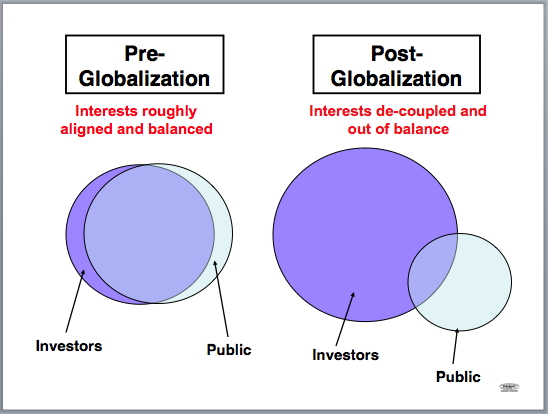
But that’s just blatantly deceptive business propaganda. The measure isn’t really about trade and it certainly isn’t about improved standards. Its real thrust is to strengthen corporations’ ability to protect and extend their intellectual property rights (drug patents, movie rights, and the like) and to guarantee that they will be compensated by governments for any profits they might lose from having to meet decent public labor and environmental (and other) standards – something certain to discourage the enactment and enforce of such standards. Key parts of the TPP permit foreign capital to freely and easily enter a country and for profits to be just as easily removed. The TPP would ban capital controls, which let nations block disruptive inflows of ‘hot money’ from speculative investors and then escape before the bubble they create explodes. It would also block the passage of financial transaction taxes, a method for checking speculation and generating public revenue. The measure also legitimizes the extensive privatization of public enterprises.
The TPP is designed to help big multinational businesses attain special deals they would be unable to get through existing political processes, considered excessively democratic by the global deep state of capital. A foreign corporation could sue and receive damages for anticipated profit losses resulting from an increase in the minimum wage (federal, state, or local) in the United States. A U.S. state or Canadian province (or any other member-state jurisdiction) would have to compensate oil and gas companies for anticipated profits lost to bans on the environmentally disastrous practice of hydraulic fracturing (fracking). Big Pharma and the big corporate media firms would be granted stronger and longer-lasting patent and copyright protections across the “free trade” zone. Big multinational banking and investment firms would have to be paid by TPP governments that wanted to keep their nations’ financial systems safe through responsible regulation. Food, chemical, consumer goods, and pesticide industries will be able to able to limit the ability of TPP governments to impose safety and environmental regulations on the things they sell and how they make them. The giant global and U.S.-based consumer packaged goods firm Procter & Gamble could demand compensation from any TPP nation (including the U.S.) that dared to subject its products and workplaces to basic social and environmental standards. (One could go on and on with such examples.)
“Level playing field”? The TPP is about a race to the capitalist bottom, a levelling down of people and government’s capacity to impose limits on business behavior. Like its regressive predecessor the North American Free Trade Agreement (NAFTA), it’s about what the New York Times calls “investor protection.”
Of critical and dark significance, the TPP constructs a new legal structure that transcends the existing, nation-based legal system.
Phone, write, send smoke signals to your MP’s fellow Canadians. We do not want this for our country, NAFTA is bad enough.
 Canadians are watching closely to see if their new government is going to stick to the promises made during the recent election campaign. One of the most important promises was to reform the electoral system and get rid of our current First Past the Post system. I was browsing about and found an interesting article (?) on the National Post’s website (!!) about possible changes and how they might effect Canada’s political parties. I was struck by the word choice in this part:
“Clearly, there is no upside for the Liberals in pursuing PR. But the introduction of a ranked ballot system would take the Liberal heels off the Conservatives’ chest and thrust it hard into the party’s wind-pipe.
As one clear-eyed senior Conservative put it, adoption of preferential balloting would force the Tories to “water down” their agenda to become the second choice of more people.
“The reality is, if the Liberals do this, the Conservative movement is going to have to increase its appeal. We won’t be able to afford to be the 35-40% party,” he said.
The NDP would face a similar dilemma, ensuring the centre ground of Canadian politics becomes a very crowded space indeed.
The question remains, how aggressive are the Liberals likely to be in pursuing the reforms signalled in the throne speech?”
Is John Ivison’s article accurate, maybe? Does it deliciously tickle my partisan happy neurons, you bet it does. :)
[Source:National Post – Canada’s other Conservative Paper that isn’t written at a Grade 4 level.]
With the downturn of the economy we are now facing a crisis in terms of food for those that need some extra help. In an article by the CBC:
The HungerCount 2015 report compiled by Food Banks Canada says 852,137 people, including 305,366 children, accessed a food bank in this country during March, a slight increase over March of last year.
and
Usage in Alberta is up by almost 83 per cent since March 2008 — right before the start of the global financial crisis — when the number of people turning to food banks was at an all-time low across the country.
While asking for increased donations is not sustainable, I think it’s time we all gave it a shot. And to that effect, let me link to this funny and informative video on how to donate to a food bank properly.
That’s right, cold hard cash. It’s easier and cost effective. And the good news is that you can even do it online! Go to the Alberta food banks and make a donation today! You might just stop a toddler from going hungry today!

 First and foremost if you are experiencing Domestic Violence in Alberta check out these numbers from the Human Services branch of the Alberta Government:
“Talk to trained staff over the phone 24 hours a day, seven days a week, in more than 170 languages. Chat anonymously online with staff from noon to 8:00 p.m., daily. Chat FAQ.
Family Violence Info Line 310‑1818 Begin chat
Bullying Helpline 1‑888‑456‑2323 Begin chat
Child Abuse Hotline 1‑800‑387‑5437″
The good news is that Deborah Drever, an Independent MLA representing Calgary-Bow, has tabled a private members bill that would make it easier for women to break a lease early to get them out of direct contact with their abusive partner.
“Drever’s Bill 204 would amend the Residential Tenancies Act to allow domestic violence victims to break a lease early and without penalty. If a person can demonstrate they or their children are in danger, they can receive a signed certificate from a list of professionals — such as a judge, nurse, police officer or social worker — compelling the landlord to terminate the lease. The law would also effectively allow a victim to remove an abuser’s name from a lease.”
Anything will help out the DV situation in Alberta as we have one of the highest incidence rates in the nation.
“Alberta ranks among the worst provinces for domestic violence. According to the most recent Statistics Canada report, there were 10,045 cases of intimate partner violence in Alberta in 2013 — a rate of 623 per 100,000 people and more than twice the national rate.”
That is a pretty terrible number, but it gets worse.
“The Alberta Council of Women’s Shelters recent annual report showed that while 10,205 women and children found haven at provincial shelters between April 2014 and March 2015, nearly twice that number — 19,251 — were turned away for lack of space.”
This is a unacceptable state of affairs and this bill goes a small way in fixing what is a much larger problem in our society today. Maria Fitzpatrick, also an MLA, spoke of her experience with her abusive husband and the lack of support she had in dealing with this life threatening situation.
“Fitzpatrick told the house that at one point during her troubled nine-year marriage to her ex-husband, who has since died, she awoke to find he had pointed a gun to the back of her head.
She recalled hearing the clicking sound of the hammer as the trigger was pulled, and his hysterical laughter as she realized there were no bullets in the gun.
She said he threatened her that the next time, there would be bullets.
“He beat me. He raped me,” she told the silent assembly.
He told her he would kill their daughters first, in order to see her pain, and then he would kill her.
“I knew it would be just a matter of time before he followed through on these threats”
No one should have to experience this sort torture – especially nine years of it. Why didn’t she just leave? Is the question so often asked of women in DV situations, you see the thing is she did leave three times…
Through the course of their marriage, she said she suffered broken bones, black eyes, sexual assault and two miscarriages as a result of the abuse.
“Three times I left with my kids,” she said. “Twice I went to shelters. Twice I was forced to return or live on the street. Both times I returned and the violence got worse and the threats, which he could have carried out at any time, became more frequent and more intimidating.”
The supports are not there for women and the justice system is of little assistance. Look how helpful the police and judge were in Fitzpatrick’s situation.
“After the incident with the gun, she called police and her husband was finally arrested and a restraining order put in place. But there was no peace.
“I called the police 16 times in two weeks before he was arrested again. Not so much for assaulting me but because he broke the restraining order.”
Eventually, he was sentenced to a year in jail but was released immediately because of the amount of time he had spent on remand.
“He turned and as he was leaving the courtroom, he said he would kill me,” she recalled.
“I asked the judge how could he let him go, and the judge said to me it’s a marital issue, get a divorce and leave. He proceeded then to give me a lecture on how much it was going to cost to keep him in jail.
“When I returned to my house, he was there, holding my children and my mother-in-law at the point of a gun. At the end of a four-hour ordeal, his mother rose and asked God to help us, and he ran from the house.”
I can’t even… When is it ever okay to classify domestic abuse as just a ‘marital issue’? And such completely naive advice – as if just leaving, with three children, is a walk in the fracking park. Ms. Fitzpatrick says it best:
“My support for this bill comes from the middle of this experience and this trap, a trap that was intentionally or unintentionally supported by society,” said Fitzpatrick. “Silence, blame, guilt and little to no support grew this injustice for decades, if not centuries.
“This should never have happened to me or these situations to anybody else. “
Let’s get this bill passed Alberta MLA’s. It is but one small step in addressing a very large problem in our society today.
 Be it resolved – If the Private Sector is cutting jobs in a economic downturn then the Government of the day should also be cutting Public Sector.
This is my debate point. You won’t find it anywhere in the Alberta@Noon podcast I’m about to link here. I know most of you won’t be thrilled to hear about Alberta’s budget from the finance minister so instead, skip forward to 33:50 of the podcast when two guests, one from the Alberta Taxpayers Federation and one from the Parkland Institute are invited to respond to callers and engage in some debate.
The Alberta Taxpayers Federation (ATF) has shades of the Tea Party mixed in with neo-liberal dogmatic imperatives. Much of their ‘research’ comes from the equally dubious Fraiser Institute, a rightwing corporate skunk-works whose only aim is the complete corporitization of civil society. Listen as Paige from the ATF gets tripped up because her sloganeering has little to do with fact and much to do with stirring right-wing populist notions.
What I’d like to talk about is the caller ‘Mike’ and the following discussion (36:40 – 41:15). Mike is a plummer who lost his job and had to take a lower rate of pay with his job because of the downturn. Mike feels like a faceless drone supporting the ‘queen bee’ of that is the public sector because our recently elected provincial government stated in their platform that they would protect the frontline public workers and public services of Alberta.
Now here is the thing, Mike and other neophytes of the Free Market dogma, there is this thing called the business cycle. When you *choose* to work in the private sector you are choosing the insecurity that comes along with ups and downs of said business cycle. In terms of personal responsibility and making choosy-fucking-choices when the economy is good you will be doing good, and when the economy is bad, you’ll be doing bad too, generally speaking.
This is a choice. Contrast this with the public sector though, whose wages are generally lower and tend not to increase as quickly or dramatically with the ebb and flow of the business cycle. Public sector work therefore, is also a choice with related benefits and negative attributes. Stability over profitability, one could say.
Mike, you don’t get to turn around and demand that the people who have chosen to make less than you in good market conditions all of a sudden should share your pain when the economy isn’t so robust.
I’m not totally against Mike and what he has to say but I don’t think he’s looking at the big picture. Our government, for the last 41 years, has been taking a shit on basic Keynesian market prescriptions. When times are great, we lower taxes because we want to attract more business. When times are crap, we lower taxes to keep our businesses afloat.
Do you see the problem here? Lowering taxes during the Boom times royally screws the government and people of Alberta. How do we save for the economic downturns when we have lower revenue during boom times coming in; also lowering taxes during boom times increase the rate of inflation and makes the bubble expand that much quicker – recklessly endangering public health, infrastructure, and public services. The Anti-Keynesian aphrodisiac the old Alberta PC Party snorted by the bucketful, systematically razed the economic flexibility and resiliency of the province by tying the running of the government closely to the business cycle.
 The false-populist beliefs that the ATF, represented by Paige on the podcast, are an extension of this seppuku inducing cycle that our old government perfected. What is fascinating to behold is the scepticism over what beneficial counter-cyclical government economic policy is actually supposed to look like. The government is supposed to spend more and take on debt to moderate the business cycle during economic slowdowns, conversely, the government must raise taxes during the high times to pay of accumulated debt and to moderate reckless growth and expansion during the boom times.
This is what moderating the business cycle is all about and why it is so important is because when you shave off the peaks and troughs, the people who make up the economy have a better chance of keeping things together and surviving in whichever phase the economy happens to be in.
This basic understanding of Keynesian market management is in the curriculum. I’ve been taught, and have taught it to students in this province. Why we elect governments (up till recently) that don’t apply this basic economic fact boggles my mind.
 The developing story about alleged Quebec police misconduct keeps getting more interesting. Neil Macdonald wrote an amazing analysis of the situation over at CBC News. There is some great analysis going into the history of SQ (Sûreté du Quebec police union) and how they consider themselves above the law but I think the closing statement is probably the best closing statement in any article I’ve ever read:
But ask yourself this: If I, a charter member of the privileged white males society, find them frightening, imagine what must go through the head of an intoxicated young aboriginal woman on a cold night, alone in a squad car?
Wow. I highly suggest reading the article in full. It will be well worth your time.
To speak to the title of my post though I wanted to address the fact that police officers were taking our aboriginal brothers and sisters for a car ride and dropping them off miles outside of town. For those of you that think this is a new or unusual practice, don’t. It has happened before. And outside of Quebec. As some of you may remember the Saskatoon Freezing Deaths. This was where the Saskatoon police force would take natives out on “starlight tours”, which would mean to drive them miles outside of the city and drop them off. In the dead of winter. We know this was happening as early 1976 because an officer was punished for this and we know it was happening as late as 2000. Is it still happening there?
I remember the reporting at the time of the story and found it troubling but I thought this must be an isolated incident, just this one police for that was doing this. To find that the SQ is doing the same is exceptionally dismaying. If the SQ is doing this, then how many other police forces are doing this as well? That the SQ *allegedly* are adding rape into the situation by demanding sexual favours for a ride back into town saddens me.
As the Intransigent One stated, these things don’t happen in a vacuum. I think this story has revealed the need for not just a federal investigation into the developing Quebec story, nor just the Highway of Tears, nor just the Missing and Murdered Indigenous Women, but on the conduct of all police forces in relations to our indigenous people. That there are three major issues happening at the same time, all in different parts of the country demonstrates the need for this. We need to get a handle on this issue. I mean, if Neil Macdonald can feel frightened by one of our police forces, imagine how it is for someone not in the privileged class. It’s no wonder why there are such trust issues between our aboriginal people and the rest of us.
The Conservatives are without their Uncle Joe now – who is next big Conservative Leader to be? Rick Mercer’s advice, don’t be the first one… :)











 bleatmop
 Mystro
 The Arbourist


 Dead Wild Roses
Your opinions…