
You are currently browsing the category archive for the ‘Education’ category.
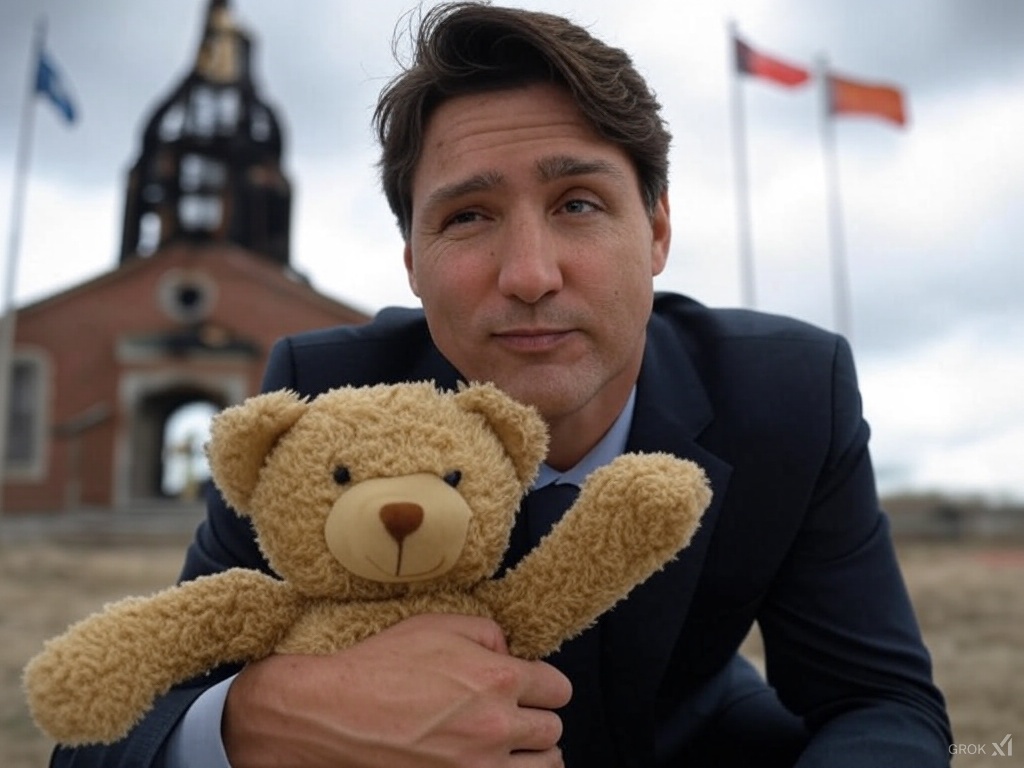
Oh, gather ’round, folks, for the grand tale of the Canadian Kamloops Grave Hoax—a story so gripping it turned the nation into a collective mourning parade faster than you can say “ground-penetrating radar.” Back in May 2021, the Tk’emlúps te Secwépemc First Nation dropped a bombshell: 215 little skeletons supposedly tucked away in an apple orchard near the old Kamloops Indian Residential School, detected by some high-tech wizardry. Cue the nationwide meltdown—flags drooped to half-mast, churches got torched, and the media spun a yarn of mass graves and murdered kids that had everyone clutching their pearls and reaching for the teddy bears. It was a tragedy so perfectly cinematic, it could’ve been scripted by Hollywood, if Hollywood cared about Canadian history.
But wait, plot twist! Turns out, this blockbuster had a few holes—like, say, the complete absence of actual bodies, graves, or, you know, evidence. Academics and skeptics started poking around, pointing out that the radar “anomalies” might just be old septic trenches or tree roots, not a secret kiddie cemetery. No excavations, no forensic digs, just a lot of hot air and $8 million in government cash handed over to the band with no receipts required. The narrative shifted from “mass genocide” to “oops, maybe we got carried away,” but not before the Pope schlepped over for an apology tour and the UN got all huffy about human rights. It’s almost like everyone forgot to check the facts before lighting the match—classic Canada, eh?
So here we are, years later, with the Kamloops saga looking less like a dark chapter and more like a masterclass in collective gullibility. The media’s still patting itself on the back for “raising awareness,” while the Tk’emlúps folks quietly admit those 215 “remains” are now just “anomalies”—no bones, no proof, just vibes. Meanwhile, the nation’s been left with a hangover of shame, a pile of burned churches, and a shiny new holiday to remind us all to feel bad about something that might not have even happened. Moral of the story? Next time someone yells “mass grave,” maybe wait for a shovel to hit dirt before rewriting history—unless, of course, you’re into fiction, in which case, this was a bestseller.
Harvard professor Roland Fryer discusses his research on police brutality in this video, focusing on the data regarding racial bias in police interactions.
Fryer’s study found no racial differences in lethal uses of force by police, which contradicted common narratives and led to significant backlash.
The conversation explores the academic and public response to his findings, highlighting the controversy and criticism he faced.
Fryer emphasizes his commitment to truth-telling despite the personal and professional repercussions, including being suspended by Harvard.
Here are three effective strategies for countering false media narratives:
“Critical Media Literacy Education:
Strategy: Promote awareness and education about media literacy. This involves teaching individuals how to critically analyze media content, understand the motives behind information dissemination, and recognize common techniques used in propaganda or misinformation.
Implementation: Engage in or support programs that teach people how to verify information, understand source credibility, and recognize bias. Workshops, online courses, or school curriculums can include topics like fact-checking, source analysis, and understanding media economics and politics.
Impact: An educated public is less likely to fall for false narratives because they are equipped with the tools to discern truth from falsehood.
Fact-Checking and Reporting:
Strategy: Utilize and support independent, non-partisan fact-checking organizations. These entities systematically verify the accuracy of claims made in media reports, by politicians, or on social media.Implementation: When encountering a narrative that seems off, individuals or organizations can:
Refer to established fact-checking websites like PolitiFact, Snopes, or FactCheck.org.
Use tools or browser extensions that automatically flag or rate the reliability of news articles.
Engage in community-driven fact-checking through social platforms or forums dedicated to uncovering the truth.
Impact: Fact-checking can debunk myths in real-time, reducing the spread of misinformation and providing a counter-narrative with evidence.
Alternative and Diverse Media Sources:
Strategy: Encourage consumption of news from a variety of sources, especially those that are less mainstream or offer alternative viewpoints. This doesn’t mean promoting unreliable sources but rather diversifying where one gets their information from to avoid echo chambers.
Implementation: Support independent journalism that isn’t tied to large conglomerates, which might have vested interests in certain narratives.
Use news aggregators that compile stories from multiple outlets, giving a broader perspective on events.
Engage with local journalism which often provides more nuanced, ground-level reporting.
Impact: By exposing oneself to a broader spectrum of views and facts, individuals can better see through manipulated narratives. This approach also supports a healthier, more pluralistic media ecosystem where misinformation has less room to thrive.
These strategies work best in combination. While countering false media narratives is crucial, it’s also important to do so in a way that doesn’t contribute to further polarization or cynicism about all media. The goal is to foster a more informed, skeptical, yet open-minded public discourse.”
Activists use polysemy to make their corrosive ideas sound palatable to people not versed in their conversational inanity. The play is usually a cloak and dagger affair where they use the commonly accepted definition of a particular word, in this case ‘Diversity’ and use it in a dishonest setup that is really about pushing their specialist meanings into society and society’s institutions.
Here is great example.
Diversity (M1): Generally refers to the presence of variety within an organizational workforce, encompassing differences in identity, such as race, gender, sexual orientation, disability, age, culture, class, religion, or opinion. It’s about having a mix of different people.
Diversity(M2): Some critics argue that in “woke” contexts, diversity might be seen more as a means to an end rather than an end in itself, potentially focusing on increasing representation of certain politically aligned marginalized groups. This view suggests that diversity is less about broad inclusion and more about specific group representation.
The woke will push M1 and be morally outraged if you speak against Diversty(M1). How could you oppose having a different mix of people involved in a situation/task?
How could one indeed? But the pushback isn’t against Diversity(M1) it is pushback against Diversity(M2) which is infused with identity politics and the oppressor/oppressed narrative. It is the Diversity(M2) narrative that calls for a diversity of group identities with the proviso that they share the same ideological beliefs. This idea is illustrated by the fact that, for example, Black Conservatives are not considered to be a ‘diverse choice’ since they often opposed the oppressor/oppressed narrative.
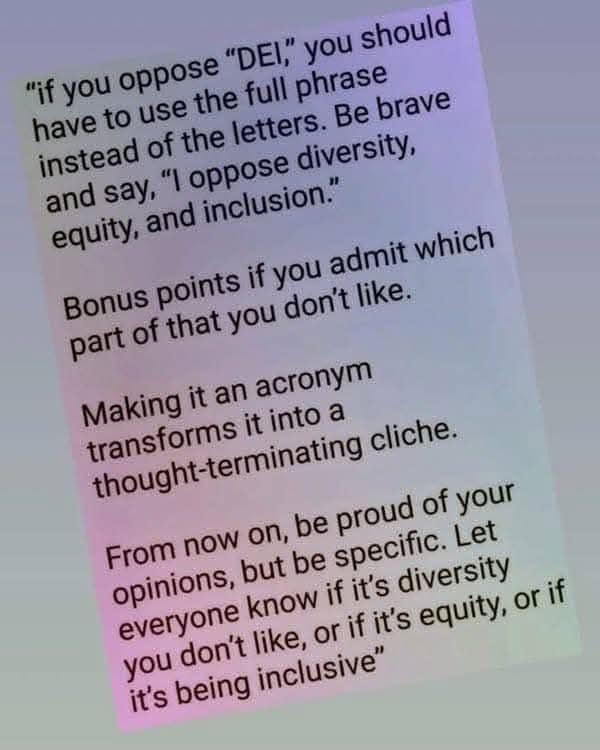
How deep does the polysemic rabbit hole go? Well…
The term “diversity” in the context of social justice advocacy often exhibits polysemy, where the word has multiple related or unrelated meanings. Here are three examples of how the term “diversity” is used:
Diversity as Representation: Meaning: This refers to the inclusion of different racial, ethnic, gender, and sexual orientation groups within organizations, institutions, or media.
Usage: In this context, “diversity” is often used to describe efforts to ensure that various demographic groups are represented in workplaces, schools, and public life. For example, a company might strive for diversity in its hiring practices to reflect the broader community’s composition.
Diversity as Ideological Uniformity:
Meaning: Some critics argue, as seen in posts on X, that “diversity” in certain circles is used to mean a variety of backgrounds but with a uniform set of political or social views, particularly those aligned with progressive or “woke” ideologies.
Usage: This interpretation suggests that while there might be diversity in appearance or demographic markers, there’s an expectation of conformity in thought, especially in terms of social justice issues. This usage is often highlighted in debates over free speech and ideological diversity.
Diversity as a Tool for Inclusion vs. Exclusion:
Meaning: “Diversity” can sometimes be perceived as inclusive when it pertains to groups historically underrepresented or marginalized, but it can also be seen as exclusive if it’s interpreted as excluding certain groups (like straight white males) from consideration for diversity initiatives.
Usage: This dual interpretation can lead to confusion or contention, where diversity initiatives are praised for broadening perspectives but criticized by others for being exclusionary based on identity rather than merit or broader inclusivity.
These examples show how “diversity” can be a multifaceted term within social justice discourse, with its meaning shaped by context, intent, and perspective. The web results and posts on X suggest that while the term is generally used positively to advocate for broader representation, there’s a significant debate around its implications and actual practice.
This is what people have a problem with, don’t let the activist play word games with you.
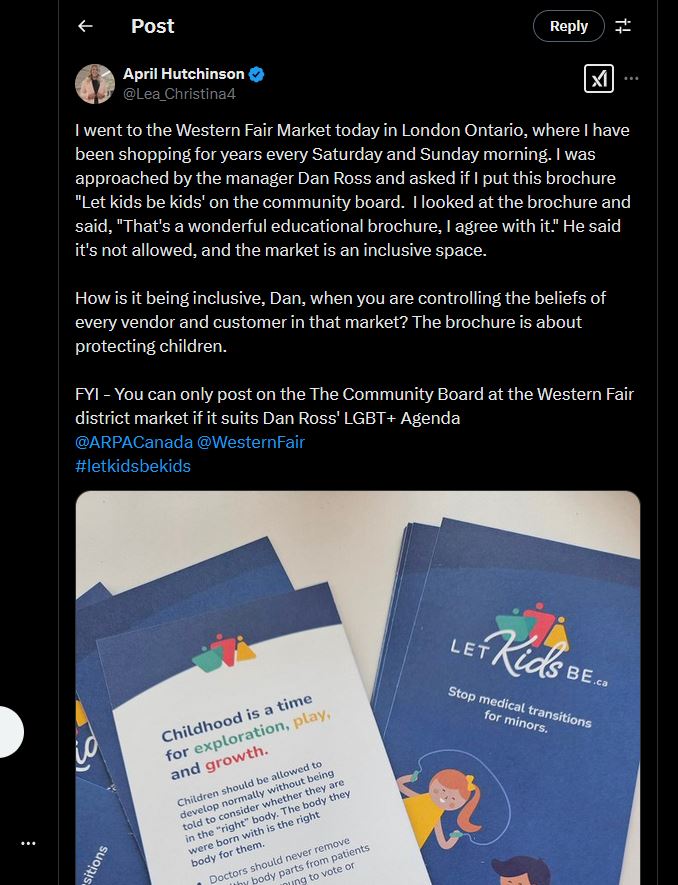
The dynamic at play is this: Inclusivity ONLY comes into play when people and the ideas that they share agree with what the activists say. Messages contrary to woke activist ideology therefore are not included under the umbrella of inclusivity.
Thus, be wary when you see the term “inclusive” because it is often used to perform the polar opposite function.
Peter Boghossian’s conversation with Jesús, a prominent cultural commentator with a significant YouTube presence in Taiwan, delves into the geopolitical dynamics between Taiwan and China, particularly focusing on the strategic importance of Taiwan in global superconductor production. Here’s a summary:
Geopolitical Dynamics: The discussion centers on the critical role Taiwan plays due to its strategic location and its dominance in producing advanced semiconductors. Taiwan is noted for manufacturing around 90% of the world’s advanced semiconductors, making it a linchpin in global technology supply chains.
Taiwan’s Defense and Security: The conversation likely touches on the resilience of Taiwan’s defense against potential Chinese aggression, the implications of a Chinese invasion, and why this scenario should concern not only Taiwan but also the United States and other Western nations. This includes discussions on how Taiwan’s defense mechanisms are vital for maintaining its sovereignty and the stability of the global tech economy.
Cultural and Identity Politics: Beyond just the economic and military aspects, the talk with Jesús might also explore Taiwan’s cultural identity, the impact of Chinese sanctions, and the importance of preserving Taiwanese culture amidst rising immigration and geopolitical tensions. This could involve discussions on how Taiwan’s cultural narrative is intertwined with its political stance against China.
Superconductor Production: The conversation highlights Taiwan’s role in superconductor production, which is central to modern technology, including AI, drones, and other high-tech applications. The control over this technology gives Taiwan significant leverage but also makes it a focal point for international tensions, as any disruption in this supply chain could have global repercussions.
International Implications: There’s an emphasis on how the dynamics between Taiwan and China extend beyond current political leaders, touching on long-term strategic interests, economic sanctions, and the global race in AI and technological advancement. The discussion might explore how these elements affect not just regional but global geopolitics.
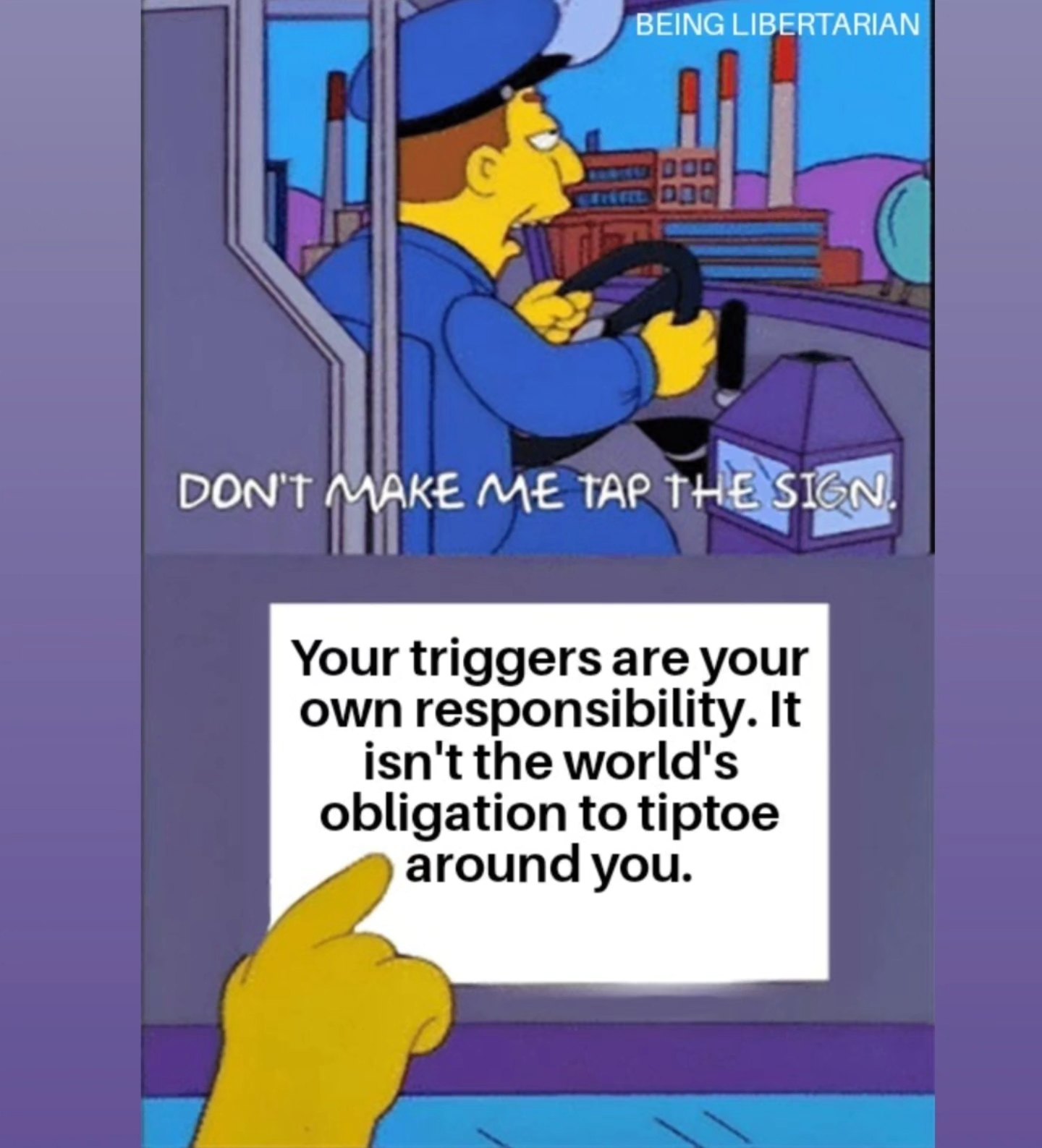
We need to be responsible for ourselves and how we process the world.











 bleatmop
 Mystro


 Dead Wild Roses
Your opinions…