
You are currently browsing the category archive for the ‘Education’ category.
Link.

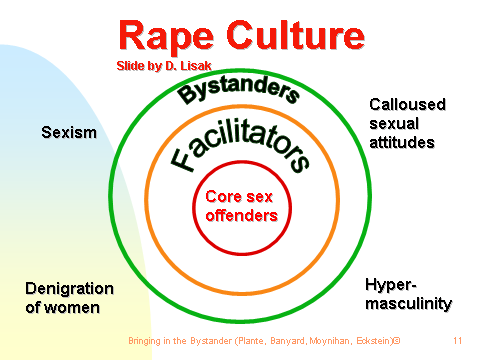 In response to the Steubenville, Ohio teen rape case, West Virginia U.S. Attorney William J. Ihlenfeld is launching a program to teach high school athletes not to post evidence of rape online.
It’s called “Project Future,” and his goal is to teach teens how to avoid getting in trouble with the law by using cell phones, cameras, and social media “responsibly.” Instead of teaching teens not to rape, the U.S. Attorney wants to teach them not to get caught.
The rape case “definitely played a role in causing us to think, ‘Who do we need to focus upon?’ ” Ihlenfeld told The Associated Press. “We thought, ‘Let’s start calling athletic directors and coaches to see if they’re interested.’ That investment of time hopefully will pay dividends down the road, not only because you hope the kids are going to stay out of trouble. Social media creates so many distractions off the field for coaches. Maybe we can help them avoid that situation as well.”
The program was unveiled in Wheeling, which is 26 miles south of Steubenville. It comes on the heels of a drug education program started by Ihlenfeld’s office last year called “Project Future.” The latest program, dubbed “Project Future Two-a-Days,” includes 15 minutes focusing on drugs and alcohol and 15 minutes on social media.
“We bring the perspective of ‘OK, if you do this, this is what can happen. We don’t want to see you in court,’ ” Ihlenfeld said.
” We don’t want to see you in court! It’s too bad a young girl’s life was changed forever and she had atrocious, felonious acts performed on her – but “Project Future” definitely won’t be talking about rape. We’ll spend 15 minutes on drugs and alcohol and 15 minutes on social media. If only the Steubenville rape hadn’t been taped and everyone wasn’t so drunk those fine young gentlemen would still be playing football. That’s the real lesson here, isn’t it?” – mommyish.com
“This is rape culture at work: The very people who are in charge of enforcing our laws look at a cruel, brutal attack on a young girl and think, “If only the teens hadn’t posted photographic evidence online.” – the Bewilderness
Patriarchy sucks. :(
Dealing with positive psychology and its converts can be most irksome at times because, like religion, they don’t smell the bullshit they are peddling. Let’s look at the concise way Chris Hedges sums up this toxic phenomena in his book Empire of Illusion.
“There is a dark, insidious quality to the ideology promoted by the positive psychologists. They condemn all social critics and iconoclasts, the dissidents and the individualists, for failing to surrender and seek fulfillment in the collective lowing of the corporate herd. They strangle creativity an moral autonomy. They seek to mold and shape individual human beings into a compliant collective. The primary teaching of this movement, which reflects the ideology of the corporate state, is that fulfillment is to be found in complete and total social conformity, a conformity that all totalitarian and authoritarian structures seek to impose on those they dominate. Its false promise of harmony and happiness only increases internal anxiety and feelings of inadequacy. The nagging undercurrents of alienation and the constant pressure to exhibit a false enthusiasm and buoyancy destroy real relationships. The loneliness of a work life where self-preservation is valued over authenticity and one must always be upbeat and positive, no matter what one’s actual mood or situation, is disorienting and stressful. The awful feeling that being positive may not, in fact, work if one is laid off or becomes sick must be buried and suppressed. Here, in the land of happy thoughts, there are no gross injustices, no abuses of authority, no economic and political systems to challenge, and no reason to complain.
Here, we are all happy. “
– Chris Hedges, The Empire of Illusion, p. 138 -139.

Reposting because it is important. Thanks to The Nation for hosting Sheldon Wolin’s article.
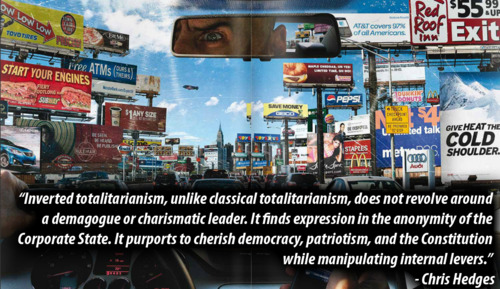 “The war on Iraq has so monopolized public attention as to obscure the regime change taking place in the Homeland. We may have invaded Iraq to bring in democracy and bring down a totalitarian regime, but in the process our own system may be moving closer to the latter and further weakening the former. The change has been intimated by the sudden popularity of two political terms rarely applied earlier to the American political system.
“Empire” and “superpower” both suggest that a new system of power, concentrated and expansive, has come into existence and supplanted the old terms. “Empire” and “superpower” accurately symbolize the projection of American power abroad, but for that reason they obscure the internal consequences. Consider how odd it would sound if we were to refer to “the Constitution of the American Empire” or “superpower democracy.” The reason they ring false is that “constitution” signifies limitations on power, while “democracy” commonly refers to the active involvement of citizens with their government and the responsiveness of government to its citizens. For their part, “empire” and “superpower” stand for the surpassing of limits and the dwarfing of the citizenry.
The increasing power of the state and the declining power of institutions intended to control it has been in the making for some time. The party system is a notorious example. The Republicans have emerged as a unique phenomenon in American history of a fervently doctrinal party, zealous, ruthless, antidemocratic and boasting a near majority. As Republicans have become more ideologically intolerant, the Democrats have shrugged off the liberal label and their critical reform-minded constituencies to embrace centrism and footnote the end of ideology. In ceasing to be a genuine opposition party the Democrats have smoothed the road to power of a party more than eager to use it to promote empire abroad and corporate power at home. Bear in mind that a ruthless, ideologically driven party with a mass base was a crucial element in all of the twentieth-century regimes seeking total power.
Representative institutions no longer represent voters. Instead, they have been short-circuited, steadily corrupted by an institutionalized system of bribery that renders them responsive to powerful interest groups whose constituencies are the major corporations and wealthiest Americans. The courts, in turn, when they are not increasingly handmaidens of corporate power, are consistently deferential to the claims of national security. Elections have become heavily subsidized non-events that typically attract at best merely half of an electorate whose information about foreign and domestic politics is filtered through corporate-dominated media. Citizens are manipulated into a nervous state by the media’s reports of rampant crime and terrorist networks, by thinly veiled threats of the Attorney General and by their own fears about unemployment. What is crucially important here is not only the expansion of governmental power but the inevitable discrediting of constitutional limitations and institutional processes that discourages the citizenry and leaves them politically apathetic.
No doubt these remarks will be dismissed by some as alarmist, but I want to go further and name the emergent political system “inverted totalitarianism.” By inverted I mean that while the current system and its operatives share with Nazism the aspiration toward unlimited power and aggressive expansionism, their methods and actions seem upside down. For example, in Weimar Germany, before the Nazis took power, the “streets” were dominated by totalitarian-oriented gangs of toughs, and whatever there was of democracy was confined to the government. In the United States, however, it is the streets where democracy is most alive–while the real danger lies with an increasingly unbridled government.
Or another example of the inversion: Under Nazi rule there was never any doubt about “big business” being subordinated to the political regime. In the United States, however, it has been apparent for decades that corporate power has become so predominant in the political establishment, particularly in the Republican Party, and so dominant in its influence over policy, as to suggest a role inversion the exact opposite of the Nazis’. At the same time, it is corporate power, as the representative of the dynamic of capitalism and of the ever-expanding power made available by the integration of science and technology with the structure of capitalism, that produces the totalizing drive that, under the Nazis, was supplied by ideological notions such as Lebensraum.
In rebuttal it will be said that there is no domestic equivalent to the Nazi regime of torture, concentration camps or other instruments of terror. But we should remember that for the most part, Nazi terror was not applied to the population generally; rather, the aim was to promote a certain type of shadowy fear–rumors of torture–that would aid in managing and manipulating the populace. Stated positively, the Nazis wanted a mobilized society eager to support endless warfare, expansion and sacrifice for the nation.
While the Nazi totalitarianism strove to give the masses a sense of collective power and strength, Kraft durch Freude (“Strength through joy”), inverted totalitarianism promotes a sense of weakness, of collective futility. While the Nazis wanted a continuously mobilized society that would not only support the regime without complaint and enthusiastically vote “yes” at the periodic plebiscites, inverted totalitarianism wants a politically demobilized society that hardly votes at all. Recall the President’s words immediately after the horrendous events of September 11: “Unite, consume and fly,” he told the anxious citizenry. Having assimilated terrorism to a “war,” he avoided doing what democratic leaders customarily do during wartime: mobilize the citizenry, warn it of impending sacrifices and exhort all citizens to join the “war effort.” Instead, inverted totalitarianism has its own means of promoting generalized fear; not only by sudden “alerts” and periodic announcements about recently discovered terrorist cells or the arrest of shadowy figures or the publicized heavy-handed treatment of aliens and the Devil’s Island that is Guantánamo Bay or the sudden fascination with interrogation methods that employ or border on torture, but by a pervasive atmosphere of fear abetted by a corporate economy of ruthless downsizing, withdrawal or reduction of pension and health benefits; a corporate political system that relentlessly threatens to privatize Social Security and the modest health benefits available, especially to the poor. With such instrumentalities for promoting uncertainty and dependence, it is almost overkill for inverted totalitarianism to employ a system of criminal justice that is punitive in the extreme, relishes the death penalty and is consistently biased against the powerless.
Thus the elements are in place: a weak legislative body, a legal system that is both compliant and repressive, a party system in which one party, whether in opposition or in the majority, is bent upon reconstituting the existing system so as to permanently favor a ruling class of the wealthy, the well-connected and the corporate, while leaving the poorer citizens with a sense of helplessness and political despair, and, at the same time, keeping the middle classes dangling between fear of unemployment and expectations of fantastic rewards once the new economy recovers. That scheme is abetted by a sycophantic and increasingly concentrated media; by the integration of universities with their corporate benefactors; by a propaganda machine institutionalized in well-funded think tanks and conservative foundations; by the increasingly closer cooperation between local police and national law enforcement agencies aimed at identifying terrorists, suspicious aliens and domestic dissidents.
What is at stake, then, is nothing less than the attempted transformation of a tolerably free society into a variant of the extreme regimes of the past century. In that context, the national elections of 2004 represent a crisis in its original meaning, a turning point. The question for citizens is: Which way?”
Just sayn’

 My summer vacation reading was a sunny little book by Nick Turse called Kill Anything That Moves. I finished the other book I was noshing on, the Age of American Unreason, just after returning from Kaslo and now I’ve started Chris Hedges book, the Empire of Illusion. Turse’s book is a necessary read for anyone who wants to understand what war is all about; I’ll be posting quotes from it here soon, but a work of that calibre needs time to digest, to make sense of the crushing sorrow it brings about.
Hedges book is similar to Jacoby’s Age of Unreason, but takes a different tack focusing almost immediately on the present. Hedges begins with a pro-wrestling story and broadens it to convey the idea that we are replacing substance and reality with flash and dramatic narrative (Check out the CBC Podcast on the Empire of Illusion):
[Plato’s Cave just before this…]
“We are chained to the flickering shadows of celebrity culture, the spectacle of the arena and the airwaves, the lies of advertising, the endless personal dramas, many of them completely fictional, that have become the staple of news, celebrity gossip, New Age mysticism, and pop psychology. In the Image: A Guide to Pseudo-Events in America, Daniel Boorstin writes that in contemporary culture the fabricated, the inauthentic, and the theatrical have displaced the natural, the genuine, and the spontaneous, until reality itself has been converted into stagecraft. Americans, he writes, increasingly live in a “world where fantasy is more real than reality,” He warns:
We risk being the first people in history to have been able to make their illusions so vivid, so persuasive, so “realistic” that they can live in them. We are the most illusioned people on earth. Yet we dare not become disillusioned, because your illusions are the very house in which we live; they are our news, our heroes, our adventure, our forms of art, our very experience.
Boorstin goes on to caution that
an image is something we have claim on. It must serve our purposes. Images are means. If a corporation’s image of itself or a man’s image of himself is not useful, it is discarded. Another may fit better. The image is made to order, tailored to us. An ideal, on the other hand, has a claim on us. It does not serve us; we serve it. If we have trouble striving towards [sic] it , we assume the matter is with us, and not with the ideal.
Those who manipulate the shadows that dominate our lives are the agents, publicists, marketing departments, promoters, script writers, television and movie producers, advertisers, video technicians, photographers, bodyguards, wardrobe consultants, fitness trainers, pollsters, public announcers, and television news personalities that create the vast stage for illusion. They are the puppet masters. No one achieves celebrity status, no cultural illusion is swallowed as reality, without these armies of cultural enablers and intermediaries. The sole object is to hold attention and satisfy an audience. These techniques of theatre, as Boorstin notes, have leached into politics, religion, education, literature, news, commerce, warfare and crime. The squalid dramas played out for fans in the wrestling ring mesh with the ongoing dramas on television, in movies, and in the news, where “real-life” stories, especially those involving celebrities, allow news reports to become mini-drams complete with a star, a villian, a supporting cast, a good-looking host, and a neat, if often unexpected, conclusion”.
*boom* The beginnings of understanding our manufactured culture in less than 600 words. Enjoy.











 bleatmop
 Mystro


 Dead Wild Roses
Your opinions…