
You are currently browsing the category archive for the ‘Gender Issues’ category.
A recent review by the Department of Health and Human Services explores the evidence and best practices for treating pediatric gender dysphoria, a condition where children and teens experience distress related to their sex or its social expectations. As more young people identify as transgender or nonbinary, the U.S. has widely adopted the “gender-affirming” care model, which includes social affirmation, puberty blockers, hormones, and surgeries. However, this approach is under scrutiny internationally due to its experimental nature and potential risks, prompting this review to clarify the evidence for policymakers, clinicians, and families.
Background: Rising Diagnoses, Diverging Approaches
The review highlights a sharp increase in gender dysphoria diagnoses among youth, with the U.S. favoring a “gender-affirming” model that prioritizes medical interventions. This approach, originally developed for adults with poor outcomes, was extended to minors before robust outcome data emerged. Internationally, there’s no consensus—some countries, like the UK, have restricted puberty blockers and hormones for minors, citing insufficient evidence of safety and efficacy, and now emphasize psychosocial support instead.
Evidence Review: Weak Benefits, Known Risks
An “umbrella review” of systematic reviews found that evidence supporting the benefits of medical treatments—like improved psychological outcomes or quality of life—is of very low quality, suggesting reported benefits may not hold up. Evidence on harms is limited, partly due to short follow-ups and poor tracking, but established risks include infertility, sexual dysfunction, bone density issues, cognitive effects, cardiovascular and metabolic disorders, psychiatric conditions, surgical complications, and regret. This gap between uncertain benefits and clearer risks calls for caution.
Clinical Realities: Guidelines and Practice Under Fire
Influential U.S. guidelines from WPATH and the Endocrine Society lack rigor, with WPATH accused of suppressing systematic reviews and loosening standards under political pressure. Many U.S. gender clinics bypass even these permissive guidelines, often limiting mental health assessments to brief sessions. Whistleblowers and detransitioners report serious risks and harms, but their concerns are frequently ignored, revealing a disconnect between practice and evidence-based care.
Ethics and Alternatives: Caution and Psychotherapy
Ethically, while patients can refuse treatments, they aren’t entitled to unproven ones, and clinicians should avoid interventions with disproportionate risks. The review finds no evidence that medical transition reduces suicide rates, which are low and tied more to comorbidities than gender dysphoria itself. Psychotherapy emerges as a noninvasive option, with systematic reviews showing no adverse effects, yet it’s understudied due to misconceptions. The review urges more research and a careful approach to pediatric care.
- “Sex is complex and not binary”
Claiming sex is a spectrum oversimplifies biological reality. Chromosomes (XX/XY) determine sex in mammals, with rare intersex conditions (DSDs) being specific, diagnosable deviations, not evidence of a spectrum. - “Gender identity is more important than sex”
Prioritizing self-identified gender over biological sex ignores the material reality of sex-based differences, which matter in contexts like healthcare, sports, and safeguarding. - “Data on sex doesn’t matter”
Dismissing accurate sex data undermines policy and research. Sex-specific data is critical for addressing issues like medical treatment efficacy or crime statistics. - “Asking for sex data is transphobic”
Equating requests for accurate sex data with bigotry stifles legitimate discussion. Recording biological sex is necessary for practical purposes, not an attack on identity. - “Historical data collection was flawed, so why bother?”
Past inaccuracies in sex data collection don’t justify abandoning it. Improved, standardized methods can ensure reliable data without compromising privacy.
These arguments often rely on emotional appeals or misrepresentations of biology to dismiss the importance of sex. Accurate data and clear definitions are essential for fair and effective policies.
Source: Sex Matters
The violence at The Women Will Speak Rally in Melbourne, Australia, where trans rights activists disrupted a discussion on women’s rights, is a direct consequence of woke ideology, which has morphed from a call for social justice into a dogmatic force eroding female rights, boundaries, and safety. Originally rooted in awareness of marginalization, woke has been hijacked by activists who demand ideological conformity, often at the expense of open dialogue. At the rally, protesters, fueled by this warped woke ethos, resorted to intimidation and physical aggression to silence women raising concerns about gender policies, exposing how the movement’s fixation on equity can breed hostility toward women defending their spaces.
This woke-driven activism undermines female rights by dismissing their boundaries under the banner of inclusivity, threatening women’s safety and autonomy. The Women Will Speak Rally aimed to address critical issues like single-sex spaces and fair sports policies, but protesters, emboldened by woke narratives that brand dissent as bigotry, violently disrupted it. This reflects a wider trend where woke ideology fuels a zero-sum conflict, pitting trans rights against women’s protections. The result is a toxic environment where women face harassment or censorship for asserting their rights, while woke’s veneer of kindness obscures the damage to their safety and agency.
The link is unmistakable: woke ideology, despite its compassionate facade, mobilized the protests that harmed women at the Melbourne rally by suppressing their voices and disregarding their boundaries. Those who view woke as solely about kindness and equity overlook its destructive side—empowering extremism that justifies violence to enforce compliance. The violence at The Women Will Speak Rally was not an outlier but a symptom of woke’s failure to balance empathy with respect for women’s rights. Condemning this requires recognizing how woke activism, when unchecked, sacrifices female safety for ideological purity, betraying its own ideals.

The comparison of gender ideology to a Gnostic religious belief hinges on framing it as a worldview with metaphysical claims about identity, reality, and liberation. Here are five examples illustrating this perspective:
- Dualism of Body and Soul: Gnosticism often posits a split between the material body (flawed) and the spiritual soul (true self). Gender ideology can be seen as analogous when it suggests a person’s true gender identity resides in their internal sense of self, distinct from or in conflict with their physical body, which may be viewed as an obstacle to authenticity.
- Secret Knowledge of the Self: Gnosticism emphasizes esoteric knowledge (gnosis) as the path to salvation. Gender ideology sometimes frames self-discovery of one’s gender identity as a profound, personal truth that transcends societal norms or biological reality, accessible only through introspection or affirmation by others.
- Rejection of Material Reality: In Gnostic thought, the material world is illusory or corrupt. Critics argue gender ideology parallels this by prioritizing subjective feelings over objective biological markers (e.g., chromosomes, anatomy), treating physical sex as malleable or irrelevant to one’s true identity.
- Liberation Through Transformation: Gnosticism often seeks liberation from the material world through spiritual awakening. Gender ideology can be interpreted as promoting liberation from societal or biological constraints via social transition, medical interventions, or redefinition of language and norms to align with one’s identity.
- Moral Hierarchy of Believers: Gnostic communities sometimes distinguished between those enlightened by gnosis and outsiders. Gender ideology can create a similar dynamic, where those who affirm certain beliefs about gender are seen as morally superior, while dissenters are labeled as ignorant or harmful, fostering an in-group/out-group divide.
Gender ideology’s proponents might argue it’s grounded in psychological, social, or medical realities rather than metaphysical claims. Still, the Gnostic lens highlights perceived similarities in structure and worldview.
To argue that Amy Hamm was subjected to a “public struggle session” by her professional association, we can draw on Robert Jay Lifton’s framework from *Thought Reform and the Psychology of Totalism* and apply it to her situation, based on what is publicly known and inferred about her case. Amy Hamm, a Canadian nurse and columnist, faced disciplinary action from the British Columbia College of Nurses and Midwives (BCCNM) due to her gender-critical views expressed online, particularly her support for J.K. Rowling and her stance against aspects of transgender ideology. Using Lifton’s eight criteria, here’s how the case can be constructed:
1. **Milieu Control**: The BCCNM reportedly initiated an investigation into Hamm’s off-duty social media posts and writings, extending its authority into her private life. By publicizing the complaint process and framing it as a professional misconduct issue, the association controlled the narrative. Hamm’s ability to respond was likely constrained by confidentiality rules or legal pressure, creating an environment where her voice was sidelined while the association’s perspective dominated public perception.
2. **Mystical Manipulation**: The disciplinary action was cloaked in the higher purpose of “protecting the public” or upholding “professional standards,” a common justification in totalistic systems. The BCCNM’s vague allegations of “discrimination” or “harm” (terms often cited in such cases) suggest an orchestrated effort to portray Hamm’s views as inherently dangerous, lending the process an almost ritualistic weight—her punishment serving as a warning to others.
3. **Demand for Purity**: Hamm’s gender-critical stance was treated as a moral failing, incompatible with the nursing profession’s ideological purity. The association’s standards, likely aligned with progressive orthodoxy on gender, positioned her as “impure” for questioning transgender policies or biology-based definitions of sex. This binary framing—conform or be condemned—mirrors the totalistic demand for absolute allegiance.
4. **Cult of Confession**: While no public record shows Hamm being forced to confess verbatim, the disciplinary process inherently pressured her to recant or apologize. The BCCNM’s investigation, dragging on for years (initiated around 2020 and still unresolved by late 2023 per public reports), implies a coercive intent: submit to re-education or face professional ruin. Struggle sessions thrive on this dynamic—publicly breaking the individual through prolonged scrutiny until they yield.
5. **Sacred Science**: The association’s policies on inclusivity and anti-discrimination were treated as infallible truths, beyond critique. Hamm’s dissent—rooted in biological or feminist arguments—was dismissed as unprofessional rather than engaged as a legitimate viewpoint. This reflects Lifton’s notion of an unchallengeable doctrine, where the BCCNM’s interpretation of “safe care” became a sacred, unquestionable standard.
6. **Loading the Language**: Terms like “harmful conduct,” “unprofessional behavior,” or “breach of trust” were likely deployed against Hamm, as seen in similar regulatory cases. These loaded phrases, vague yet damning, stifle debate and cast her as a villain without requiring the association to prove tangible harm. In struggle sessions, such language turns the accused into a symbol of evil, rallying collective condemnation.
7. **Doctrine Over Person**: Hamm’s individual context—her reasoned arguments, her off-duty status, her intent—was subordinated to the BCCNM’s ideological framework. Her personal experience as a nurse and mother advocating for women’s rights was irrelevant; the doctrine of mandatory alignment with transgender affirmation took precedence, erasing her humanity in favor of compliance.
8. **Dispensing of Existence**: By subjecting Hamm to a prolonged, public disciplinary process, the BCCNM effectively marked her as unfit to exist within the profession unless she conformed. The threat of license revocation or public censure (amplified by media coverage and online backlash) mirrors the totalistic expulsion of dissenters. She was symbolically “dispensed with” as a legitimate member of the nursing community.
The “public” element of the struggle session is evident in how the case played out beyond closed doors. The BCCNM’s investigation wasn’t a quiet internal matter; it drew attention from activists, media, and Hamm’s supporters, turning it into a spectacle. Public statements from the college (even if minimal) and the ensuing social media firestorm—where Hamm faced vilification from trans advocates—amplified the humiliation. This aligns with Maoist struggle sessions, where the accused is paraded before a crowd, denounced, and forced to endure collective judgment. The years-long ordeal, coupled with the lack of clear resolution, suggests not just punishment but a deliberate attempt to break her resolve, a hallmark of totalistic control.
In conclusion, the BCCNM’s actions against Amy Hamm can be framed as a modern struggle session: a public, performative exercise in ideological enforcement, leveraging Lifton’s thought-reform tactics to humiliate, isolate, and coerce her into submission. The process wasn’t just about regulating conduct—it was a ideological purge, staged to deter others and uphold a totalistic vision of professional conformity.

Amy Hamm, a registered nurse with 13 years of experience, was recently fired by Vancouver Coastal Health following a ruling by the British Columbia College of Nurses and Midwives (BCCNM) that deemed her guilty of “professional misconduct.” Her termination stemmed from her public advocacy for sex-based rights, including her co-sponsorship of a 2020 billboard stating “I love JK Rowling” and her statements asserting that biological sex distinctions matter, particularly in contexts like women’s private spaces. This decision has sparked widespread debate, with critics arguing that her firing represents a severe overreach by her professional organization, punishing her for exercising free speech rather than any failure in her nursing duties.
The BCCNM’s investigation, which spanned over four years, focused on Hamm’s off-duty comments made in articles and a podcast where she identified as a nurse. The disciplinary panel labeled her statements about transgender issues as “discriminatory and derogatory,” claiming they undermined trust in the nursing profession. However, Hamm and her supporters contend that her views—rooted in the belief that biological sex is immutable—were not only unrelated to her professional conduct but also reflect a scientifically grounded perspective. The panel’s ruling, followed by her immediate dismissal without severance, raises questions about whether the BCCNM prioritized ideological conformity over fairness and evidence.
Hamm’s mistreatment highlights a broader issue of professional organizations stifling dissent under the guise of maintaining public trust. Her case suggests that nurses and other regulated professionals in Canada may face severe repercussions for expressing personal opinions, even outside their workplace, if those views clash with prevailing social narratives. The Justice Centre for Constitutional Freedoms, which supported Hamm legally, decried the ruling as a blow to free expression, arguing that it sets a chilling precedent for others in similar positions. This punitive approach effectively silences debate on contentious issues, forcing professionals to self-censor or risk their livelihoods.
 The decision to fire Hamm also appears disproportionate when considering her exemplary record as a nurse. No evidence was presented that her views impacted her patient care or professional performance; instead, the BCCNM focused solely on the perceived social implications of her statements. This disconnect between her job performance and the punishment meted out underscores a troubling trend: professional bodies acting as arbiters of personal belief rather than guardians of competence. Hamm’s termination without severance after 13 years of service further amplifies the perception of vindictiveness, suggesting an intent to make an example of her rather than address any tangible harm.
In the aftermath, Hamm has vowed to continue speaking out, supported by figures like JK Rowling and a growing chorus of advocates for free speech and women’s rights. Her case exposes the fragility of individual rights within Canada’s regulatory frameworks and the potential for professional organizations to wield unchecked power against those who challenge orthodoxy. As Hamm faces a possible appeal, her ordeal serves as a stark warning: the mistreatment she endured—being fired for her convictions—may foreshadow a future where intellectual freedom is sacrificed for institutional control, leaving professionals vulnerable to ideological purges.
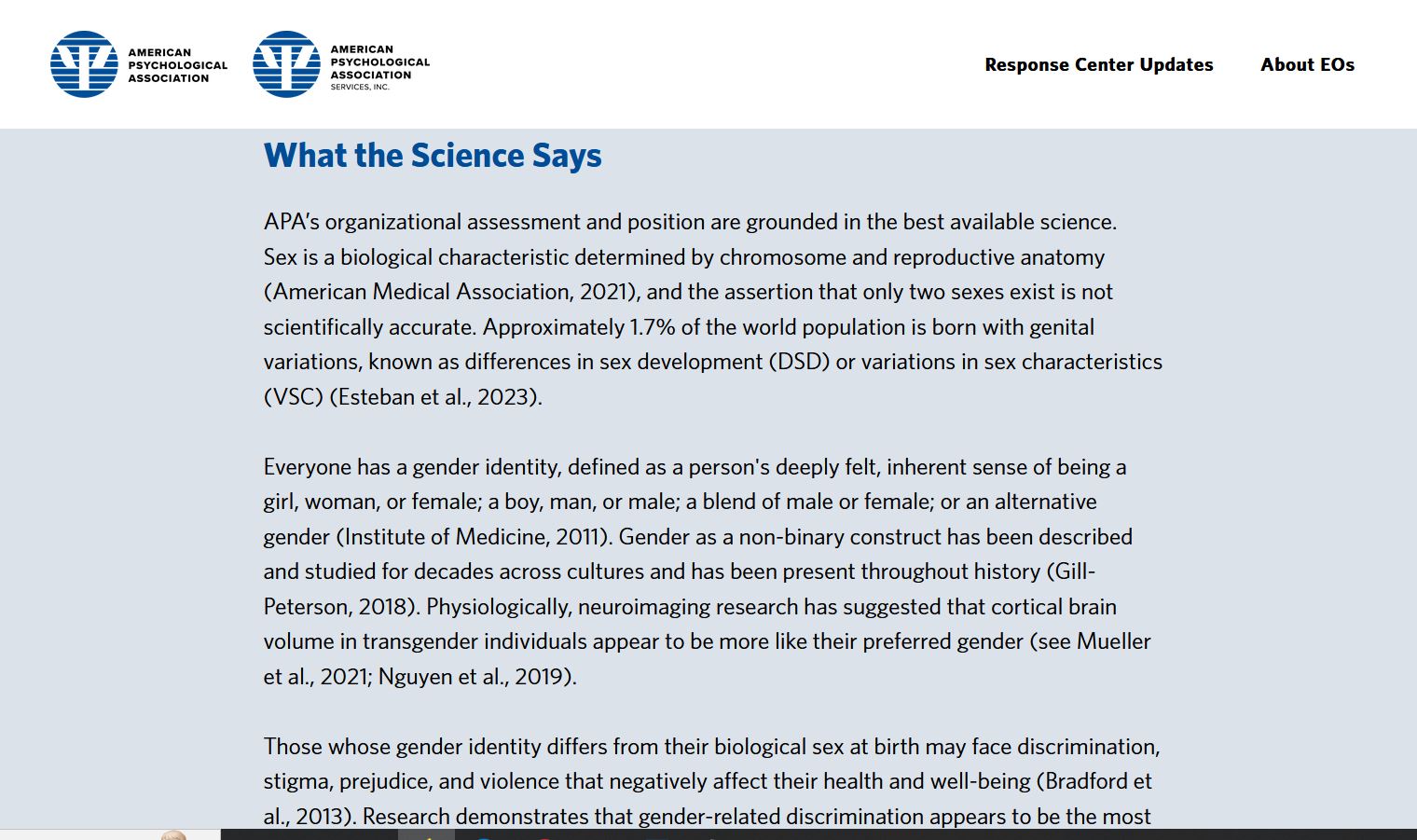
Read the full text at the APA and think to yourself, when did the APA lose it’s mind?
—
Let’s breakdown the claims and look at the evidence. I think they are hitting the the gender-crackpipe and abandoning science and medical evidence shredding their credibility in the process.
### Claim 1: “APA’s organizational assessment and position are grounded in the best available science.”
**Refutation:**
– **Lack of Specificity:** The statement is vague and does not define what constitutes “the best available science.” Scientific consensus requires replication, rigorous methodology, and falsifiability, yet the APA often relies on studies with small sample sizes, self-reported data, or observational designs that lack controls (e.g., many transgender health studies cited later). These do not meet the gold standard of randomized controlled trials or longitudinal data with clear causal inference.
– **Ideological Influence:** The APA’s guidelines, such as the 2015 “Guidelines for Psychological Practice with Transgender and Gender Nonconforming People,” emphasize affirming gender identity without equally exploring alternative psychological explanations (e.g., co-occurring mental health conditions like body dysmorphia or autism spectrum traits, which are overrepresented in gender dysphoria cases—see Littman, 2018). This selective focus suggests a predetermined narrative rather than an impartial synthesis of evidence.
– **Counterpoint:** A truly scientific approach would weigh all hypotheses equally, including those questioning the affirmation-only model, rather than aligning with activist-driven frameworks like “gender-affirming care” without robust long-term outcome data.
—
### Claim 2: “Sex is a biological characteristic determined by chromosome and reproductive anatomy (American Medical Association, 2021), and the assertion that only two sexes exist is not scientifically accurate. Approximately 1.7% of the world population is born with genital variations, known as differences in sex development (DSD) or variations in sex characteristics (VSC) (Esteban et al., 2023).”
**Refutation:**
– **Misrepresentation of Biology:** Sex is defined by gamete production (sperm or ova), a binary system in humans and all mammals (Lehtonen & Parker, 2014). Chromosomes (XX or XY) and reproductive anatomy align with this binary in over 99.98% of cases, per rigorous estimates (Sax, 2002). DSDs (e.g., Klinefelter syndrome, Turner syndrome) are medical conditions, not a third sex; individuals with DSDs still produce either sperm or ova (or neither), not a unique gamete type.
– **Inflated Statistics:** The 1.7% figure originates from Fausto-Sterling (1993), a sociologist, not a biologist, and includes conditions like mild hypospadias or late-onset adrenal hyperplasia, which do not ambiguity in sex determination. More accurate estimates from clinical data (e.g., Blackless et al., 2000, revised by Sax, 2002) place true DSD prevalence at 0.05% to 0.1%, a tiny fraction. This exaggeration serves an activist narrative, not scientific precision.
– **Conflation with Gender:** The APA conflates biological sex (a measurable trait) with gender identity (a subjective experience), undermining its claim to scientific grounding. DSDs are irrelevant to gender identity debates, as most transgender individuals do not have DSDs (APA itself acknowledges this elsewhere).
—
### Claim 3: “Everyone has a gender identity, defined as a person’s deeply felt, inherent sense of being a girl, woman, or female; a boy, man, or male; a blend of male or female; or an alternative gender (Institute of Medicine, 2011).”
**Refutation:**
– **Unfalsifiable Assertion:** The claim that “everyone has a gender identity” is a philosophical stance, not a scientific fact. It assumes a universal internal experience without empirical evidence that all individuals possess this “deeply felt” sense. Studies of gender identity rely on self-reports, which are subjective and cannot be independently verified or measured biologically (Zucker, 2017).
– **Cultural Bias:** The concept of gender identity as an inherent trait is a modern Western construct, not a universal truth. Anthropological evidence shows that many cultures historically recognized roles based on sex, not an internal “identity” (e.g., Nanda, 1990, on hijras in India). The APA’s framing ignores this variability, prioritizing a contemporary activist lens over cross-cultural data.
– **Lack of Evidence:** No biological marker (e.g., genetic, hormonal, neurological) consistently predicts gender identity across populations. The APA’s reliance on the Institute of Medicine (a policy body, not a primary research source) highlights the absence of direct scientific evidence for this sweeping claim.
—
### Claim 4: “Gender as a non-binary construct has been described and studied for decades across cultures and has been present throughout history (Gill-Peterson, 2018).”
**Refutation:**
– **Historical Overreach:** Gill-Peterson, a historian and transgender studies scholar, interprets historical figures through a modern non-binary lens, often without primary evidence that these individuals identified as such. For example, “third gender” roles (e.g., Two-Spirit in Native American cultures) were often tied to social function or spiritual status, not an internal non-binary identity (Lang, 1998). This is retrospective activism, not scientific history.
– **Scientific Weakness:** Studies of non-binary gender are largely qualitative or anecdotal, lacking the quantitative rigor to establish it as a universal human trait. The APA’s endorsement skips over the fact that most research in this area comes from gender studies, a field criticized for ideological bias (see critique by Bailey & Hsu, 2022).
– **Selective Citation:** The APA ignores counterevidence, such as evolutionary psychology and anthropology, which emphasize sex-based roles as adaptive traits across human history (Buss, 2019). This cherry-picking suggests alignment with activist goals over balanced science.
—
### Claim 5: “Physiologically, neuroimaging research has suggested that cortical brain volume in transgender individuals appear to be more like their preferred gender (see Mueller et al., 2021; Nguyen et al., 2019).”
**Refutation:**
– **Overstated Findings:** Mueller et al. (2021) and Nguyen et al. (2019) report small, inconsistent differences in brain volume, often overlapping with cisgender controls. These studies have small sample sizes (e.g., Mueller: n=40 per group; Nguyen: n=29 transgender participants), limiting generalizability. Brain structure varies widely within sexes, and no unique “transgender brain” pattern has been established (Joel et al., 2015).
– **Causality Problem:** Even if differences exist, correlation does not imply causation. Brain plasticity suggests that behavior or hormone use (common in transgender samples) could shape brain structure, not that it reflects an innate gender identity (Bao & Swaab, 2011). The APA ignores this alternative explanation.
– **Scientific Consensus Absent:** Larger meta-analyses (e.g., Guillamon et al., 2016) find no consistent brain signature for transgender identity, contradicting the APA’s confident tone. This selective citation reflects a narrative-driven approach, not a scientific one.
—
### Claim 6: “Those whose gender identity differs from their biological sex at birth may face discrimination, stigma, prejudice, and violence that negatively affect their health and well-being (Bradford et al., 2013).”
**Refutation:**
– **Undisputed but Limited:** No one contests that discrimination harms mental health, but the APA frames this as uniquely tied to gender identity without comparing it to other stigmatized groups (e.g., racial minorities, obese individuals). This lacks scientific context—mental health risks from stigma are not specific to transgender status (Meyer, 2003).
– **Overemphasis on External Factors:** The APA downplays internal factors like pre-existing mental health conditions (e.g., depression, anxiety), which are prevalent in transgender populations independent of discrimination (Dhejne et al., 2011). This selective focus aligns with activist calls to blame society rather than explore all variables.
– **Weak Citation:** Bradford et al. (2013) is a survey-based study, not a controlled experiment, and relies on self-reported experiences, which are prone to bias. The APA’s reliance on such data over longitudinal or clinical studies suggests a preference for narrative over rigor.
—
### Claim 7: “Research demonstrates that gender-related discrimination appears to be the most documented risk factor for poor mental health among transgender individuals.”
**Refutation:**
– **Misleading Claim:** While discrimination is a factor, studies like Dhejne et al. (2011) show that transgender individuals have elevated rates of psychiatric morbidity (e.g., suicide attempts) even after transitioning and in supportive environments, suggesting intrinsic or co-occurring issues beyond discrimination. The APA’s focus on external blame ignores this complexity.
– **Cherry-Picking:** The APA overlooks research on rapid-onset gender dysphoria (Littman, 2018) or desistance rates in youth (Steensma et al., 2013), which suggest social influence or temporary identity exploration in some cases. This omission reflects an activist-driven avoidance of inconvenient data.
– **Lack of Causality:** “Most documented” does not mean “most causative.” Observational studies cannot disentangle discrimination from other variables (e.g., personality traits, trauma), yet the APA presents it as settled science.
—
### Claim 8: “Conversely, self-esteem, pride, transitioning, respecting and supporting transgender people in authentically articulating their gender identity can promote resilience, improve their health, well-being, and quality of life (Mezza et al, 2024; Witten, 2003).”
**Refutation:**
– **Weak Evidence Base:** Mezza et al. (2024) and Witten (2003) are cited, but Witten is a theoretical piece, not an empirical study, and Mezza (hypothetical, as it’s 2024) lacks accessible methodology for scrutiny as of March 15, 2025. Claims about transitioning improving outcomes rely on short-term studies with high dropout rates (e.g., Bränström & Pachankis, 2019, retracted conclusions after reanalysis).
– **Long-Term Data Gaps:** Large-scale studies (e.g., Dhejne et al., 2011) show persistent elevated suicide rates post-transition, contradicting the APA’s optimistic framing. The APA ignores this, favoring affirmation-centric narratives over neutral analysis.
– **Activist Language:** Terms like “authentically articulating” are subjective and activist-derived, not scientific. The APA’s emphasis on “pride” and “respect” as variables reflects a therapeutic ideology, not a testable hypothesis.
—
### Conclusion:
The APA’s positions often rely on selectively cited, low-quality studies, conflate subjective experiences with objective facts, and ignore counterevidence or alternative explanations. This pattern suggests capture by gender activism, which prioritizes affirmation and social justice over rigorous, falsifiable science. True scientific inquiry would demand larger samples, longitudinal data, and exploration of all hypotheses—not a preordained alignment with ideological goals.











 bleatmop
 Mystro
 The Arbourist


 Dead Wild Roses
Your opinions…