
You are currently browsing the category archive for the ‘Gender Issues’ category.
So many discussion centre around this notion. It would be nice if we could agree on a basic set of facts rather than arguing from completely different frameworks.

[Source]
I’m sometimes asked why I give such serious side-eye to the term identity politics. This isn’t some sort of dogwhistle like the freezepeach moniker that gets affixed to people who want to say racist or sexist things and then hide behind free speech. Gender IDPOL is a systemic denial of the reality women face and an iron scold meant to silence and shame women who dare to speak out against the arguments IDPOL make.
The good news is that despite the abuse from the ‘progressive’ left and the usual abuse from dudes, brave women are speaking out against gender IDPOL, precisely because of its insidious nature and the implicit erasure of the female experience from the public sphere.
Ms. Sanchez writes a cogent essay that appears on the Feminist Current, I suggest going there and reading the entire work. However, I wanted to highlight this section in particular as it speaks to the material situation women face in society, and how IDPOL is obfuscating that struggle. Also highlighted are some of the rhetorical dodges genderists use to muddy the water when it comes to the reality of sex based oppression.
“This is because there is an expectation that women are inherently nurturing. Being forced into the position of caretaker translates to women having less savings, being promoted less, and accumulating less money in their pensions.
But gender identity politics reduces this reality — and womanhood itself — to a trivial, malleable identity. It is baffling that in a world where women and girls face structural oppression due to their biology, gender identity politics has thrived.
Susan Cox argues that: “The non-binary declaration is a slap in the face to all women, who, if they haven’t come out as ‘genderqueer,’ presumably possess an internal essence perfectly in-line with the misogynistic parody of womanhood created by patriarchy.” There’s a twisted, neoliberal cruelty in arguing that the primary problem with gender is its impact on the chosen identities of individuals, and not the way it operates systemically, under patriarchy, to normalize and encourage male violence and female subordination.
When confronted with evidence that, historically and globally, women’s oppression is sex-based, gender identity politics simply claims that sex itself is an “invented” social construct.
BUT male/female as two distinct categories is a system we made. bio sex is a classification we invented. these aren’t inherent in nature.
— Riley J. Dennis (@RileyJayDennis) July 9, 2017
In an article at Quartz, Jeremy Colangelo writes:
“Sex and gender are much more complex and nuanced than people have long believed. Defining sex as a binary treats it like a light switch: on or off. But it’s actually more similar to a dimmer switch, with many people sitting somewhere in between male and female genetically, physiologically, and/or mentally. To reflect this, scientists now describe sex as a spectrum.
Despite the evidence, people hold on to the idea that sex is binary because it’s the easiest explanation to believe. It tracks with the messages we see in advertisements, movies, books, music — basically everywhere. People like familiar things, and the binary is familiar (especially if you’re a cisgender person who has never had to deal with sexual-identity issues).”
But feminists don’t argue that sex is real because it is “the easiest explanation to believe” or because of what the media tells us. We argue sex is real because from the moment an ultrasound reveals a baby is female, her subjugation begins. And though “gender identity” is presented as an issue feminism must contend with, it is, as Rebecca Reilly-Cooper explains, completely at odds with feminist analysis of biological sex as an axis of oppression:
“Women’s historic and continued subordination has not arisen because some members of our species choose to identify with an inferior social role (and it would be an act of egregious victim-blaming to suggest that it has). It has emerged as a means by which males can dominate that half of the species that is capable of gestating children, and exploit their sexual and reproductive labour.
We cannot make sense of the historical development of patriarchy and the continued existence of sexist discrimination and cultural misogyny, without recognizing the reality of female biology, and the existence of a class of biologically female persons.”
Far from fluid, the realities of sex-based oppression are strict and enforced through violence — this is particularly true for women of colour and women in poverty.”
If gender identity is so amazing why are not females in large droves identifying as Men to escape their oppression?
A quite comprehensive list. Female erasure is a serious problem in our society and we should move to ensure that the rights of Women are preserved.
“Here is a list of the Human Rights of Women that so-called Transgender Rights are eliminating. No one is saying Trans folk should not have rights, but what IS wrong is that trans activists are denying and destroying the Human Rights of women—and children who have no voice at all. Read this list—and wonder. And then, get angry . Here is the list , prepared by Gallus Mag, a blogger and writer in the women’s community…
Removing the legal right of women to organize politically against sex-based oppression by males
Removing the legal right of women to assemble outside the presence of men
Removing the legal right of women to educational programs created for women outside the presence of men
Eliminating data collection of sex-based inequalities in areas where females are underrepresented
Elimination of sex-based crime statistics
Eliminating athletic programs and sports competition for women and girls
Removing the legal right of women to be free from the presence of men in areas of public accommodation where nudity occurs
Elimination of grants, scholarships, board and trustee designations, representative positions, and affirmative programs for women
Removing the legal right of women to create reproductive clinics, rape crisis services, support groups, or any organizations for females
Eliminating media and all public discourse specific to females
Removal of the right of journalists to report the sex, and history, of subjects
Eliminating the legal right of lesbians to congregate publicly
Elimination of lesbian-specific organizations and advocacy groups
Removing the legal right of women to free speech related to sex roles and gender
Elimination of the legal right of women to protection from state-enforced sex-roles (appearance/behavior/thought)
Elimination of the legal right of girls to protection from state-enforced sex-roles in public education
Elimination of the patient right of dependent females to hospital/facility bed assignments separate from males
Elimination of the right of dependent females to prefer female providers for their intimate personal care requirements
Elimination of the human right of female prisoners under state confinement to be housed separately from male prisoners” (from here)”
This quote starkly lays out exactly what is at stake when it comes to the politics of gender and those who follow its dictates.
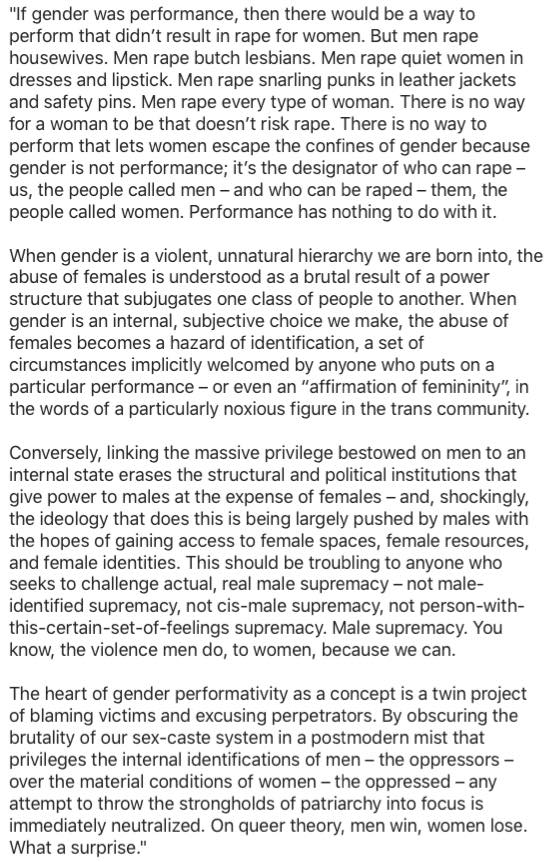
So no, feminism is not about being mean to the poor menz, it is fighting against the oppressive shit that hurts women. Focusing on how the conception of gender is problematic for everyone involved isn’t ‘phobic’ – it is an attempt to recognize, deconstruct, and tear down a bastion of sexism in our society that has been polluting our civilizations for hundreds of years.
Hmm. Time to give some side eye to queer theory as it seems to go against much of what feminism is about. Let’s examine a part of an essay by Susan Cox writing on the Feminist Current.
“Feminists defied patriarchal ideology by declaring that we do not have “wandering uteruses” that make us prone to “hysteria” and inherently inferior to men. Feminists also argued that men are not biologically destined to be a bunch of rapist cavemen, and that we should therefore hold them to higher standards, in terms of their treatment of women. We showed that these ideas were were social constructions artificially imposed on males and females.
Queer theory flipped that whole framework upside-down.
In a textbook example of what is known as “patriarchal reversal,” queer theory embraced the idea that womanhood is defined by femininity (described as gender “performance”). In other words, the things feminists worked so hard to show were not essential to women — makeup, skirts, and coquettish mannerisms, for example — are now said to be the things that make a person a woman. This implies that if a woman rejects her oppressive gendered role, it probably means that she was never really a woman at all.
Queer theory claims to have an interest in the feminist project, which has confused discourse on women’s issues. Recently, an email conversation I had with a male philosopher who has published on feminist theory revealed he didn’t actually understand the difference between sex and gender.
He wrote to me:
“I’m not a macho man. I don’t like violent sports, and I’ve undergone a lot of self-reflection and critique from feminist friends to get to a place where I don’t treat women in the brutish heteronormative way that patriarchy prescribes. So, in many ways, I’ve come to have an identity that reflects my gender and not my sex.”
He seemed to be referring to his “sex” as synonymous with masculinity and using “gender” to mean “personality.” I replied:
“Your sex (male) doesn’t automatically make you a rapey, macho asshole. That is actually the gender role you’ve been assigned under patriarchy. You rejecting the norms of masculinity is you rejecting gender — not identifying with it.”
You know we’re in desperate times when a young scholar has to explain basic feminist theory to someone who’s supposedly been studying it for decades.
Right now, it’s crucial that we remember the feminist critique of biological determinism. We don’t need to pretend as though biological sex doesn’t exist or isn’t important, because sexual difference doesn’t naturally cause male supremacy or female subordination. Acknowledging biological difference is, in fact, very important — we need to know who and what we are talking about, in order to address and remedy the unjust power relationship between males and females.
Patriarchy claims that male supremacy is encoded in the sexed biology of maleness and femaleness. And perhaps it’s an indication of something significant when queer theory says exactly the same.”
So much confusion surround the ideas of sex and gender, I wonder who that could be benefiting…
Bill C-16 is problematic for women. Go read the entirety of Megan Murphy’s article on the Feminist Current, I’ve excerpted a key bit here though. :)
Bill C-16 passed at the Senate on Thursday. Under this new Canadian legislation, which follows similar laws in a number of Western countries, a person can determine their gender or sex via self-declaration at any time and for any reason. It’s considered a human rights violation to question it. No criteria, physical markers, or tests have been identified to determine trans status. As an inherently individualistic idea, gender identity isn’t tethered to any external reality and is therefore considered immune from qualification or broader critical analysis.
If an individual’s identity doesn’t impinge on anyone, it’s easy to accept it at face value. But when an individual transitions into a group of people who face different challenges, questions will naturally arise about whether opportunities reserved for those who are marginalized in their own right will be inevitably claimed by these new members, once again making it more difficult for the original members to get ahead. Already, we’ve seen a handful of examples of males who transitioned later in life showered with praise and handed awards reserved for women, who have spent their entire lives enduring patriarchy as females.
Remarkably, troubling philosophical questions remain unaddressed. If gender identities are determined on an individual basis with no parameters around what they mean, it follows that there can be as many genders as there are human beings. If each individual has a purely self-determined identity, then, by definition, these inherently unique identities can’t be shared with anyone else. No one person can experience another person’s thoughts or feelings to verify that they are thinking or feeling the same things. How can males, or anyone for that matter, know that they feel like a woman? Even if, for the sake of argument, we accept the tautology that a woman is a person who identifies as a woman, the logical conclusion is that “woman” can mean anything and therefore means nothing.
And yet women exist.
Despite a lack of clarification and broad consensus on this, women are vilified simply for asking questions. We’re expected to abandon all prior experiences and notions of ourselves, most especially those that relate to our female embodiment and the oppression that stems from it. Sex-based protections have been effectively dissolved. When it comes to female-only facilities, human rights law is clear: a male who claims the identity of “female” or “woman” can’t be turned away. If a woman has concerns or is in a vulnerable position, her options are to somehow get over it or leave. What this tells women and girls who are survivors of male violence is that females’ right to refuge and privacy away from males is negotiable and that they come last. This is an insidious form of grooming that tells women and girls that they are hysterical for recognizing the epidemic of discrimination and violence directed at them and that they must prioritize the feelings of others over their own sense of self-preservation.
Though frequently twisted, the argument here isn’t that trans people in particular pose a threat. The issue is that as long as gender identity rests on self-declaration, it is impossible — and illegal — for females to distinguish between males who simply wish to live as transgender women and other males. This is an unwarranted burden to place on women and girls, who shouldn’t be obligated to have or divulge a history of trauma in order to justify maintaining independent spaces (not that it makes a difference when they do anyway).
Laws based on personally subjective, indescribable feelings are bad news, not only Canadian women, but the rest of society as well.
Consider this conversation and then juxtaposition it with all the chatter one hears about ‘gender identity’ and ‘gender expression’. Add to your lens the notion of male privilege and how it often plays out when it comes to respecting the boundaries of females.
(not) Funny how that works.
http://auntiewanda.tumblr.com/post/160517895825/cecaeliawitch-this-was-a-pretty-grand-moment-and











 bleatmop
 Mystro
 The Arbourist


 Dead Wild Roses
Your opinions…