
You are currently browsing the category archive for the ‘History’ category.
The Armenian genocide of 1915 happened. Where you happen to live in the world determines if you would argue against the truth of this statement. Robert Fisk, as usual, takes our past grim accounts and makes us see our blood stained history.
“The Nazis told their Jewish victims that they were going to be “resettled” in the east rather than gassed. They also tried to cover the traces of the gas chambers of Treblinka before the Red Army arrived. But the “double” instructions sent by Talat Pasha and his 1915 genociders demonstrate that the pretence of humanitarian resettlement was conceived even before the organised genocide began. Some of the young German officers who witnessed the killings of 1915 turned up 26 years later in the Soviet Union, overseeing the slaughter of Jews.
And here is one very short account (courtesy of the Turkish historian Akcam) of an Armenian witness to his people’s destruction, which could – if the identities and locations were changed to the Ukraine or Belarus – have been written during the Second World War: “In order to eliminate the last remaining Armenian deportees…between Aleppo and Deyr-i Zor [sic] who had managed to survive…Hakki Bey…evicted all the deportees along the Euphrates, starting from Aleppo… Close to 300 young men and boys…surviving in the camp Hamam were sent to the South in a special convoy… Solid reports about them arrived that they had been killed in Rakka [sic]… Elsewhere, we learned in no uncertain terms that in the area around Samiye, 300 children were thrown into a cave opening, gas was poured in and they were burned alive.”
So here’s the real hypocrisy of this story. The Israeli government, so outraged by Poland’s Jewish Holocaust denialism, refuses to recognise the Armenian Holocaust. Shimon Peres himself said that “we reject attempts to create a similarity between the [Jewish] Holocaust and the Armenian allegations. Nothing similar to the Holocaust occurred. What the Armenians went through is a tragedy, but not genocide.”
The Americans, I should add – Trump included, of course – have been equally pathetic in their failure to acknowledge the Armenian truth. But oddly, not Poland.
For 13 years ago, the Polish parliament passed a bill which specifically referred to the “Armenian genocide”. The speaker of the Polish parliament, Wlodzimierz Cimoszewicz, said at the time that the Armenian genocide did indeed take place, that responsibility fell on the Turks, and that Turkish documents – though not yet those which Akcam has just revealed – “confirm” this.
So there you have it. Poland punishes anyone who speaks of Polish participation in the Jewish Holocaust, but accepts the Armenian Holocaust. Israel insists that all must acknowledge the Jewish Holocaust – and Poland’s peripheral guilt – but will not acknowledge the Armenian Holocaust.
Mercifully, Israeli scholars like Israel Charny do so. And mercifully, Turks like Taner Akcam agree. But how many times must the dead die all over again for nations to accept the facts of history?”
We’ve had a few pieces on the disconnect between the public and the political process. This essay by Richard D. Wolff looks to answering the question why, despite there being two different political parties in the US, that the overall arc of the US body politic maintains the same general direction.
“In short, “democracy” has been applied to societies whose political/residential sphere was at least formally democratic but whose economic sphere was decidedly not.
The ideological rigidity of most brands of anti-statism across US history served nicely to keep the focus forever on state/public versus individual/private in thinking and acting about social change. Democracy was redefined in practical terms as the liberty of the individual/private from the intrusion of the state/public. The democratic quality of the individual/private enterprise – the central structure of the economy – was exempted from analysis or even from view in terms of its structural incompatibility with democracy. Legalistic equations of capitalist corporations with individual personhood also helped to distract attention away from the undemocratic structure of the corporation. Likewise, the US government’s commitment to a “democratic foreign policy” fostered the reproduction elsewhere of the same undemocratic economic structure that characterized the US.
The right wing of US politics has long understood and responded to social movements for equality and democracy as threats to capitalism. Its leaders built their coalitions by working to mobilize public opinion against those movements as threats to the “American way of life.” It built its ideology on the notion that democracy meant a state kept from intruding on the lives and activities of persons and enterprises rendered as equivalently “individuals.” Equality to them meant equality of opportunity, not outcomes: and then only if opportunity was strictly disconnected from the wealth, income and social position each individual was born into.
The left wing of US politics has always tried hard to sustain the notion that capitalism was not only compatible with egalitarianism and democracy. It would also be strengthened, not threatened, by moving capitalist society closer to equality and democracy. In practical terms it contested against the right wing by insisting that the mass of people – the workers in capitalist enterprises – would become disaffected from and disloyal to capitalism if it indulged its anti-egalitarian and anti-democratic tendencies. Capitalism, it argued and argues, will be strengthened not threatened by less inequality and more democracy.
Both left and right – and their expressions in the leaderships of the Republican and Democratic Parties – live in fear, conscious or otherwise, that the mass of people, the working class, will become disaffected from capitalism. “Populist” is the currently popular epithet that expresses this fear. Both parties contest for the support of the leaders of capitalism – major shareholders and the corporate boards of directors they select – by offering their alternative strategies for avoiding, controlling, or safely channeling mass disaffection with capitalism.”
Want to know moar, citizen? Check out Manufacturing Consent by Noam Chomsky.
Some historical context By Tom Englehardt showing the lead up to the bright and cheery future we now inhabit.
“In the end, those seeds, first planted in Afghan and Pakistani soil in 1979, led to the attacks of September 11, 2001. That day was the very definition of chaos brought to the imperial heartland, and spurred the emergence of a new, post-Constitutional governing structure, through the expansion of the national security state to monumental proportions and a staggering version of imperial overreach. On the basis of the supposed need to keep Americans safe from terrorism (and essentially nothing else), the national security state would balloon into a dominant — and dominantly funded — set of institutions at the heart of American political life (without which, rest assured, FBI Director James Comey’s public interventions in an American election would have been inconceivable). In these years, that state-within-a-state became the unofficial fourth branch of government, at a moment when two of the others — Congress and the courts, or at least the Supreme Court — were faltering.
The 9/11 attacks also unleashed the Bush administration’s stunningly ambitious, ultimately disastrous Global War on Terror, and over-the-top fantasies about establishing a military-enforced Pax Americana, first in the Middle East and then perhaps globally. They also unleashed its wars in Afghanistan and Iraq, the U.S. drone assassination program across significant parts of the planet, the building of an unprecedented global surveillance state, the spread of a kind of secrecy so all-encompassing that much of government activity became unknowable to “the People,” and a kind of imperial overreach that sent literally trillions of dollars (often via warrior corporations) tumbling into the abyss. All of these were chaos-creating factors.
At the same time, the basic needs of many Americans went increasingly unattended, of those at least who weren’t part of a Gilded Age 1% sucking up American wealth in an extraordinary fashion. The one-percenters then repurposed some of those trickle-up funds for the buying and selling of politicians, again in an atmosphere of remarkable secrecy. (It was often impossible to know who had given money to whom for what.) In turn, that stream of Supreme Court-approved funds changed the nature of, and perhaps the very idea of, what an election was.
Meanwhile, parts of the heartland were being hollowed out, while — even as the military continued to produce trillion-dollar boondoggle weapons systems — the country’s inadequately funded infrastructure began to crumble in a way that once would have been inconceivable. Similarly, the non-security-state part of the government — Congress in particular — began to falter and wither. Meanwhile, one of the country’s two great political parties launched a scorched-earth campaign against governing representatives of the other and against the very idea of governing in a reasonably democratic fashion or getting much of anything done at all. At the same time, that party shattered into disorderly, competing factions that grew ever more extreme and produced what is likely to become a unique celebrity presidency of chaos.
The United States with all its wealth and power is, of course, hardly an Afghanistan or a Libya or a Yemen or a Somalia. It still remains a genuinely great power, and one with remarkable resources to wield and fall back on. Nonetheless, the recent election offered striking evidence that the empire of chaos had indeed made the trip homeward. It’s now with us big time, all the time. Get used to it.”
Something something reaping…and sowing et cetera. :/
The tortures that the Grecian people are being subjected to by the neo-liberal institutions of Europe (European Commission, European Central Bank and IMF) are unnecessarily brutal and threaten to unravel the fabric of their society. We can learn what is in store for other nations that dare to act against the ‘good prudence’ of the current economic elite. Robert Hunziker writes about the toxic economic prescription being forced onto Greece and some of the reasoning behind it.
“Mysteriously, but maybe not so mysterious, this particular Greek Tragedy does not pass the sniff test. Something is rotten, somewhere. In order to get to the bottom of it, according to Dimitris Konstantakopoulos, member Secretariat of Syriza: “The Greek Reform Program was no mistake but was and remains the premeditated assassination, by economic and political means, of a European nation and its state, for reasons of much wider significance than the significance of the country itself,” Ibid.
Which prompts: Why so brutally horribly dehumanizing?
According to one analysis, Greece is the scapegoat for all European ills, thus it represents a looming threat to all other abusers of neoliberal dicta. The rationale: Other delinquent southern European countries were spared the hatchet only because, if Troika brutalized them as well, it risks alliances of like-minded protagonists and revolt all across half of Europe. Which would exceed the wherewithal of the grand neoliberal crusade and possibly blow its covert operations wide open for all to see. As it happens, Greece was/is low hanging fruit and a perfect whipping boy that hopefully knocks some sense into spendthrift Mediterranean lefties, or so the Troika likely assumes. Otherwise, why destroy Greece?
As it happened, Troika misrepresented good intentions, and in fact lied by publicly claiming Greece was receiving enormous amounts of financial support from its European partners, whereas 95% of those funds zip-zip right back to Deutsche Bank, PNB Paribas, and other U.S. and European banks, bypassing Greece’s banks and citizens as quickly as a finger click. But wait; of course, Greece keeps five percent.
In order to receive Troika’s financial bailout, Greece has undergone a massive transfer of public assets, all the best stuff, to privatization interests, part of the hardcore hypothesis behind neoliberalism, e.g., (1) 14 major regional airports sold to Germany’s Fraport, (2) the Port of Piraeus, one of the largest ports in Europe sold to China’s Cosco, (3) the Port of Thessaloniki, which is Greece’s second largest city, sold to a German consortium, and (4) privatization funds created, under Germany’s direction, for water utility transfers to private hands, prompting the president of the Greece water company trade union to forewarn that the for-profit model often times raises prices for consumers and sometimes service degrades. But then it’s too late to do much about it.
And, come to think of it, why should water be a for-profit enterprise in the first instance? And, why should ports, as old as the city of Athens, be for-profit private enterprises? By longevity alone, it is an iconic attachment to Greece, dating back centuries upon centuries. Maybe some precious things in life should escape the dictates of profit for the few in favor of the common interests of the many.
Regardless, financial colonization is ripping Greece to shreds same as 19th-century European colonization of Africa, in harmony with the Industrial Revolution, shredded natural resources. But, nowadays Industrial Revolution is passé as the Internet revolutionizes everything, other than the onslaught of neoliberalism’s transnational elite special forces.”
I think we, as Canadians, should be aware of what is in the toolbox of the world’s financial instituions when it comes to deal with countries that are ‘in need of financial discipline’.
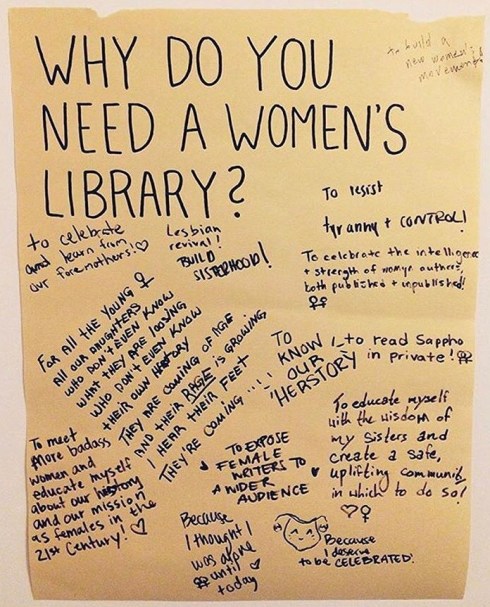
The Vancouver Women’s Library has withstood the siege of entitled males. The need for female only spaces in our society cannot be understated. Women need a place to share their stories and communicate with each other away from male expectations and the male gaze. When I speak with younger women, I despair because they often know nothing about their revolutionary sisters in history, and sadly even less about feminist theory and praxis. This dearth of knowledge and, more importantly, the transfer of knowledge is not a bug in our society, but rather a feature.
Standing on the shoulders of those that came before you, is how any set of ideas progresses and evolves through time. Females are denied this key step in building their awareness and raising their consciousness and must start their discovery of their history and feminism alone and from scratch almost every time (and generation). This process slows the progress of civilization and retards the moral arc that feminism brings to society, and it is a travesty.
I think it should be an obligation of radical feminists to support their local women’s library, and if one doesn’t exist, start one because education and the sharing of values and experiences is what will reignite the feminist revolution that we are in such dire need of.
The latest uproar from the Trumpian led Republican Administration down South:
” -Washington (CNN) President Donald Trump recognized Jerusalem as Israel’s capital on Wednesday and announced plans to relocate the US Embassy there, a move expected to inflame tensions in the region and unsettle the prospects for peace.
“Today, we finally acknowledge the obvious: that Jerusalem is Israel’s capital. This is nothing more or less than a recognition of reality. It is also the right thing to do,” Trump said from the White House’s Diplomatic Reception Room.”
 It is surprising to find nuggets of truth in what comes out of the current American Republican presidency. US policy has always been one of obstructionism toward any sort of reasonable peace between Palestine and Israel. Having this truth out in the open must be somewhat uncomfortable for many Americans and other supporters of the official historical narrative. Noam Chomsky has been reporting on the false “peace process” for decades:
“Many of the world’s problems are so intractable that it’s hard to think of ways even to take steps towards mitigating them. The Israel-Palestine conflict is not one of these. On the contrary, the general outlines of a diplomatic solution have been clear for at least 40 years. Not the end of the road—nothing ever is—but a significant step forward. And the obstacles to a resolution are also quite clear.
The basic outlines were presented here in a resolution brought to the U.N. Security Council in January 1976. It called for a two-state settlement on the internationally recognized border—and now I’m quoting—”with guarantees for the rights of both states to exist in peace and security within secure and recognized borders.” The resolution was brought by the three major Arab states: Egypt, Jordan, Syria—sometimes called the “confrontation states.” Israel refused to attend the session. The resolution was vetoed by the United States. A U.S. veto typically is a double veto: The veto, the resolution is not implemented, and the event is vetoed from history, so you have to look hard to find the record, but it is there. That has set the pattern that has continued since. The most recent U.S. veto was in February 2011—that’s President Obama—when his administration vetoed a resolution calling for implementation of official U.S. policy opposition to expansion of settlements. And it’s worth bearing in mind that expansion of settlements is not really the issue; it’s the settlements, unquestionably illegal, along with the infrastructure projects supporting them.
For a long time, there has been an overwhelming international consensus in support of a settlement along these general lines. The pattern that was set in January 1976 continues to the present. Israel rejects a settlement of these terms and for many years has been devoting extensive resources to ensuring that it will not be implemented, with the unremitting and decisive support of the United States—military, economic, diplomatic and indeed ideological—by establishing how the conflict is viewed and interpreted in the United States and within its broad sphere of influence.”
So really, this latest ham-handed announcement should not be a surprise when viewed in context of the historical precedents on record. So, what we are seeing is really the fruition of guided US policy in Israel regarding the one-state solution that moving the embassy to Jerusalem implies.
“Except in stages, the one-state option is an illusion. It has no international support, and there is no reason why Israel and its US sponsor would accept it, since they have a far preferable option, the one they are now implementing; with impunity, thanks to US power.
The US and Israel call for negotiations without preconditions. Commentary there and elsewhere in the West typically claims that the Palestinians are imposing such preconditions, hampering the “peace process.” In reality, the US-Israel insist upon crucial preconditions. The first is that negotiations must be mediated by the United States, which is not a neutral party but rather a participant in the conflict. It is as if one were to propose that Sunni-Shiite conflicts in Iraq be mediated by Iran. Authentic negotiations would be in the hands of some neutral state with a degree of international respect. The second precondition is that illegal settlement expansion must be allowed to continue, as it has done without a break during the 20 years of the Oslo Accord; predictably, given the terms of the Accord.
In the early years of the occupation the US joined the world in regarding the settlements as illegal, as confirmed by the UN Security Council and the International Court of Justice. Since Reagan, their status has been downgraded to “a barrier to peace.” Obama weakened the designation further, to “not helpful to peace,” with gentle admonitions that are easily dismissed. Obama’s extreme rejectionism did arouse some attention in February 2011, when he vetoed a Security Council resolution supporting official US policy, ending of settlement expansion.
As long as these preconditions remain in force, diplomacy is likely to remain at a standstill. With brief and rare exceptions, that has been true since January 1976, when the US vetoed a Security Council resolution, brought by Egypt, Jordan, and Syria, calling for a two-state settlement on the internationally recognized border, the Green Line, with guarantees for the security of all states within secure and recognized borders. That is essentially the international consensus that is by now universal, with the two usual exceptions – not just on Middle East issues, incidentally. The consensus has been modified to include “minor and mutual adjustments” on the Green Line, to borrow official US wording before it had broken with the rest of the world.”
The reason for this post is that I had to get some context out there as I’m hearing, even on my beloved CBC, about America’s “concern” over the what will become of the “peace process”. It is such a crock of shit. There has not been and nor will there be any sort of “peace process” with US acting as an “honest broker” in the proceedings.
Howard Zinn was an active and vocal opponent of the Vietnam War. He brings insight, like Noam Chomsky, to the issues that our liberal societies won’t acknowledge. The diffusion of Personal responsibility – and no, not the ‘personal responsibility’ (bootstraps!?!!!!) wielded by the corporatist right to bludgeon the poor, but actual personal responsibility is what is being discussed in the quote. It happens all to often when it comes to how we react to the actions taken in our stead by our government.
“I didn’t vote for them,” or “I’m just doing my job…” or <insert excuse here> does not make you any less responsible for the actions committed in your name.
“The fact that there is only an indirect connection between Dow recruiting students and napalm dropped on Vietnamese villages, does not vitiate the moral issue. It is precisely the nature of modern mass murder that it is not visibly direct like individual murder, but takes on a corporate character, where every participant has limited liability. The total effect, however, is a thousand times more pernicious, than that of the individual entrepreneur of violence. If the world is destroyed, it will be a white-collar crime, done in a business-like way, by large numbers of individuals involved in a chain of actions, each one having a touch of innocence.”
-Howard Zinn. On War (second edition). p. 64.











 bleatmop
 Mystro
 The Arbourist


 Dead Wild Roses
Your opinions…