“The most dangerous immediate foreign policy crisis is the conflict with Iran, which has been deemed the official source of all evil. Iran must end its “aggression” and become a “normal country” — like Saudi Arabia, which is making rapid progress in Trump’s fantasy world, even “a great job in Saudi Arabia from the standpoint of women,” he explained at G20.
The charges against Iran resonate through the media echo chamber with little effort to assess the validity of the accusations — which hardly withstand analysis. Whatever one thinks of Iranian international behavior, by the miserable standards of U.S. allies in the region — not to speak of the U.S. itself — it is not much of a competitor in the rogue state derby.
In the real world, the U.S. unilaterally decided to destroy the well-functioning nuclear agreement (JCPOA), with ludicrous charges accepted by virtually no one with the slightest credibility, and to impose extremely harsh sanctions designed to punish the Iranian people and undermine the economy. The [U.S. government] also uses its enormous economic power, including virtual control of the international financial system, to compel others to obey Washington’s dictates. None of this has even minimal legitimacy; the same is true of Cuba and other cases. The world may protest — last November, the UN General Assembly once again condemned the U.S. embargo on Cuba, 189-2 (only the U.S. and Israel voted against the resolution). But in vain. The weird idea of the founders that one might have “decent respect to the opinions of mankind” has long vanished, and the pained bleatings of the world pass in silence. On Iran as well.
This is not the place to pursue the matter, but there is a good deal more to say about the U.S. specialty of resorting to sanctions (with extraterritorial reach) to punish populations — a form of “American exceptionalism” that finds its place within what Nick Turse calls “the American system of suffering” in his harrowing expose of the U.S. assault on the civilian population of South Vietnam. The right to engage in this malicious practice is accepted as normal in the U.S. doctrinal system, with little effort to analyze the actual motives in individual cases, the legitimacy of such policies, or in fact even their legality. Matters of no slight significance.
With regard to Iran, within the government-media doctrinal system, the only question that arises is whether the victim will respond in some way, maybe by “violating” the agreement that the U.S. has demolished, maybe by some other act. And if it does, it obviously will be deemed to deserve brutal punishment.
In commentary made by U.S. officials and media, Iran “violates” agreements. The U.S. merely “withdraws” from them. The stance is reminiscent of a comment by the great anarchist writer and Wobbly activist T-Bone Slim: “Only the poor break laws — the rich evade them.”
In a uncanny sort of way the slow motion failure of the US war effort in Afghanistan is a testament to the fiercely stubborn nature of our species. The US has total control of the air, real-time satellite imagery, and soldiers equipped with the best (and most expensive) military equipment known to our species. And yet, they continue to fail. The war in Afghanistan is almost two decades old now, and an favourable end for the West is unlikely.
The US, despite its world leadership, seems to learn little from it mistakes. Vietnam remains a powerful lesson and reminder that ‘big guns, best tech’ military option is not a guarantee of victory. The cost of resisting the US war machine is appalling, some two million(plus) dead, but Vietnam illustrated it is possible to resist. Afghanistan is on a similar course.
This is what happens when a country decides to wage an unpopular war. A disconnect grows between the citizens of the country and the political class that is waging the war. A professional military bears the causalities with little coverage at home, so the war in question can fade out of the public consciousness. Coupled with a lapdog media that should be exposing the tragedy of errors that is the Afghan war, little is said, and the boondoggle can continue.
Alfred McCoy reviews a small slice of the American failure in Afghanistan, focusing on the drug trade, that happens to fuel the Taliban and provide roughly 85% of the world’s heroin. You’d think the biggest guns and the brightest minds could plot victory over a dirt poor nation and peasant farmers…
“Not only did this problematic drug war fail to curtail the traffic, but it also alienated the rural residents the government so desperately needed to win over. Worse yet, in the end it actually encouraged illicit opium production — a frequent outcome in Washington’s worldwide drug war that I once called “the stimulus of prohibition.”
Using sophisticated satellite imagery, Sopko’s team, for example, found a troubling disconnect between areas that received development aid from Washington or its allies and those that were subjected to opium eradication programs. In strategic Helmand and Nangarhar provinces, for instance, satellite photographs clearly reveal that the various drug eradication projects ripped through remote areas where “the population was highly dependent on opium poppy for its livelihoods,” rendering poor farmers destitute. The development aid was, however, lavished on more accessible, largely drug-free districts near major cities elsewhere in Afghanistan, leaving countless thousands of farmers in critical rural areas angry at the government and susceptible to Taliban recruitment.
Even liberal development alternatives to those rip-up-the-poppies programs, claims Sopko, only served to stimulate opium production in surprising ways. The U.S. Agency for International Development (USAID), for instance, spent $36 million on irrigation for a showcase Food Zone project, meant to promote the growing of legal crops in southern Kandahar Province. As it happened, though, this important infrastructure program actually turned out to contribute “to rising levels of opium poppy cultivation” — an unintended outcome that could be seen in similar “irrigation projects in provinces like Nangarhar, Badakhshan, and Kunar.”
Next door to Kandahar in central Helmand Province, another Food Zone program initially helped reduce the opium crop by 60%. But as British agronomist David Mansfield reports, by the spring of 2017 an “unprecedented” proliferation of poppies covered up to 40% of the farmland targeted by that project; guerrillas were back in force; and farmers felt, as one put it, that “the Taliban is better than the government; they don’t ban poppy, they just ask for tax.” By now, of course, given all the years of bungled anti-drug programs, Mansfield concludes that the Kabul government has little hope of wresting “back control of central Helmand.”
USAID programs that emphasized increased wheat production proved similarly counterproductive. “With higher-yielding varieties and improved agricultural technologies,” writes Sopko, “households in the well-irrigated central valleys of rural Afghanistan would be able to meet their family wheat requirements with a smaller part of their land,” allowing “a larger area… to be allocated to [the] high-value… opium poppy.”
An Uncertain Future
Corroborating Sopko’s pessimism, a recent report by Mujib Mashal of the New York Times depicted the worsening Afghan drug situation as the product, in part, of Washington’s failed policies. Fueled by a booming opium harvest, the Taliban has recently expanded from poppy growing into large-scale heroin production with an estimated 500 labs refining the drug inside Afghanistan — part of a strategy aimed at capturing a greater share of the $60 billion generated globally by the country’s drug exports.
Out of the whole opium eradication project, the National Interdiction Unit, an Afghan outfit trained by U.S. Special Forces, is more or less what’s left when it comes to hopes for reducing the traffic in drugs. Yet their nighttime helicopter interdiction raids on mobile, readily reconstructed heroin labs are proving futile and their chief, reports Mashal, was recently sacked for “probably leaking information to hostile forces.” U.S. military commanders now realize that local Taliban bosses, enriched by the heroin boom, have nothing to gain from further peace negotiations, which remain the only way of ending this endless war.
Meanwhile, the whole question of opium eradication has, according to Mashal, gotten surprisingly “little attention in the Trump administration’s new strategy for the Afghan war.” It seems that U.S. counter-narcotics officials have come to accept a new reality “with a sense of helplessness” — that the country now supplies 85% of the world’s heroin and there’s no end to this in sight.
So why has America’s ambitious $9 billion counter-narcotics program fallen into failure again and again? When such illegality corrupts a society as thoroughly as opium has Afghanistan, then drug trafficking comes to distort everything — giving even good programs bad outcomes and undoubtedly twisting Trump’s headstrong plans for victory into certain defeat.
Think of the never-ending war in Afghanistan as Washington’s drug of choice of these last 16 years.”
Most of you don’t know war. I certainly do not know what war is. Nick Turse reports on it, but like reporters, can leave and return to the relative safety of home. But an Libyan citizen nails down what its like in just a few short sentences: “I drive by myself. I don’t know where I’m going and don’t have any place to go. My life has stopped. This is the only way to keep moving, but I’m not going anywhere.”
Crushing. Exhausting. Existential dread and uncertainty in a decidedly untidy package – all part and parcel of what war is.
“One hundred and fifty years after Henry became the first civilian casualty of the Civil War, Libyans began dying in their own civil strife as revolutionaries, backed by U.S. and NATO airpower, ended the 42-year rule of dictator Muammar Gaddafi in 2011. Before the year was out, that war had already cost an estimated 30,000to50,000 lives. And the killing never ended as the country slid into permanent near-failed-state status. The current conflict, raging on Tripoli’s doorstep since April, has left more than 4,700 people dead or wounded, including at least 176 confirmed civilian casualties (which experts believe to be lower than the actual figure). All told, according to the United Nations, around 1.5 million people — roughly 24% of the country’s population — have been affected by the almost three-month-old conflict.
“Heavy shelling and airstrikes have become all too common since early April,” said Danielle Hannon-Burt, head of the International Committee of the Red Cross’s office in Tripoli. “Fierce fighting in parts of Tripoli includes direct or indiscriminate attacks against civilians and their property. It also includes attacks against key electricity, water, and medical infrastructure essential for the survival of the civilian population, potentially putting hundreds of thousands of people at risk.”
In this century, it’s a story that has occurred repeatedly, each time with its own individual horrors, as the American war on terror spread from Afghanistan to Iraq and then on to other countries; as Russia fought in Georgia, Ukraine, and elsewhere; as bloodlettings have bloomed from the Democratic Republic of Congo to South Sudan, from Myanmar to Kashmir. War watchers like me and like those reporters atop the Caravelle decades ago are, of course, the lucky ones. We can sit on the rooftops of hotels and listen to the low rumble of homes being chewed up by artillery. We can make targeted runs into no-go zones to glimpse the destruction. We can visit schools transformed into shelters. We can speak to real estate agents who have morphed into war victims. Some of us, like Hedrick Smith, Michael Herr, or me, will then write about it — often from a safe distance and with the knowledge that, unlike Salah Isaid and most other civilian victims of such wars, we can always find an even safer place.
War has an all-consuming quality to it, which is at least part of what can make it so addictive for those blessed with the ability to escape it and so devastating to those trapped in it. A month of war had clearly worn Isaid down. He was slowly being crushed by it.
In the middle of our conversation, he pulled me aside and whispered so his boys couldn’t hear him, “When I go to bed at night, all I can think is ‘What is going on? What does war have to do with me?’” He shook his head disbelievingly. Some days, he told me, he gets into his car and weaves his way through the traffic on the side of the capital untouched by shelling but increasingly affected by the war. “I drive by myself. I don’t know where I’m going and don’t have any place to go. My life has stopped. This is the only way to keep moving, but I’m not going anywhere.”
I kept moving and left, of course. Isaid and his family remain in Tripoli — homeless, their lives upended, their futures uncertain — pinned under the heavy weight of war. “
“Thousands of socialists and leftists were marched into stadiums in Chile in the 1970s and gunned down, tortured, or disappeared in a country with a much smaller military than the US. Between 1965 and 1966, at least a million communists, or those believed to be communists, were hunted down and brutally murdered in Indonesia by rightwing death squads and the police. And millions of Jews, Roma, communists, homosexuals and the disabled were persecuted, rounded up and sent to concentration camps in the 1930s and 40s in Germany and Nazi occupied countries, where most perished at a time when many ordinary people thought “the logistics” of doing something like that were too “enormous” to fathomed, much less carried out. And each atrocity was preceded by the rise of a pernicious fascism and the language of dehumanization by leaders.
The notion that atrocity “can’t happen here” is soundly refuted by the fact that it has happened here. And countless times. The US, a nation founded upon organized ethnic cleansing and genocide of the native population, and the brutal enslavement of millions of Africans, has also been home to more recent mass atrocities. Thousands of black and brown men and some women were lynched over the early part of the 20th century. Events organized and sanctioned by authorities, police and politicians, where popcorn, postcards and body parts were sold as souvenirs to the ghoulish onlookers. Thousands of Japanese Americans were rounded up and put in internment camps in the desert during WW2 for the sake of “national security.”
The US has many a precedent to follow with regards to mass detainment and slaughter.
And even a short historical account of the American ruling establishment and its institutions reveals that it has the capacity to participate and administer the most heinous crimes against humanity that have ever been conceived. ICE is more than happy to follow his dictates, and establishment Democrats, the so-called “resistance,” have indicated time and time again that they will unite with Republicans in defending the most odious of American policies.
One thing history has proven is that mass atrocity can be committed with few people, with great efficiency at a moment’s notice, little technology, and with shocking approval or the complacence of the majority of ordinary people. But it must first be normalized. To be sure, if a people can tolerate dehumanizing language of entire groups by its leader, and the utterly sadistic policy of ripping children from the arms of their parents and putting them in cages, or pregnant women being shackled to beds, or the torture of non-violent LGBTQ and mentally ill migrants via solitary confinement for days, or militias working in tandem with government agencies to round up unarmed migrants, or a government prosecuting those who provide water and shelter to other human beings in desperate need, it is certainly capable of tolerating, or even applauding, even worse monstrous depravity. And without a doubt, we are only one absurd tweet away from that potential nightmare.
Election time in 2020. War abroad and societal repression on the homefront perfect for reelecting an populist incumbent president.
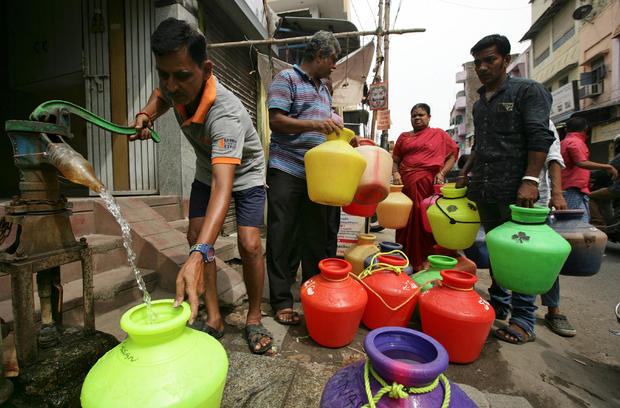
“New Delhi — Millions of people in the South Indian city of Chennai, the country’s sixth largest metropolis, are facing an acute water shortage as the main reservoirs have dried up after a poor monsoon season. Some schools in the city have cut working hours and dozens of hotels and some restaurants have reportedly shut down due to the shortage.
The city of more than 4.5 million has been left to rely on wells and water brought in by truck. Thousands of wells dug across the city are leading to a rapid drop in the ground water level, and raising even further the concerns of environmentalists.
New wells are being dug as deep as 1,000 feet. Much of the water they produce isn’t even fit to drink.”
I cannot even imagine what it would be like not having water on demand in my home. What is happening in India seems quite alien to me, having never been through a drought or even a severe period of water rationing. Living in Canada I have access to what will become one of the most sought after resources in the late 21st century, potable water. Oil and gas are soooooo… 20th century.
I imagine my insular situation is being replicated in segments of Indian society as those who have the political and economic power are not feeling the water stress that the poor in Chennai are experiencing. Given some of human nature, I would not be surprised if certain enterprising individuals were making a profit off of the shortage of water, selling a life sustaining resource to their fellow citizens…
“But the government trucks are only able to meet part of the demand, leaving the rest of the population at the mercy of private vendors, who appear to be making a killing off the crisis. A private truck carrying about 3,200 gallons of water would have cost around 1,500 Rupees (about $22) in April. Now such a delivery is going for about $85.
A man uses a hand-pump to fill up a container with drinking water as others wait in a queue on a street in Chennai, India, June 17, 2019. REUTERS
Reghu Ram, a filmmaker who has lived in the city for eight years, told CBS News the cost of such a private water supply “would mean about 50% of the monthly income of a significant part of the population.”
Ah, my faith in capitalism remains unshaken. God bless (and may they go well) those pioneering water entrepreneurs for helping fulfilling a basic need of Chennai’s citizenry (and procuring an earnest profit of course).
One can expect reckless profiteering and exploitation of the poorest members of society during any crisis. Heady libertarians and advocates for a denuded state take note, this is endgame that you seem to be constantly striving toward. It is neither just, nor humane.
“Water needs to be treated as a highly limited resource,” Vencatesan said. “There is a gap between government policy and the implementation.”
An alarming report last year by the Indian government’s own research institute, NITI Aayog, warned that 21 Indian cities, including New Delhi, Chennai, Bengaluru, and Hyderabad, would run out of groundwater by 2020.
The report also said 40% of India’s 1.34 billion people would have no access to drinking water by 2030. More than 600 million Indians are facing “acute water shortage” already, according to the report.
And there it is folks. First sentence. “There is a gap between [(water conservation/management)] government policy and implementation.” The Indian state has been ineffective in managing the water situation. Lax regulations, corruption, and general malaise from the leadership within have allowed this crisis to boil over.
The simple point is this: Those at the top of the hierarchy are not in jeopardy. The water crisis situation has not been realized for them, and like me in Canada, they cannot really fathom the problem, and thus, even less the solution to the water crisis. Therefore the machinery of state is not being effectively mobilized because those in charge do not feel the dire threat to their existence unlike those of the lower classes of society. This is the disconnect that is being played out the world over, our hierarchies are unresponsive to the latent threats climate change brings. This makes effective, coordinated responses difficult if not impossible to orchestrate.
Hierarchies activate when the threat level becomes serious enough that the perceived social and economic insularity suddenly falls away. The elite’s inevitable “oh shit” moment though comes entirely too late to remedy the situation. Then, of course, people die.
Let’s hope our elites here in North America are watching the situation closely in India, as their crisis will soon be our crisis.
Why would people vote against their own interests? Why do so many people choose not to vote at all? Some of the answers lie with the very structure of the American political system and the ideological rules that are currently being followed.
Noam Chomsky has always said that the US has two business class parties. Ostensibly, they agree on a core of values and only differ on a few social and economic ones, just enough to differentiate themselves (modestly from the other).
” -In the US, there is basically one party – the business party. It has two factions, called Democrats and Republicans, which are somewhat different but carry out variations on the same policies. By and large, I am opposed to those policies. As is most of the population.”
-Noam Chomsky
So, it is a terrible system for most, except for the people in power. Rob Urie explains:
“Tacticians for the political establishment(s) understand that electoral politics is antithetical to democracy, which is why they use strategies of exclusion to maintain their lock on power. This unity through exclusion is what makes the pretense that they— Democrats versus Republicans, are ideological combatants so self-serving and implausible. Either Party could expand the electorate by bringing in unaffiliated and disaffected voters, and in-so-doing dominate American politics. But to do so, they would have to offer a political program that voters want.
The U.S. has a very low electoral turnout rate compared with other so-called democracies. The question then is why Democrats would focus their efforts on luring a small number of suburban Republicans to vote for Democrats rather than on the large number of eligible voters from urban, suburban and rural working class and poor neighborhoods? The answer is class. The oligarchs + the richest 9.9% won’t support policies that benefit poor and working-class voters. They might oppose racism, but not poverty.
One easy way to expand the electorate is to stop excluding it. Old news here— voter suppression is rampant in the U.S. While this is a favorite tactic of Republicans, Democrats have passed up every opportunity to 1) force Republicans to stop doing it and 2) enact universal suffrage. Here’s the rub— even if Democrats accepted 20% voter suppression as a background level, they could still craft policies that support the poor and working class and bring in tens of millions of voters by doing so. But they apparently don’t want ‘those people’ voting.
In 2018 in my poor and working class, 98% Democrat, neighborhood, the Democrats left door tags with two messages: property tax ‘relief’ that has little appeal in a 90%+ renter neighborhood and ‘stopping Trump.’ This neighborhood suffered horribly in the Bush / Obama years from the twin catastrophes of de-industrialization and financialization. De-industrialization took away the jobs and then financialization made housing unaffordable while growing a below living-wage chain-store economy that bankrupted local businesses.”
Breaking out of the two party system is the first requirement for any sort of authentic change not only in American society, but also in Canada as well. The two ‘preferred choices’ both serve a narrow slice of the population while essentially disenfranchising the rest.
If we wish to see real change, we will need to address the systemic electoral obstacles first.
What is ad block? It is an application that, at your discretion blocks out advertising so you can browse the internet for content as opposed to ads. If you do not have it, get it here so you can enjoy my blog without the insidious advertising.












 bleatmop
 Mystro


 Dead Wild Roses
Your opinions…