
You are currently browsing the category archive for the ‘International Affairs’ category.
We have to dispel the notion that the US, UK, and Canada are on always on the side of justice and that we can do no wrong. If this was the case, we would happily welcome the scrutiny of the ICC in our wars and international affairs, as we would (in theory) have nothing to hide. Vijay Prashad writing for Counterpunch disagrees.
Clearly, this is not the case.
“The United States is not a party to the International Criminal Court (ICC). It had helped establish the Court, but then reversed course and refused to allow itself to be under the ICC’s jurisdiction. In 2002, the U.S. Congress passed the American Service-Members’ Protection Act, which allows the U.S. government to “use all means” to protect its troops from the ICC prosecutors. Article 98 of the Rome Statute does not require states to turn over wanted personnel from a third party if these states had signed an immunity agreement with the third party; the U.S. government has therefore encouraged states to sign these “article 98 agreements” to give its troops immunity from prosecution.
The enormity of evidence of war crimes by U.S. troops and U.S.-affiliated troops in Afghanistan and Iraq weighed on the credibility of the ICC. In 2016, after a decade of investigation, the ICC released a report that offered hope to the Afghan people. The ICC said that there is “a reasonable basis” to pursue further investigation of war crimes by various forces inside Afghanistan—such as the Taliban, the Haqqani network, and the United States military forces alongside the Central Intelligence Agency. The next year, the ICC went forward with more detailed acknowledgment of the possibility of war crimes. Pressure on the ICC’s prosecutor mounted.
Pressure on the Court
This is where everything seemed to end. The Trump administration, via John Bolton and Mike Pompeo, made it clear to the ICC that if they pursued a case against the U.S., then the Trump administration would go after the ICC prosecutor and judges personally. An application for a U.S. visa by Fatou Bensouda, the ICC prosecutor, was denied; she had intended to come to the U.S. to appear before the United Nations. This was a shot across the bow of the Court. The U.S. was not going to play nice. Not long thereafter, in April 2019, the ICC said that it would not go ahead with a war crimes case against the United States, or indeed against any of the belligerents in Afghanistan. The Court said it would “not serve the interests of justice” to pursue this investigation.
Trump responded to this decision by calling the ICC “illegitimate” and—at the same time—that the ICC’s judgment was “a victory, not only for these patriots, but for the rule of law.”
Staff at the ICC were dismayed by the ICC’s decision. They were eager to challenge it, fearing that if they let the U.S. mafia tactics prevent their own procedures then the ICC would lose whatever shred of legitimacy remains. As it is, the ICC is seen as being deployed mainly against the enemies of the United States; there have been no serious investigations of any power that is closely aligned with the United States.”
We have one set of rules for the rest of the world and another version that we apply to ourselves. The exceptionalism that is portrayed in our media and repeated by our political classes needs to be dispelled. We should not be above the ICC’s reach, nor should we be impeding the investigations that it undertakes. Yet it is the reality we inhabit.
Most nations will act with a certain level of impunity when it comes to their interests at home and abroad. We in the West need to acknowledge that through our actions, are no better or worse then the countries we seek to censure through the ICC and the war crimes it prosecutes.
Rob Urie takes a good run at explaining some of the problems with the United States polity. The infusion/revolving door of money and politics means that society is being run for the benefit of tiny minority of people. They have two ‘choices’ in the electoral sense, but it does nothing to halt this malformation of democracy and democratic values.
Even with the realization of late that money determines political outcomes, the distribution of income and wealth is considered economics while the use that these are put to in the political arena is considered politics. The unvirtuous circle of capitalism, where concentrated income and wealth are used to affect political outcomes so as to increase concentrated income and wealth, ties economics to politics through the incompatibility of capitalism with democracy.
Modern electoral politics replaces this relationship of economics to politics with color-coded branding— red or blue, where ‘our guy’ is what is good and true about America. The other party exists to pin ‘our guy’ into a corner that prevents him / her from acting on this goodness. Barack Obama was prevented from enacting his ‘true’ progressive agenda by Republican obstructionists. Donald Trump is being persecuted by deep-state, snowflake, socialists.
Left unaddressed and largely unconsidered has been the persistence of class relations. The rich continue to get richer, the rest of us, not so much. For all of the claims of political dysfunction, when it comes to bailouts and tax cuts, wars and weaponry and policing and surveillance, these opposition parties can be counted on to come together to overcome their differences. Likewise, when it comes to the public interest, partisan differences are put forward to explain why nothing is possible.
The unitary direction of this government response in favor of the rich may seem accidental, a byproduct of ‘our system’ of governance. In fact, the defining political ideology of the last half-century has been neoliberalism, defined here as imperialist, state-corporatism, controlled by oligarchs. And contrary to assertions that neoliberalism is a figment of the imagination of the left, its basic tenets were codified in the late 1980s under the term ‘Washington Consensus.’
What the Washington Consensus lays out is the support role that government plays for capitalism. Its tenets are short and highly readable. They provide a blueprint that ties Democratic to Republican political programs since the 1980s. They also tie neoliberalism to the Marxist / Leninist conception of the capitalist state as existing to promote the interests of connected capitalists. Left out, no doubt by accident (not), was / is a theory of class struggle.
When Donald Trump passed tax cuts that disproportionately benefited the rich and corporations, this was the Washington Consensus. When Barack Obama put ‘market mechanisms’ into Obamacare and promoted the TPP (Trans-Pacific Partnership), this was the Washington Consensus. When Bill Clinton tried to privatize Social Security, this was the Washington Consensus. The alleged ‘opposition parties’ have been working together from a single blueprint for governance for four decades.
The intended beneficiary of this unified effort is ‘capitalism,’ conceived as multinational corporations operating with state support to promote a narrowly conceived national interest. An ISDS (Investor-State Dispute Settlement) clause was included in NAFTA when Bill Clinton promoted and signed it. An even more intrusive ISDS clause was included in the TPP when Barack Obama promoted it. The intent of these ISDS clauses is to give the prerogative of governance (sovereign power) to corporations.
It is no secret in Washington and outside of it that multinational corporations pay few, if any, taxes. The logic of this is two sided. On the one side, the neoliberal / Washington Consensus premise is that corporations can put the money to better use than government. The other is that the role of government is to support capitalism, not to constrain it. Barack Obama’s consequence-free bailouts of Wall Street, often at the expense of ordinary citizens, possessed an internal logic when considered through this frame.”
Listening to the news on the way to work this morning the last story was about the smog problem in New Delhi. The amount of particulate matter in the air was something like ten times the recommended levels for good health.
“Part of the problem stems from residents who burn small fires to keep warm when temperatures drop. Combined with crop burning, vehicle exhaust, industrial emissions from coal-fired plants, dust from building sites and smoke from the burning of waste, air quality is frequently unhealthy for residents. The AQI tends to spike when there is a lack of wind to clear out the particulate matter.
“India’s smog problem is due, in part, to the cooler temperatures recently, the lack of big weather systems to move air pollutants around and an ongoing drought across much of the country,” said weather.com meteorologist Jonathan Belles. ”
It looks pretty bad there:

They have been dealing with their smog problem for quite a while. Devising on the ground solutions to the particulate matter difficulties:

But this current bout with pollution has been the attributed primarily to the actions of farmers in the surrounding regions:
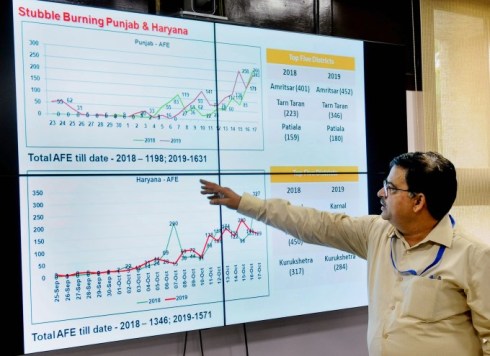
Poor farmers lack the modern tools to clear their fields after harvest. The traditional solution is to burn the stubble to the ground. Hence the annual spike in pollution in the city of New Delhi.
These sorts of problems are calling out for a communal based solution. The people in the city need to help the people in the poorer rural areas acquire the proper technology (tractors) to help them efficiently clear the fields. With the fields not being burnt, the air quality in New Delhi would improve, or at least not be exacerbated by the annual crop stubble clearing.
Wouldn’t be nice if we could get away from the capitalistic neoliberal model and focus on working on the problems that we face together? The world is just too small to continue to ‘f-you, I’ve got mine mentality’.
This of course is anecdotal, but perhaps an concerning insight into the culture that exists for school children for my neighbours to the South. As a school teacher one of touchstones I strive to establish is the idea that the classroom that we are in is a place of safety and comfort. Good things and the good feelings that go along with them happen in class along with, hopefully, some learning.
I find it difficult to relate to the experience described below, as Canada does not have a gun culture like the US, and if this is typical, I hope we never will.


Paul Street pulls few punches as he describes the US Democrats using Sheldon Wolin’s terminology as ‘the inauthentic opposition’. It must be hard for the Democrats to be in opposition to the republicans when you represent the same set of business interests…
“Wolin called it. A nominal Democrat was elected president along with Democratic majorities in both houses of Congress in 2008. What followed under Barack Obama (as under his Democratic presidential predecessor Bill Clinton) was the standard “elite” neoliberal manipulation of campaign populism and identity politics in service to the reigning big-money bankrollers and their global empire. Wall Street’s control of Washington and the related imperial agenda of the Pentagon System were advanced more effectively by the nation’s first Black president than they could have been by stiff and wealthy white Republicans like John McCain or Mitt Romney. The reigning U.S. system of corporate and imperial “inverted totalitarianism” (Wolin) was given a deadly, fake-democratic re-branding. The underlying “drift rightwards” sharpened, fed by a widespread and easily Republican-exploited sense of popular abandonment and betrayal, as the hypocritical and inauthentic dollar Democrats depressed and demobilized their own purported popular base.
Hillary Clinton did nothing to correct that problem in 2016. Quite the opposite. With a colossal campaign finance war-chest fed not just by the usual Wall Street and Silicon Valley suspects but also by many traditionally Republican big money donors who were repelled by Trump’s faux “populism,” the transparently corporate establishmentarian candidate Clinton could barely deign to pretend to be a progressive. She ran almost completely on the argument that Trump was too terrible and unqualified to be president. Making candidate character and qualities her sole selling point was a critical and historic mistake given the angry and anti-establishment mood of the electorate and her own epic unpopularity. So was calling Trump’s flyover county supporters a “basket of” racist and sexist “deplorables” in a sneering comment (one that accurately reflected her aristocratic “progressive”-neoliberal world view) to rich Manhattan campaign donors.
The Democrats would have won the 2016 election and overcome some of their authenticity problem by running Bernie Sanders, “the one guy that didn’t run to Wall Street for money” (Hersh). In something of a tantalizing anomaly for professor Stanley’s rule, Sanders “raise[d] huge sums” but did so from working- and middle-class small-donors (see the remarkable work of Thomas Ferguson and his colleagues on this) and didn’t “represent the interests of…large donors” or “pretend that the bests interests of the multinational corporations” were “also the common interest.” Quite the opposite.
Sanders would have authentically tapped authentic popular anger from the center-left, advancing a policy agenda and anti-plutocratic sentiments consistent with longstanding majority-progressive public opinion in the U.S.
It would have been a winning formula in an anti-establishment election. But so what? The Democratic nomination process was rigged against Sanders for some very good ruling-class reasons. As William Kaufman told Barbara Ehrenreich on Facebook two years ago, “The Democrats aren’t feckless, inept, or stupid, unable to ‘learn’ what it takes to win. They are corrupt. They do not want to win with an authentically progressive program because it would threaten the economic interests of their main corporate donor base… The Democrats know exactly what they’re doing. They have a business model: sub-serving the interests of the corporate elite.”
The reigning corporate Democrats would rather lose to the right, even to a proto-fascistic white nationalist and eco-exterminist right, than lose to the left, even to a mildly progressive social democratic and environmentalist left within their own party.
How else explain their insistence on promoting the ridiculous, right-wing arch-corporatist, imperialist, and dementia-plagued right-wing gaffe machine Joke Biden in the long march to the 2020 Democratic presidential primaries? Again and again, the Democrats’ main cable news networks CNN and MSDNC falsely and insidiously describe Sanders’ highly popular, majority-backed Single Payer health insurance policy plank as an authoritarian big government assault on people’s existing coverage instead of a great democratic human rights demand. The “liberal” media perversely portrays the fiscally viable and existentially necessary Green New Deal as a far-out and dreamy radical scheme from another galaxy. When they’re not just completely ignoring him and his large rallies (probably the main way they undermine Sanders), the corporate media even stoops to painting out Sanders as another version of Trump: old, authoritarian, stubborn, male, and boorish.
But this is timeworn standard operating procedure in the Democratic Party and its allied media, leading agents in what the prolific leading left scholar Henry Giroux calls “neoliberal fascism.” It’s a richly bipartisan disease. In Giroux’s book American Nightmare: Facing the Challenge of Fascism (City Lights, 2018), one sees none of Stanley’s hesitation or reluctance when it comes to forthrightly acknowledging and exposing the central roles of the Democrats and the capitalist order in the creation of the neofascist menace that haunts the United States today.”
Voting is just a small part of the answer. Active, conscious political engagement is the only solution to this political problem. We in Canada share a similar trajectory.
The CBC’s reporting on Hong Kong:
“The anti-government protests present one of the biggest challenges facing Chinese President Xi Jinping since he came to power in 2012. And with the ruling Communist Party preparing to mark the 70th anniversary of the founding of the People’s Republic on Oct 1, the crisis in Hong Kong has come at a sensitive time.
Beijing has struck an increasingly strident tone over the protests, accusing foreign countries including the United States of fomenting unrest.
Scenes of Chinese paramilitary troops training at a stadium in the city of Shenzhen, which borders Hong Kong, gave a clear warning that mainland intervention by force is possible.”
These protests are not going to end well.
China is a world power and has the political and economic clout to do whatever the hell it pleases in Hong Kong.
I foresee an abrupt media black out coinciding with the military going into Hong Kong and reestablishing the correct type of order for the area. It will be bloody and ruthless, but necessary from the government of China’s point of view. Real democracy is a threat to the status quo and is intolerable state of being for the elite classes.
The protesters must be prepared for this eventuality and decide whether they are willing to pay the price in blood for their freedom. There is no other way to purchase liberty.











 bleatmop
 Mystro


 Dead Wild Roses
Your opinions…