
You are currently browsing the category archive for the ‘International Affairs’ category.
High-trust societies are defined by robust interpersonal trust and shared ethical norms, enabling seamless cooperation and social stability. These societies rely on transparent governance, respected legal systems, and an unspoken confidence that individuals and institutions will act with integrity. This trust fuels efficiency—people leave doors unlocked or engage in transactions with minimal suspicion. In contrast, low-trust societies lack this cohesion, marked by skepticism, weak institutions, and reliance on tight-knit groups like family. Corruption and self-preservation dominate, stalling broader societal progress as trust remains scarce outside personal circles.
The 2025 incident involving two Australian Muslim nurses, Sarah Abu Lebdeh and Ahmad Rashad Nadir, at Bankstown Hospital exemplifies a severe breach of trust in a high-trust society. Caught on a viral video threatening to harm or refuse treatment to Israeli patients, their statements shattered the assumption that healthcare professionals prioritize care over prejudice. In Australia, where patients entrust their lives to medical staff without hesitation, this betrayal undermines confidence in a cornerstone institution. The public backlash and swift suspension reflect the shock of such behavior in a system built on mutual reliability.
This breach highlights why high-trust societies must impose strong sanctions. When trust is compromised, the fallout threatens social and economic harmony, as people question the safety of once-reliable systems. The nurses’ actions prompted criminal charges—threatening violence and menacing communication—carrying potential decades-long sentences, alongside professional bans. Such measures deter future violations and reaffirm societal standards. Without them, trust could erode, pushing Australia toward the inefficiencies and wariness of low-trust environments, where institutional faith is perpetually in doubt.
In low-trust societies, such threats might be shrugged off as routine bravado, met with cynicism rather than accountability. But in high-trust contexts, the expectation of integrity amplifies the need for a firm response. The nurses’ remarks, even if hyperbolic, exploit the openness of a trusting system, risking a broader chilling effect if unpunished. Australia’s reaction—legal action, political condemnation, and ongoing investigations—aims to preserve its high-trust framework, signaling that such behavior is anathema to its values.
Ultimately, strong sanctions in high-trust societies like Australia are vital to protect their fragile ecosystem of trust. The 2025 Bankstown incident underscores the stakes: tolerating such breaches could unravel the mutual reliance that distinguishes high-trust from low-trust worlds. By prosecuting the nurses and reinforcing ethical boundaries, Australia defends the trust that underpins its social order. This resolute stance ensures that the benefits of a high-trust society—cooperation, safety, and prosperity—endure against those who would exploit its openness.

The disparity in global outrage between the conflicts in Gaza and Syria is a striking phenomenon that reveals much about media influence, geopolitical dynamics, and public perception. In Gaza, the Israel-Palestinian conflict, particularly since the escalation following Hamas’s attack on October 7, 2023, has garnered immense international attention. Over 46,000 Palestinians have been reported killed by March 2025, according to Gaza health officials, with widespread destruction reducing much of the territory to rubble. This has sparked massive protests worldwide, intense media coverage, and vocal condemnation from various governments and activist groups. The visibility of the conflict is amplified by its historical context, the involvement of Israel—a close Western ally—and the stark imagery of civilian suffering in a densely populated enclave.
In contrast, Syria’s civil war, which has claimed over 600,000 lives and displaced millions since 2011, has faded from the global spotlight despite its staggering toll. The prolonged nature of the conflict, coupled with its complexity involving multiple factions, has led to a sense of fatigue and desensitization among the international community, reducing the urgency and emotional resonance it once held.
Geopolitical interests and alliances further underscore this disparity. Israel’s role in Gaza, supported by significant U.S. military and political backing, places the conflict under a microscope, as it ties into broader narratives of Western imperialism, colonialism, and human rights that resonate deeply with activist movements and progressive audiences. The accessibility of Gaza’s narrative—framed as a David-versus-Goliath struggle—makes it a rallying point for outrage, with real-time accounts from Palestinian journalists and citizens amplifying its reach. Syria, however, lacks a similarly clear-cut antagonist in the eyes of the West. The Assad regime, while brutal, is opposed by a fractured array of rebel groups, some with extremist ties, complicating the moral clarity that drives public mobilization.
Moreover, Syria’s primary allies—Russia and Iran—are already at odds with Western powers, diluting the incentive for sustained Western outrage or intervention. This suggests that the absence of a Jewish or Western state as a central villain in Syria’s case may contribute to the muted response compared to the intense focus on Gaza, where such dynamics align with prevailing ideological currents.
Finally, the scale and speed of devastation also play a critical role in shaping outrage. In Gaza, the death rate has been extraordinarily high in a short period—half of Syria’s decade-long toll in just over a year—concentrated in a population ten times smaller, making the per-capita impact far more immediate and visceral. This intensity, combined with restricted humanitarian access and a blockade, heightens the sense of urgency and helplessness that galvanizes global responses. Syria’s war, by contrast, has unfolded over 14 years, with peaks of violence—like the siege of Homs—spaced out and overshadowed by other global crises, leading to a gradual numbing effect. The recent resurgence of fighting in Syria, such as the rebel offensive in Aleppo in late 2024, briefly rekindled interest, but it lacks the sustained momentum of Gaza’s coverage.
The disparity, then, is not just about numbers but about narrative coherence, media amplification, and the alignment of each conflict with broader political stakes. While both tragedies deserve attention, the uneven outrage reflects a world where emotional resonance and ideological alignment often dictate which crises capture our collective conscience.

My choir is singing this at a late Remembrance Day Concert. I hope to get a recording of us performing, but until then the ASU concert choir does a masterful rendition for this most important of days.
We Remember Them
In the rising of the sun and in its going down,
we remember them.
In the blowing of the wind and in the chill of winter,
we remember them.
In the opening of buds and in the rebirth of spring,
we remember them.
In the blueness of the sky and in the warmth of summer,
we remember them.
In the rustling of leaves and in the beauty of autumn,
we remember them.
In the beginning of the year and when it ends,
we remember them.
When we are weary and in need of strength,
we remember them.
When we are lost and sick at heart,
we remember them.
When we have joys we yearn to share,
we remember them.
So long as we live, they too shall live, for they are now a part of us,
as we remember them.
Amnesty International continues to demonstrate how completely they have lost the plot. Here they are celebrating the removal female rights in Australia:

And when their bullshit gender ideology meets the real world they are forced to say inane things like their statement below.
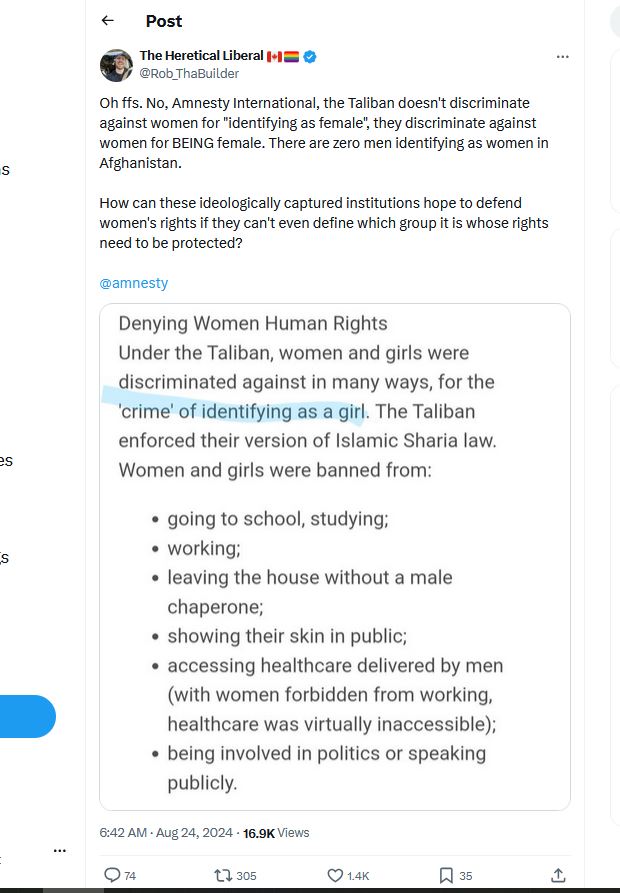
Just say no to gender ideology, you are flirting with becoming estranged from reality.
I look forward to the all the major news organizations issuing retractions for their untruthful reporting.
Trying to find video evidence of this… event was a bit challenging. If the video does not start at 6:24 please navigate to that timestamp to witness a PHd demonstrate her craft in ‘breaking’.
Let’s look at some samples of her “scholarship”.
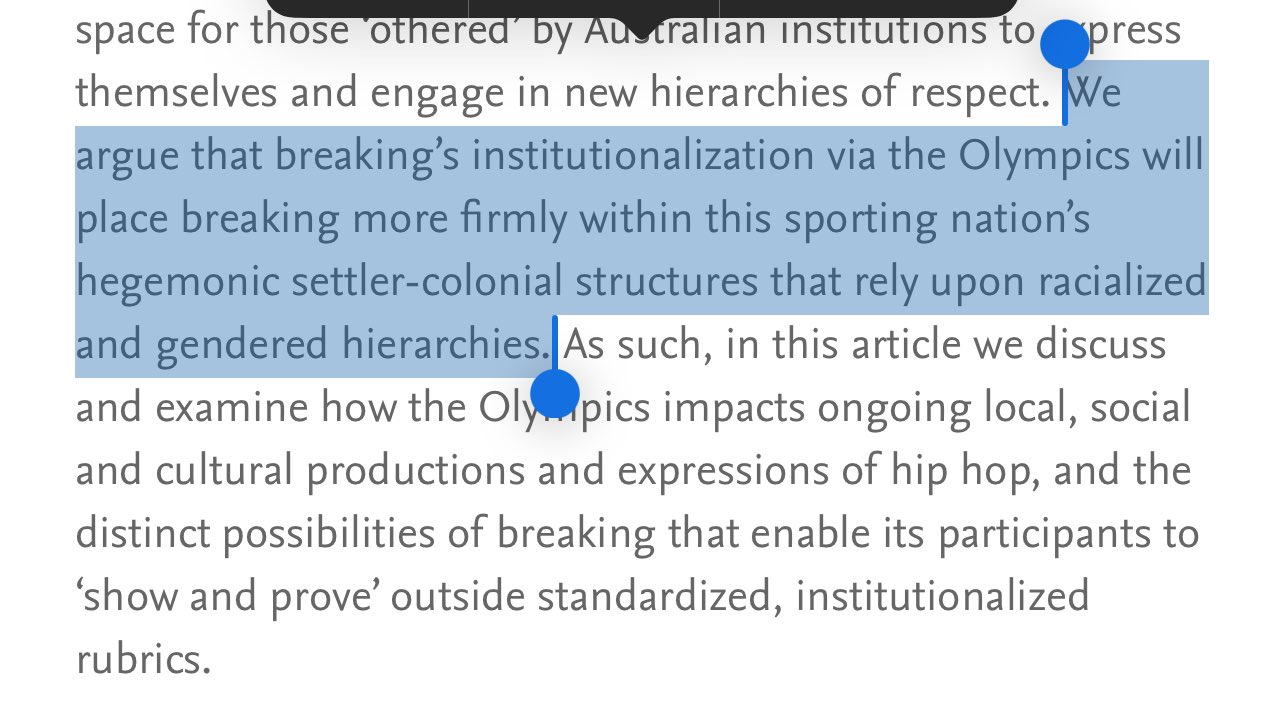
“We argue that breaking’s institutionalization via the Olympics will place breaking more firmly within this sporting nation’s hegemonic settler-colonial structures that rely upon racialized and gendered hierarchies.”
This intentional word salad is endemic across all of the Grievance Study fields – for those not in the know – any course that ends in “Studies” usually qualifies as a Grievance Study. Essentially these are ‘fields’ that have been set up to give employment to ‘scholars’ that otherwise would not be able to find a job anywhere in society.
Thus the only vocation available is one of indoctrinating others into the bullshit and churning out vacuous papers that cite other bullshit papers (citation laundering) in attempt to look like a credible academic subject.
Let’s see what the good Dr.Gunn says on ‘breaking’.
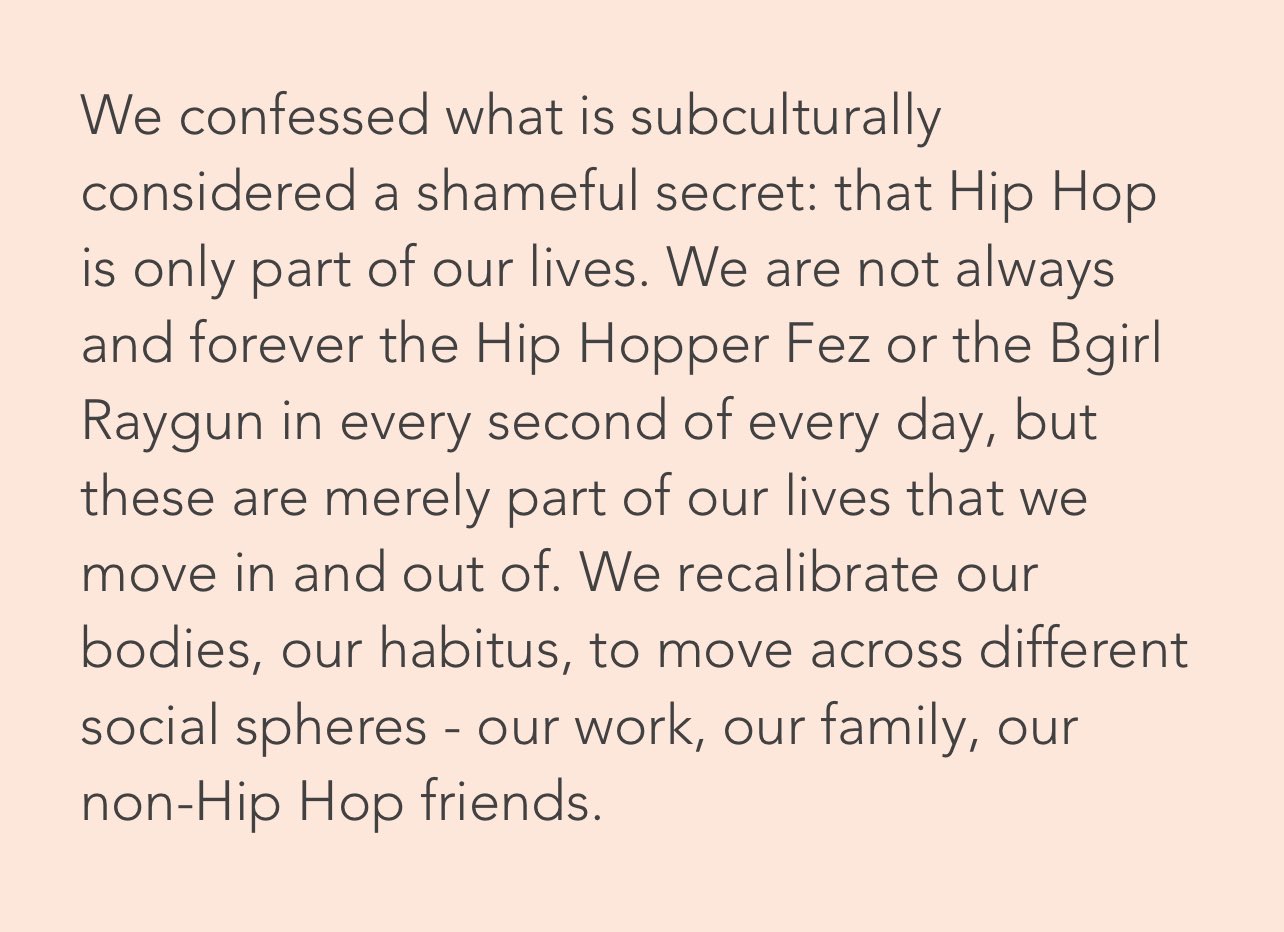
And finally the best for last:
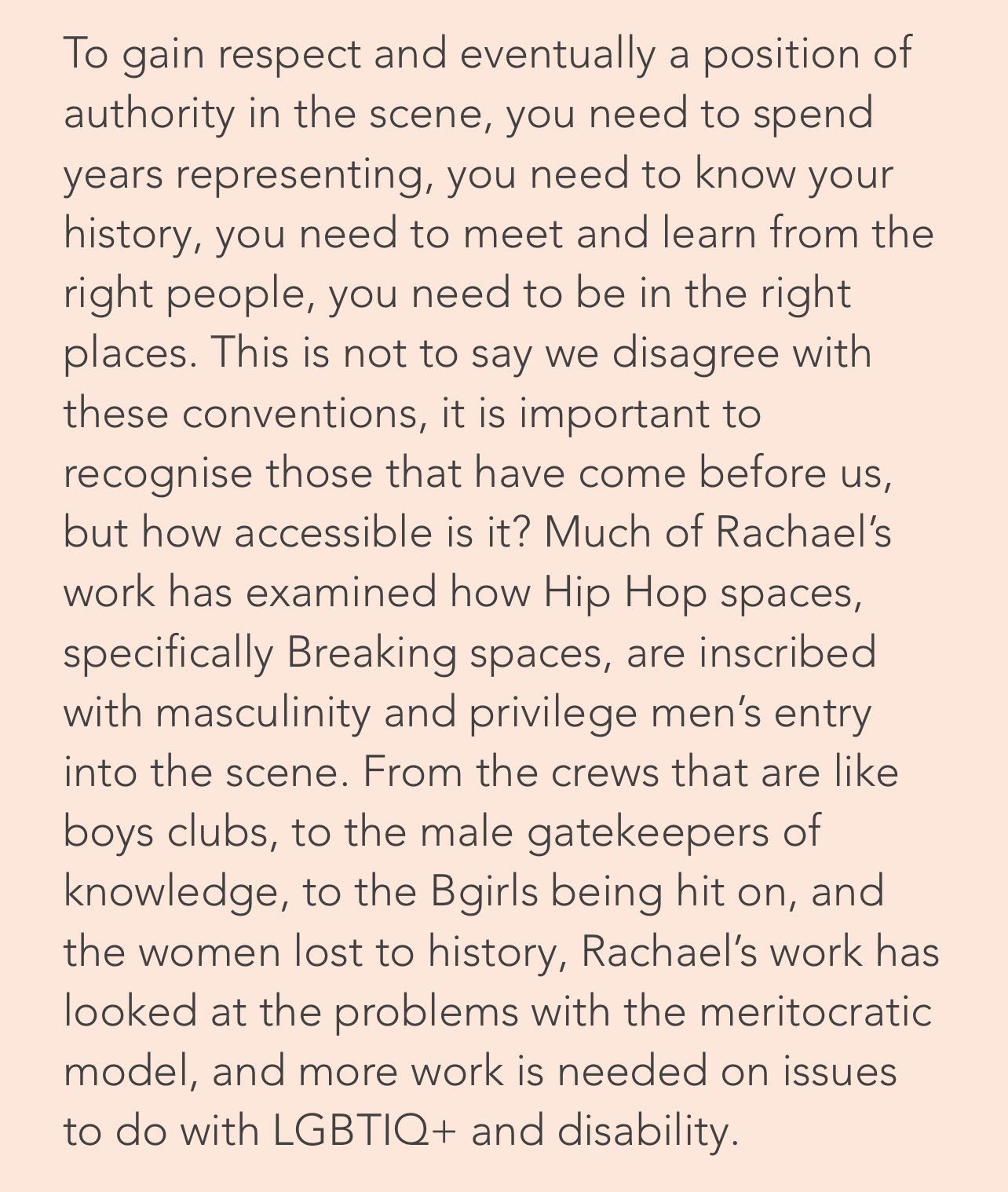
So to put things in perspective – the video of Gunn ‘breaking’ is the prefect illustration of her grasp of the subject, and really her connection to reality.
This is a brutal attack on freedom of speech and expression. The people of the UK need to stand up and stand up quickly before they lose more of their rights and freedoms.

Just the imagine the tangled nightmare of how this is enforced. Who decides what is “hate speech”? What is the metric used? I cannot believe this is actually a thing in 2024.
That couldn’t possible happen in Canada…

Oh dear…











 bleatmop
 Mystro


 Dead Wild Roses
Your opinions…