
You are currently browsing the category archive for the ‘Internet’ category.
 The American public is starved for actual news. The conservative propaganda mill that masquerades as fox news is the premier example of a society that is becoming insular and uncritical of its policy and place in the world. For a country that purports to value the idea of freedom of speech and the marketplace of ideas, the US certainly seems to define Al-Jazzera outside the acceptable limits of discourse for the public.
“The network has been targeted by the US government since 2003, when former vice president Dick Cheney and former defence secretary Donald Rumsfeld described it as tantamount to an arm of al-Qaeda.
Two of its reporters were later killed in Baghdad when US missiles hit its office. Al Jazeera and others voiced suspicions that the channel’s reporters had been deliberately targeted.
And, to this day, Al Jazeera, which, together with BBC News, has become one of the premier global outlets for serious television news, is virtually impossible to find on televisions in the US.
The country’s major cable and satellite companies refuse to carry it – leaving it with US viewers only in Washington, DC and parts of Ohio and Vermont – despite huge public demand.”
Ah, that must be the market making the correct decision about the needs and wants of its consumers. Or perhaps it is the politics that actually drive the market as a opposed to the cherished notion of supply demand.
“The station’s US push could hardly be more necessary – to Americans. By being denied the right to watch Al Jazeera, Americans are being kept in a bubble, sealed off from the images and narratives that inform the rest of the world. Consider the recent scandal surrounding atrocity photos taken by US soldiers in Afghanistan, which are now available on news outlets, including Al Jazeera, around the globe.
In America, there have been brief summaries of the fact that Der Spiegel has run the story. But the images themselves – even redacted to shield the identities of the victims – have not penetrated the US media stream. And the images are so extraordinarily shocking that failing to show them – along with graphic images of the bombardment of children in Gaza, say, or exit interviews with survivors of Guantanamo – keeps Americans from understanding events that may be as traumatic to others as the trauma of the terrorist attacks of September 11, 2001.”
Not surprising, as the forces of the status-quo do not need inflammatory images stirring up the population. Seeing the actual face of American foreign policy and what it is responsible for might waken the good altruism in the American people and have them demand a stop to the atrocities committed in their name.
“For example, the leading US media outlets, including the New York Times, have not seen fit to mention that one of the photos shows a US soldier holding the head of a dead Afghan civilian as though it were a hunting trophy.
So, for America’s sake, I hope that Al Jazeera penetrates the US media market. Unless Americans see the images and narratives that shape how others see us, the US will not be able to overcome its reputation as the world’s half-blind bully.
Indeed, Egyptians are in some ways now better informed than Americans (and, as Thomas Jefferson often repeated, liberty is not possible without an informed citizenry). Egypt has 30 newspapers and more than 200 television channels.
America’s newspapers are dying, foreign news coverage has been cut to three or four minutes, at most, at the end of one or two evening newscasts, and most of its TV channels are taken up with reality shows.”
The people of America are good decent people, but are purposefully being kept in the dark about what their role in the world is and how their corporations and government are acting internationally.
“Americans have a hunger for international news; it is a myth that we can’t be bothered with the outside world. Maybe Americans will rise up and threaten to boycott their cable and satellite providers unless we get our Al Jazeera – and other carriers of international news.
We would then come one step closer to being part of the larger world – a world that, otherwise, will eventually simply leave us behind.”
To my erudite and gentle readers, I wish you all a wonderful and prosperous New Year. We made it, Hallelujah!
 This could be a small win for corporate greed, but somehow I think the internet is a little to big for their money grubbing to contain.
“The men linked to the Pirate Bay file-sharing site were defiant on Friday after a Swedish court found them guilty of breaking the country’s copyright law.
The Stockholm district court sentenced Gottfrid Svartholm Warg, Peter Sunde, Fredrik Neij and Carl Lundstrom to one year each in prison for “assisting making available copyrighted content.”
They were also ordered to pay damages of 30 million kronor ($4.3 million Cdn) to a number of entertainment companies, including Warner Bros., Sony Music Entertainment, EMI and Columbia Pictures.”
An appeal is already in the works so the founders are not currently in jail or responsible for paying some silly amount of money.
“But the group said any verdict would be appealed, and the website home page carried a message equally defiant:
“As in all good movies, the heroes lose in the beginning but have an epic victory in the end anyhow,” said a message posted to the site. “That’s the only thing Hollywood ever taught us.”
Peter Sunde, one of the four founders of the site, said in a video posted Friday the court’s ruling was “bizarre.” “It’s so bizarre we just have to laugh about it, it’s unreal,” he said. As for the damages awarded, Sunde said the number was meaningless. “They could have gotten one billion,” he said. “We can’t pay and we won’t pay.”
Predictably, hollywood is crowing about their victory.
“This is an important decision for rights-holders, underlining their right to have their creative works protected against illegal exploitation and to be fairly rewarded for their endeavours,” Glickman said in a statement.”
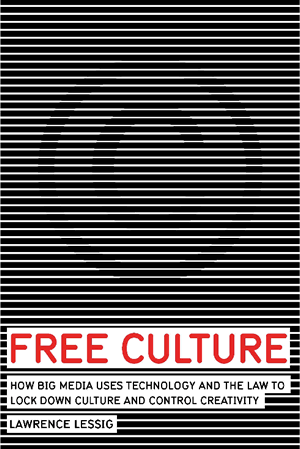
Creative protection. What a load of hoo-haa. They really mean is that they want access to an unending stream of royalties from these so called protected works. See Lawrence Lessig’s work on how they have gamed the copyright system to work for them in their favour.
Stay tuned, this case is far from over.
Facebook is rife with privacy concerns and data leaks. What is being introduced on September 15th is called Diaspora and will mimic what facebook does, without (apparently) shredding your privacy.
 “Developers of an open-source alternative to Facebook have set a launch date of Sept. 15. Diaspora, developed by four U.S. students, is described as a “privacy-aware, personally controlled” social network.
The project made headlines earlier this year when Facebook was slammed for its complex and confusing privacy settings.”
I’m curious to see how this pans out. Check out their webpage here.
“The developers said they spent the summer “building clear, contextual sharing.”
“That means an intuitive way for users to decide, and not notice deciding, what content goes to their co-workers and what goes to their drinking buddies,” the Diaspora team wrote on its blog.
I might check this out because, in my opinion, too much of this happens on facebook.
 Private enterprise never misses an opportunity to diminish our rights in the pursuit of profit. The CBC reports from the Kingdom of Saud:
“Saudi Arabia and the Canadian makers of the BlackBerry have reached a preliminary deal on granting access to users’ data that will avert a ban on the phone’s messenger service in the kingdom, Saudi officials said Saturday.
The agreement would likely involve placing a BlackBerry server inside the kingdom to allow the government to monitor messages and allay official fears the service could be used for criminal purposes, the telecom regulatory officials said.”
What is all the fuss about? Well apparently, the BlackBerry uses some pretty nifty encryption, making emails and documents send via BB hard for governments easily decode.
“That will guarantee the kingdom’s ability to see communications and data exchanged on BlackBerry handsets, he said. Al-Mohammed said talks were ongoing and declined to provide more details pending an announcement, which he said was expected soon.”
Saudi Arabia often sets the tone for the rest of the Middle East when it comes to issue such as this, now other countries are coming to RIM with similar demands.
“The deal could have wide-ranging implications for several other countries, including India and the United Arab Emirates, which have expressed similar concerns over how RIM handles data.”
Of course, the profit motive handily pushes aside any sort of privacy concern private citizens may have.
“RIM is quite smart. They’re seeing this is a very lucrative market. They don’t want to take themselves out of this market,” he added.”
Woo haa! That is exactly how long it takes for industry to flush your rights down the crapper.
I suppose one should not be too worried, Saudi Arabia make no airs about being democratic or protecting the rights of its citizens. They were going to shut down the BB service if RIM did not do anything to “fix” the privacy problem. So perhaps this is the best compromise that could be worked out for all involved. I imagine there is a tech fix coming to add another layer of encryption so the Saudi business people who use the BB can continue to work with minimal government interference. And so the privacy/public security race continues…
What I find interesting about this story is the conflux of several important issues regarding privacy and how intrusive the state can be with regards to ‘protecting the national interest’. I think we need to come down on the side of the individual’s privacy. The state does not need to know the contents of my personal messages sent over the Internet (they already do for the most part, but for arguments sake).
I agree there are many strong cases to be make for the state’s right to know, for instance tracking down people planting bombs in schools and coordinating via the Internet. The problem is that, people who use the Net for such nefarious activities will not be communicating via the normal means, they will be using their own cryptography or codes to send their messages.
The sweeping measures (see Patriot Act) implemented will not stop half-way smart, dedicated people. I wager they snap up the stupid ones all the time, so we get a measure of protection versus the incompetent. I do not however think the privacy loss the for great majority of us is worth protecting us from the Stupid.
I hope that the Saudi point of view on this issue is not mirrored through out the world, as it would be a detriment to reasonable private communication everywhere.
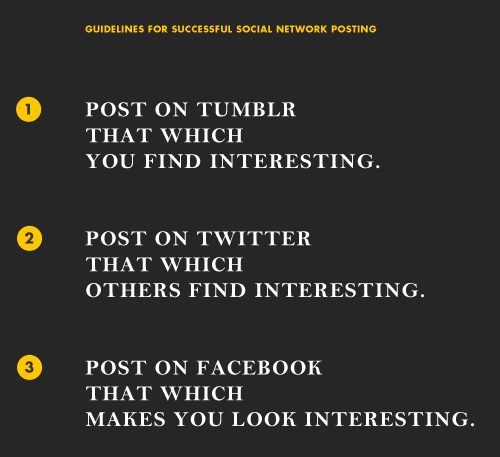 I guess I get to feel old and snarky today. So be it. I just shake my head when I read articles about people who value ‘sharing’ over ‘privacy’ when it comes to net usage. My cynical weasel whiskers get all twitchy when I read about the sheer awesomeness of social networking. I’ll explain why as we look at the article.
“Two-thirds of 895 technology experts and stakeholders surveyed about the future of the internet believe the millennial generation, born mainly in the 1980s and 1990s, will make online sharing a lifelong habit, suggests a Pew Research Center and Elon University study released Friday.”
Oh fantastic! The generation ahead of me feels all entitled and special enough to think that people actually care about what happens in their pathetically small, atomized existences. I would propose the only time people actually notice your ‘meaningful socially networked discourse’ is when you say something stupid or inappropriate.
Facebooking about the puerile experiences of your life and having them remain on the web for roughly forever just does not seem like a wise decision to me. Mistakes are learning opportunities, but exist only on facebook for the amusement of others. On the other hand facebook does serve a somewhat Darwinistic purpose; that of weeding out extra stupid people who get caught for making threats or cyberbullying while on FB or Twitter. I mean really? Posting threats to someone on your own FB page? You may as well begin playing in traffic right now.
“There were voices saying privacy is going to appear quaint, it’s completely changed, maybe privacy doesn’t exist anymore,” said Janna Anderson, an associate professor at Elon University School of Communications who led the study. At least one respondent wrote that publicness is becoming a public good. “And keeping information to yourself is going to be seen as antisocial.… There were a lot of people saying sharing is the new normal.”
“Sharing is the new normal”, indeed! The intense need for self-gratification seems to be winning out on any sort of rational view of this phenomena. Instead of actually doing something worthwhile you get your needs for acceptance filled by the number of facebook ‘friends’ you have?
“Young people enjoy the feeling of being connected and feel sharing benefits their personal lives, Anderson added. “They understand that there are negatives, but they believe that the upside is dominant.”
Young people are also stupid. They lack the experience and discipline needed to make rational decisions about relatively simple life decisions, nevermind the complexities of social sharing on the Internet.
Have the techno-youth really considered why it is so darn easy to get up and running in the various social networking sites? Why is that? Social networking is the advertisers wet dream. You have peoples private information and various applications and ‘fun surveys’ that collect information about an individuals likes and dislikes. By social networking you are essentially doing the leg work for advertisers as you data-mine yourself for free, plus you have no control over who gets to see your information once its out there. In Canada this has been addressed to a limited extent by the Privacy Commissioner, but I guarantee that the practice is still rampant. How else do you pay for the servers and the bandwidth to keep the FB servers operational?
“Many of those surveyed said new social norms are emerging that reward disclosure among young people, said Lee Rainie, director of the Internet & American Life Project, in a statement.
“Some experts also expressed hope that society will be more forgiving of those whose youthful mistakes are on display in social media such as Facebook picture albums or YouTube videos,” he added.”
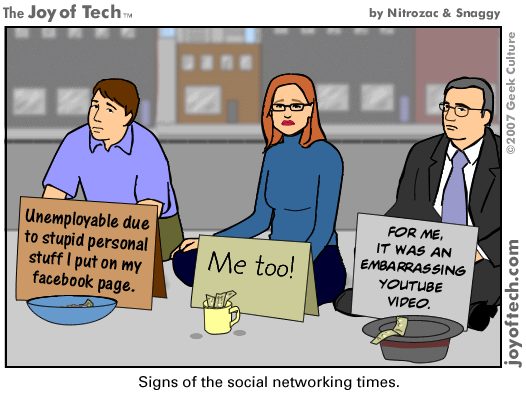 Is that not a nice hope? ‘Society will be more forgiving of youthful mistakes…’. That is certainly not the case if you wish to run for public office. So naive experts whinge for a more naive society. Perfect. Anything (anything) you put on the web is fair game. Assume your scribblings will be used against you in the worst possible light devoid of context, to smear and sully your reputation or job application or whatever as IPIP (important people in power) will google you to see if you have indeed made an asshat of yourself on the Internet.
 When I first started Blogging I was all about the hits and stats and ooooh, who is reading me now? About a year into this blogventure I still like looking at the stats and what not, but I wonder why I continue to put my thoughts and analysis out on the Internet for others to partake in?
What do I offer than cannot be found elsewhere (and more finely polished I might add)? What is the function of this blog vis a vis my actual life? Both to a certain extent are unrelated, necessarily so as I am employed in a profession in which one must mind their p’s and q’s when it come to making public statements about topics. The relative anonymity I enjoy here at DWR allows me to express my opinion on a myriad of topics without having to filter for the normative influences and expectations of my career.
It is interesting to take a step back everyone once and awhile and examine the meta-data that surround the assumptions we make and why we do things.
The Arbourist.











 bleatmop
 Mystro


 Dead Wild Roses

Your opinions…