
You are currently browsing the category archive for the ‘Media’ category.
 Modern Journalism sucks.
The idea that the there are plucky reporters casting a critical eye toward the power structures in society is a process that resides firmly outside what is considered the mainstream media. Consider what Journalism could be like by looking at reporter I.F Stone and his practices and attitudes when reporting on political issues.
From an interview on Democracy Now with Amy Goodman.
AMY GOODMAN: And the issue, what many will call a false dichotomy between advocacy and journalism, his views on this?
D.D. GUTTENPLAN: Well, his views were that you can either be — he said two things that I think are important. He didn’t believe in objective journalism. He said people who talk about objective journalism are basically just trying to make you say the same things that everybody else says to enforce a consensus.
He did say, though, that journalists have a choice to be either consistent or honest, that if you’re worried about what you reported last week and whether what you’re reporting now is consistent with it, you’re going to end up distorting what you say in order to maintain consistency. So he felt you needed to be prepared to be, and allow yourself to be, surprised by facts. And it was Stone’s willingness to be surprised by facts that, in a way, makes him such a good read.
But he certainly believed in and was part of a tradition that is much older than the tradition of objective journalism, and that’s the muckraking tradition, the tradition that if you tell people the truth, then they’ll be able to take action.
 This excerpt is from an article on Counterpunch titled “Treason”. It is on the rhetorical side and my eyes did roll when I saw that the author’s upcoming book to be released was called ‘Zen Economics’. But I liked this paragraph enough in his essay to share it with you my faithful readership because it succinctly illustrates the sad state that most of journalism is in.
“Likewise, there appears eternal mystery on the part of the compassionate right—liberals and progressives, why the corporate media are tools of corporate leaders and their servants in government. It is no accident Andrew Ross Sorkin, Jeffrey Toobin and David Gregory use the royal ‘we’ to conflate their interests as rich, connected, white ‘journalists’ with those of Mr. Obama and Ms. Feinstein. The received wisdom is ‘access’ to elite sources is behind the ‘affectation,’ but it is no affectation. The strategy to ‘universalize’ narrow interests through the use of totalizing language (‘we’) is class politics 101. These ‘journalists’ are responding to disclosure of class ‘secrets’ that threaten their privilege, not to acts against the public interest. (‘Access’ is to report what elites say, not what they do (a/k/a journalism) and these brave folk have a greater chance of dying from choking on Jell-O than from terrorist attacks).”
(ed. bolding mine)
 I’m not much for the Hollywood movie-culture scene. Either I’m getting to old or too smart for the usual smarm of what Hollywood has to offer; and on that note I’d like to think of my self in the later rather than the former category.
Ironic self-delusion aside, pop culture these days rarely entices me with its chintzy glitz and shiny images. Enter Iron Man 3. This is the end chapter for Tony Stark and the current Disney/Marvel money machine. IM3 hastily ties up the plot lines started in the previous movies and attempts to give the viewer a satisfying denouement to the Iron Man story (rest assured dear readership the money-mantle is just changing form, prepare yourself for Avengers “9” and Thor Infinity).
Iron man 3 is a mediocre flick, it had all the prerequisite action and ‘witty-dialogue’, but as a final chapter those are now baseline expectations, and thus I expected more.
I suggest looking at rotten tomatoes or metacritic for an actual review of Iron Man 3 because it is not really my intent to review the movie so to speak, but rather set up a preamble to some inane meta-thoughts spawned by the viewing of said movie.
Meta-Thought #1 – How long is the superhero fad going to last? Marvel and DC are currently churning out flick after flick about super powered characters and the woes that they face, but the saturation point must soon be coming. There are only so many times we can genuine feel someone with fledgling superpowers/super-situation rediscover their humanity and victoriously battle evil to save the girl/earth/multi-verse.
 Why do I tire of this? Because humanity isn’t that fucking special. Human dignity and worth are crushed as a matter of routine and a large majority of people who are not the ones with Orwell’s perpetual boot stamping on their face do not know or do not care to know about it. We stand atomized in our societies and hem and haw about the injustice going on, while those without the burden of conscience continue to perfect the system that allows for the savage exploitation of so many.
We have ‘super-problems’ in the present on a scale that individuals cannot fix. Yet, we are fed a stream of movies that exemplify individual action and ‘sacrifice’ that always somehow manages to resolve the problems and win the day. I think that the glut of hero movies being promulgated as Triple A entertainment of late represent the subconscious desires of people who feel fundamentally powerless to escape that crushing reality and identify with a idea/role that gives them some feeling of autonomy and power.
Meta-Thought #1A – A meta thought on a meta thought (Groovy!). Gee-Wilikers! How far can the Arbourist go on this thought-wanking experiment? Don’t worry gentle readership it will be all over soon, my interest and angst are waning as writing stuff like this depresses the heck out of me. But, back on topic, (let’s, like good academic writers, paraphrase the last sentence to establish a sense of coherency ((another level of meta! Holy Frak!))) the idea that somehow an individual can rid themselves of the sense of powerlessness through exclusively embracing individual action is at its very foundation misleading. Misleading in the sense that, back here in the real world, it is going to take to change things is mass-coordinated, cooperative action to change what is wrong with our societies.
The great man (and I do use “great man” because it is part of the trope, women-folk with their “feelings” just don’t cut it) that is going to change society for the better does not exist. Great men wannabees are identified and either destroyed or co-opted to work for the system rather than against it. Herein lies my discontent – the model of change we are being shown simply does not work. Individuals, without organizational support, that go against the system are crushed. It is only through collective action and coordination that change can be affected on the societal level. But we’re never given that set of blueprints to base our narratives on.
Why? Because it might inspire people to get together and actually change the system. And that is why Iron Man 3 is a mediocre movie.
(Wow…concluded just about as well as the movie did…)
 It is important to periodically remind yourself of who the corporate media serves and how that focus bends what is reported and how it is reported into the fantastical shapes we observe today. Critical thinking, news triangulation and a healthy dose of skepticism are all required to make sense of what is actually happening in the world. One of the sources that I have found helpful in my quest for media awareness have been by the folks over at Media Lens – David Edwards and David Cromwell.
“Media Lens focuses on the media in the UK mostly, but the same lessons can be applied to your media consumption. I excerpt from their latest alert and recommend that you subscribe and support these two journalists who have the audacity to authentically practice their trade.
“In the last year, Media Lens has dissected corporate media performance on a host of topics including climate change, Iraq, the death of Hugo Chávez, the case for challenging corporate journalism, Israel and Palestine, WikiLeaks, Syria, Libya, the pharmaceuticals industry, US imperialism, the Leveson inquiry, North Korea, the NHS and Iran. We also publish Cogitations which look at the philosophy and spirituality underpinning our work, issues which are so often ignored and even derided by progressive commentators.
We were asked recently by author and journalist Ian Sinclair to contribute to a roundtable discussion for Peace News on the pros and cons of working with, or in, the ‘mainstream’ media. We first pointed out that we should dispense with the misleading term ‘mainstream’. Why? Because the corporate media is a powerful but mostly extremist fringe that supports the humanly-catastrophic goals of a ruthless, unaccountable elite. This system is not in business to alert humanity to the real risk of climate catastrophe and the need for immediate action to avert disaster. The corporate media has a proven, indeed astonishing, track record of suppressing public awareness on these crucial issues.
For years, left and green activists have argued that we should work with, or within, corporate media to reach a wider public. And for a long time the argument seemed reasonable. But after decades of accelerating planetary devastation and rapidly declining democracy, the argument has weakened to the point of collapse. By a process of carefully-rationed corporate ‘inclusion’, the honesty, vitality and truth of both the greens and the left have been contained, trivialised and stifled.
But while the internet remains relatively open, there is a brief window to break away from the corporate media, to build something honest, radical and publicly accountable. The first step is to build public motivation and momentum for this shift by exposing the corporate media for what it is. Climate crisis is already upon us, with much worse likely to come. The stakes almost literally could not be higher.”
Media Lens is well worth your time and support.
 Ideology can be a horrible thing. It sinks the brain in a rut, spitting out automatic responses with no regard to critical thought or empirical evidence. This results in a huge resistance to progress. “Change? No! We were right before, so your new option must be wrong! Actually consider the facts and implications? Nope, not interested.”
This sad fact is now rearing its ugly head in the arena of children’s sports, specifically, soccer. The Alberta Soccer Association is proposing to stop keeping score and tracking wins for children under 12. They tried to push this through earlier, but met with too much resistance from parents. Now, they are trying once more and I’m worried that they may fail to persuade the parents yet again.
So why is this being pushed and what are the concerns of parents? Before we look at the real answer, let’s check in with some commercial media. I’ll start with the pinnacle of mindless, reactionary, things-were-better-with-polio zealotry, The Sun.
“Will it result in coddled kids, less equipped to handle the pressures of winning and losing? Probably.
Will the lack of a score promote a culture of mediocrity, where some kids don’t bother to try, and where the best young athletes are dragged down to the level of the lowest denominator? Pretty much.”
Wow, all it needs is to suggest that this new no-score system will lead to socialism or nazism and it’s like we have our own Fox News. But surely, this troglodyte spewing out baseless claims is in the minority. Other mass media personalities will be at least moderately responsible about what comes out of their mouths and actually look into the issue before spouting ill-informed tripe, won’t they? Sure won’t.
Over in radio land, The Bear’s Yukon Jack, the station’s ranter for the everyman, made a Yap entitled “Sports are for Winning” where he posited that the reason behind the no score movement was ‘winning isn’t important’, declared it “nonsense”, then suggested that without winning, kids would have no reason to try or succeed. Of course, no justification was presented for any of this. But then, it’s pretty hard to present what doesn’t exist.
So what’s actually going on? It’s bigger than soccer. Some few articles will mention that this no-scoring for young children is starting in other sports as well. It’s bigger than that too. Sports Canada, the body dedicated to developing federal policies for Canadians to participate and excel in sports, is putting out a massive amount of programs and research dedicated to getting Canadians active for life. They are pushing for all sports to use the Long Term Athlete Development Model . Indeed, some sports have already implemented much of the LTAD model with great success. The mass of research, study, work, and data supporting the LTAD model is staggering. And guess what? Not only is keeping score not important at a young age, it’s harmful.
The load of moronic BS myth is that ‘without winning, children won’t be competitive or motivated to do well’.
LTAD recommends the removal of KEEPING score, not the removal of scoring. People who confuse the two are insulting the intelligence of children. Kids know full well when they kick the ball into the net, hit the ball with the bat, or run all the way to the end zone without being stopped, they’ve achieved. They will feel the rush of success, the thrill of triumph, and the burning desire to do it again. All the motivation, encouragement, and fun one could ask of sports, and no one loses.
In the simpler world of children, losing is failure, losing is being a bad player, losing isn’t fun, losing can be the end of the world. The message ‘you’re a loser’ being pounded into a young mind has disastrous consequences.
The first response to this point is usually something like ‘it builds character and perseverance’. No, for most kids that age, it doesn’t. What it builds is a dislike of sports and aversion to activity. “Why be active and be called a loser when I can play video games? At least video games are fun.” A huge part of the obesity problem we currently face is people are not active enough. Hardly surprising when old school “character building” is teaching kids that sports are for the few elite winners, not for fun.
The other response is ‘kids need to learn about losing, or they’ll be ill prepared for it later’. I can’t help but see claims like this as deliberately dense, as they are wrong on a couple of levels. One, learning to have fun playing sports is crucial to seeing what is really important, which will, ultimately, develop a healthy attitude towards losing when the child gets older. Two, ‘losing’ is ubiquitous in today’s society. It’s a part of almost all games, activities, and all kinds of social engagements. Taking losing out of sports won’t suddenly make ‘losing’ a surprise.
Children need to learn to have fun playing sports, or you end up with a huge chunk of the population who have all kinds of health problems associated with low levels of activity. Once the love of sports is built in, not only will you have a much more active population, training for high level competition is much more likely to happen later in life for a lot more people.
I point this out, not because it’s the way I was raised. Not because I identify with a group that feels this way. Because that’s what mountains of research has shown to be effective.
Just as they didn’t poll parents when they brought in child seat regulations, I feel it is inappropriate to decide whether to go ahead with LTAD based on what parents think. The information is available. Being willfully ignorant of it to the detriment of children is neglectful and borderline abusive. It should not be an option. Not to say that the LTAD model is perfect. There is still lots to work out in terms of ideal implementation. And I definitely am not denying the possibility of improvement, but hashing out these details is not the discussion that’s being had.
Society should always want better for their children. Improvement of this kind demands we move beyond the ‘it-was-good-enough-for-me’ mentality. This would be expedited significantly if media personalities would actually do a bit of research, speak honestly, and not automatically resort to the traditonal-bootlicking, comfortzone-pandering, misinformation-spreading, ignorance-enabling clap trap that currently pollutes our culture.
Links:
I’m not sure what it is with a British accent that makes a smack-down so much more viscerally satisfying, but whatever it is; it works. This video dismantles the tomfoolery surrounding the end of the world ballyhoo that was making the rounds in late 2012.
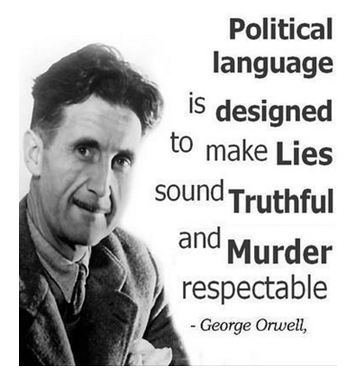 Orwell day was January 21st, and of course, I missed it. Media Lens did not miss the boat and has an article up laced with the sort of irony and breathtaking self-deception that Orwell fought against.
“January 21, ‘Orwell Day’, marked the 63rd anniversary of George Orwell’s death, Steven Poole notes in the Guardian. To commemorate 110 years since Orwell was born (June 25), BBC radio will broadcast a series about his life while Penguin will publish a new edition of his essay, ‘Politics and the English Language’. This essay, Poole comments, is Orwell’s ‘most famous shorter work, and probably the most wildly overrated of any of his writings’.
Why ‘wildly overrated’?
‘Much of it is the kind of nonsense screed against linguistic pet hates that anyone today might compose in a green-text email to the newspapers.’
The essay’s ‘assault on political euphemism’, it seems, ‘is righteous but limited’, while its more general attacks ‘on what he perceives to be bad style are often outright ridiculous, parading a comically arbitrary collection of intolerances’.
This is strong stuff indeed. Was one of Orwell’s most highly-regarded essays really about venting ‘linguistic pet hates’? The answer is in the essay. Orwell noted that the writing he admired was generally provided by ‘some kind of rebel, expressing his private opinions and not a “party line”. Orthodoxy, of whatever colour, seems to demand a lifeless, imitative style’.
As for the mainstream productions of his day – the ‘pamphlets, leading articles, manifestos’:
‘one almost never finds in them a fresh, vivid, homemade turn of speech. When one watches some tired hack on the platform mechanically repeating the familiar phrases — bestial, atrocities, iron heel, bloodstained tyranny, free peoples of the world, stand shoulder to shoulder — one often has a curious feeling that one is not watching a live human being but some kind of dummy: a feeling which suddenly becomes stronger at moments when the light catches the speaker’s spectacles and turns them into blank discs which seem to have no eyes behind them’.
This typically dramatic and disturbing passage makes clear that Orwell was not focusing on ‘linguistic pet hates’. Rather, he was motivated to resist a process of social dehumanisation facilitated by ‘imitative’ and ‘lifeless’ communication, by a toxic ‘orthodoxy’. He underlined his reasoning:
‘I have not here been considering the literary use of language, but merely language as an instrument for expressing and not for concealing or preventing thought.’
If this was a crucial issue in Orwell’s time, it is even more so today.”
[…]
Follow the link and read the rest of the article. If it doesn’t inspire you to triangulate your news reading, I’m not sure what will.











 bleatmop
 Mystro
 The Arbourist


 Dead Wild Roses

Your opinions…