
You are currently browsing the category archive for the ‘Music’ category.
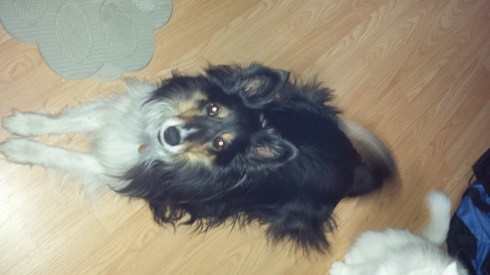
Thank you Shadow, for your years with us. Mahler’s Adagietto says so much more than words ever could. You shall ever be missed, and ever remembered.

EXIF_JPEG_T422


The earliest extant source of the work is an autograph manuscript[2] of the early 1740s, containing 12 fugues and 2 canons. This autograph is typically referred to by its call number of P200 in the Berlin State Library. Three manuscripts for pieces that would appear in the revised edition were bundled with P200 at some point before its acquisition by the library.
The revised version was published in May 1751, slightly less than a year after Bach’s death. In addition to changes in the order, notation, and material of pieces which appeared in the autograph, it contained 2 new fugues, 2 new canons, and 3 pieces of ostensibly spurious inclusion. A second edition was published in 1752, but differed only in its addition of a preface by Friedrich Wilhelm Marpurg.
In spite of its revisions, the printed edition of 1751 contained a number of glaring editorial errors. The majority of these may be attributed to Bach’s relatively sudden death in the midst of publication. Three pieces were included that do not appear to have been part of Bach’s intended order: an unrevised (and thus redundant) version of the second double fugue, Contrapunctus X; a two-keyboard arrangement[3] of the first mirror fugue, Contrapunctus XIII; and a chorale harmonization “Vor deinen Thron tret ich hiermit” (“Herewith I come before Thy Throne”), derived from BWV 668a, and noted in the introduction to the edition as a recompense for the work’s incompleteness, having purportedly been dictated by Bach on his deathbed.
The anomalous character of the published order and the Unfinished Fugue have engendered a wide variety of theories which attempt to restore the work to the state originally intended by Bach.
Structure
The Art of Fugue is based on a single subject:
 which each canon and fugue employs in some variation.
The work divides into seven groups, according to each piece’s prevailing contrapuntal device; in both editions, these groups and their respective components are generally ordered to increase in complexity. In the order in which they occur in the printed edition of 1751 (without the aforementioned works of spurious inclusion), the groups, and their components are as follows.
- Contrapunctus I: 4-voice fugue on principal subject
- Contrapunctus II: 4-voice fugue on principal subject, accompanied by a ‘French’ style dotted rhythm
- Contrapunctus III: 4-voice fugue on principal subject in inversion, employing intense chromaticism
- Contrapunctus IV: 4-voice fugue on principal subject in inversion, employing counter-subjects
Counter-fugues, in which the subject is used simultaneously in regular, inverted, augmented, and diminished forms:
- Contrapunctus V: Has many stretto entries, as do Contrapuncti VI and VII
- Contrapunctus VI, a 4 in Stylo Francese: This adds both forms of the theme in diminution,[4] (halving note lengths), with little rising and descending clusters of semiquavers in one voice answered or punctuated by similar groups in demisemiquavers in another, against sustained notes in the accompanying voices. The dotted rhythm, enhanced by these little rising and descending groups, suggests what is called “French style” in Bach’s day, hence the name Stylo Francese.[5]
- Contrapunctus VII, a 4 per Augmentationem et Diminutionem: Uses augmented (doubling all note lengths) and diminished versions of the main subject and its inversion.
Double and triple fugues, employing two and three subjects respectively:
- Contrapunctus VIII, a 3: Triple fugue, with three subjects, having independent expositions
- Contrapunctus IX, a 4 alla Duodecima: Double fugue, with two subjects occurring dependently, and in invertible counterpoint at the 12th
- Contrapunctus X, a 4 alla Decima: Double fugue, with two subjects occurring dependently, and in invertible counterpoint at the 10th
- Contrapunctus XI, a 4: Triple fugue, employing the three subjects of Contrapunctus VIII in inversion
Mirror fugues, in which a piece is notated once and then with voices and counterpoint completely inverted, without violating contrapuntal rules or musicality:
- Contrapunctus XII, a 4
- Contrapunctus XIII, a 3
Canons, labeled by interval and technique:
- Canon per Augmentationem in Contrario Motu: Canon in which the following voice is both inverted and augmented.
- Canon alla Ottava: Canon in imitation at the octave
- Canon alla Decima in Contrapunto alla Terza: Canon in imitation at the tenth
- Canon alla Duodecima in Contrapunto alla Quinta: Canon in imitation at the twelfth
The Unfinished Fugue:
- Fuga a 3 Soggetti (“Contrapunctus XIV”): 4-voice triple fugue (not completed by Bach, but likely to have become a quadruple fugue: see below), the third subject of which begins with the BACH motif, B♭ – A – C – B♮ (‘H’ in German letter notation).
This is going to be one of my choir’s first body percussion songs. Memorizing is challenging, but adding actions and neat stuff happening on the off-beats…well…its next level stuff. When it gets all together though, it will be amazing. :)











 bleatmop
 Mystro


 Dead Wild Roses
Your opinions…