
You are currently browsing the category archive for the ‘Music’ category.
Not quite baroque, but everyone needs a good thumpy track to dance with once in awhile.
Life is a mystery,
Everyone must stand alone
I hear you call my name
And it feels like home
[Chorus:]
When you call my name it’s like a little prayer
I’m down on my knees, I wanna take you there
In the midnight hour I can feel your power
Just like a prayer you know I’ll take you there
I hear your voice, it’s like an angel sighing
I have no choice, I hear your voice
Feels like flying
I close my eyes, Oh God I think I’m falling
Out of the sky, I close my eyes
Heaven help me
[Chorus x2]
Life is a mystery, everyone must stand alone
I hear you call my name
And it feels like…
[Chorus x2 (with Choir)]
(Just like a prayer, I’ll take you there
It’s like a dream to me)
Just came back from a vacation/choral music workshop. This is one of the round we sang. Simple, haunting, and beautiful.
Appreciate the difficulty of A cappella and maintain a steady tempo and intonation. ( I know I certainly did) :)
——-
Sarah Williams’s poetry is where the text for the round originated.
Williams was born in December 1837[a] in Marylebone, London, to Welsh father Robert Williams (c. 1807–1868) and English mother Louisa Ware (c. 1811–1886).[2][3] She was very close to her father and considered her “bardic” interests to come from him.[4] As a young child unable to pronounce ‘Sarah’, she inadvertently gave herself the nickname ‘Sadie’.[1] An only child, she was educated first by her doting parents and later governesses.[4]
Although Williams was only half Welsh by birth and never lived outside London, she incorporated Welsh phrases and themes in her poems and Sadie was considered a Welsh poet.[5]
Robert Williams died in January 1868 of a sudden illness. Already suffering from cancer and devastated by the loss of her father, Sarah’s condition deteriorated.[4] After three additional months of hiding the cancer from her friend and mother, she agreed to surgery despite knowing it might kill her. She died in Kentish Town, London during surgery on April 25, 1868.[3][6]
Her second book of poetry, Twilight Hours: A Legacy of Verse, was published in late 1868. The collection included “The Old Astronomer” (also known as “The Old Astronomer to His Pupil”, as it was titled in a 1936 U.S. reprint), now the most famous of her poems. The second half of the fourth stanza is widely quoted:
Though my soul may set in darkness, it will rise in perfect light;
I have loved the stars too truly to be fearful of the night.[7]
Ian Rankin titled his Inspector Rebus novel Set in Darkness after the lines and quoted them in the introduction. In an interview, Rankin linked the quote to the rise of a restored Scottish Parliament and the redemption of the Inspector in the novel.[8] The poem is written from the perspective of an aged astronomer on his deathbed bidding his student to continue his humble research. The lines have been chosen by a number of professional and amateur astronomers as their epitaphs.[3][9]
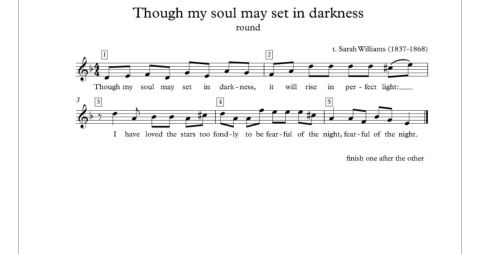
We did it in A minor, but this is the tune.
I’m pretty sure this is not the libretto we want, but the one we deserve. :)
“Straighten Up and Fly Right” is a 1943 song written by Nat King Cole and Irving Mills and performed by The King Cole Trio. The single was the trio’s most popular single reaching number one on the Harlem Hit Parade for ten nonconsecutive weeks. The single also peaked at number nine on the pop charts.[1] “Straighten Up and Fly Right” also reached number one for six nonconsecutive weeks on the Most Played Jukebox Hillbilly Records.[2]
The song was based on a black folk tale that Cole’s father had used as a theme for one of his sermons. In the tale, a buzzard takes different animals for a joy ride. When he gets hungry, he throws them off on a dive and eats them for dinner. A monkey who had observed this trick goes for a ride; he wraps his tail around the buzzard’s neck and gives the buzzard a big surprise by nearly choking him to death.











 bleatmop
 Mystro


 Dead Wild Roses
Your opinions…