
You are currently browsing the category archive for the ‘Music’ category.
Category Archive
The DWR Friday Musical Interlude – Last Leaf
January 27, 2017 in Music | Tags: Ok go, The DWR Friday Musical Interlude, The Last Leaf | by The Arbourist | 4 comments
A toast, to Ok Go for rising to the challenge and leavening no stone upturned while baking up such creative music video. :)
Share this:
The DWR Friday Baroque Interlude – D. Scarlatti: Sonata in E Major, K 380 (L 23)
January 20, 2017 in Music | Tags: D. Scarlatti: Sonata in E Major, K 380 (L 23), The DWR Friday Baroque Interlude | by The Arbourist | Comments closed
Domenico Scarlatti began his compositional career following in the footsteps of his father Alessandro Scarlatti by writing operas, chamber cantatas, and other vocal music, but he is most remembered for his 555 keyboard sonatas, written between approximately 1719 and 1757.
It is believed that Domenico received most of his musical training from family members, but his father was the dominant figure in his life. It was Alessandro who arranged Domenico’s first appointment, as organist and composer for Naples’ Cappella Reale, and wanted him to continue with vocal music despite the enormous talent he had shown for keyboard music. Domenico was sent to Venice in 1705, where he met Handel, and in 1708 to Rome to become maestro di cappella to the exiled queen of Poland, Maria Casimira, and later, head of the Cappella Giulia. In these positions, he composed his operas and serenatas, and some sacred vocal works. It was also in Rome where he developed a friendship with the Portuguese ambassador, the Marquis de Fontes, which eventually led to Scarlatti’s being appointed master of the royal chapel by João V of Portugal in 1719. Scarlatti was also teacher to the royal family, particularly princess Maria Barbara. Scarlatti had already written approximately 50 keyboard pieces before coming to Lisbon, but wrote many more for his students, which also included Carlos de Seixas. When Maria Barbara married Spanish prince Ferdinando, Scarlatti followed her to Spain. His first publication, 30 sonatas called “Essercizi,” was issued in 1738 and sold throughout Europe. Although as King and Queen, Ferdinando and Maria Barbara introduced opera into Spain’s cultural life, Scarlatti did not write any for them. However, he did assist in their private musical soirées, again writing cantatas and working with singers such as Farinelli. Scarlatti also continued to teach, and, in the last six years of his life, concentrated on organizing his sonatas in manuscripts.
Share this:
The DWR Friday Classical Interlude – Mahler’s Titan – Second Movement
January 13, 2017 in Music | Tags: Gustav Mahler, Second Movement, The DWR Friday Classical Interldue, Titan | by The Arbourist | Comments closed
Big, boisterous, and makes you want to dance wherever you happen to be. :)
Share this:
The DWR Friday Baroque Interlude – Bach, Cantata 35, 5. Sinfonia
January 6, 2017 in Music | Tags: Bach, Baroque, Cantata 35, The DWR Friday Baroque Interlude | by The Arbourist | Comments closed
Bach’s Cantata BWV 35, Geist und Seele wird verwirret (Soul and spirit become confused), is one of three alto solo works in Trinity Time of the third annual church cycle of 1726-27 that has an old established and much used text of Georg Christian Lehms. It employs obbligato organ in “conversational galant” manner and has two arias in dance style siciliano and menuet. Its origin and genesis derives from much earlier borrowed instrumental concertos and sonatas in Köthen and Weimar. Questions remain. Just how many of the movements are based on preexisting works? Why does Cantata 35 have two instrumental sinfonias introducing the two parts, performed before and after the sermon (a rare Bach form in Trinity Time)? Was the unfigured organ part for his adolescent first son Emmanuel or for himself? Was Bach motivated to compose so many solo cantatas in the third cycle because he lacked competent resources or was he returning to the Italian style, without biblical dictum and sometimes closing four-part chorales
Share this:
The DWR Friday Baroque Interlude – J.S. Bach: “Nun komm, der Heiden Heiland”, BWV 62 – 1. Chorus “Nun komm, der Heiden
December 30, 2016 in Music | Tags: BWV 62 - 1. Chorus "Nun komm, der Heiden, der Heiden Heiland", J.S. Bach: "Nun komm, The DWR Friday Holiday Baroquq Interlude | by The Arbourist | Comments closed
One of my favourite holiday tunes. :)
The old hymn tune is in four lines, the last one equal to the first.[5] The instrumental ritornello of the opening chorus already quotes this line, first in the continuo, then slightly different in meter in the oboes.[2][6] Other than these quotes, the orchestra plays a free concerto with the oboes introducing a theme, the first violin playing figuration. The ritornello appears shortened three times to separate the lines of the text and in full at the end.[2] The soprano sings the cantus firmus in long notes, while the lower voices prepare each entry in imitation.[6] Alfred Dürr suggests that Bach was inspired to the festive setting in 6/4 time by the entry into Jerusalem.[2] Christoph Wolff stresses that the instrumentation is simple because Advent was a “season of abstinence”.[3] Church music was allowed in Leipzig only on the first Sunday of Advent. John Eliot Gardiner observes about all three extant cantatas for this occasion, also Nun komm, der Heiden Heiland, BWV 61, and Schwingt freudig euch empor, BWV 36, which all deal with Luther’s hymn, that they “display a sense of excitement at the onset of the Advent season. This can be traced back both to qualities inherent in the chorale tune itself, and to the central place Bach gives to Luther’s words.”[4]
Bach wrote the cantata in 1724, his second year as Thomaskantor in Leipzig, for the First Sunday of Advent.[2] The prescribed readings for the Sunday were from the Epistle to the Romans, night is advanced, day will come (Romans 13:11–14), and from the Gospel of Matthew, the Entry into Jerusalem (Matthew 21:1–9). The cantata is based on Martin Luther’s chorale in eight stanzas “Nun komm, der Heiden Heiland“, the number one hymn to begin the Liturgical year in all Lutheran hymnals.[3] The unknown poet kept the first and last stanza, paraphrased stanzas 2 and 3 to an aria, stanzas 4 and 5 to a recitative, the remaining stanzas to an aria and a duet recitative.
Bach first performed the cantata on 3 December 1724,[2] and he performed it again in 1736, adding a part for violone in all movements, after the Thomasschule had bought an instrument at an auction in 1735.[4] Bach’s successor Johann Friedrich Doles performed the cantata after Bach’s death.[3]
Share this:
The DWR Friday Choral Interlude – In The Bleak Midwinter – Gustav Holst
December 23, 2016 in Music | Tags: Holst, In the Bleak Midwinter, The DWR Friday Choral Interlude | by The Arbourist | 4 comments
Sang this tune at the holiday concerts this year. The tenor part is all over the place (the usual), but well worth learning and singing. :)
Share this:
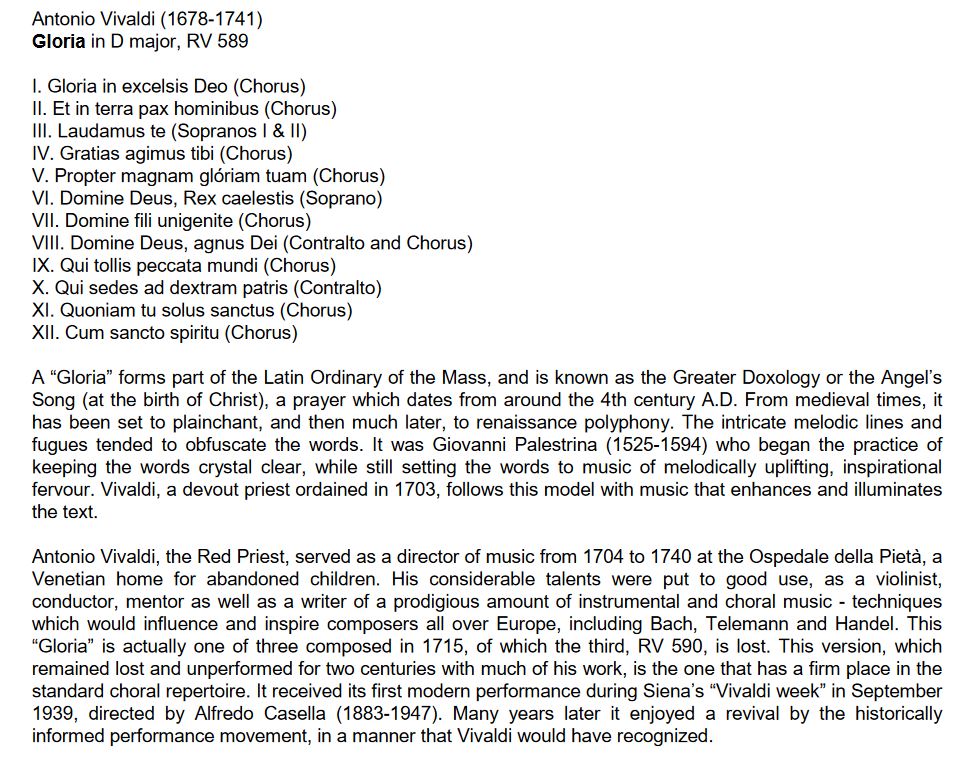
The DWR Friday Christmas-ish Baroque Interlude – A. Vivaldi: RV 589 / Gloria in excelsis Deo in D major
December 16, 2016 in Music | Tags: A. Vivaldi: RV 589 / Gloria in excelsis Deo in D major, The DWR Friday Baroque Interlude, Vivaldi | by The Arbourist | Comments closed











 bleatmop
 Mystro


 Dead Wild Roses
Your opinions…