You are currently browsing the category archive for the ‘Philosophy’ category.
Controversial topics are hard to talk about. What makes the process even more difficult is when one side, for whatever reason, decides that disagreeing with their position is equivalent to you *hating* their position.
The disagreement=hate confab is almost an exclusive feature of attempting to dialogue with someone on the Left of the political spectrum. I hesitate to use the Left/Right distinction though because the terms are not describing the political reality we now inhabit. Perhaps authoritarian vs anti-authoritarian might be a better way to describe positions these days.
Authoritarians whether on the Left or the Right seem to have a built in predisposition to thinking that their choice is the moral choice and that somehow by questioning their assertions you are questioning their morality or ethics.
It really isn’t that, at least not a first. One must grapple with the argument the person makes not the morality or ethics the person in question happens to hold.
An easy example is a person stating the fact that women, exclusively, are adult human females. The simple action of stating a fact can lead to accusations of hatred, discrimination, and even bigotry.
How does that even work? My hypothesis is that when you encounter the disagreement=hate trope the person that you are dealing with isn’t willing to put the thought or effort in to make a reasonable counter-argument. It is much easier to simply dismiss statements and thoughts that do not comport with what you hold to be true than do the work to properly refute them (also the statement in question may be closest to the truth and thus more accurate than your worldview).
Another issue is that your interlocutor may rate highly on the authoritarian scale. Woke ideologies like transgender ideology are totalizing, for them to reach their final stage *everyone* has to believe in the ideology. The utopian magic can’t happen until everyone is ideologically congruent thus wrong-thinkers must be converted or removed from the equation. If you are speaking against gender ideology -for the converted it simply must be “hate” – because the ideologue is convinced that their position is not only factually correct, but morally and ethically correct as well. Thus, the problem lies in you, not them as they have deep insight into the question, that gives them access to the “truth” and speaking against this “truth” must be hateful in nature.
It isn’t.
Being able to interrogate and critique ideas is part of the bedrock of a free society. We need to be able to objectively look at what people say and determine for ourselves the value of their arguments. Doing this now in society can be challenging precisely because questioning the orthodoxy is often misconstrued as “hatred”, thus speech and debate must be kept in check to stop the “hate” if one is to follow the reasoning from those who seek to limit speech in our society.
Limiting speech is such a completely terrible idea and we should really pause and consider the nature of so called progressive movements that advocate for the censure of speech in society.
I’m up to Chapter 3 so far and would highly recommend this book to those who want understand the ‘why & how’ of what is happening in our society. Understanding post-modernism is the first step. This is a short summary gleaned from ‘Goodreads’ is a part of what the book is explaining about Postmodern thought.

“The online Encyclopedia Britannica defines postmodernism as: “a late 20th-century movement characterized by broad scepticism, subjectivism, or relativism; a general suspicion of reason; and an acute sensitivity to the role of ideology in asserting and maintaining political and economic power.” The authors of this book mentions the two principles and four themes of postmodernism thus:
1. The postmodern knowledge principle: Radical skepticism about whether objective knowledge or truth is obtainable and a commitment to cultural constructivism.
2. The postmodern political principle: A belief that society is formed of systems of power and hierarchies, which decide what can be known and how.
The Four Major Themes
1. The blurring of boundaries
2. The power of language
3. Cultural relativism
4. The loss of the individual and the universalNow, to translate this to words of one syllable.
The first principle means that we can never know the objective truth: indeed, it is doubtful whether it exists at all. The second principle means that what is known as the truth is decided by the power hierarchy inside the system.
Thus, in one fell swoop, postmodernism dethroned science from its pedestal – because if we are not sure whether there is objective truth at all, why spend time looking for it? And in the colonial world, most of the objective knowledge was based upon colonial viewpoints; so a deconstruction of this was essential, especially as Orientalism was holding sway in the West.
(However, this doesn’t negate the power of science – but the fallout of postmodernism has engendered dangerously unscientific attitudes.)
Now let’s move on to the themes.
The blurring of boundaries means categorisations are no longer trusted. Not only the boundaries between objective and subjective and between truth and belief have been blurred, but also those between science and the arts, the natural and the artificial, high and low culture, man and other animals, and man and machine, and between different understandings of sexuality and gender as well as health and sickness. Everything is a spectrum.
The power of language emphasises that it is through language that we define power structures in a society. Under postmodernism, many ideas that had previously been regarded as objectively true came to be seen as mere constructions of language. In postmodern thought, language is believed to have enormous power to control society and how we think and thus is inherently dangerous. It is also seen as an unreliable way of producing and transmitting knowledge. To summarise: we create reality through language.
In a world where there is no objective truth, no boundaries, and where everything is created through how we speak and think, truth and knowledge are different for each and every culture and no one from outside that culture can comprehend it. This is called cultural relativism.
Consequently, to postmodern theorists, the notion of the autonomous individual is largely a myth. The individual, like everything else, is a product of powerful discourses and culturally constructed knowledge. Equally, the concept of the universal—whether a biological universal about human nature; or an ethical universal, such as equal rights, freedoms, and opportunities for all individuals regardless of class, race, gender, or sexuality —is, at best, naive. At worst, it is merely another exercise in power-knowledge, an attempt to enforce dominant discourses on everybody. This leads to the loss of the individual and the universal.
I totally get this. It’s a very nice intellectual exercise: and I must say that in the field of arts, literature and sociology, it has got valid uses. The only place I take the high road while postmodernists take the low road is when it comes to the concept of the individual and the universal, which I do believe are required as valid concepts if we need an equitable world. And also, for all our subjective perceptions, science has discovered many objective truths through its powerful method, which are not dependent upon language and/ or culture.
But now, the authors started talking about Theory (with a capital T: applied postmodernism) and the concept of Social Justice; and I started getting a bit alarmed – because I could now make sense of how I was annoying all those woke people.
Arguing with certain people can be very frustrating as they seem to not want to engage with what is being said. Instead, the use of hyperbole, insults, and emotionally charged language are meant to infuriate and obfuscate with the goal of winning the superficially wrought emotional battle (arguing versus agitating). The Activist Left are engaging you with a Dialectical (See the third meaning) approach – they need you to strongly react so as to subsume your argument/position in order to advance the dialectic. Deny them their secret weapon and here’s how.

Fuzzy on what Dialectic is and how it is used? Find out here:
“In short, it’s the fusion of opposites in a way that understands them from a higher-level perspective, which is necessarily synthetic.”
If you want to be a Commie Disruptor, and I mean an effective one we have to break you from falling for Dialectical Traps while making you feel you are still being effective in combating the Woke. So we’re going to have break this down a bit and look at the components.
As previously mentioned the Woke use inflammatory agitation tactics to draw you into their contrived inanity.
Before we break down this aspect you must understand that…
You are being used by the Woke
I mean like used in the humiliating sense. When you engage in inflammatory Woke inanity you are doing EXACTLY what they plan and want you to do.Like lemmings off a bridge…Self Negation.
This usage of you should irritate and anger you, perhaps even more so than their stigmatization. Back to Agitation. This is simple:
Racist, Nazi, Fascist, Bigot, Anti-White, Anti-Christian, Nationalist, Christian Nationalist, White Nationalist, White Supremist, TERF, Transphobe, etcetera and etcetera.
Either you or they are being portrayed as these things right? Something about these terms rile you up, right?
Letting the Left twist and distort language and words that should have good meaning into bad ones or stigmatize us with hacks you off, right?
They shouldn’t be able to do these things!!! We shouldn’t let them do these things!!!
Right?
“You’re damn right in being completely justified in defending yourself and your family and your country against this inflammatory Woke inanity.”
Hmmm…I can’t blame anyone for this disposition, indeed sometimes I even fall for it.
I get it.
But you’re being used. Your justifiable obstinance to ideologically defend yourself is being used against you, to defeat you.
This tactic works on you because…
The Woke aren’t idealistic…they’re Operational.
They Operationally use your values and virtues against you. They Operationally use your railing against their inanity to negate you and undermine your Liberty.
So you’ll often here me an others say “Don’t step into the Wizard’s Circle” or Political Warfare Traps.
Don’t engage their Dialectical Inanity. We tell you to point out their real targets which is to undermine your Liberty and your Natural Rights, and normalcy, and your family, and your faith.
But the inflammatory stigmatization they impose on you is still there. Still inflammatory, sullying your way of life.
Furthermore while their inane beliefs aren’t real the effects of their inanity and prejudice against the “Oppressor” classes (white, male, woman, straight, Christian, normal) is VERY real.It’s not very satisfying at all to let this stand! To let them do this to us! See no one here is saying do nothing. Indeed do MORE but don’t do it THEIR WAY.
Watch.
Leftist Agitator: “All these MAGA people who are upholding White Nationalism are a threat to ‘our Democracy’!”
Now you’re reeeeally gonna want to call this Agitator “anti-white” or rail against the label of “White Nationalism”.And I would tell you “Don’t do it!” “It’s a trap! It’s a Dialectical Wizard’s Circle! You will negate yourself and help pseudo-legitimize their inanity Avoid!”
Then what I would do is point out that what this Agitator is doing is well first Agitating to amplify engagement and second point out what the real target is.Your Liberty.
How so? Again going back to previous threads the intent of the Agitator is to optically make it >look< like there is a “right wing” problem.
Why? So fence sitting, undecided Centrists (Left and Right) will be alarmed at “right wing attacks on Democracy” and vote in someone to “take care of this problem.”
So who exactly would take care of this problem? Neo Communists. Who have no compunction creating laws and policy to undermine your Liberty.
And all it took was for YOU to contribute by engaging in inflammatory Woke inanity.
But I do concede it’s not very…satisfying to only do this, only point out their end game. Even when it’s probably the most effective thing to do.
So let’s try this.
When confronted with inflammatory Woke inanity, tell them.
“We reject and will not tolerate your prejudice against your Contrived ‘privileged classes’ it doesn’t matter how many of you believe in it.”
“We also reject and will not tolerate your attack on our Liberty, Family, Faith and way of Life which is what you really are trying to destroy in the name of ‘Progress’.”
“We also know that this an Agitation tactic”
“You have NO LEGETIMACY”
See there, didn’t mention or amplify “White Nationalism” or “Anti-White” because it will be used against you, yet still addressed exactly the things they are attacking and more. Not just the local prejudice but the Woke’s ACTUAL Target.
YOUR’S AND EVERYONE’S LIBERTY.
Instead you rejected their Contrived prejudice, exposed their real target (Liberty), exposed their tactic (Agitation), and exposed their fake pseudo-real nonsense for what it is, illegitimate. And minimizing your own negation and the erosion of American Liberty in the process.
I know it’s hard. But it CAN be done with satisfying justification.HIT them where it counts.
THEY ABSOLUTELY >HATE< THIS
Do MORE of it!!
DON’T get used
DON’T get Negated
EXPOSE Them
DISRUPT their Operations
FIGHT for Liberty
Final Note: I need to make a CLEAR distinction here
While Woke ideological framework and inanity is not Objectively Real.
Their impact on society is VERY VERY Real and must be unequivocally rejected and fought against
Make sure you tell our anti-woke compatriots you know this.”
One of the curses that progressives that have gone awry (the woke) bring to the table is often the disregard of objective fact. For the faux-progressive sets, the more oppressive factors that you happen to bring to the situation makes your insights somehow more relevant and more important (‘truthier’) than someone who has experienced less oppression. So much of faux-progressive time is spent comparing, ordering, and reordering postures and arguments in accordance with perceived levels of oppression that the actual truth of the matter becomes lost in the internecine conflict that inevitably occurs.
We as a society need to decide that objective truth matters and strive to base our decisions on the version of events/details that most closely coincides with the material reality we all share. In short we need to return to and reaffirm the ideas of the Enlightenment and of the Classical Liberalism that followed.
“Feminist standpoint theorists make three principal claims: (1) Knowledge is socially situated. (2) Marginalized groups are socially situated in ways that make it more possible for them to be aware of things and ask questions than it is for the non-marginalized. (3) Research, particularly that focused on power relations, should begin with the lives of the marginalized. Feminist standpoint theory, then, makes a contribution to epistemology, to methodological debates in the social and natural sciences, to philosophy of science, and to political activism.”
I think part of the problem that we’ve run into with the transgender issue is that a good chunk of feminism has been using a methodology that puts Knowledge in the realm of being socially situated, rather than being a set of objective facts that exist regardless of human consciousness/interference.
“Standpoint epistemology (or standpoint theory) arose within feminist epistemology in the 1970s and 1980s, reaching something of a zenith in its application under the noted feminist theorist Sandra Harding in the late 1980s. (Harding is perhaps most famous for her developments of standpoint theory and her related notion of “strong objectivity,” unless it is for calling Isaac Newton’s Principia Mathematica a “rape manual.”) In short, standpoint theory posits that one’s social position relative to systemic power confers additional insight or access to knowledge(s) that allows the oppressed to understand both oppression and the society or systems it operates within better than the privileged are able to (see also, white ignorance, white innocence, lived experience, and ways of knowing).
Though Harding credits the idea to Marxian thought—not without reason—this concept ultimately seems to arise from Georg W. F. Hegel’s “master-slave dialectic,” which is where Marx likely got similar ideas. The rough concept here is that the “slave” (oppressed, marginalized, or subordinated) class possesses a kind of double understanding of society because the “master” class experiences life as a master in a masters’ world while the “slave” class experiences it as a slave in a masters’ world, thus deriving direct insight about both social positions (see also, double consciousness, kaleidoscopic consciousness, multiple consciousnesses, and master’s tools). Harding, ultimately, believed that one’s standpoint within oppression—i.e., by introducing a known bias to counteract allegedly hidden or invisible biases (see also, implicit bias)—confers better access to objectivity than is possible from a standpoint within dominance.
Under intersectionality, as articulated by the black feminist Patricia Hill Collins (see below), standpoint theory was challenged and ultimately adapted to a new context. Intersectionality, being fully reliant upon postmodern thought (see also, Foucauldian and Matrix of Domination), does not accept that objectivity is possible whatsoever and thus lies at natural odds with feminist standpoint epistemology. This prevents any naive extensions from critical race Theory, black liberationism, and/or black feminism of a standpoint epistemology with regard to other facets of identity (this has been written about extensively by the Theorist José Medina).
Consequently, Collins (and later Medina and many others) adapted standpoint epistemology in a way more consistent with postmodern and intersectional thought, moving away from Harding’s “strong objectivity,” which should give something like the truth about oppression and (eventually) toward Medina’s “kaleidoscopic consciousness,” which offers multiple truths about different forms of oppression. This would represent the same kind of shift that took feminist consciousness raising and made it more about gaining awareness of multiple consciousnesses.
In this new “kaleidoscopic” understanding, one can engage their positionality to identify which “truths” or “knowledges” they can access and be taken as an authority upon. Possessing a racially minoritized identity provides insight into black truths, Asian truths, or Latinx truths, for example, and other identities provide access to additional truths. Where one is privileged, the expectation is roughly that one is to “shut up and listen,” and where one is Theoretically oppressed, one’s views can be considered authoritative, so long as they’re “authentic,” which roughly means in alignment with how Theory describes the experience of oppression for that identity group.
As Harding noted (below), it is not sufficient for one to merely possess the identity group membership to gain the special insight on offer by standpoint epistemology. One must also be politically engaged, which means having adopted the right critical methods and a critical consciousness (or, wokeness). In other words, insight into societal truths is available, by virtue of standpoint theory, to members of minoritized groups who are also critical theorists, but essentially nobody else. Everyone else is trapped in the “masters’ world” and somehow subscribing to the “masters’ view” (see also, internalized dominance; internalized oppression, internalized racism, internalized sexism, internalized misogyny, internalized ableism, internalized transphobia, and false consciousness).
That said, there are also believed (usually within Social Justice perspectives) to be specialized knowledges based in the lived experience of belonging to some identity group (see also, racial knowledge, racial humility, and cultural humility). These aren’t necessarily strictly understood under the umbrella of standpoint epistemology, and unless the invoke positionality or power dynamics as the reason for the specialized insight, they represent a different form of identity-based “knowledges.” This kind of claim to knowledge (especially “cultural knowledge”) is not necessarily something to be skeptical of, as everyday experiences of certain phenomena may tend to be different for people with different physiological features, living in different environments, or belonging to different cultures.
In practice, though it is possible, it is very difficult for this other kind of identity-knowledge claim to refrain from drawing upon standpoint epistemology when utilized by any member of a minoritized group, especially in service of Critical Social Justice, because the lived experience of being such a person will almost definitely bring up what it’s like to be such a person in a society that is allegedly rife with such power dynamics. This is because of the critical orientation of Critical Social Justice, which is by definition interested in these power dynamics and essentially nothing else. Therefore, in practice, these legitimate forms of identity-based knowledge claims often act as a means to slide standpoint epistemology beneath the door, particularly when used in service to a critical perspective.
Of note on this, one will notice that identity-based knowledge based in “whiteness” is a very thoroughly Theorized concept—always problematically. Under the view of Critical Social Justice, there is very much something understood to be white knowledge (or Western, or Eurocentric). It is, in fact, described as an “epistemology of ignorance,” wherein white people, as a result of their privilege, are invested in not-knowing so actively, willfully, perniciously, and (semi)-intentionally as for it to constitute its own kind of false knowledge (see also, white ignorance). Moreover, whiteness itself would constitute, or at least possess, its own kind of knowledge system (see also, episteme) that characterizes “white knowledge” (see also, white mathematics, white science, and white empiricism), which is often held up as a reason why racial minorities and people outside of the West shouldn’t adopt science, reason, civility, or other vestiges of “Western culture,” which are deemed inherently white supremacist and colonialist (among other sins). It’s difficult to discern how this blatant confusion about practical realities is meant to help anyone.
In summary, standpoint epistemology (and related identity-based epistemologies) are a complicated and widely discredited way to create and justify a kind of gnosticism around critical conceptions of identity and the relevant power dynamics in society. In practice, this typically means it is yet another justification within Theory for only people who agree with Theory to be considered knowledgeable authorities, which is then used to silence opposition and install “professionals” in positions of authority and power based on group identity alone—or, almost alone, as such people tend to have to present a critical consciousness, i.e., be woke Critical Social Justice activists, as well (see also, diversity and inclusion).”
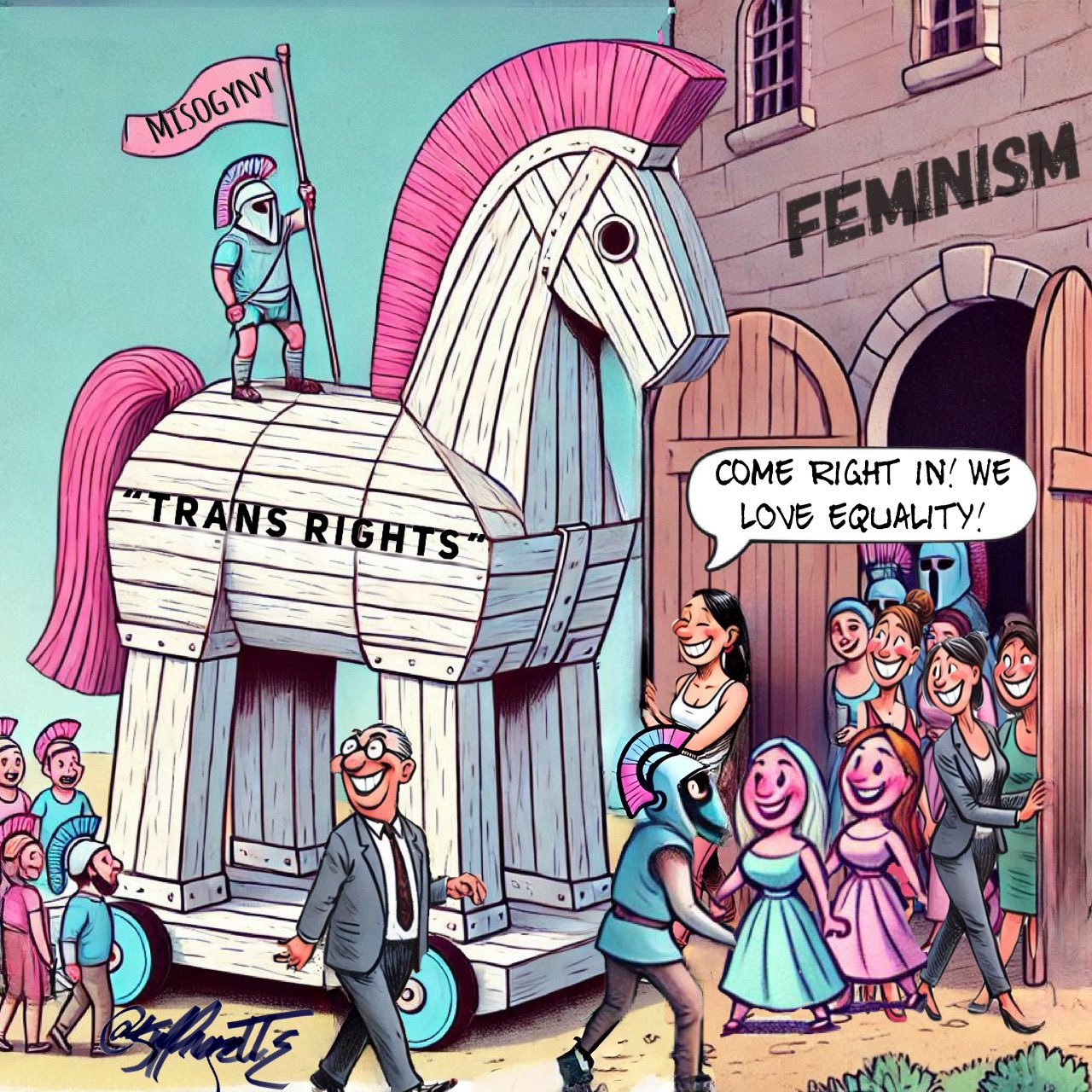
Feminists in bringing this epistemology to bear have also unleashed it upon themselves and their movement as trans identified males now claim they are the most oppressed in society and can – using this method – claim special knowledge and insight into what it means to be a woman and not have their point of view challenged without sever social consequences for the questioner. This is based on social power dynamics as criticizing their uniquely oppressed point of view – which grants them great CLARITY – means that you must be an oppressor and part of problem and thus, your critiques can be dismissed.
Not really a good operating system in a society that values truth and the free expression of ideas.


Your opinions…