He who commits violence first loses moral authority and legitimacy in society. We are entering a period where the provocateurs on both the Left and Right will be doing all they can to make the other side resort to force and violence. We, in our fight to save our culture, must always be sure never to blindly react to the other sides provocations – the target’s reaction is the action – is how Saul Alinsky’s The Rules for Radicals phrases it. We must stop – breathe – and see the contrived decision dilemma we are being maneuvered into.
It’s tough to do in the heat of the moment, but it must be done in order to avoid the reactionary outcomes that ultimately push the other side to victory. Manifestos (that advocate for violence) are part of the path of blind reaction and are almost never justifiable in a peaceable society.
“A manifestor’s engagement with violence, whether it’s aggressive language sharpied onto the body, or the gunning down of children, is a premeditated rhetorical act. It’s what makes the manifesto itself a performance as opposed to a static object: it possesses the power to communicate something of its own and stop an audience in its tracks. An act of violence amplifies the ethos of the writer and the legitimacy of their cause, adding flesh and bone (often literally) to mere words. Without the rhetorical effect of direct violence, the manifesto is just a literary rant.
Manifestos are not your usual five-paragraph essay, or editorial thinkpiece or essayistic article like the one I’m writing at the moment. They’re not even measured, posturing political speeches; as Breanne Fahs notes in ‘Writing with Blood’ (2019), manifestos are ‘wild-eyed calls to arms intended to provoke radical social change, often moving at breakneck speed and invoking the collective “we” as they envision a new world order.’ There is always a dimension of spleen and spite, an ‘us’ vs ‘them’, or ‘it’, or ‘everything’. And it all has to go. Be it up in flames or surgically removed, the manifesto’s target will have a fight on its hands.
Here is the explosive recipe we’re working with as we approach the manifesto’s present-day incarnation:
Demonstrate a burning desire for change.
Identify a clear target of blame.
Remain committed to the intended goal, no matter how extreme the proposed solutions.
Experiment with style and form for the sake of impactful rhetoric, expressivity and wresting attention from the reader.
Promote ideas off the page through direct action.
A contemporary equivalent of the traditional manifesto doesn’t really exist. Did its recipe disappear? Has it been replaced by a new one? Not quite. It’s migrated online, reverted to the shadows, stretched like smooth taffy across the ether to grow less identifiable with each click. The modern manifesto is no longer a singular, blatant document touting a megaphone, but an underground extremist network fronted by professional interests.”
I was a strong proponent of the Harm Reduction strategy until more data has come out about its effectiveness and benefits for society versus other methods. There might be a case for Harm Reduction, but as currently implemented in BC it is a like a 4 legged stool that is missing three legs -harm reduction, law enforcement, prevention and treatment – just focusing on harm reduction and not the other areas is a recipe for social disaster.
The Alberta rehabilitation model has been modestly more successful in dealing with the problems of addictions. Both systems require overlapping programs working together to get people out of the drug abuse loop – whether Alberta has been more successful in coordinating the synergy of anti-addiction programs or that rehabilitation programs are just more effective remains to be seen. Initial data points to the Alberta method being more successful.
The divergent policies and politics of B.C. and Alberta have played a major role in determining the public perception of Canada’s opioid crisis. Left-leaning media outlets have tended to laud B.C.’s harm reduction as being more compassionate, while conservative voices point to Alberta’s focus on treatment as more practical and realistic. What Canada had lacked until recently was an impartial, data-driven assessment of the two competing systems.
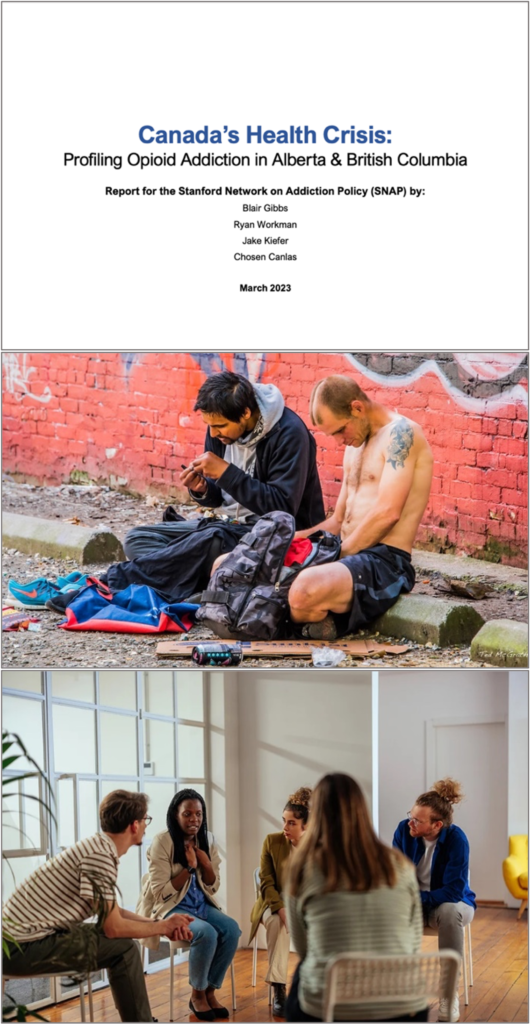
Advantage Alberta: The Stanford Network on Addiction Policy’s 2023 report (depicted above) observes that, “Alberta is currently experiencing a reduction in key addiction-related harms,” while “Canada overall, and BC in particular, is not yet showing the progress that the public and those impacted by drug addiction deserve.” At middle, a typical street scene in Vancouver’s Downtown Eastside; at bottom, a therapy session at Alberta’s new Red Deer Recovery Community. (Sources of photos: (middle) Ted McGrath, licensed under CC BY-NC-SA 2.0 DEED; (bottom) EHN Canada)
That problem was partially solved last year with the release of a report from the U.S.-based Stanford Network on Addiction Policy. Entitled Canada’s Health Crisis: Profiling Opioid Addiction in Alberta & British Columbia, the document offers an even-handed review of the differing policies of the two provinces, summarizes the latest available data (which it criticizes as inadequate) and cautiously evaluates the results. B.C., the report notes, emphasizes harm reduction, “safe supply” of illicit drugs, decriminalization of possession and reduction of addiction stigma. Alberta, by contrast, is focusing on “investment in rehabilitation beds and spaces, such as therapeutic communities,” while moving away from “safe supply” of opioids and instead providing addicts with medications.
Using these differences as a natural experiment, the Stanford report comes to a few key conclusions. First, it observes “a lack of policy innovation in BC on the issue of drug addiction.” Obsessive attention to harm reduction appears to have blinded politicians and public health officials to the longer-term consequences of their favoured policy. “Enforcement against drug crime has [been] reduced in recent years,” the report notes, “indicating a general lessening of criminal justice enforcement against drug offences in Canada during the escalating health crisis of opioid addiction.”
Second, “Of the two provinces studied for this report, Alberta is currently experiencing a reduction in key addiction-related harms.” The province’s rate of overdose deaths declined by 17 percent from 2021 to 2022 (B.C.’s remained almost unchanged), although it was still Alberta’s second-worst year on record. Using the most recent data available, the Stanford researchers point to B.C.’s higher death rate as suggestive of the two approaches’ relative effectiveness: “Our research indicates that Canada overall, and BC in particular, is not yet showing the progress that the public and those impacted by drug addiction deserve.”
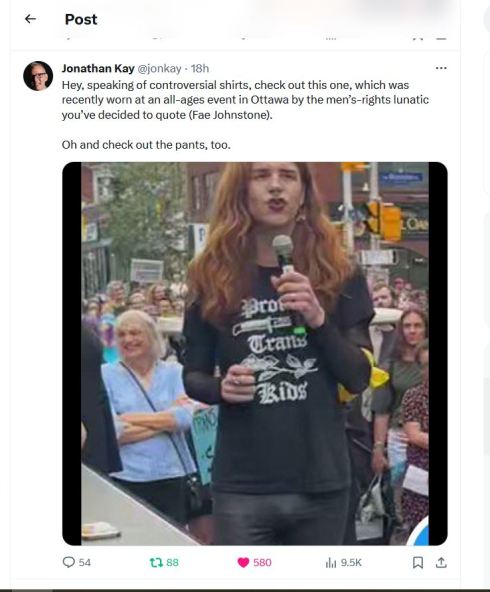
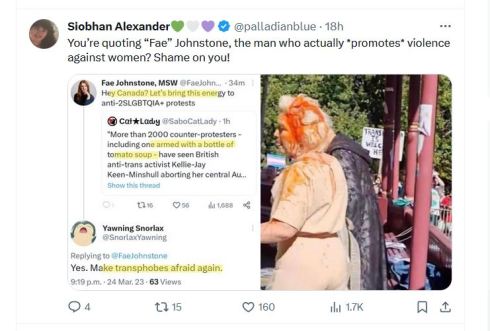
Maybe quoting a male that is rabidly misogynistic for your attack ad isn’t a keen strategy? But of course, throwing Canadian women under the bus is nothing new for this government.
Our federal election cannot come to soon. I sorely need to see the activist Left out of power here in Canada.
This is a frustrating clip to watch. The host is constantly talking over the guest as she tries to respond to the attempted ‘gotcha’ questions being posed.
I think we need to be clear here. There is no need to “Experts” to weigh in on keeping sexually explicit and pornographic material out of public school libraries. We need to keep age appropriate books in public school libraries – and certainly there can and should be discussion about the exact guidelines.
Children do not need to know about dildos, strap-ons, and anal rape. This shouldn’t be a hard issue to comprehend.
What is ad block? It is an application that, at your discretion blocks out advertising so you can browse the internet for content as opposed to ads. If you do not have it, get it here so you can enjoy my blog without the insidious advertising.














 bleatmop
 Mystro


 Dead Wild Roses
Your opinions…