
On February 10, 2026, Tumbler Ridge, B.C. (population ~2,400) was hit with a catastrophe it will carry for decades. RCMP have confirmed eight victims: five students aged 12–13, one education assistant (39), and—before the school attack—the shooter’s mother (39) and 11-year-old half-brother. The perpetrator, 18-year-old Jesse Van Rootselaar, then died by suicide.
Name the dead, because that’s the baseline for honest coverage. Abel Mwansa (12). Ezekiel Schofield (13). Kylie Smith (12). Zoey Benoit (12). Ticaria Lampert (12). Shannda Aviugana-Durand (39). Jennifer Jacobs (39). Emmett Jacobs (11). The family tributes are almost unbearable. Ticaria’s mother called her “my Tiki torch… a blazing light in the darkness.” Kylie’s father pleaded with the world to “hold your kids tight.” This is a tight community. The loss isn’t “eight fatalities.” It’s eight holes in a town where most people can point to the exact place those kids used to stand.
Now the media problem: within days, a noticeable slice of Canadian coverage pivoted to managing the public’s reaction to the shooter’s transgender identification. Global News ran a segment framed around “misinformation about trans people” being fueled by the shooting. The Tyee published an opinion piece warning that suffering “should never be weaponized,” focused less on the dead children than on backlash narratives. Even wire coverage foregrounded the shooter’s identity and used female pronouns while naming victims in the same breath—an editorial decision that tells you what frame is being protected.
Let me be precise about the critique, because this is where defenders hide behind a strawman. Nobody reasonable is arguing that “all trans people are responsible” for anything. The question is simpler: why was the instinct—right after slaughtered children—to warn Canadians about transphobia and “disinformation” rather than interrogate the failure chain that got us here? Reporting has already described a history of serious mental health issues and police encounters connected to the shooter, including firearm-related interactions. What interventions happened? What warnings were missed? How did access to weapons occur? Those are the adult questions. “Don’t be mean online” is not an answer to a mass killing.
This is what ideological capture looks like in practice: a hierarchy of empathy enforced by institutions. The victims are mourned, yes—but the “secondary story” rapidly becomes protecting a narrative category from reputational harm. That is not compassion. It’s brand management, and it trains the public to understand tragedy through approved lenses: some facts are treated as volatile, some questions as taboo, and anyone who notices patterns is pre-emptively suspected of malice.
Tumbler Ridge deserves better than that. Journalism’s first duty in a massacre is not to pre-scold the audience. It is to tell the truth, foreground the human cost, and pursue the causal chain without fear or favour. Start with the dead kids. Keep them at the center. And then do the hard work—because if the press won’t, the vacuum gets filled by cynics, activists, and conspiracy merchants. That isn’t “safety.” It’s surrender.

References
- RCMP victim identifications & family statements: https://www.cbc.ca/news/canada/british-columbia/livestory/active-shooter-alert-tumbler-ridge-secondary-school-bc-live-updates-9.7083740
- CNN victim profiles: https://www.cnn.com/2026/02/13/americas/victims-tumbler-ridge-shooting-intl
- Global News on “misinformation”: https://globalnews.ca/news/11667066/tumbler-ridge-shooting-misinformation-trans-people/
- The Tyee op-ed: https://thetyee.ca/Opinion/2026/02/12/Suffering-Should-Never-Be-Weaponized-Tumbler-Ridge-Tragedy/
- BBC/RCMP timeline: https://www.bbc.com/news/articles/c1e98w35qyjo
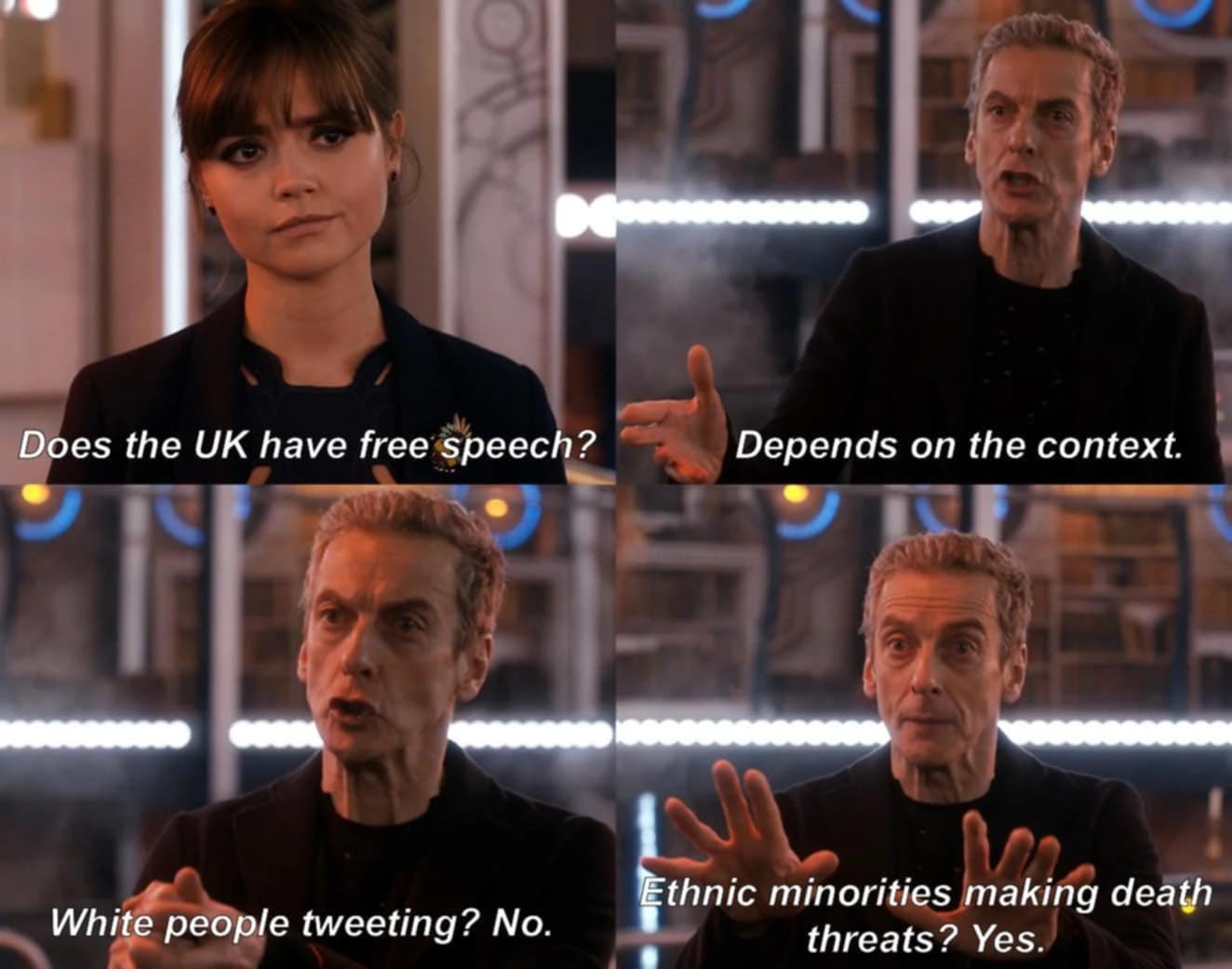
The background.
- https://www.bbc.com/news/articles/c62ln7mzd5ro – This BBC analysis explores the escalating debate on UK free speech limits, highlighting comparisons to authoritarian regimes like North Korea and the heated rhetoric around Starmer’s policies.
bbc.com
- https://www.wsj.com/opinion/free-expression/watch-what-you-say-or-two-tier-keir-might-put-you-away-73e99511 – A Wall Street Journal opinion piece critiques selective punishment of speech dissenting from progressive views in Starmer’s Britain, directly referencing the “Two Tier Keir” nickname.
wsj.com
- https://www.city-journal.org/article/britain-keir-starmer-free-speech-crime – This City Journal article discusses Britain’s shift toward authoritarianism, focusing on Starmer’s role in prosecuting speech crimes and curtailing individual freedoms.
city-journal.org
- https://www.foxnews.com/world/uk-government-accused-cracking-down-free-speech-think-before-you-post – Fox News reports on accusations of Starmer’s government rolling back free speech protections, including the “Two-tier Keir” label amid claims of selective law enforcement.
foxnews.com
In the remote British Columbia town of Tumbler Ridge, a horrific school shooting unfolded on February 10, 2026, claiming eight lives, including five children aged 12 to 13 and a female educator, while injuring more than two dozen others. One 12-year-old girl remains in critical condition with severe brain trauma from a gunshot wound to the head. The perpetrator, 18-year-old Jesse Van Rootselaar, a biological male who had been transitioning and identifying as female since approximately age 12, first killed their 39-year-old mother and 11-year-old stepbrother at home before opening fire at Tumbler Ridge Secondary School. Van Rootselaar then died by suicide. Authorities noted a history of mental health crises, multiple police interventions at the family home, school dropout several years prior, and access to household firearms despite an expired license.
Canadian legacy media outlets, including CTV, quickly pivoted to familiar territory: gun control. Coverage highlighted past mass shootings as drivers for stricter firearm laws, the suspect’s lapsed license, and questions about why previously seized household weapons were returned. This framing reduced the tragedy to a debate over firearms access rather than examining the full context of the shooter’s background and actions. By prioritizing this narrative, major outlets failed to provide the public with a complete picture, focusing on policy talking points instead of the human and societal elements at play.
The cultural and personal factors warrant far greater scrutiny. Van Rootselaar’s transition began in early adolescence, a developmental stage coinciding with documented mental health challenges and police contacts. Broader societal patterns include rising youth mental health crises potentially linked to identity-based ideologies, social influences on gender dysphoria, family disruptions, and widespread use of psychiatric medications. When media outlets gloss over or sideline these dimensions in favor of gun-centric stories, they shield uncomfortable truths about how modern cultural pressures such as rapid affirmation of gender confusion in minors may contribute to instability in vulnerable young people.
This selective reporting directly endangers the public. By obsessing over gun restrictions while minimizing mental health epidemics, the effects of early gender transitions amid distress, and the role of identity politics, media and policymakers divert attention from actionable prevention. Communities, families, and educators lack candid discussion of warning signs or reforms needed to address root causes. The outcome is repeated tragedies, as resources target symptoms among law-abiding citizens rather than the underlying cultural and psychological drivers producing alienated or radicalized youth.It is time to demand truthful journalism that confronts reality head-on. The Tumbler Ridge victims deserve more than politicized narratives that dishonor their memory by avoiding difficult conversations about mental illness, unchecked gender ideology, and societal conditions fostering despair. Facing these issues honestly through better mental health support, cautious approaches to youth transitions, and cultural course correction offers the best hope of preventing future horrors.
Legacy media’s reluctance to engage fully undermines public safety and erodes trust when clarity is most needed.

References
- CNN: Canada mass shooting at a school and home (February 11-12, 2026) – https://www.cnn.com/world/live-news/tumbler-ridge-canada-shooting-02-11-26
- USA Today: Who is Jesse Van Rootselaar, teen who killed 8 in Canada – https://www.usatoday.com/story/news/nation/2026/02/11/jesse-van-rootselaar-tumbler-ridge-canada-shooter/88631889007/
- CTV News: Mass shootings in Canada have helped prompt changes to firearm laws – https://www.ctvnews.ca/politics/article/mass-shootings-in-canada-have-helped-prompt-changes-to-firearm-laws-over-the-decades/
- BBC News: Police name suspect in Canada school shooting as 18-year-old Jesse Van Rootselaar – https://www.bbc.com/news/live/cr5lnzqdr5pt
- Al Jazeera: Canada police identify shooting suspect as 18-year-old Jesse Van Rootselaar – https://www.aljazeera.com/news/2026/2/12/canada-police-identify-shooting-suspect-as-18-year-old-jesse-van-rootselaar
- Additional reporting from The New York Times, CBC News, and official RCMP statements via multiple outlets.
At the core of much of the tension surrounding transgender issues lies a profound and inescapable cognitive dissonance.
P
Biological reality is clear and immutable.
P
Human sex is binary—male or female—and determined at conception. No medical intervention, no amount of social affirmation, and no subjective feeling can change this fundamental fact. You will always and forever remain the sex you were born.
P
Transgender ideology asserts the opposite. It claims that whatever sex you feel you are, you become in reality. Your internal sense of self overrides chromosomes, reproductive anatomy, and every observable marker of biological sex. This ideology is inherently anti-reality.
P
Those who fully internalize it place themselves in a state of permanent conflict—not just with their own bodies, but with the entire external world. Reality itself becomes the enemy, repeatedly negating their subjective self-perception.
P
Queer Theory provides the escape hatch. Rather than confronting the mismatch between feelings and facts, adherents are guided to externalize the source of their distress. Through an oppressor/oppressed lens, the cause of their pain is never their own faulty perception of self—absolutely not. Instead, it is “normative” society that is actively oppressing them, enforcing rigid gender norms and inflicting all their suffering. This framework transforms personal dissonance into righteous grievance. The distress is no longer internal; it is the fault of everyone else.
P
Medical interventions amplify the problem. So-called “gender-affirming care”—puberty blockers followed by cross-sex hormones—adds fuel to the fire. These treatments carry serious, well-documented deleterious effects on both mental and physical health. Far from resolving underlying issues, they often deepen psychological instability while creating permanent physical changes.
P
The result is a perfect storm: individuals who were already vulnerable, now further destabilized, carrying a massive chip on their shoulders. They view the rest of society—the “normative” majority—as the active source of their pain. To defend their constructed identity and quiet the cognitive dissonance, they feel compelled to strike back against this perceived evil force: you and me.In this worldview, disagreement equals enmity.
P
If you refuse to affirm their ideology, you are not offering a different opinion—you are the oppressor who must be confronted, silenced, or defeated.
P
Dissent is violence.
P
Reality itself is violence.
P
This dynamic helps explain patterns of hostility, aggression, and, in extreme cases, violence that emerge from certain segments of transgender activism. It does not stem primarily from societal rejection, but from a foundational rejection of biological reality and the refusal to address internal distress with honesty.
True compassion does not mean enabling delusion.
P
It means grounding support in reality—the only place where genuine mental health and social peace can be found.
Modern North American politics is increasingly conducted as if the other side is not an opponent but a threat. Not “wrong,” but illegitimate. Not “mistaken,” but dangerous. Once that framing takes hold, everything downstream gets harder: legislating, compromising, trusting institutions, even sharing a country.
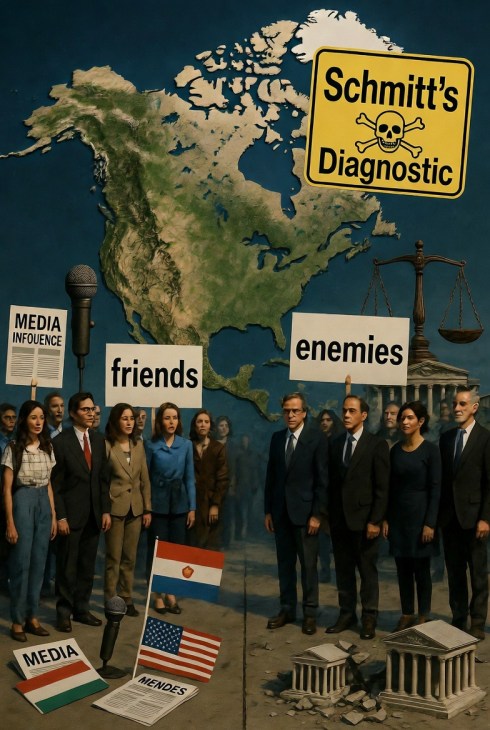
There’s a name for this move, and it’s older than social media: the friend–enemy distinction associated with the German jurist Carl Schmitt. Use it carefully. Attribute it correctly. Treat it as a warning label, not a blueprint.
The Schmitt paragraph (correct attribution without laundering)
In The Concept of the Political (first as an essay in 1927; expanded as a book in 1932), Carl Schmitt argued that what is distinctively political is not morality, economics, or aesthetics, but the capacity to sort human beings into friends and enemies—public groupings that can reach the highest intensity and, in the extreme case, make violence thinkable. (Stanford Encyclopedia of Philosophy) Schmitt is a morally compromised figure: he joined the Nazi Party in 1933 and wrote in support of the regime, which makes him “radioactive” as an authority. (Wikipedia) That’s precisely why the concept should be handled as a diagnostic for a recurring political pattern—not as an endorsement of Schmitt’s politics, and not as a permission slip to treat fellow citizens as foes.
That’s the frame. Now the point: you can reject Schmitt’s politics and still find his definition useful for recognizing when a society is sliding from politics-as-bargaining into politics-as-threat-management.
1) What the friend–enemy distinction is (and isn’t)
Schmitt’s core claim is often quoted badly. The clean version is this:
- It’s public, not personal. “Enemy” is not your private dislike. It’s a public adversary, a category applied at the level of groups. (Stanford Encyclopedia of Philosophy)
- It’s about intensity and stakes. The distinction becomes political when disagreement is framed as a contest over a community’s existence or way of life—when coercion becomes not just imaginable but morally narratable. (Stanford Encyclopedia of Philosophy)
- It’s not reducible to morality. In Schmitt’s framing, you can judge an enemy morally good and still treat them as an enemy; the political is not the same thing as ethics. (Stanford Encyclopedia of Philosophy)
So the friend–enemy distinction is less a philosophy lesson than a switch. When it flips on, political disagreement stops being about what we should do and becomes about who is allowed to be “us.”
2) The observable move: how to spot it in the wild
You’re watching friend–enemy politics when rhetoric shifts from:
- “Their plan won’t work” → “They cannot be permitted to govern.”
- “We’ll reverse this policy later” → “If they win, the country is finished.”
- “We can bargain on X” → “Any compromise is betrayal.”
- “Institutions are imperfect” → “Institutions are legitimate only when they deliver our outcomes.”
Here’s the part that matters: this is not just “heated language.” It’s a legitimacy test. The argument isn’t “our side has better ideas.” It’s “the other side is outside the moral community.”
What it sounds like now (no special villains required)
Over the last decade, ordinary campaign language has absorbed a new register: catastrophe certainty. You hear it when routine electoral competition is narrated as a point of no return not “we’ll reverse their policy,” but “if they win, the country is over.” You hear it when every institution that fails to deliver your preferred outcome becomes not merely flawed but captured—courts, schools, public health bodies, legacy media, election administration. Once those are recast as enemy infrastructure, the next step is predictable: treating compromise as collaboration.
That’s the Schmittian escalator: it turns normal democratic rivalry into a kind of internal cold war.
3) Why this maps onto polarization in the U.S. (with verifiable anchors)
American public opinion data increasingly fits the emotional profile you would expect in a friend–enemy environment: high frustration, high anger, low confidence, and pervasive negativity toward the opposing party.
Pew Research Center (survey fielded Sept. 22–28, 2025) reports that roughly half of U.S. adults say each party makes them feel angry (Democratic Party 50%, Republican Party 49%), and large majorities say each makes them feel frustrated (Democratic Party 75%, Republican Party 64%). (Pew Research Center) Pew also reports that majorities view both parties as too extreme (GOP 61%, Democrats 57%). (Pew Research Center)
That doesn’t “prove Schmitt.” It shows a climate where it’s easy for elites and activists to plausibly say: “The other side isn’t just wrong; they’re dangerous.”
Political science has a name for the emotional side of this: affective polarization which is the tendency for partisans to dislike and distrust the out-party as a social group. Iyengar, Sood, and Lelkes argue that affect increasingly operates through social identity dynamics rather than ideological distance alone. (Political Communication Lab)
Affective polarization supplies the fuel. Friend–enemy rhetoric supplies the spark.
4) Why Canada is not “the same,” but not immune
Canada has its own stresses: regional tensions, institutional distrust, culture-war imports, and an online ecosystem shared with the U.S. but it is still a mistake to claim Canada is simply America north.
A careful comparative point looks like this: research summarized by UBC Magazine reports Canadians show moderate affective polarization and lower levels of deeper hostility (political sectarianism) than Americans; divisions exist, but they are less intense, and fewer people treat the other side as morally beyond the pale. (UBC Alumni Magazine)
A note on insulation (not immunity) 🧯
Canada also has some built-in insulation: parliamentary governance can make politics feel less like a single, winner-take-all presidency; multi-party dynamics can prevent a total two-tribe monopoly; party discipline can concentrate bargaining inside caucuses rather than turning every vote into a public loyalty test. None of that makes Canada immune especially in a shared online ecosystem with American media incentives but it helps explain why Canadian polarization can be real without being identical.
5) Why identity politics dovetails so easily (even when it starts as justice) 🧩
“Identity politics” is a term that gets used as a slur, so define it cleanly. The Stanford Encyclopedia of Philosophy describes identity politics as political activity and theorizing rooted in shared experiences of injustice among members of particular social groups, often aiming to secure political freedom for a marginalized constituency. (Stanford Encyclopedia of Philosophy)
That definition is not inherently friend–enemy. You can organize around group experiences without treating dissenters as enemies.
So why the dovetail?
Because identity politics—left and right—naturally foregrounds group boundaries: who counts, who belongs, who’s harmed, who threatens, who is owed what. Schmitt’s point is that any distinction ethnic, cultural, religious, linguistic, and ideological can become politically decisive if it becomes a marker of collective identity with enough intensity. (Stanford Encyclopedia of Philosophy)
Now add moralization. Finkel and colleagues define political sectarianism as “the tendency to adopt a moralized identification with one political group and against another.” (Political Communication Lab) Once politics is moralized at the identity level, compromise starts to look like apostasy: you don’t bargain with evil; you resist it.
Here’s the dovetail in one line:
Identity makes the boundary salient; moralization makes it sacred; friend–enemy logic makes it coercive.
The accelerant: attention economics
The friend–enemy move also fits the modern information economy. Outrage travels; nuance doesn’t. Platforms and partisan media ecosystems reward content that converts complexity into moral clarity so we get villains, victims, emergencies, and betrayal. That incentive structure doesn’t invent the friend–enemy distinction, but it mass-produces it, because existential framing is the most reliable way to keep attention and discipline the in-group.
6) The cost: why friend–enemy politics jams the machinery of governance
When politics is friend–enemy:
- Compromise becomes betrayal.
Not merely “a bad deal,” but disloyalty to the tribe. - Institutions become contested terrain.
Courts, legislatures, bureaucracies, and media are judged not by process but by whether they serve “us.” Legitimacy becomes outcome-dependent. - Policy friction skyrockets.
Even mutually beneficial reforms become hard because the other side’s win is treated as loss of status or existential risk. - Moderation gets punished.
The moderate’s basic civic move—“I’ll grant you partial legitimacy and bargain” gets rebranded as weakness or collaboration.
The social cost (quiet, cumulative, real)
The damage isn’t confined to legislatures. Friend–enemy framing erodes social trust: people self-censor at work, avoid neighbours, and retreat into curated friend-only spaces. Institutions become identity badges your media, your university, your charities, your professional associations until public life resembles a network of gated communities with competing moral jurisdictions.
7) The steelman (and the answer)
Steelman: sometimes the other side really is dangerous. Sometimes a movement is openly anti-democratic, violent, or committed to permanent domination. In those cases, “enemy” language can feel like moral clarity.
Answer: danger exists. But friend–enemy framing is cheap to claim and expensive to live under. The burden of proof has to be high, because once you normalize existential threat talk, you train citizens to treat routine democratic alternation as intolerable. You also incentivize mirroring: nobody wants to be the only player insisting it’s “just politics” while being branded a threat.
Friend–enemy politics is a ratchet. It rarely turns only one way.
8) A short field guide: “know it when you see it”
You’re in friend–enemy territory when you hear:
- “They’re illegitimate.”
- “If they win, the country is over.”
- “Neutrality is complicity.”
- “Compromise is betrayal.”
- “The system is rigged—unless we win.”
- “Your neighbour’s vote is violence / treason / conquest.”
And you’re watching it spread when those claims expand outward to tag neutral institutions and ordinary citizens: not just the party but anyone who isn’t for us is with them.
9) The exit ramp: moderation without naïveté
This is not a call for civility theatre. It’s a call for civic hygiene.
A workable politics of moderation has one core rule:
Treat opponents as lawful rivals unless and until they clearly demonstrate otherwise and even then, be precise.
Practically, that means:
- Argue policy in terms of tradeoffs, constraints, second-order effects (the language of governing, not excommunication).
- Reserve “enemy” language for genuinely exceptional cases, and specify evidence and predictions that could, in principle, be falsified.
- Defend institutional legitimacy as a process, not a scoreboard.
If you can’t do that, you don’t just intensify conflict you corrode the shared premise that makes democratic disagreement possible: that losing an election is not losing the country.
Closing: the consequence if we don’t name it
Schmitt’s concept is dangerous partly because it’s accurate as a description of how politics can harden. Once a society trains itself to see politics as friend versus enemy, it will eventually demand enemy-handling tools: purges, blacklists, emergency powers, legitimacy tests, permanent distrust. The policy state becomes brittle; the civic culture becomes suspicious; moderation becomes a vice.
The friend–enemy distinction is not merely an idea. It’s a habit of mind. And habits, unlike ideologies, don’t require formal assent. They spread by imitation.
The minimum defensive act is to recognize the move when it’s being done to you, and when you’re tempted to do it back. 🧭
Glossary
Affective polarization — Dislike, distrust, and social hostility toward supporters of the opposing party, treated as a group identity rather than merely a set of policy positions. (Political Communication Lab)
Catastrophe register / no-return framing — A rhetorical mode that describes ordinary electoral competition as an existential point of no return (“if they win, the country is over”).
Friend–enemy distinction (Schmitt) — The claim that the political is defined by the capacity to distinguish friend from enemy in a public sense, with sufficient intensity that coercion or violence becomes thinkable in extreme cases. (Stanford Encyclopedia of Philosophy)
Identity politics — Political activity and theorizing grounded in shared experiences of injustice among members of particular social groups, typically aimed at securing political freedom for a marginalized constituency. (Stanford Encyclopedia of Philosophy)
Legitimacy denial — Treating the opposing side as outside the set of lawful rivals who may govern; shifting from “they’re wrong” to “they must not rule.”
Political sectarianism — “The tendency to adopt a moralized identification with one political group and against another,” borrowing the metaphor of religious sects rather than mere teams. (Political Communication Lab)
Process legitimacy — The idea that institutions are legitimate because procedures are lawful, stable, and fairly applied—not because they produce outcomes you like.
Citations (Sources)
- Carl Schmitt (Stanford Encyclopedia of Philosophy), overview of Schmitt and the friend–enemy distinction. (Stanford Encyclopedia of Philosophy)
- Background note on The Concept of the Political and Schmitt’s Nazi Party membership (reference context). (Wikipedia)
- Pew Research Center (Oct 30, 2025), party feelings: anger/frustration measures. (Pew Research Center)
- Pew Research Center (Oct 30, 2025), views of both parties: “too extreme” findings. (Pew Research Center)
- UBC Magazine (Dec 2, 2025), summary of Canadian polarization research and comparative claims. (UBC Alumni Magazine)
- Iyengar, Sood, & Lelkes (2012), “Affect, Not Ideology,” on affective polarization as social identity. (Political Communication Lab)
- Finkel et al. (Science, 2020), “Political sectarianism in America,” definition and framework. (Political Communication Lab)
- Identity Politics (Stanford Encyclopedia of Philosophy), definition and scope. (Stanford Encyclopedia of Philosophy)











 bleatmop
 Mystro
 The Arbourist


 Dead Wild Roses
Your opinions…