
You are currently browsing the tag archive for the ‘American Exceptionalism’ tag.
Much of the talk about the rule of law, at least in international politics seems to be but a mere convenience to be followed when international law happens to be in favour of a countries policies. When it becomes inconvenient to the national policy or doctrine, then the rule of law becomes an obsolete antiquated legal fixture, or international meddling in a sovereign countries affairs.
The US is rather notorious for this dubious commitment to the international rule of law.
“The United States contempt for international law is neither new nor an aberration but a long standing tradition between both democrats and republicans in the United States.
In another stunning example of human rights abuse by the United States is the case of Khaled El-Masri. Who happened to have the misfortune of having the same name as a terror suspect. He was subsequently kidnapped, flown to Afghanistan and was tortured and sodomosied.(4)
“Masri’s treatment at Skopje airport at the hands of the CIA rendition team — being severely beaten, sodomised, shackled and hooded, and subjected to total sensory deprivation — had been carried out in the presence of state officials of [Macedonia] and within its jurisdiction,” the European Court of Human Rights ruled. (Idid.)
When the International Court of Justice ruled against the United States in 1986 in favour of Nicaragua and found the United States was guilty of many international laws and human rights violations it simply upped and walked away from the court. (5)
The US benches were empty when the court announced its decision. Among the Nicaraguan delegates was the Foreign Minister, Father Miguel d’Escoto, who said he hoped that the verdict would help the Americans to re-evaluate their position and stop defying the law and the court.
Dutch legal experts argue that the decision is legally binding on the US, despite the American refusal to recognise the court’s jurisdiction. One said: ‘The USA has always recognised the ICJ. It should have changed its position earlier if it wanted to duck the court in this case.
‘It is a well-known principle of international law that, if a country submits to the jurisdiction of a court, it cannot sidestep the court after the judges have started their work,’ a professor of international law at Amsterdam University said. (Ibid.)”
I’d like to live in a world where concepts such as the rule of law actually exist in a state where they applied equally to all parties involved. The state of the world precludes this fair application of the rules at the moment and it should be taken into account when appeals to the ‘rule of law’ are made.
[Source:Counterpunch]
This excerpt from Paul Street’s essay, “Bob Kerrey, Fulbright University, and the Neoliberal Erasure of History.”
Mistakes Happen
“And besides, the conventional imperial American exceptionalist wisdom holds. mistakes happen. It’s true, dominant media and reputable intellectuals acknowledge, Uncle Sam and his innately gallant gendarmes occasionally make “mistakes” in their inherently noble (because American) zeal to improve an often nasty and unruly world. It’s a messy, imperfect planet on which the intrinsically benevolent, peace- and freedom-loving United States struggles selflessly to make its righteous mark. Slip-ups and oversteps occur. “Mistakes,” you know, like the so-called Vietnam War and its many My Lais and Thanh Phongs. “Mistakes” like the U.S. invasion of Mesopotamia, which led to the premature death of more than a millions Iraqis. Still, the reigning American thought-habit holds, U.S. intentions are always virtuous. The “blunders” take place in the context of an ugly and dangerous world where evil is rife – a world where the United States always strives mightily to stay morally upright while dealing with “bad guys” like “the Viet Cong” (the American military and media’s racist label for Vietnamese revolutionaries who fought for national independence and social justice). As Bill Clinton’s second Secretary of State Madeline Albright (the one who said that the death of more than half a million Iraqi children through U.S-led economic sanctions was “a price worth paying” for the advance of U.S. foreign policy goals) once explained, “The United States is good…We try to do our best everywhere.”
We must never forget how splendid we are, something that makes it essential for us to toss vast volumes of U.S. “foreign relations” (imperial) history down Orwell’s “memory hole.”
The celebratory mood seems to have died down a little in the US as perhaps they realize celebrating the gross violation of international law loud and proud might not be such a good thing. If the same sort of action where to happen to us, we would not be in such a happy mood, I can guarantee it. Noam Chomsky wrote an article, appearing on Alternet, that I quote for this post.
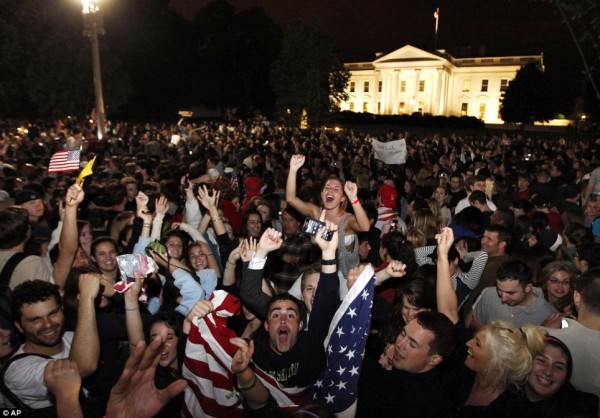 “The authors add: “For many at the Pentagon and the Central Intelligence Agency who had spent nearly a decade hunting bin Laden, killing the militant was a necessary and justified act of vengeance.” Furthermore, “Capturing bin Laden alive would have also presented the administration with an array of nettlesome legal and political challenges.” Better, then, to assassinate him, dumping his body into the sea without the autopsy considered essential after a killing, whether considered justified or not – an act that predictably provoked both anger and skepticism in much of the Muslim world.”
Yet another fine act of terror to bring us closer in our relations with those who are different that us. People watch and listen to see how Western powers act, as we are the self-proclaimed standard bearers of civilization. What standard to we set when we ignore the rule of law?
“The authors [from the Atlantic Monthly] quote former West German Chancellor Helmut Schmidt, who “told German TV that the U.S. raid was ‘quite clearly a violation of international law’ and that bin Laden should have been detained and put on trial,” contrasting Schmidt with US Attorney General Eric Holder, who “defended the decision to kill bin Laden although he didn’t pose an immediate threat to the Navy SEALs, telling a House panel on Tuesday that the assault had been ‘lawful, legitimate and appropriate in every way’.”
At least all of Western ‘civilization’ is not on board the assassination train. Germany is not on board, the UK of course is, but then again they do allow for a touch more dissent to hit the media.
“Geoffrey Robertson, who supported the intervention and opposed the execution largely on pragmatic grounds, nevertheless described Obama’s claim that “justice was done” as an “absurdity” that should have been obvious to a former professor of constitutional law. Pakistan law “requires a colonial inquest on violent death, and international human rights law insists that the ‘right to life’ mandates an inquiry whenever violent death occurs from government or police action. The U.S. is therefore under a duty to hold an inquiry that will satisfy the world as to the true circumstances of this killing.” Robertson adds that “The law permits criminals to be shot in self-defense if they (or their accomplices) resist arrest in ways that endanger those striving to apprehend them. They should, if possible, be given the opportunity to surrender, but even if they do not come out with their hands up, they must be taken alive if that can be achieved without risk. Exactly how bin Laden came to be ‘shot in the head’ (especially if it was the back of his head, execution-style) therefore requires explanation.”
Clearly, rules were not followed in this case. History provides a telling counterpoint to that action undertaken by Obama and the US.
“Robertson usefully reminds us that “It was not always thus. When the time came to consider the fate of men much more steeped in wickedness than Osama bin Laden — namely the Nazi leadership — the British government wanted them hanged within six hours of capture. President Truman demurred, citing the conclusion of Justice Robert Jackson that summary execution ‘would not sit easily on the American conscience or be remembered by our children with pride…the only course is to determine the innocence or guilt of the accused after a hearing as dispassionate as the times will permit and upon a record that will leave our reasons and motives clear’.”
Was OBL the same as the German leadership post WW2. Of course not, but the idea remains the same. If we were just in our actions, they should stand in a neutral court and be proven accountable so that history and the world can see how justice is done. Would it be wrong to run a scenario that involved us on the other end of the stick?
“It might be instructive to ask ourselves how we would be reacting if Iraqi commandos landed at George W. Bush’s compound, assassinated him, and dumped his body in the Atlantic (after proper burial rites, of course). Uncontroversially, he is not a “suspect” but the “decider” who gave the orders to invade Iraq — that is, to commit the “supreme international crime differing only from other war crimes in that it contains within itself the accumulated evil of the whole” (quoting the Nuremberg Tribunal) for which Nazi criminals were hanged: in Iraq, the hundreds of thousands of deaths, millions of refugees, destruction of much of the country and the national heritage, and the murderous sectarian conflict that has now spread to the rest of the region. Equally uncontroversially, these crimes vastly exceed anything attributed to bin Laden.”
Whoops, getting a little uncomfortable isn’t it? Read the rest of this entry »
 The primacy of this lesson can not be overstated. The lovey-dovey notion that the US spreads democracy and peace throughout the world exists only within the borders of the US to keep its population ignorant of the injustice and violence committed in their name. The US, as with every great power, is largely imperialistic by nature and therefore promoting democracy and its associated freedoms is not particularly high on the US’s foreign policy agenda. Al-Jazeera, unlike the corporate media in North America, actually reports critically on the West’s policy decisions. Educating people on important topics though, is also a ways down the list for most of North America’s corporate media as well, so we will have to continue to look to independent media organizations for critical views of our policies.
“It’s incredible, really. The president of the United States can’t bring himself to talk about democracy in the Middle East. He can dance around it, use euphemisms, throw out words like “freedom” and “tolerance” and “non-violent” and especially “reform,” but he can’t say the one word that really matters: democracy.”
Of course not. Government for the people tends to make policies, well, for the people and that dear friends is most certainly not business friendly policy.
“How did this happen? After all, in his famous 2009 Cairo speech to the Muslim world, Obama spoke the word loudly and clearly – at least once.
“The fourth issue that I will address is democracy,” he declared, before explaining that while the United States won’t impose its own system, it was committed to governments that “reflect the will of the people… I do have an unyielding belief that all people yearn for certain things: the ability to speak your mind and have a say in how you are governed; confidence in the rule of law and the equal administration of justice; government that is transparent and doesn’t steal from the people; the freedom to live as you choose. Those are not just American ideas, they are human rights, and that is why we will support them everywhere.”
“No matter where it takes hold,” the president concluded, “government of the people and by the people sets a single standard for all who hold power.”
Simply rhetoric?
Of course, this was just rhetoric, however lofty, reflecting a moment when no one was rebelling against the undemocratic governments of our allies – at least not openly and in a manner that demanded international media coverage.
Now it’s for real.”
Obama just speaking to hear the sound of his lovely words, I’m completely shocked.
“And “democracy” is scarcely to be heard on the lips of the president or his most senior officials.
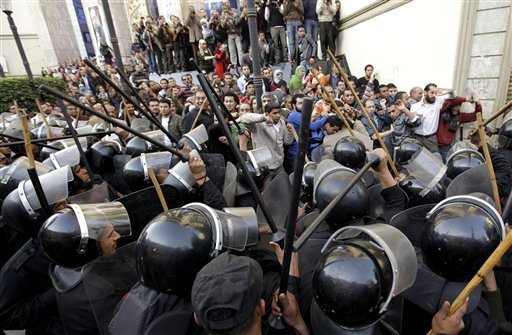 In fact, newly released WikiLeaks cables show that from the moment it assumed power, the Obama administration specifically toned down public criticism of Mubarak. The US ambassador to Egypt advised secretary of state Hillary Clinton to avoid even the mention of former presidential candidate Ayman Nour, jailed and abused for years after running against Mubarak in part on America’s encouragement.
Not surprisingly, when the protests began, Clinton declared that Egypt was “stable” and an important US ally, sending a strong signal that the US would not support the protesters if they tried to topple the regime. Indeed, Clinton has repeatedly described Mubarak as a family friend. Perhaps Ms Clinton should choose her friends more wisely.
Similarly, president Obama has refused to take a strong stand in support of the burgeoning pro-democracy movement and has been no more discriminating in his public characterisation of American support for its Egyptian “ally”. Mubarak continued through yesterday to be praised as a crucial partner of the US. Most important, there has been absolutely no call for real democracy.”
Well of course not, real democracy is a messy people-centric process that does not ensure a business friendly stable environment.
“Rather, only “reform” has been suggested to the Egyptian government so that, in Obama’s words, “people have mechanisms in order to express legitimate grievances”.
“I’ve always said to him that making sure that they are moving forward on reform – political reform, economic reform – is absolutely critical for the long-term well-being of Egypt,” advised the president, although vice-president Joe Biden has refused to refer to Mubarak as a dictator, leading one to wonder how bad a leader must be to deserve the title.
Even worse, the president and his senior aides have repeatedly sought to equate the protesters and the government as somehow equally pitted parties in the growing conflict, urging both sides to “show restraint”. This equation has been repeated many times by other American officials.
This trick, tried and tested in the US discourse surrounding the Israeli-Palestinian conflict, is equally nonsensical here. These are not two movements in a contest for political power. Rather, it is a huge state, with a massive security and police apparatus that is supported by the world’s major superpower to the tune of billions of dollars a year, against a largely young, disenfranchised and politically powerless population which has suffered brutally at its hands for decades.
The focus on reform is also a highly coded reference, as across the developing world when Western leaders have urged “reform” it has usually signified the liberalisation of economies to allow for greater penetration by Western corporations, control of local resources, and concentration of wealth, rather than the kind of political democratisation and redistribution of wealth that are key demands of protesters across the region.”
Damn, but is nice to see geopolitical reality being espoused by a major news outlet.
“An Al Jazeera English interview on Thursday with US state department spokesman PJ Crowley perfectly summed up the sustainability of the Obama administration’s position. In some of the most direct and unrelenting questioning of a US official I have ever witnessed, News Hour anchor Shihab al-Rattansi repeatedly pushed Crowley to own up to the hypocrisy and absurdity of the administration’s position of offering mild criticism of Mubarak while continuing to ply him with billions of dollars in aid and political support.
When pressed about how the US-backed security services are beating and torturing and even killing protesters, and whether it wasn’t time for the US to consider discontinuing aid, Crowley responded that “we don’t see this as an either or [a minute later, he said “zero sum”] proposition. Egypt is a friend of the US, is an anchor of stability and helping us pursue peace in the Middle East”.
Each part of this statement is manifestly false; the fact that in the midst of intensifying protests senior officials feel they can spin the events away from openly calling for a real democratic transition now reveals either incredible ignorance, arrogance, or both.”
Ah yes, stability. We kill and torture to maintain it, and if we are doing it, it simply must be just and interests of the “greater good”. The world really is a nice place when you are at the friendly end of the sharp stick.
“Moreover, Crowley, like his superiors, refused to use the word democracy, responding to its use by anchor al-Rattansi with the word “reform” while arguing that it was unproductive to tie events in Egypt to the protests in other countries such as Tunis or Jordan because each has its own “indigenous” forces and reasons for discontent.
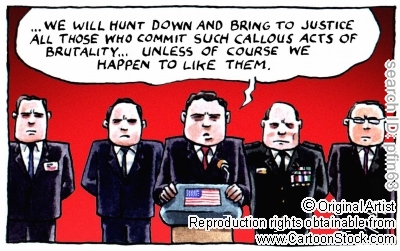 That is a very convenient singularisation of the democracy movements, which ignores the large number of similarities in the demands of protests across the region, the tactics and strategies of protest, and their broader distaste and distrust of the US in view of its untrammelled support for dictatorships across the region.
Of course, autocracies are much more stable than those messy democracies, no?
“The most depressing and even frightening part of the tepid US response to the protests across the region is the lack of appreciation of what kind of gift the US, and West more broadly, are being handed by these movements. Their very existence is bringing unprecedented levels of hope and productive activism to a region and as such constitutes a direct rebuttal to the power and prestige of al-Qaeda.
Instead of embracing the push for real democratic change, however, surface reforms that would preserve the system intact are all that’s recommended. Instead of declaring loud and clear a support for a real democracy agenda, the president speaks only of “disrupting plots and securing our cities and skies” and “tak[ing] the fight to al-Qaeda and their allies”, as he declared in his State of the Union address.
Obama doesn’t seem to understand that the US doesn’t need to “take the fight” to al-Qaeda, or even fire a single shot, to score its greatest victory in the “war on terror”. Supporting real democratisation will do more to downgrade al-Qaeda’s capabilities than any number of military attacks. He had better gain this understanding quickly because in the next hours or days the Egypt’s revolution will likely face its moment of truth. And right behind Egypt are Yemen, Jordan, Algeria, and who knows what other countries, all looking to free themselves of governments that the US and its European allies have uncritically supported for decades.”
Ah yes, but then what external enemy could the US scapegoat to cover its domestic failures at home? I mean, actually decreasing the amount of terrorist activity would mean resources could be used to make life better for the average American rather than the military industrial complex and other conglomerates that make a goodly amount of profit on war and strife.
“If president Obama has the courage to support genuine democracy, even at the expense of immediate American policy interests, he could well go down in history as one of the heroes of the Middle East’s Jasmine winter. If he chooses platitudes and the status quo, the harm to America’s standing in the region will likely take decades to repair.”
I believe that for Obama supporting any genuine democracy will happen right after denouncing the corrosive effects of religion , declaring his atheism, and then re-regulating the business sector.
Honest.











 bleatmop
 Mystro
 The Arbourist


 Dead Wild Roses
Your opinions…