
You are currently browsing the tag archive for the ‘Atheism’ tag.
 There is a conversation that happens all the time between theists and non-believers. I have engaged in it many times myself as well as observed others engaging in it more times than I can count. While there are a number of seemingly valid ways atheists could deal with this conversation, I have come to believe that many of these methods merely lead to baited traps.
This conversation starts with the theist coming up with Claim X, asserting that no one could explain Claim X without invoking god, and smugly concluding that god must exist.
There are four categories Claim X might fall into:
1) Claim X is simply false
2) Claim X is easily explained without invoking god
3) Claim X is explained without invoking god, but it’s complex
4) Claim X actually has no current non-god explanations
While there have been millions of examples of ‘Claim X’ used in these conversations, scant few still fall into the fourth category. Because it’s so rare, most atheist responses to such a conversation ignore this category. This, I think, is the major reason such conversations can (and have) gone on for seeming eternities. To illustrate, let’s look at each of the categories.
Claim X is simply false
The bait here is nigh on irresistible. One of the theist’s premises are wrong, thus the argument is invalid and the conclusion does not follow! It’s irrefutable!
What do you mean it isn’t? Oh silly secularist, you fell into a trap of perpetual distortions.
Showing Claim X to be false simply invites the theist to propose ‘Claim X-prime’ that is slightly different or a bit more vague than Claim X. And when you do the same for Claim X-prime, the theists alters it again, and so on ad infinitum. Should you ever get to the point where all versions of Claim X are shown to be false, the theist then just says something to the effect of ‘Look at all that contorting and effort you had to do, just to grasp at straws. Your desperation indicates your flaw. Your story keeps changing, while my answer, “God”, stayed constant.’
Is that rational?
No.
But discourse is not based on rationality. It’s based on persuasion. As such, the theist is right, you have failed to be persuasive. To the theist, that is. Those exercising reason may indeed enjoy your absolute thrashing of whatever B.S. the theist churns up. But then, if we were only trying to persuade people with reason, we wouldn’t be talking to theists, would we?
Claim X is easily explained without invoking god
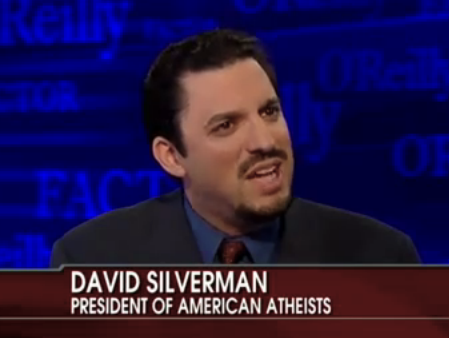 A wonderful example of this is Bill Head-Up-My-Arse O’Reilly’s infamous ‘Tide goes in, tide goes out’ line. Again, the pull here to shove reality based ideas in the theist’s face is often overwhelming. But, like in our previous case, just because the secularist is right, doesn’t mean they win. Once more, the theist backs up a bit and makes Claim X slightly harder to explain, and then slightly harder still and so on until it eventually turns into…
Claim X is explained without invoking god, but it’s complex
Now things can get tricky. We saw this as O’Reilly responded to the initial wave of attacks with his ‘How’d the moon get there?’ bit. Answering the theist’s challenge might now actually require formal education to supply the answer. In some cases, it might require a fair deal of study just to understand the answer. I personally enjoy listening to responses from people who have done the requisite schoolwork, as it can be a fun way to learn about things (I highly recommend TheLivingDinosaur ‘s “Holy Hallucinations” series) but alas, these are also doomed to fail. As the answers are now further away from the layman, the theist is safe to ignore all presented evidence. It’s not as if anyone in their camp is going to actually research this stuff. Thus, the theist vision of what fits into the next and final category is quite bloated.
Claim X actually has no current non-god explanations
This is where the theist wants to go and, as I’ve described above, there is little to be done to stop them from getting here, other than infinite loops of explanations that are ever more easily discarded. And you can’t get anywhere inside of an infinite loop.
A key point to realize is that in these conversations, the theist doesn’t really care to which category their particular ‘Claim X’ belongs. Rather, what matters is that somewhere out there, some ‘Claim X’ does reside in the fourth category.
And, ultimately, the theist is right. There are things that currently cannot be explained. There are things that may never be explained. Further, there may be things that inherently defy human understanding and are impossible to explain. So the theist wins. God exists. Accept it and go home.
Wait a minute…That can’t be right. Let’s back things up and look at the original argument structure.
1) Claim X is true
2) Claim X cannot currently be explained by humans without invoking god
3) Therefore god exists
There are two huge problems with this structure, regardless on the truth of the first two premises. The first problem is a false dichotomy implied by 2): as Claim X cannot be explained without god, it is explained *with* god. “God did it” does not explain anything. If I ask you ‘how does a clock work?’ and you reply ‘a clock-maker makes it work’, have I gained any understanding at all? Not one lick. All the god “answer” does is avoid explaining anything at all.
But a theist could potentially offer an actual explanation that is based on the god hypothesis. This tactic is used less and less, as these explanations are invariably discovered to be wrong (see Thunderf00t’s wonderful ‘Why people laugh at creationists‘ series). But lets say a brilliant theist comes up with an explanation that cannot be disproven by even the most intense scrutiny carried out by our most brilliant minds. If this were to ever happen (don’t hold your breath) we then run into the second problem: 3 does NOT follow from 1 and 2. Just because a hypothesis CAN explain a phenomenon, does not mean it DOES explain it.
 Going back to our clock, consider if, instead of “a clock-maker makes it work / god did it”, you replied “inside there is a team of invisible gremlins with perfect timing. They were captured and placed in this clock and forced to move the hands of the clock in order to relay time to outside viewers,” and there was an elaborate tale explaining all the ins and outs, and further, we had no way of observing the gremlins inside this clock to verify this (or any other) story. According to the theist’s argument model, we’ve just proven the existence of clock gremlins. The god hypothesis is a worthless ad-hoc conjecture as it is dependent on nothing, predicts nothing, and is non-falsifiable. As such, any of an infinite of imagined things could take god’s place in the theist’s argument and it would be equally valid.
The theist wants their argument to come off like this:
1) Claim X
2) Claim X would be impossible unless god exists.
3) Therefore god exists.
But the theist will never say anything close to this, because then the onus is obviously on them to demonstrate 2) and they just can’t do it. It is an impossible premise to validate. So they twist and distort until their argument takes the fallacious form we see so often, to try and shirk the onus of proof onto non-believers.
So how should one react to Claim X?
I would recommend immediately acknowledging that there are things that current science cannot explain, regardless of under which category Claim X falls. Resist the bait. Then, address how a gap in knowledge cannot prove any supernatural entity, as otherwise it could prove any of an infinite possible deities.
Remember, it doesn’t matter to the theist’s argument if Claim X is wrong or currently understood – even though it should – so it shouldn’t matter to yours.
 Thunderf00t gets a trophy for patience as he systematically attempts to debate with the foolishly inane Eric Hovind. This video is 29 minutes of fist-clenching agony as Hovind petulantly refuses to answer questions and fails to understand the most rudimentary principles of arguing. People who debate Theists are aware of the nuclear grade delusion necessary to maintain belief in magic, and now after watching this video, you are too.
 Greta Christina is a prominent member of the new Atheist movement. She has recently published a work called “Why are you Atheists so Angry? – 99 Things that piss off the Godless.” I’m happy to feature some of her work here on the Sunday Disservice.
1: The consistent replacement of supernatural explanations of the world with natural ones.
When you look at the history of what we know about the world, you see a noticeable pattern. Natural explanations of things have been replacing supernatural explanations of them. Like a steamroller. Why the Sun rises and sets. Where thunder and lightning come from. Why people get sick. Why people look like their parents. How the complexity of life came into being. I could go on and on.
All these things were once explained by religion. But as we understood the world better, and learned to observe it more carefully, the explanations based on religion were replaced by ones based on physical cause and effect. Consistently. Thoroughly. Like a steamroller. The number of times that a supernatural explanation of a phenomenon has been replaced by a natural explanation? Thousands upon thousands upon thousands.
Now. The number of times that a natural explanation of a phenomenon has been replaced by a supernatural one? The number of times humankind has said, “We used to think (X) was caused by physical cause and effect, but now we understand that it’s caused by God, or spirits, or demons, or the soul”?
Exactly zero.
Sure, people come up with new supernatural “explanations” for stuff all the time. But explanations with evidence? Replicable evidence? Carefully gathered, patiently tested, rigorously reviewed evidence? Internally consistent evidence? Large amounts of it, from many different sources? Again — exactly zero.
Given that this is true, what are the chances that any given phenomenon for which we currently don’t have a thorough explanation — human consciousness, for instance, or the origin of the Universe — will be best explained by the supernatural?
Given this pattern, it’s clear that the chances of this are essentially zero. So close to zero that they might as well be zero. And the hypothesis of the supernatural is therefore a hypothesis we can discard. It is a hypothesis we came up with when we didn’t understand the world as well as we do now… but that, on more careful examination, has never once been shown to be correct.
If I see any solid evidence to support God, or any supernatural explanation of any phenomenon, I’ll reconsider my disbelief. Until then, I’ll assume that the mind-bogglingly consistent pattern of natural explanations replacing supernatural ones is almost certain to continue.
The title of the video is actually called “Thunderf00t Unmasked” as it deals with some of the nasty things zealots have and continue to do. It is a little slice of youtube drama, but at the same time the argument Thunderf00t makes against religion is remarkably cogent and clear and deserves to be amplified :) Thus it ends up here…
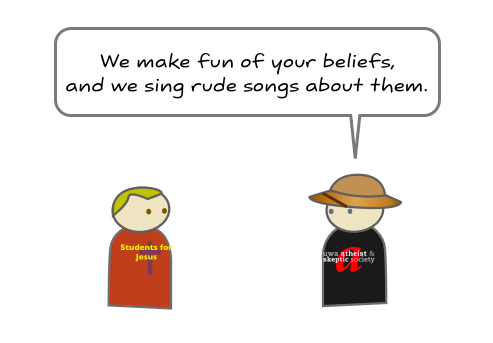
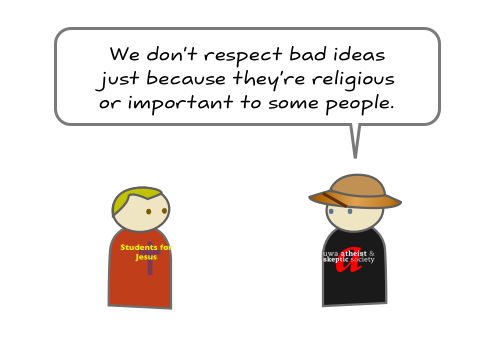
Why do atheists hate so much? Is it some sort of unnatural compulsion to blasphemy and make the religious feel uncomfortable? Well, not really. The message from this part of the atheist community is clear: believing in the supernatural is not rational and basing decisions that affect people and institutions on mythology is credulous behaviour at best. This cartoon has been making the rounds in various atheist hotspots( I found it on Good Reason) on the net, and I reproduce it here for you today for the Sunday Disservice. The cartoon is a concise summary of why many atheists sound and act the way they do.







 All too frequently when the horrible/insane/incoherant practices/beliefes/consequences of religious dogma are pointed out, one hears responses that try to dodge the point rather than address it directly. One of the most common of these dodges takes this approximate shape: “Why do you even bother? It’s not like religious people ever do anything harmful in this day and age. And if they do, those harmful actions are never based on their religious beliefs. You’re obviously just full of hate for people not like you, so I now get to disregard your point.” Typically, believers will also throw in a reference to some other part of their religion’s teachings which sounds nice and lovey dovey. Can’t have a problem with lovey dovey, can you?
 First, I want to stress that this IS a dodge. It doesn’t matter if I happen to be the most hateful person on the planet or if the idea I’m attacking isn’t currently held by anyone alive today. Nor does it matter that Belief Y is a good one, if we are discussing Belief X. In rational discussions, one must challenge the actual points presented. It is meaningless to quibble over the context around them or to focus on something else. Plunging your head into the sand is not a valid reasoning technique.
Alternatively, one could concede the point and admit that said dogma/practice/belief is indeed horrible/insane/incoherent. Then you could start a second discussion to try to argue that the dogma’s despicable nature doesn’t influence the world in any meaningful way. While this would be acceptable, it’s rare that a theist is will allow that any of their core religious ideas are either loathsome or inconsequential, much less both.
Much more likely, the theist will refuse to return to the main topic until this non-sequitor is dealt with. In either event, I would like to share ProportionalResponse’s reaction. The suggestion that religion today is harmless would be laughable, if it wasn’t so spirit-crushingly sad. Here is a link to the full image, should you wish to study it more carefully.
This dodge neither reflects reality nor addresses the topic actually under discussion. It’s a cheap diversionary tactic of the desperate and/or lazy. Users of this dodge may leave, give their heads a shake, and come back when they’re ready to say something meaningful.
Theramin Trees a youtube author made a series of videos in response to the following questions.
This three-part series looks at:
1. What I believed when I was a theist
2. Concepts for gods I affirmatively believe do not exist
3. Concepts for god I believe to be unknowable
The first video, a trek into the author’s beliefs is fascinating as it is a tour of how his conception of the christian god evolved over time and where TT came to the conclusion that there was no God and that was the most reasonable hypothesis to hold given the current information.
Stay tuned for part 2 tomorrow. :)











 bleatmop
 Mystro


 Dead Wild Roses
Your opinions…