Intersectionality in the Classroom: From Empathy to Indoctrination
Intersectionality, a framework coined by legal scholar Kimberlé Crenshaw in 1989, purports to illuminate how overlapping social categories such as race, gender, class, and sexuality compound experiences of discrimination or privilege. Emerging from Crenshaw’s analysis of Black women’s marginalization within both feminist and civil rights discourses, the term has since evolved into a pervasive lens for examining interlocking systems of power.
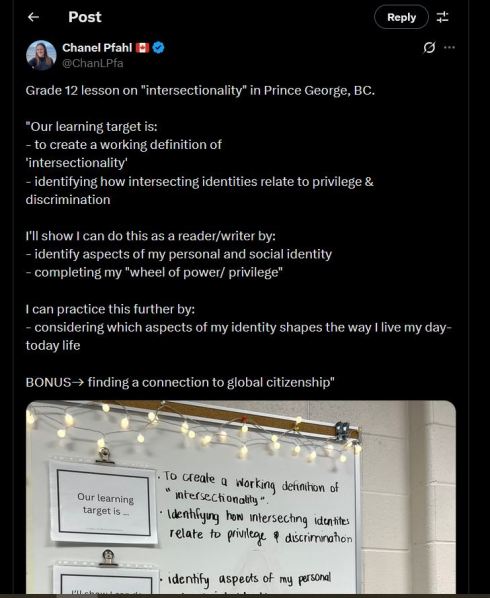
In a recent Grade 12 lesson plan from Prince George, British Columbia, students are tasked with crafting personal definitions of intersectionality, mapping their identities onto a “wheel of power/privilege,” and connecting these to daily life and global citizenship. This exercise, ostensibly designed to foster empathy, exemplifies how the theory infiltrates education—reducing multifaceted human experience to a grid of predetermined oppressions and advantages. Yet beneath its academic veneer lies a mechanism for sowing division, one that demands scrutiny for its role in perpetuating grievance over growth.
At its core, intersectionality falters by collapsing the rich tapestry of individual lives into rigid identity matrices, sidelining agency, character, and shared humanity in favor of immutable traits assigned at birth. By framing privilege as an unearned inheritance tied to one’s position on the proverbial wheel, the framework risks breeding resentment among students, who learn to view peers not as collaborators but as bearers of systemic guilt. Empirical observations from social movements underscore this fragmentation: alliances crumble when identity eclipses common purpose, as seen in fractured coalitions where tactical solidarity yields to performative purity tests.
Even within leftist traditions, critics decry how intersectionality dilutes rigorous economic analysis into cultural essentialism, obscuring material inequities under a haze of subjective hierarchies. Far from empowering, this lesson in Prince George transforms the classroom into a theater of suspicion—where adolescents dissect their “intersecting identities” not to build resilience but to catalog wounds, fostering a generation primed for perpetual victimhood rather than principled action.
This pedagogical sleight of hand reveals intersectionality’s deeper allegiance to identity politics, a doctrine that elevates collective affiliation above individual merit and moral accountability. In the lesson’s directive to “identify aspects of my personal and social identity” relative to privilege, students are subtly coerced into prioritizing group-based narratives over personal narratives, echoing a broader cultural shift where loyalty to tribe trumps universal ethics. Such politics, by design, atomizes society into silos of grievance, undermining the Enlightenment ideal of judgment by deeds rather than descent.
The result is not enlightenment but alienation: white students branded as inherent oppressors, marginalized peers cast as eternal victims, all while the lesson’s “bonus” nod to global citizenship rings hollow amid the induced tribalism. Verifiable accounts from educators and observers confirm this corrosive effect, with classrooms devolving into echo chambers of accusation rather than forums for frank exchange.
Worse still, intersectionality’s Marxist undercurrents betray its origins in class warfare, merely repackaging economic antagonism as identitarian strife to sustain endless conflict without resolution. Drawing from dialectical materialism’s emphasis on oppositional forces, the theory substitutes proletariat–bourgeois divides with fluid yet perpetually clashing identity classes—oppressors versus oppressed—fueling a zero-sum battle that mirrors historical agitprop but swaps factories for feelings. Critics within the Marxist canon itself lament this dilution, arguing it retreats from revolutionary class consciousness into liberal fragmentation, where cultural skirmishes supplant systemic overhaul.
In the Prince George curriculum, this manifests as students pondering how their “wheel” positions them in global hierarchies, unwittingly internalizing a narrative of inevitable clash that excuses inaction while justifying radicalism. By promoting such identitarian discord, intersectionality does not liberate; it entrenches a spectral class war, audible in its echoes from the Frankfurt School to contemporary campus upheavals.
In place of this divisive doctrine, educators should pivot to a lesson grounded in universal human rights, drawing from the Enlightenment’s timeless assertion of equality before the law irrespective of ascribed identities. Students might begin by studying the Universal Declaration of Human Rights (1948)—articulating core tenets like dignity and non-discrimination—and then apply them to case studies that transcend identity silos. Group debates could explore how these rights galvanize cooperation in pluralistic societies, extending into civic duties such as community service that bridge divides through shared endeavor.
This alternative, far from ignoring inequities, confronts them through aspirational universality, fostering citizens equipped for concord rather than combat. By centering verifiable principles over subjective grids, such a curriculum honors truth’s pursuit, arming youth against narrative warfare with the unyielding shield of human solidarity.
References
Crenshaw, Kimberlé. “Demarginalizing the Intersection of Race and Sex.” University of Chicago Legal Forum 1989(1): 139–167.
— Foundational essay introducing intersectionality in the context of Black women’s employment discrimination cases.
Crenshaw, Kimberlé. “Mapping the Margins: Intersectionality, Identity Politics, and Violence against Women of Color.” Stanford Law Review 43, no. 6 (1991): 1241–1299.
— Expanded articulation of intersectional theory applied to social and legal contexts.
Bell, Daniel.The Cultural Contradictions of Capitalism. New York: Basic Books, 1976.
— Influential analysis of how ideological movements replace class analysis with cultural moralism.
Fraser, Nancy. “From Redistribution to Recognition? Dilemmas of Justice in a ‘Post-Socialist’ Age.” New Left Review 212 (1995): 68–93.
— A left-wing critique of intersectionality’s turn toward identity over material class structures.
Marcuse, Herbert.One-Dimensional Man. Boston: Beacon Press, 1964.
— Core Frankfurt School text examining how ideology replaces substantive rationality; relevant to intersectionality’s theoretical lineage.
United Nations.Universal Declaration of Human Rights. Adopted December 10, 1948.
— Primary document grounding an alternative civic and moral education in universalism rather than identity determinism.
Lilla, Mark.The Once and Future Liberal: After Identity Politics. New York: Harper, 2017.
— Liberal critique of identity politics and its corrosive impact on civic cohesion.
The recent ruling against Amy Hamm by the British Columbia College of Nurses and Midwives (BCCNM) is nothing short of a travesty, a glaring assault on free speech and common sense that should leave any reasonable person fuming. Hamm, a nurse and vocal advocate for women’s sex-based rights, was found guilty of “professional misconduct” in March 2025 for stating biological facts and expressing opinions critical of gender identity ideology. Specifically, the disciplinary panel zeroed in on a handful of her online statements—made while identifying as a nurse—deeming them “discriminatory and derogatory” toward transgender individuals. This isn’t just a punishment for Hamm; it’s a warning shot to every professional in Canada: step out of line with the prevailing ideology, and your career could be next. How dare a regulatory body, meant to ensure competence in healthcare, stretch its tentacles into policing personal beliefs expressed off-duty?
What’s particularly infuriating is the absurdity of the tribunal’s reasoning—or lack thereof. One so-called expert reportedly argued that being a woman is a “social identity category rather than a biological reality,” a statement so detached from science it’s laughable if it weren’t so dangerous. Hamm’s crime? Asserting that biological sex is real and matters, especially when it comes to women’s spaces and rights—a position grounded in observable fact, not hate. Yet, the panel chose to side with ideological fantasy over evidence, slapping Hamm with a guilty verdict for daring to speak her mind. This isn’t about protecting anyone; it’s about control, about silencing dissent under the guise of professionalism. The fact that her extensive Twitter posts, where she didn’t explicitly tie her nurse status, were spared only highlights the flimsy, cherry-picked nature of this witch hunt.
The implications of this ruling are chilling, and that’s putting it mildly. If a nurse can be professionally crucified for advocating for women’s rights and biological truth, what hope is there for free discourse in Canada? The BCCNM’s decision doesn’t just harm Hamm—it erodes the freedom of every regulated professional, from doctors to teachers, who now must tiptoe around controversial issues or risk their livelihoods. This is the kind of dystopian overreach that should spark outrage, not apathy. Hamm’s fight isn’t over—she’s hinted at appeals, potentially up to the Supreme Court—and thank goodness, because someone needs to stand up to this madness. We should all be rooting for her, not because we agree with every word she says, but because the principle at stake is too precious to let slip away without a fight.
I was a strong proponent of the Harm Reduction strategy until more data has come out about its effectiveness and benefits for society versus other methods. There might be a case for Harm Reduction, but as currently implemented in BC it is a like a 4 legged stool that is missing three legs -harm reduction, law enforcement, prevention and treatment – just focusing on harm reduction and not the other areas is a recipe for social disaster.
The Alberta rehabilitation model has been modestly more successful in dealing with the problems of addictions. Both systems require overlapping programs working together to get people out of the drug abuse loop – whether Alberta has been more successful in coordinating the synergy of anti-addiction programs or that rehabilitation programs are just more effective remains to be seen. Initial data points to the Alberta method being more successful.
The divergent policies and politics of B.C. and Alberta have played a major role in determining the public perception of Canada’s opioid crisis. Left-leaning media outlets have tended to laud B.C.’s harm reduction as being more compassionate, while conservative voices point to Alberta’s focus on treatment as more practical and realistic. What Canada had lacked until recently was an impartial, data-driven assessment of the two competing systems.
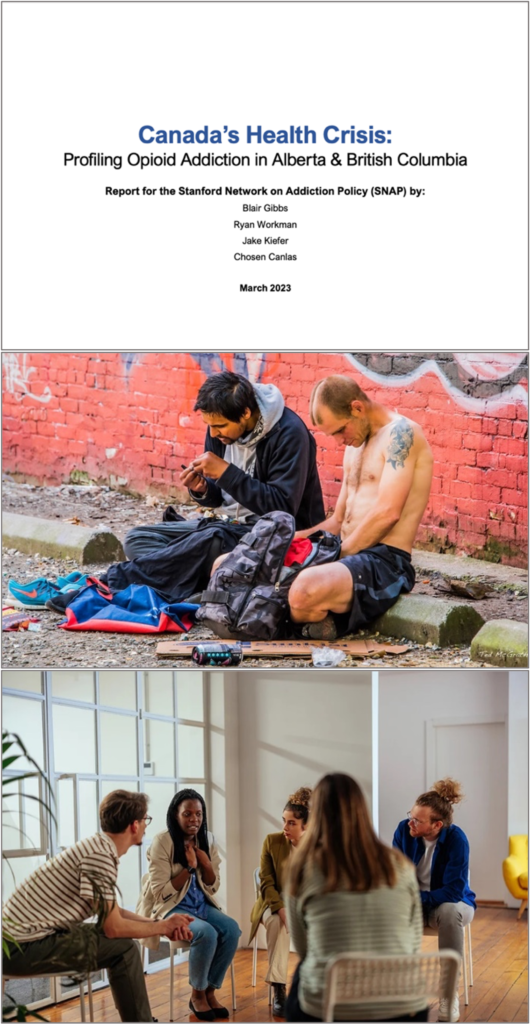
Advantage Alberta: The Stanford Network on Addiction Policy’s 2023 report (depicted above) observes that, “Alberta is currently experiencing a reduction in key addiction-related harms,” while “Canada overall, and BC in particular, is not yet showing the progress that the public and those impacted by drug addiction deserve.” At middle, a typical street scene in Vancouver’s Downtown Eastside; at bottom, a therapy session at Alberta’s new Red Deer Recovery Community. (Sources of photos: (middle) Ted McGrath, licensed under CC BY-NC-SA 2.0 DEED; (bottom) EHN Canada)
That problem was partially solved last year with the release of a report from the U.S.-based Stanford Network on Addiction Policy. Entitled Canada’s Health Crisis: Profiling Opioid Addiction in Alberta & British Columbia, the document offers an even-handed review of the differing policies of the two provinces, summarizes the latest available data (which it criticizes as inadequate) and cautiously evaluates the results. B.C., the report notes, emphasizes harm reduction, “safe supply” of illicit drugs, decriminalization of possession and reduction of addiction stigma. Alberta, by contrast, is focusing on “investment in rehabilitation beds and spaces, such as therapeutic communities,” while moving away from “safe supply” of opioids and instead providing addicts with medications.
Using these differences as a natural experiment, the Stanford report comes to a few key conclusions. First, it observes “a lack of policy innovation in BC on the issue of drug addiction.” Obsessive attention to harm reduction appears to have blinded politicians and public health officials to the longer-term consequences of their favoured policy. “Enforcement against drug crime has [been] reduced in recent years,” the report notes, “indicating a general lessening of criminal justice enforcement against drug offences in Canada during the escalating health crisis of opioid addiction.”
Second, “Of the two provinces studied for this report, Alberta is currently experiencing a reduction in key addiction-related harms.” The province’s rate of overdose deaths declined by 17 percent from 2021 to 2022 (B.C.’s remained almost unchanged), although it was still Alberta’s second-worst year on record. Using the most recent data available, the Stanford researchers point to B.C.’s higher death rate as suggestive of the two approaches’ relative effectiveness: “Our research indicates that Canada overall, and BC in particular, is not yet showing the progress that the public and those impacted by drug addiction deserve.”
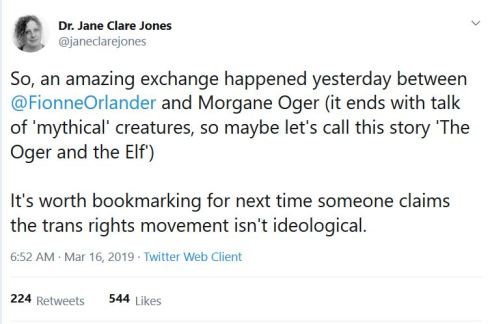
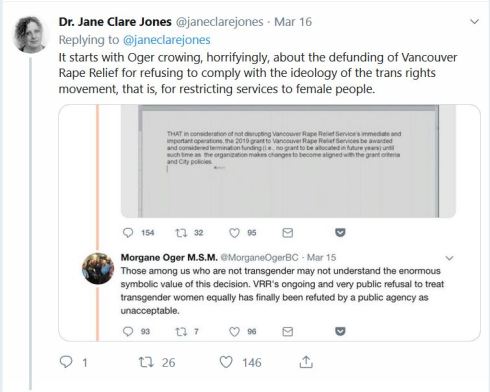
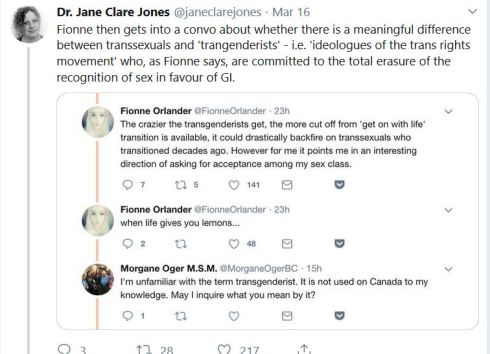
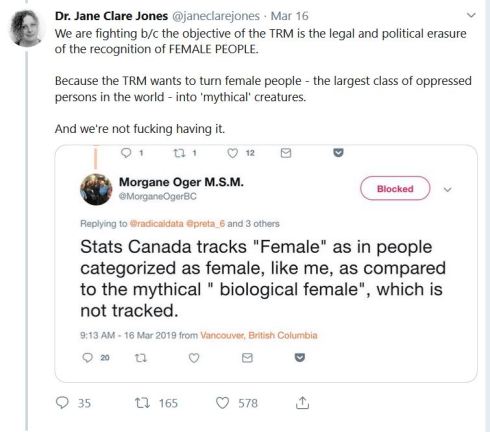
Dr.Jane Clare Jones clearly describes the problem. Here is the link to the twitter thread as the screen captures won’t have active links. And also the quote of the day from Dr. Jane Clare Jones:
“That Morgane Oger, and the movement she represents[transactivism], gives not one flying fuck about the fact that the presence of male-bodied people can cause extreme trauma to already very vulnerable women, is completely evident. Let’s be clear, this is absolute contempt for female people.”
Send an email to the BC NDP and ask them why they are engaged in this brand virulent misogyny.
And now sadly, I have to qualify what I mean when I write the word ‘woman’ because males, with subjective, indescribable feelings have decided that they are also women. So, ‘women’ defined here and in reality refers to adult human females.
Obvious female erasure aside, let’s move on to the news item itself. To summarize – two women have been forced to leave a Woman’s Shelter because a man who calls himself a woman resides there.
Up is not down, dry is not wet, and for goodness sake men are not women. Understand that strong feelings cannot and do not change the biological facts and features of our species.
“Two women are raising concerns about the latest person to move into a Kelowna homeless shelter for women.
“He wants to become a woman, I mean that is his choice but when a man comes into a women’s shelter who still has a penis and genitals he has more rights than we do.” Tracey said.
Tracey is upset that she was made to share a room with a transgender individual, a man transitioning to become a woman.
“They told me, sorry if a person identifies themselves with female, then we have to go with that.” Tracey said.”
Listen to Tracy speaking the truth to power. Men have more rights than women, even in a woman’s shelter, because what a male believes is more important than the safety of actual women.
If you wish to respect reality you can no more identify as a woman as you could identify as a member of different race, or as different physical age. If you happen to have just a casual relationship with reality, it is most definitely your problem, and others should not have to respect your personal fantasy life.
Yet here we be, males being prioritized in a Woman’s Shelter. Orwellian notions and alternative facts are the new truth – so say we all!
“Another client named Blaine was also staying at the shelter. She recently fled from an abusive relationship and says she’s uncomfortable with a transgender person staying at women’s only facility.
“Some women have had bad experiences with men so they are fleeing men and now we have a man living there,” Blaine said.”
The root problem male violence, never seems to get any air time. We, as a society continue to dance around the very real problems of male socialization and male violence and prefer to, as always, give short shrift to women and the life defining problems they face while living in a patriarchal society.
“The shelter is run by the NOW Canada Society. While the organization declined an interview on the matter, it did issue the following statement to Global News.
“NOW Canada cannot speak to specific cases. It is against the law to discriminate against transgender individuals. NOW Canada and other shelters in Kelowna welcome people without regard to age, race, religion and gender identity.”
Are you feeling the equality? Basking in the wonderful egalitarian outcomes where unsurprisingly, the questionably superfluous needs of males, are prioritized over the physical safety of women?
I’m not. I’m seeing patriarchy and misogyny in action. I’m seeing men’s rights activism in action, I’m seeing the damage done to women because we as a society have uncritically accepted the nebulous notion that ‘gender identity’ is somehow more real that physical, biological fact.
“On Thursday morning, both Blaine and Tracey were asked to leave the shelter for good after speaking to the media and breaking the confidentiality agreement designed to protect the safety of all the clients. But now they say their safety has been compromised after being tossed out on the street.
“Hopefully we will stay safe,” Blaine said.”
Yes. Hopefully indeed, while the male, in a female only space remains safe and sound. The important class of people is protected, sorry ladies, you are just not welcome in a Woman’s Shelter anymore.
What is ad block? It is an application that, at your discretion blocks out advertising so you can browse the internet for content as opposed to ads. If you do not have it, get it here so you can enjoy my blog without the insidious advertising.





 The politics of gender identity hurt women.











 bleatmop
 Mystro


 Dead Wild Roses
Your opinions…