
You are currently browsing the tag archive for the ‘Canada’ tag.
Decoding activist language is a tiresome, but important task. I’ll print the original letter, and then an annotated version that identifies that tropes and linguistic warfare undertaken.
“Morgan’s Warriors stands firmly against all forms of denialism that attempt to dismiss, distort, or erase the lived truths of Indigenous Peoples – particularly the truths surrounding the residential school system, Missing and Murdered Indigenous Women, Girls, and Two-Spirit People (MMIWG2S+), and the intergenerational impacts of colonial violence.
Truth Cannot Be Denied
The evidence of abuse, death, and cultural genocide committed in residential schools across Canada is well-documented through survivor testimony, government records, and community-led ground searches.
To deny or minimize these truths is not an act of “critical thinking” – it is an act of racism. Denialism invalidates Indigenous experiences, mocks the pain of survivors, and attempts to erase the memory of children who never made it home.Truth is not a debate. It is a moral responsibility. Every act of denial reopens old wounds and deepens the trauma that Indigenous families and communities have carried for generations.
Denialism Protects Colonial Power
Denialism is not harmless. It protects systems of privilege and power that continue to benefit from Indigenous suffering.
By denying genocide, forced assimilation, and systemic racism, denialists shield the very institutions – churches, governments, and agencies – that carried out these atrocities.
This refusal to accept truth sustains ongoing colonial violence and stands directly in opposition to reconciliation, justice, and healing.
The Human Cost of Denial
Every denial of truth is a denial of humanity.
When someone says the graves aren’t real, or that survivors are lying, they are telling Indigenous peoples that their history, their grief, and their voices do not matter.
This dehumanization is the very essence of racism. It silences survivors and retraumatizes those who continue to live with the scars of Canada’s colonial past.
Reconciliation Demands Truth
Reconciliation begins with truth. It cannot coexist with denial.
We call upon all Canadians — educators, leaders, and citizens — to confront denialism wherever it appears: in classrooms, media, institutions, or conversations.
We must choose truth over comfort, accountability over avoidance, and humanity over hate.To deny truth is to deny the future. To face truth is to heal it.
Our Commitment
Morgan’s Warriors will continue to:
• Uphold the truths shared by survivors, families, and communities.
• Support Indigenous-led investigations into missing children and unmarked graves.
• Confront racism and denialism in public discourse and policy.
• Educate and advocate for truth and justice in alignment with the 231 Calls for Justice and the United Nations Declaration on the Rights of Indigenous Peoples (UNDRIP).Final Words
Denialism is not dialogue — it is discrimination.
Racism is not freedom of speech — it is a wound that silences truth.
We stand with survivors, families, and all truth-tellers.We believe you. We honour you. We will never deny you.”
And now the annotated version:
Morgan’s Warriors stands firmly against all forms of denialism that attempt to dismiss, distort, or erase the lived truths of Indigenous Peoples—particularly the truths surrounding the residential school system, Missing and Murdered Indigenous Women, Girls, and Two-Spirit People (MMIWG2S+), and the intergenerational impacts of colonial violence. [Identitarian Trope: Prioritizes “Indigenous Peoples” as a unified identity group with exclusive claim to “lived truths,” framing external skepticism as erasure; this reinforces identity-based epistemology where group membership grants epistemic privilege.] [Wound Collecting: Lists specific traumas (residential schools, MMIWG2S+, colonial violence) to accumulate moral weight, positioning the group as perpetual victims to justify advocacy.]
Truth Cannot Be Denied. The evidence of abuse, death, and cultural genocide committed in residential schools across Canada is well-documented through survivor testimony, government records, and community-led ground searches. [Leftist Trope: Invokes “cultural genocide” as systemic critique of colonialism, aligning with anti-imperialist narratives that view institutions as inherently oppressive.] To deny or minimize these truths is not an act of “critical thinking”—it is an act of racism. [Leftist Trope: Equates skepticism with racism, a common tactic in progressive discourse to delegitimize opposition by associating it with structural bigotry, shutting down debate.] [Identitarian Trope: Centers racial identity, implying only non-Indigenous or “colonial” perspectives engage in denial, reinforcing an us-vs-them binary.] Denialism invalidates Indigenous experiences, mocks the pain of survivors, and attempts to erase the memory of children who never made it home. [Wound Collecting: Amplifies “pain of survivors” and lost children to evoke emotional response, collecting historical wounds to bolster the argument’s urgency and moral superiority.] Truth is not a debate. It is a moral responsibility. Every act of denial reopens old wounds and deepens the trauma that Indigenous families and communities have carried for generations. [Wound Collecting: Explicitly references “reopens old wounds” and “deepens the trauma,” using intergenerational suffering as a rhetorical device to portray denial as ongoing violence, thereby claiming victimhood as a shield against critique.]
Denialism Protects Colonial Power. Denialism is not harmless. It protects systems of privilege and power that continue to benefit from Indigenous suffering. [Leftist Trope: Frames denial as upholding “systems of privilege and power,” drawing on Marxist-inspired analysis of colonialism as economic and social exploitation persisting today.] [Identitarian Trope: Positions “Indigenous suffering” as central to identity, contrasting it with non-Indigenous “privilege” to highlight power imbalances.] By denying genocide, forced assimilation, and systemic racism, denialists shield the very institutions—churches, governments, and agencies—that carried out these atrocities. [Leftist Trope: Targets “institutions” like churches and governments as agents of “systemic racism,” promoting a narrative of institutional reform or dismantling as necessary for justice.] This refusal to accept truth sustains ongoing colonial violence and stands directly in opposition to reconciliation, justice, and healing. [Wound Collecting: Ties denial to “ongoing colonial violence,” extending past wounds into the present to justify continued activism and demand reparations.]
The Human Cost of Denial. Every denial of truth is a denial of humanity. When someone says the graves aren’t real, or that survivors are lying, they are telling Indigenous Peoples that their history, their grief, and their voices do not matter. [Identitarian Trope: Elevates “Indigenous Peoples” voices as inherently valid, dismissing challenges as dehumanizing, which enforces identity-based hierarchies in discourse.] [Wound Collecting: Focuses on “grief” and invalidated “history” to accumulate emotional injuries, using them to indict critics.] This dehumanization is the very essence of racism. [Leftist Trope: Defines racism broadly as “dehumanization,” encompassing not just overt acts but denial of narratives, aligning with expansive definitions in critical race theory.] It silences survivors and retraumatizes those who continue to live with the scars of Canada’s colonial past. [Wound Collecting: References “scars” and “retraumatizes,” metaphorically collecting physical and emotional wounds to emphasize perpetual harm.]
Reconciliation Demands Truth. Reconciliation begins with truth. It cannot coexist with denial. We call upon all Canadians—educators, leaders, and citizens—to confront denialism wherever it appears: in classrooms, media, institutions, or conversations. [Leftist Trope: Advocates collective action against “denialism” in public spheres, echoing calls for societal re-education and institutional accountability in progressive movements.] We must choose truth over comfort, accountability over avoidance, and humanity over hate. To deny truth is to deny the future. To face truth is to heal it. [Identitarian Trope: Frames “truth” as Indigenous-centered, implying non-Indigenous “comfort” and “avoidance” stem from privilege, reinforcing group-based moral dichotomies.]
Our Commitment. Morgan’s Warriors will continue to: Uphold the truths shared by survivors, families, and communities. Support Indigenous-led investigations into missing children and unmarked graves. Confront racism and denialism in public discourse and policy. [Leftist Trope: Prioritizes “Indigenous-led” efforts and confronting “racism in policy,” advocating for decolonized approaches over mainstream ones.] Educate and advocate for truth and justice in alignment with the 231 Calls for Justice and the United Nations Declaration on the Rights of Indigenous Peoples (UNDRIP).
Final Words. Denialism is not dialogue—it is discrimination. Racism is not freedom of speech—it is a wound that silences truth. [Wound Collecting: Portrays racism itself as a “wound,” inverting the dynamic to collect societal harms as part of the Indigenous experience.] [Leftist Trope: Rejects “freedom of speech” for denialism, prioritizing harm prevention over open debate, a stance common in hate speech regulations.] We stand with survivors, families, and all truth-tellers. We believe you. We honour you. We will never deny you. [Identitarian Trope: Affirms solidarity based on shared identity and experiences, excluding deniers and centering “survivors” as authoritative.]
And here is a handy glossary of why using these tropes is bad for Western Liberal Democratic societies.
Glossary of Leftist Tropes
This glossary enumerates and explicates each Leftist trope identified in the annotated rewrite of the statement. Entries are drawn directly from the annotations, with explanations grounded in observable patterns from political discourse, critical theory, and historical leftist frameworks. Each trope is presented with its core characteristics, contextual application in the text, and verifiable rationale, prioritizing empirical accuracy over ideological endorsement. Additionally, a brief refutation is provided for each, detailing its corrosive effects on Western liberal democratic societies, which emphasize individual liberties, open inquiry, pluralism, and evidence-based governance.
Advocates Collective Action Against Denialism: This trope calls for widespread societal intervention—targeting educators, leaders, and citizens—to suppress denialism in public arenas like classrooms and media. It reflects progressive strategies for re-education and accountability, akin to historical leftist mobilizations against perceived systemic threats, as seen in anti-fascist or decolonization campaigns. In the statement, it manifests as a directive to “confront denialism wherever it appears,” emphasizing communal responsibility to enforce narrative conformity.
Refutation: This trope undermines pluralism by mobilizing collective pressure to stifle dissent, eroding the democratic principle of open debate and risking authoritarian conformity, where majorities or activists impose orthodoxy rather than allowing verifiable evidence to prevail through rational discourse.
Defines Racism Broadly as Dehumanization: Here, racism extends beyond explicit acts to include narrative denial, aligning with critical race theory’s expansive view that subtle invalidations perpetuate oppression. Verifiable in works like those of Ibram X. Kendi or Kimberlé Crenshaw, this trope reframes intellectual disagreement as harm. The statement applies it by asserting that denying graves or survivor accounts equates to telling Indigenous Peoples their “voices do not matter,” thus broadening racism to encompass epistemic violence.
Refutation: By inflating racism to cover mere disagreement, it dilutes the term’s meaning, fostering a chilling effect on free expression and hindering verifiable truth-seeking, as citizens fear reputational harm for questioning narratives, contrary to liberal ideals of tolerance and empirical scrutiny.
Equates Skepticism with Racism: A rhetorical device that links doubt or “critical thinking” to bigotry, effectively closing off debate by moral condemnation. Rooted in leftist critiques of neutrality as complicity (e.g., in anti-racism literature), it delegitimizes opposition. The text uses this by declaring denial “not an act of ‘critical thinking’—it is an act of racism,” positioning skepticism as inherently prejudiced rather than evidence-based.
Refutation: This stifles scientific and intellectual inquiry, core to Western liberalism, by labeling evidence-based doubt as moral failing, which corrodes democratic discourse and invites dogmatic echo chambers where truth is subordinated to ideological purity.
Frames Denial as Upholding Systems of Privilege and Power: Drawing from Marxist analyses of class and colonialism (e.g., Frantz Fanon or contemporary dependency theory), this trope portrays denial as a mechanism sustaining exploitation. It highlights how denial “protects systems… that continue to benefit from Indigenous suffering,” verifiable in leftist scholarship on neocolonialism, where truth denial preserves economic and social hierarchies.
Refutation: It promotes a conspiratorial view of society as perpetually rigged, undermining trust in institutions and individual agency, which erodes liberal democracy’s foundation in meritocracy and rule of law, replacing verifiable accountability with class-based suspicion and division.
Invokes Cultural Genocide as Systemic Critique: This employs the term “cultural genocide” to indict colonialism holistically, viewing institutions as engines of erasure. Aligned with anti-imperialist narratives in leftist thought (e.g., UN definitions influenced by Raphael Lemkin), it critiques inherent oppressiveness. In the statement, it references “abuse, death, and cultural genocide” as documented, framing the residential system as deliberate structural violence.
Refutation: Overuse of loaded terms like “genocide” for historical analysis inflames polarization without nuance, corroding democratic dialogue by equating past injustices with contemporary intent, thus impeding balanced policy-making rooted in verifiable facts rather than emotive hyperbole.
Prioritizes Indigenous-Led Efforts and Confronting Racism in Policy: Emphasizing decolonized, group-specific approaches over universal ones, this trope advocates for policy reforms rooted in marginalized leadership. Echoing leftist decolonization theories (e.g., Linda Tuhiwai Smith’s work), it commits to “Indigenous-led investigations” and alignment with UNDRIP, verifiable as a push against mainstream assimilationist policies.
Refutation: By favoring group identity over individual equality, it fragments society along identitarian lines, undermining liberal democracy’s commitment to universal rights and merit-based governance, potentially leading to exclusionary policies that prioritize ancestry over verifiable expertise or consensus.
Rejects Freedom of Speech for Denialism: This prioritizes harm mitigation over unfettered expression, common in leftist arguments for hate speech limits (e.g., European models or Canadian section 319 of the Criminal Code). The statement declares “Racism is not freedom of speech—it is a wound that silences truth,” framing denial as discriminatory rather than protected dialogue, thus justifying censorship in service of equity.
Refutation: Curtailing speech on subjective grounds erodes the First Amendment-like protections central to Western liberalism, inviting state or social censorship that suppresses verifiable debate, historically leading to tyrannical outcomes where power defines “harm” to silence opposition.
Targets Institutions as Agents of Systemic Racism: By naming churches, governments, and agencies as perpetrators shielded by denial, this trope promotes institutional overhaul or dismantling. Grounded in leftist institutional critiques (e.g., Michel Foucault’s power structures or Antonio Gramsci’s hegemony), it asserts denial “shields the very institutions… that carried out these atrocities,” verifiable in analyses of colonial legacies as ongoing systemic failures.
Refutation: This fosters pervasive distrust in foundational institutions without proportionate evidence, corroding social cohesion and governance in liberal democracies, where verifiable reform through democratic processes, not wholesale condemnation, sustains progress and stability.

The UK government under Prime Minister Keir Starmer has introduced the so-called BritCard proposal: a mandatory digital identity (ID) scheme set to roll out by 2029. According to Reuters and other major outlets, the idea is that workers will need this digital ID for right-to-work checks, and over time it may be extended to access public services like tax records, childcare, welfare, etc. (reuters.com) Critics argue it creates centralized databases, raises risks of surveillance, invites overreach, and may pave the way for a social credit framework. (theguardian.com)
A social credit system, like the one China is implementing, is where citizens are monitored, graded or blacklisted for various behaviors (both major and minor), and then rewarded or punished accordingly. In China, examples include: blocking millions of people from buying airplane or train tickets due to “discredited behaviour” (which might include unpaid fines or minor public misbehavior); preventing access to education or luxury purchases; placing people or companies on public blacklists affecting their livelihoods; and using facial recognition and wide surveillance to monitor compliance. (theguardian.com) Such a system curtails freedoms: freedom of movement, career opportunities, public participation, and even speech if one criticizes the state or fails to conform to expected norms.
The UK’s BritCard digital ID proposals, alongside other legislative trends, are troubling signs of creeping authoritarianism—where government tools offer the capacity for control as much as for convenience. Canada shows similar risks: its proposed Combatting Hate Act includes expanding definitions of hate speech, creating new offences for obstruction, intimidation, and streamlining hate-speech and propaganda prosecutions. (canada.ca) While aiming to protect vulnerable communities, such expanded powers risk chilling free speech, targeting dissent, and giving the state too much discretion over what is or isn’t allowable expression. As free societies, the West must resist anything resembling social credit systems dressed up as digital ID or online-hate regulation.

The Panopticon come to life.
What Social Credit Means for Freedom
Here’s what is at stake if systems like China’s are ever adopted in the West:
- Freedom of Movement: Bans on travel by air, train, or road for those with low “scores.”
- Freedom of Speech: Criticism of the government or “unharmonious” views can lower your score.
- Economic Opportunity: Blacklisting can prevent people from starting businesses, holding jobs, or receiving loans.
- Privacy & Autonomy: Facial recognition, mass surveillance, and data collection track daily life in detail.
- Access to Education & Services: Children of “blacklisted” parents have been denied access to private schools.
- Social Participation: Public shaming lists and score rankings reduce citizens to state-monitored reputations.
- Rule of Law: Arbitrary and opaque standards allow punishment without due process.
References
- Reuters – Britain to introduce mandatory digital ID cards
- FT – Digital ID: what is the UK planning, and why now?
- The Guardian – Digital ID plan for UK risks creating an ‘enormous hacking target’
- The Guardian – China bans 23m ‘discredited’ citizens from buying travel tickets
- CNBC – China to stop people traveling who have bad ‘social credit’
- Sohu – Examples of Chinese blacklists and restrictions
- Government of Canada – Combatting Hate Act – proposed legislation
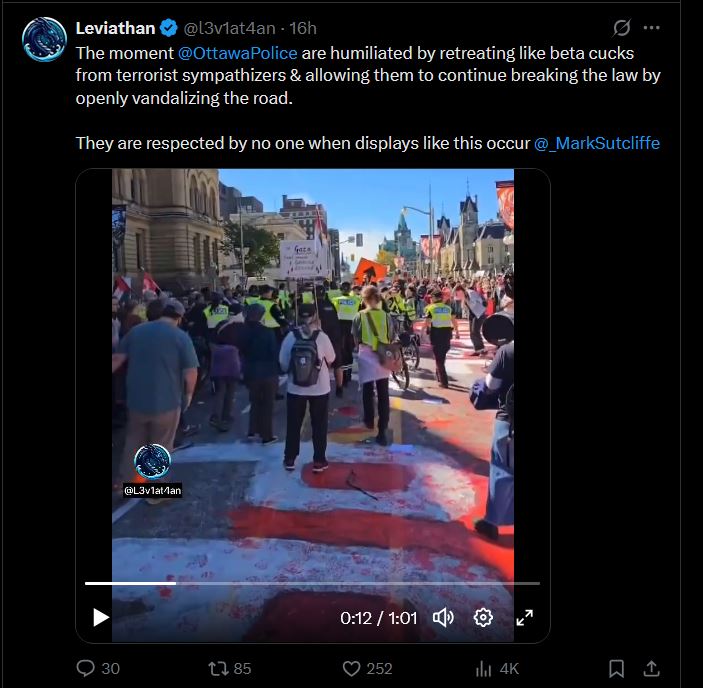
On September 20, 2025, activists from the “Draw the Line” movement staged a highly visible protest directly in front of Parliament Hill, painting a large red-and-white mural on Wellington Street. Ottawa Police closed the street for hours to facilitate the action, citing the use of washable paint, though critics noted that under Canada’s Criminal Code and municipal bylaws, the activity qualifies as vandalism. Two arrests occurred during clashes as protesters attempted to expand the mural near the Prime Minister’s Office. Hundreds participated, and cleanup concluded later the same day, with no reported injuries but lingering questions about liability for slippery surfaces (Ottawa Citizen, CTV News Ottawa, Ottawa CityNews, CBC News). Video evidence posted on X by @l3v1at4an shows police standing by as activists painted, sparking over 450 replies highlighting perceived enforcement disparities (X Thread).
Contrast this with the 2022 Freedom Convoy protests: organizers faced weeks of sustained police enforcement, arrests, and eventually prosecutions including mischief and counselling to disobey court orders. High-profile participants like Tamara Lich and Chris Barber were convicted and sentenced, while the federal government invoked the Emergencies Act — a level of response not seen for the mural or similar protests. The discrepancy demonstrates a clear selective approach in how law enforcement applies the law depending on the protesters’ affiliation, cause, or perceived political stance (AP News, CBC).
The mural incident, combined with historical patterns, fuels concerns over two-tier policing: some groups are allowed to vandalize public property with minimal immediate consequence, while others are met with swift arrest, prosecution, or extraordinary federal enforcement. Canadians deserve equal application of the law — whether it’s a climate mural, a roadblock, or any form of civil demonstration. When enforcement varies by cause, political affiliation, or identity, trust in public institutions erodes, and the perception of injustice becomes reality.
References
- Ottawa Citizen — “Two arrests amid Wellington Street mural painting” (Sept 20, 2025) — https://ottawacitizen.com
- CTV News Ottawa — Coverage of Draw the Line protest and police confirming street closure for washable paint removal — https://ottawa.ctvnews.ca
- Ottawa CityNews — “Hundreds participate in 65-foot mural as part of nationwide rallies” — https://ottawacitynews.ca
- CBC News — “Mural in front of Carney’s office with police aiding the demonstration” — https://cbc.ca
- X Thread by @l3v1at4an — Video evidence of police standing by as activists paint; 450+ replies discuss selective enforcement — https://x.com/l3v1at4an/status/1969466596499308628
- AP News — “Prominent figure from Canada’s trucker protests found guilty” — https://apnews.com/article/3975bb6bbd0c089e0c56cebbe9187fd2
- CBC News — Freedom Convoy prosecutions (Tamara Lich, Chris Barber, Chris) — https://cbc.ca
In Canada’s high-trust society, the rule of law cannot endure selective enforcement. When certain groups are shielded from consequences while others face harsh penalties for identical actions, the principle of equality before the law collapses. What emerges instead is favoritism by creed or identity—a betrayal that fragments unity and breeds resentment.
Uneven Standards in Practice
Toronto street prayers (August 2024). Hundreds of worshippers staged outdoor prayers at a busy downtown intersection, apparently without permits, halting traffic. Police did not intervene and later described the disruption as lawful. Few doubt how a Christian congregation attempting the same would have been treated: injunctions would be swift, fines inevitable. The point is not hostility toward prayer, but the evident double standard.[1]
Reckless firearm discharge in Muskoka (August 2025). Videos surfaced of men firing rifles and pistols from a snowmobile bridge near MacTier. Ontario Provincial Police confirmed an investigation, warning that careless use of firearms can bring Criminal Code charges. Yet similar celebratory gunfire at cultural festivals, whether at South Asian weddings or Indigenous gatherings, often receives muted responses or “contextual” exemptions. Danger is danger, regardless of tradition.[2]
Pro-Palestinian marches in Toronto (2024–2025). Demonstrations repeatedly blocked major roads, including rallies where smoke bombs were deployed from overpasses. Despite millions spent on policing, arrests remained rare—only 24 across hundreds of events by March 2024. Contrast this restraint with the 2022 Freedom Convoy in Ottawa, where the Emergencies Act was invoked, bank accounts were frozen, and police forcibly dismantled encampments. The contrast is glaring: enforcement appears to hinge less on infractions than on identity and political alignment.[3][4]
Mill’s Warning on Law and Liberty
John Stuart Mill, in On Liberty (1859), emphasized that genuine freedom depends on impartiality of the law. If rules are applied based on popularity or group identity, he argued, society replaces principle with prejudice, inviting arbitrary power. Selective enforcement, Mill warned, is a subtle but corrosive path to tyranny—not only by the state but by favored factions within society.[5]
Restoring Trust
A society built on trust cannot thrive under inconsistent law enforcement. The law must apply equally, regardless of race, religion, or political leaning. To preserve legitimacy, policing standards should be codified and subject to independent oversight. Discretion is unavoidable, but unreviewed discretion becomes favoritism. Equality before the law is not optional—it is the bedrock of Canadian unity. Without it, trust will wither, and division will prevail.

References
- “Toronto residents upset after Hamas supporters blockade busy intersection.” Juno News, Mar 21, 2025. Link
- “Gun video sparks OPP investigation.” MuskokaRadio.com, Aug 28, 2025. Link
“UPDATE: Bracebridge OPP investigating social media videos depicting unlawful firearm use.” MyMuskokaNow, Aug 28, 2025. Link
“OPP seek public help in identifying men firing guns off bridge in Mactier.” Barrie360.com, Aug 30, 2025. Link - “Police arrest two at pro-Palestinian rally that delayed Trudeau event in Toronto.” CityNews, Mar 15, 2024. Link
“Palestine solidarity protesters attacked by police in Toronto.” People’s Dispatch, Apr 3, 2024. Link
“Violent Crackdown at Land Day March.” The Grind Magazine, Mar 31, 2024. Link - “Canada convoy protest.” Wikipedia, accessed Sept 2025. Link
“TD Bank freezes accounts that received money for Canada protests.” Reuters, Feb 12, 2022. Link - Mill, J.S. On Liberty. London: John W. Parker and Son, 1859.
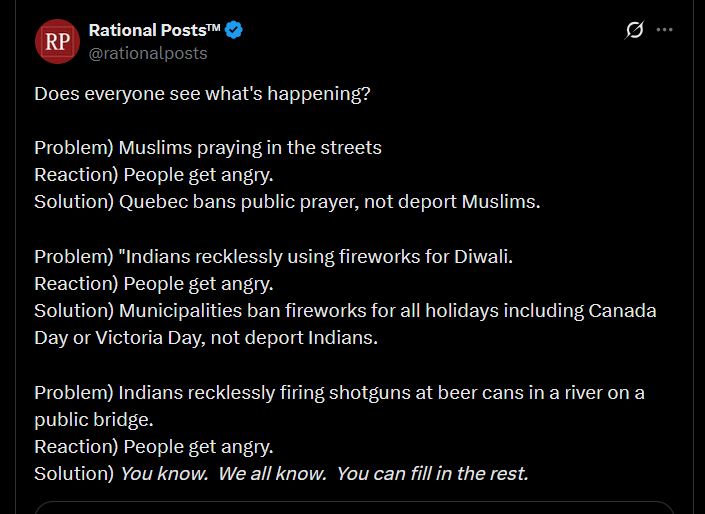
The solution to thwart this insidious strategy of systematically stripping Canadians of their rights lies in enforcing the law with unyielding equality, blind to race or religion, a principle that stands as the bedrock of a just society. The Rational Posts narrative reveals a troubling trend: public outrage over Muslims praying in streets or Indians celebrating Diwali with fireworks, and now shotguns on a bridge, triggers blanket bans, from Quebec’s prohibition on public prayer to municipal fireworks restrictions, effectively punishing entire communities rather than addressing specific transgressions. This corrosive approach, echoing the divisive echoes of Jim Crow or apartheid, corrodes multicultural unity and foments resentment, as social cohesion studies irrefutably demonstrate. Instead, precise legislation targeting reckless acts, such as discharging firearms irresponsibly, must replace these broad edicts, ensuring accountability without stifling cultural expression. Fair laws unite: bans divide. Let us, with urgent resolve, choose the former and reclaim a Canada where justice, not prejudice, prevails.
The latest claim of “unmarked graves” at St. Joseph’s Mission Residential School in British Columbia exposes a familiar pattern: sweeping headlines, scant evidence. On August 14, 2025, the Williams Lake First Nation announced ground-penetrating radar (GPR) detected 16 “anomalies.” Global News and others framed them as “potential burial sites.” Yet no remains have been confirmed, substituting implication for proof.
Canadians know this script. In 2021, Kamloops’ claim of 215 “graves” became Canada’s “news story of the year,” sparking global outrage and $12 million in federal funding. Four years on, no bodies surfaced—GPR anomalies aligned with tree roots or septic tiles. Still, the unverified narrative lingers as proof of mass graves.
Geophysicists note GPR cannot distinguish human remains from soil disruptions—a fact buried in coverage. Yet sensational claims yield dividends: $8 million in reconciliation grants since 2021, media clout, and moral authority, all absent hard evidence. The Williams Lake announcement follows suit, with no excavation planned, only “consultation.”
None of this negates the residential school era’s tragedies—deaths from disease or neglect were documented. But inflating anomalies into “graves” distorts history, manipulates grief, and diverts resources from urgent Indigenous needs. Worse, a proposed federal bill to criminalize “denialism” would shield such claims from scrutiny, turning skepticism into heresy.
Truth demands excavation, not headlines. Until anomalies are verified, Canadians are asked to mistake speculation for fact. That is not reconciliation—it is a grave error, fracturing trust in a nation desperate for unity.

Sources Referenced
- Global News, “Williams Lake First Nation Finds 16 Potential Burial Sites,” August 14, 2025
- Fraser Institute, “No Evidence of ‘Mass Graves’ in Residential Schools,” February 12, 2024
- National Post, “Kamloops Graves Remain Unproven,” April 6, 2025
- Struggles-Activist.com, “Three Years Later, Canadian ‘Mass Graves’ Claims Remain Unproven,” January 7, 2025
- Aggregated X posts, August 2025
Canada’s tariff wars reveal a glaring double standard: confrontation with Communist China draws muted shrugs, while disputes with the United States ignite fiery “elbow up” rhetoric and national outrage. When China slapped a 75.8% tariff on Canadian canola in August 2025—retaliation for Ottawa’s 100% tariff on Chinese electric vehicles and 25% on steel and aluminum announced earlier that spring—Manitoba farmers were left reeling. Nearly half of their canola exports go to China, and industry estimates project multi-billion-dollar losses. Yet Canada’s political class and major media outlets framed Beijing’s move as a mere “tit-for-tat” trade dispute, urging patience and diplomacy. Outside the mainstream, social media filled with posts lamenting the devastation in farm country.
Contrast this with the uproar over U.S. tariffs. In March 2025, President Donald Trump imposed 25% duties on Canadian goods (excluding energy), escalating them to 35% by August. Ottawa erupted. Prime Minister Mark Carney thundered about the need for a unified “North American market,” while pundits and media outlets blasted “unjustified” American aggression. Canadians were rallied with slogans of defiance and “elbow up” resolve. Yet under CUSMA, more than 85% of Canada–U.S. trade remains tariff-free, meaning the outrage over Washington’s measures dwarfed the reaction to China’s far heavier blow to canola.
The contrast betrays selective indignation. China, an authoritarian regime, cripples a vital Canadian industry yet escapes national fury. The United States, a democratic ally, delivers a lesser economic hit and is vilified. Such narrative hypocrisy undermines both unity and credibility, sacrificing farmers’ livelihoods for geopolitical posturing. If Canada roars at Washington but bows to Beijing, it sends a dangerous message: principle is negotiable, and farmers are expendable.

Sources:
-
Statistics Canada, 2023 Trade Data
-
CBC News, “China’s Tariffs on Canadian Canola,” Aug. 13, 2025
-
Fraser Institute, “Trump’s Trade War Update,” Aug. 12, 2025
-
Globe and Mail, “Over 85% of Canada–U.S. Trade Remains Tariff-Free under CUSMA,” Aug. 2025
-
Aggregated X posts, Aug. 2025











 bleatmop
 Mystro
 The Arbourist


 Dead Wild Roses
Your opinions…