
You are currently browsing the tag archive for the ‘Carl Schmitt’ tag.
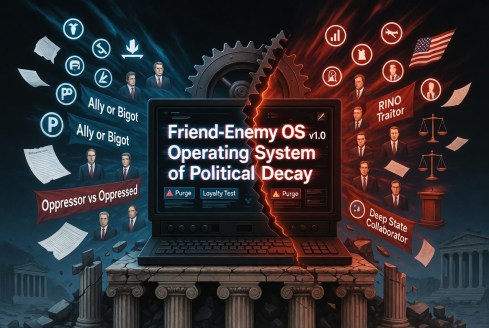
One of the most destructive temptations in politics is the urge to turn disagreement into moralized tribal war. Not argument. Not persuasion. Not the hard, frustrating work of governing a society full of competing interests and imperfect people. War. Friends and enemies. Allies and traitors. The pure and the contaminated. Once that frame takes hold, politics stops being about order, restraint, and judgment. It becomes a loyalty machine. Carl Schmitt gave this instinct its most famous formulation in The Concept of the Political, where he argued that the essence of politics lies in the distinction between public friend and public enemy. He was right to see that real political life can descend to existential conflict. He was wrong to treat that descent as the essence of politics rather than one of the permanent dangers civilized politics is supposed to contain. The friend-enemy distinction is not the foundation of healthy politics. It is the logic of political decay.
The danger is not only that the framework is harsh. Politics can be harsh. The danger is that it installs enmity at the center of public life and pushes everything else to the margins. Institutions, laws, debate, compromise, constitutional limits, due process, even ordinary factual disagreement all become secondary. What matters is identifying the enemy, consolidating the team, and punishing hesitation. That is why this logic travels so easily across ideologies. It can appear in revolutionary Marxism, in Maoist “enemies of the people,” in Islamist loyalty-and-disavowal frameworks, in activist binaries like ally versus bigot or oppressor versus oppressed, and in right-wing scripts about traitors, regime collaborators, and weak conservatives who supposedly enable the left. The vocabulary changes. The mechanism does not. A public enemy is named, and then a moral test is imposed: how fully will you align against him?
“The ratchet always turns one way: toward greater fanaticism, greater purification, greater moral ugliness. Truth is subordinated to solidarity. Principle is subordinated to faction.”
What makes this logic totalitarian is that it abolishes the space for dissent. Once the enemy has been declared, neutrality is no longer allowed. You either join the mobilization or you are suspected of serving the enemy’s cause. Hesitation becomes complicity. Refusal becomes betrayal. Moderation becomes guilt. That is how political movements become purge machines. You can either be anti-racist or you are helping racism. You can either be a trans ally or you are enabling bigotry. You can either fight the deep state, resist the regime, and oppose the left without reservation, or you are a RINO, a coward, a collaborator. This is the structure that matters. Not the tribe wearing it. Once politics is moralized into friend and enemy, the pressure falls hardest not only on official opponents, but on the insufficiently zealous within one’s own camp.
That is why factions organized around “no enemies to the left” or “no enemies to the right” almost always radicalize inward. The outer edge of the movement becomes untouchable because criticizing it risks helping the enemy. So the only safe targets are moderates, doubters, and fellow travelers who fail the loyalty test. The left protects its most extreme activists and attacks liberals who cannot keep up. The right protects its own hardliners and attacks conservatives who still think prudence, constitutional restraint, or factual discipline matter. In both cases, the center is hollowed out first. The ratchet always turns one way: toward greater fanaticism, greater purification, greater moral ugliness. Truth is subordinated to solidarity. Principle is subordinated to faction. Politics ceases to be the art of living together under conditions of disagreement and becomes a permanent sorting mechanism for friends, enemies, and suspects.
A civilized society cannot survive on those terms. That does not mean pretending enemies never exist. They do. Free societies are not obliged to indulge movements openly hostile to liberty, law, and peaceful coexistence. But the achievement of constitutional civilization is precisely that it refuses to make enmity the organizing principle of normal public life. It channels conflict through law, opposition, procedure, restraint, and rights. It leaves room for disagreement without turning every disagreement into proof of treason. That is the line Schmitt blurred and totalitarian movements erase completely. The mistake is not in noticing that politics can become existential. The mistake is in treating that possibility as the deepest truth of politics and then building public life around it. Once you do that, purges are no longer an accident. They are the destination. Friend-enemy politics is not realism. It is the operating system of political decay.
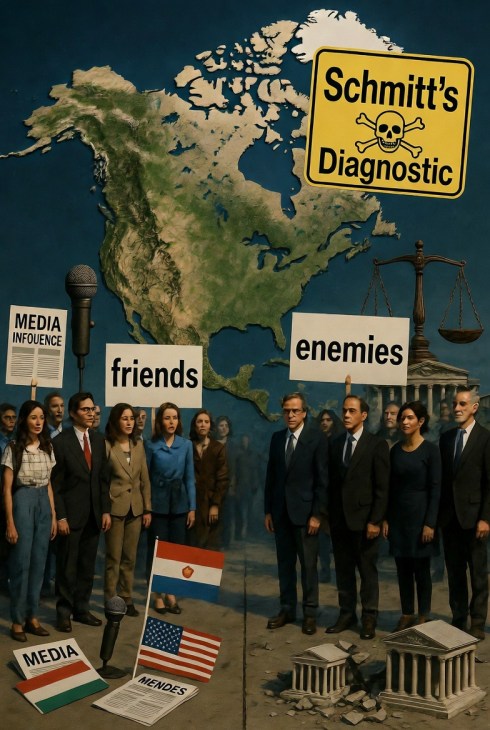
Modern North American politics is increasingly conducted as if the other side is not an opponent but a threat. Not “wrong,” but illegitimate. Not “mistaken,” but dangerous. Once that framing takes hold, everything downstream gets harder: legislating, compromising, trusting institutions, even sharing a country.
There’s a name for this move, and it’s older than social media: the friend–enemy distinction associated with the German jurist Carl Schmitt. Use it carefully. Attribute it correctly. Treat it as a warning label, not a blueprint.
The Schmitt paragraph (correct attribution without laundering)
In The Concept of the Political (first as an essay in 1927; expanded as a book in 1932), Carl Schmitt argued that what is distinctively political is not morality, economics, or aesthetics, but the capacity to sort human beings into friends and enemies—public groupings that can reach the highest intensity and, in the extreme case, make violence thinkable. (Stanford Encyclopedia of Philosophy) Schmitt is a morally compromised figure: he joined the Nazi Party in 1933 and wrote in support of the regime, which makes him “radioactive” as an authority. (Wikipedia) That’s precisely why the concept should be handled as a diagnostic for a recurring political pattern—not as an endorsement of Schmitt’s politics, and not as a permission slip to treat fellow citizens as foes.
That’s the frame. Now the point: you can reject Schmitt’s politics and still find his definition useful for recognizing when a society is sliding from politics-as-bargaining into politics-as-threat-management.
1) What the friend–enemy distinction is (and isn’t)
Schmitt’s core claim is often quoted badly. The clean version is this:
- It’s public, not personal. “Enemy” is not your private dislike. It’s a public adversary, a category applied at the level of groups. (Stanford Encyclopedia of Philosophy)
- It’s about intensity and stakes. The distinction becomes political when disagreement is framed as a contest over a community’s existence or way of life—when coercion becomes not just imaginable but morally narratable. (Stanford Encyclopedia of Philosophy)
- It’s not reducible to morality. In Schmitt’s framing, you can judge an enemy morally good and still treat them as an enemy; the political is not the same thing as ethics. (Stanford Encyclopedia of Philosophy)
So the friend–enemy distinction is less a philosophy lesson than a switch. When it flips on, political disagreement stops being about what we should do and becomes about who is allowed to be “us.”
2) The observable move: how to spot it in the wild
You’re watching friend–enemy politics when rhetoric shifts from:
- “Their plan won’t work” → “They cannot be permitted to govern.”
- “We’ll reverse this policy later” → “If they win, the country is finished.”
- “We can bargain on X” → “Any compromise is betrayal.”
- “Institutions are imperfect” → “Institutions are legitimate only when they deliver our outcomes.”
Here’s the part that matters: this is not just “heated language.” It’s a legitimacy test. The argument isn’t “our side has better ideas.” It’s “the other side is outside the moral community.”
What it sounds like now (no special villains required)
Over the last decade, ordinary campaign language has absorbed a new register: catastrophe certainty. You hear it when routine electoral competition is narrated as a point of no return not “we’ll reverse their policy,” but “if they win, the country is over.” You hear it when every institution that fails to deliver your preferred outcome becomes not merely flawed but captured—courts, schools, public health bodies, legacy media, election administration. Once those are recast as enemy infrastructure, the next step is predictable: treating compromise as collaboration.
That’s the Schmittian escalator: it turns normal democratic rivalry into a kind of internal cold war.
3) Why this maps onto polarization in the U.S. (with verifiable anchors)
American public opinion data increasingly fits the emotional profile you would expect in a friend–enemy environment: high frustration, high anger, low confidence, and pervasive negativity toward the opposing party.
Pew Research Center (survey fielded Sept. 22–28, 2025) reports that roughly half of U.S. adults say each party makes them feel angry (Democratic Party 50%, Republican Party 49%), and large majorities say each makes them feel frustrated (Democratic Party 75%, Republican Party 64%). (Pew Research Center) Pew also reports that majorities view both parties as too extreme (GOP 61%, Democrats 57%). (Pew Research Center)
That doesn’t “prove Schmitt.” It shows a climate where it’s easy for elites and activists to plausibly say: “The other side isn’t just wrong; they’re dangerous.”
Political science has a name for the emotional side of this: affective polarization which is the tendency for partisans to dislike and distrust the out-party as a social group. Iyengar, Sood, and Lelkes argue that affect increasingly operates through social identity dynamics rather than ideological distance alone. (Political Communication Lab)
Affective polarization supplies the fuel. Friend–enemy rhetoric supplies the spark.
4) Why Canada is not “the same,” but not immune
Canada has its own stresses: regional tensions, institutional distrust, culture-war imports, and an online ecosystem shared with the U.S. but it is still a mistake to claim Canada is simply America north.
A careful comparative point looks like this: research summarized by UBC Magazine reports Canadians show moderate affective polarization and lower levels of deeper hostility (political sectarianism) than Americans; divisions exist, but they are less intense, and fewer people treat the other side as morally beyond the pale. (UBC Alumni Magazine)
A note on insulation (not immunity) 🧯
Canada also has some built-in insulation: parliamentary governance can make politics feel less like a single, winner-take-all presidency; multi-party dynamics can prevent a total two-tribe monopoly; party discipline can concentrate bargaining inside caucuses rather than turning every vote into a public loyalty test. None of that makes Canada immune especially in a shared online ecosystem with American media incentives but it helps explain why Canadian polarization can be real without being identical.
5) Why identity politics dovetails so easily (even when it starts as justice) 🧩
“Identity politics” is a term that gets used as a slur, so define it cleanly. The Stanford Encyclopedia of Philosophy describes identity politics as political activity and theorizing rooted in shared experiences of injustice among members of particular social groups, often aiming to secure political freedom for a marginalized constituency. (Stanford Encyclopedia of Philosophy)
That definition is not inherently friend–enemy. You can organize around group experiences without treating dissenters as enemies.
So why the dovetail?
Because identity politics—left and right—naturally foregrounds group boundaries: who counts, who belongs, who’s harmed, who threatens, who is owed what. Schmitt’s point is that any distinction ethnic, cultural, religious, linguistic, and ideological can become politically decisive if it becomes a marker of collective identity with enough intensity. (Stanford Encyclopedia of Philosophy)
Now add moralization. Finkel and colleagues define political sectarianism as “the tendency to adopt a moralized identification with one political group and against another.” (Political Communication Lab) Once politics is moralized at the identity level, compromise starts to look like apostasy: you don’t bargain with evil; you resist it.
Here’s the dovetail in one line:
Identity makes the boundary salient; moralization makes it sacred; friend–enemy logic makes it coercive.
The accelerant: attention economics
The friend–enemy move also fits the modern information economy. Outrage travels; nuance doesn’t. Platforms and partisan media ecosystems reward content that converts complexity into moral clarity so we get villains, victims, emergencies, and betrayal. That incentive structure doesn’t invent the friend–enemy distinction, but it mass-produces it, because existential framing is the most reliable way to keep attention and discipline the in-group.
6) The cost: why friend–enemy politics jams the machinery of governance
When politics is friend–enemy:
- Compromise becomes betrayal.
Not merely “a bad deal,” but disloyalty to the tribe. - Institutions become contested terrain.
Courts, legislatures, bureaucracies, and media are judged not by process but by whether they serve “us.” Legitimacy becomes outcome-dependent. - Policy friction skyrockets.
Even mutually beneficial reforms become hard because the other side’s win is treated as loss of status or existential risk. - Moderation gets punished.
The moderate’s basic civic move—“I’ll grant you partial legitimacy and bargain” gets rebranded as weakness or collaboration.
The social cost (quiet, cumulative, real)
The damage isn’t confined to legislatures. Friend–enemy framing erodes social trust: people self-censor at work, avoid neighbours, and retreat into curated friend-only spaces. Institutions become identity badges your media, your university, your charities, your professional associations until public life resembles a network of gated communities with competing moral jurisdictions.
7) The steelman (and the answer)
Steelman: sometimes the other side really is dangerous. Sometimes a movement is openly anti-democratic, violent, or committed to permanent domination. In those cases, “enemy” language can feel like moral clarity.
Answer: danger exists. But friend–enemy framing is cheap to claim and expensive to live under. The burden of proof has to be high, because once you normalize existential threat talk, you train citizens to treat routine democratic alternation as intolerable. You also incentivize mirroring: nobody wants to be the only player insisting it’s “just politics” while being branded a threat.
Friend–enemy politics is a ratchet. It rarely turns only one way.
8) A short field guide: “know it when you see it”
You’re in friend–enemy territory when you hear:
- “They’re illegitimate.”
- “If they win, the country is over.”
- “Neutrality is complicity.”
- “Compromise is betrayal.”
- “The system is rigged—unless we win.”
- “Your neighbour’s vote is violence / treason / conquest.”
And you’re watching it spread when those claims expand outward to tag neutral institutions and ordinary citizens: not just the party but anyone who isn’t for us is with them.
9) The exit ramp: moderation without naïveté
This is not a call for civility theatre. It’s a call for civic hygiene.
A workable politics of moderation has one core rule:
Treat opponents as lawful rivals unless and until they clearly demonstrate otherwise and even then, be precise.
Practically, that means:
- Argue policy in terms of tradeoffs, constraints, second-order effects (the language of governing, not excommunication).
- Reserve “enemy” language for genuinely exceptional cases, and specify evidence and predictions that could, in principle, be falsified.
- Defend institutional legitimacy as a process, not a scoreboard.
If you can’t do that, you don’t just intensify conflict you corrode the shared premise that makes democratic disagreement possible: that losing an election is not losing the country.
Closing: the consequence if we don’t name it
Schmitt’s concept is dangerous partly because it’s accurate as a description of how politics can harden. Once a society trains itself to see politics as friend versus enemy, it will eventually demand enemy-handling tools: purges, blacklists, emergency powers, legitimacy tests, permanent distrust. The policy state becomes brittle; the civic culture becomes suspicious; moderation becomes a vice.
The friend–enemy distinction is not merely an idea. It’s a habit of mind. And habits, unlike ideologies, don’t require formal assent. They spread by imitation.
The minimum defensive act is to recognize the move when it’s being done to you, and when you’re tempted to do it back. 🧭
Glossary
Affective polarization — Dislike, distrust, and social hostility toward supporters of the opposing party, treated as a group identity rather than merely a set of policy positions. (Political Communication Lab)
Catastrophe register / no-return framing — A rhetorical mode that describes ordinary electoral competition as an existential point of no return (“if they win, the country is over”).
Friend–enemy distinction (Schmitt) — The claim that the political is defined by the capacity to distinguish friend from enemy in a public sense, with sufficient intensity that coercion or violence becomes thinkable in extreme cases. (Stanford Encyclopedia of Philosophy)
Identity politics — Political activity and theorizing grounded in shared experiences of injustice among members of particular social groups, typically aimed at securing political freedom for a marginalized constituency. (Stanford Encyclopedia of Philosophy)
Legitimacy denial — Treating the opposing side as outside the set of lawful rivals who may govern; shifting from “they’re wrong” to “they must not rule.”
Political sectarianism — “The tendency to adopt a moralized identification with one political group and against another,” borrowing the metaphor of religious sects rather than mere teams. (Political Communication Lab)
Process legitimacy — The idea that institutions are legitimate because procedures are lawful, stable, and fairly applied—not because they produce outcomes you like.
Citations (Sources)
- Carl Schmitt (Stanford Encyclopedia of Philosophy), overview of Schmitt and the friend–enemy distinction. (Stanford Encyclopedia of Philosophy)
- Background note on The Concept of the Political and Schmitt’s Nazi Party membership (reference context). (Wikipedia)
- Pew Research Center (Oct 30, 2025), party feelings: anger/frustration measures. (Pew Research Center)
- Pew Research Center (Oct 30, 2025), views of both parties: “too extreme” findings. (Pew Research Center)
- UBC Magazine (Dec 2, 2025), summary of Canadian polarization research and comparative claims. (UBC Alumni Magazine)
- Iyengar, Sood, & Lelkes (2012), “Affect, Not Ideology,” on affective polarization as social identity. (Political Communication Lab)
- Finkel et al. (Science, 2020), “Political sectarianism in America,” definition and framework. (Political Communication Lab)
- Identity Politics (Stanford Encyclopedia of Philosophy), definition and scope. (Stanford Encyclopedia of Philosophy)











 bleatmop
 Mystro
 The Arbourist


 Dead Wild Roses
Your opinions…