
You are currently browsing the tag archive for the ‘CBC Signature Series’ tag.
G-sharp minor is a minor scale based on G♯, consisting of the pitches G♯, A♯, B, C♯, D♯, E, and F♯.
 Few symphonies are written in G♯ minor; among them are Nikolai Myaskovsky’s 17th Symphony, Christopher Schlegel’s 5th Symphony, and an abandoned work of juvenilia by Marc Blitzstein.
Despite the key rarely being used in orchestral music other than to modulate, it is not entirely uncommon in keyboard music, as in the sonatas of Scriabin. For orchestration of piano music, some theorists recommend transposing the music to G minor or A minor. If G-sharp minor must absolutely be used, one should take care that B-flat wind instruments be notated in B-flat minor, rather than A-sharp minor.
A big thanks to the CBC and Paolo Pietropaolo for hosting the Signature Series.
 In music theory, B major is a major scale based on B. The pitches B, C♯, D♯, E, F♯, G♯, and A♯ are all part of the B major scale. Its key signature has five sharps.
Although B major is usually thought of as a remote key (due to its distance from C major in the circle of fifths and its fairly large number of sharps), Frédéric Chopin regarded its scale as the easiest of all to play, as its black notes fit the natural positions of the fingers well; as a consequence he often assigned it first to beginning piano students, leaving the scale of C major till last because he considered it the hardest of all scales to play completely evenly (because of its complete lack of black notes).
A big thanks to the CBC and Paolo Pietropaolo for hosting the Signature Series.
F♯ major or F-sh arp major is a major scale based on F♯, consisting of the pitches F♯, G♯, A♯, B, C♯, D♯, and E♯. Its key signature has six sharps.
Its relative minor is D♯ minor, and its parallel minor is F♯ minor. Its enharmonic equivalent is G♭ major.
F-sharp major is the key of the minuet in Joseph Haydn’s “Farewell” Symphony, of Beethoven’s Piano Sonata, Op. 78, of Chopin’s Barcarolle, of Liszt‘s Hungarian Rhapsody No. 2, of Mahler’s unfinished Tenth Symphony, of Erich Korngold’s Symphony Op. 40, and of Scriabin‘s Fourth Sonata. The key was the favourite tonality of Olivier Messiaen, who used it repeatedly throughout his work to express his most exciting or transcendent moods, most notably in the Turangalîla Symphony.
In a few scores, the F-sharp major key signature in the bass clef is written with the sharp for the A on the top line.
The CBC Signature Series is hosted by Paolo Pietropaolo.
 The CBC Signature Series is hosted by Paolo Pietropaolo.
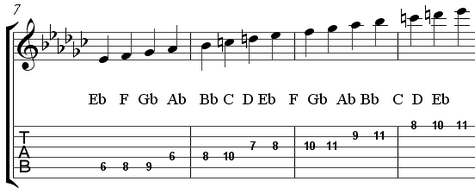
The E♭ (E-flat) minor scale consists of the pitches E♭, F, G♭, A♭, B♭, C♭, and D♭. In the harmonic minor, the D♭ is raised to D♮. Its key signature consists of six flats (see below: Scales and keys).
Its relative major is G-flat major, and its parallel major is E-flat major. Its enharmonic equivalent is D-sharp minor. Changes needed for the melodic and harmonic versions of the scale are written in with accidentals as necessary.
Despite the key rarely being used in orchestral music other than to modulate, it is encountered in a small fraction of keyboard music, and has been most popular in Russian pieces. For orchestration of piano music, some theorists recommend transposing to D minor or E minor.
This key is often popular with jazz or blues influenced keyboard players as, using all the black keys along with the A, it allows for an easily playable blues scale.
 In Book 1 of The Well-Tempered Clavier by Johann Sebastian Bach, Prelude No. 8 is written in E-flat minor while the following Fugue is written in D-sharp minor. In Book 2, both movements are in D-sharp minor.
One of the few symphonies written in this key is Prokofiev’s Symphony No. 6. A few other less well-known Soviet composers also wrote symphonies in this key, such as Andrei Eshpai, Janis Ivanovs (fourth symphony Atlantis, 1941), Ovchinnikov and Nikolai Myaskovsky. Aram Khachaturian wrote his Toccata in E-flat minor while studying under Myaskovsky.
It is also the key in which Dmitri Shostakovich composed his final string quartet.
Alexander Scriabin’s Prelude No. 14 from his 24 Preludes, Op. 11, is in E Flat Minor.
Sergei Rachmaninoff’s Elegie, Op. 3, No. 1, is in E-flat minor, as is his Étude-Tableau, Op. 39, No. 5. These pieces are noted for being dark and mysterious (a characteristic of this key), as shown even in the later jazz compositions “‘Round Midnight” and “Take Five”, which are also in the key.
Oskar Bohme’s Trumpet Sextet, Op. 30 is written in E-flat minor.
The extended orchestral introduction to Part II Gustav Mahler’s Eighth Symphony is in E-flat minor, as is the dark orchestral introduction to Beethoven’s only oratorio, Christ on the Mount of Olives. Jazz composer Thelonious Monk’s most famous composition, ‘Round Midnight is in E-flat minor.
Guitarist Yngwie Malmsteen has composed a number of pieces in E-flat minor, including the Concerto Suite for Electric
 Many thanks to the CBC and Paolo Pietropaolo for bringing the Signature Series to life.
F-sharp minor: The Recluse
Also known as:
The Cat Lady
Miss Lonelyhearts
F-sharp minors you might know:
Miss Havisham from Great Expectations.
Annie Wilkes from Stephen King’s Misery.
Edith Bouvier Beale.
The notes: F♯- G♯ – A – B – C♯ – D – E♯ – F♯.
Number of sharps: three.
Relative major: A major.
What they said about F-sharp minor in the 18th century:
“F-sharp minor, although it leads to great distress, nevertheless is more languid than lethal. Moreover, it has something abandoned, singular and misanthropic about it.” – Johann Mattheson, 1713.
“A gloomy key: it tugs at passion as a dog biting a dress. Resentment and discontent are its language. It really does not seem to like its own position: therefore it languishes ever … for the triumphant happiness of D major.” – Christoph Schubart, 1784.

Thanks to the CBC and Paolo Pietropaolo for hosting the CBC Signature Series. The key de jour is D flat major.
Also known as:
The Flower Child.
The New Age Mystic.
D-flat majors you might know:
Marianne Dashwood from Sense and Sensibility.
Anne of Green Gables.
Phoebe from Friends.
The notes: D♭ – E♭ – F – G♭- A♭ – B♭ – C – D♭.
Number of flats: five.
Relative minor: B-flat minor.
Enharmonic equivalent: C-sharp major.
What they said about D-flat major in the 19th century:
“The pure chord of D-flat major has only to ring out, and the sensitive soul will see itself, as it were, surrounded by pure luminous spiritual creatures, which perceive it in a shape or apprehend it in a form to which the soul, by virtue of its momentary mood, is attracted most of all.” – Gustav Schilling, 1835
More D-flat major listening:
Die Forelle by Franz Schubert.
Hab’ mir’s gelobt from Der Rosenkavalier by Richard Strauss.
Music in D-flat major’s alter-ego, C-sharp major:
Ondine from Gaspard de la nuit by Maurice Ravel.
 the CBC and Paolo Pietropaolo for bringing the Signature Series to life and structuring the guided tour through the key of D minor.
“D minor: The Ice Queen
Also known as:
The Femme Fatale.
The Vengeful Vamp.
D minors you might know:
Carmen, from Bizet’s opera Carmen.
The White Witch from The Lion, the Witch and the Wardrobe.
Cruella de Vil from 101 Dalmatians.
The notes: D – E – F – G – A – B♭ – C♯- D.
Number of flats: one.
Relative major: F major.
What they said about D minor in the 19th century:
“This key sounds melancholy and horrible. It proclaims gloomy lament, deep suffering.” – J.A. Schrader, 1827
“A ghost must speak in D minor, though on this point Gluck, Mozart and Rossini differ.” – Anonymous, 1828, in The Spectator”











 bleatmop
 Mystro


 Dead Wild Roses
Your opinions…