
You are currently browsing the tag archive for the ‘CBC Signature Series’ tag.
 Welcome readers to the key of A minor, the CBC Signature Series continues and as always, you will have to go over to the CBC Radio 2 site to listen to the music and voice-over by Paolo Pietropaolo.
A minor: The Faded Beauty
Also known as:
The Wilted Rose.
The Cougar.
A minors you might know:
Miss Havisham from Great Expectations.
Blanche DuBois from A Streetcar Named Desire.
Blanche Devereaux from The Golden Girls.
The notes: A – B – C – D – E – F – G♯ – A.
Number of sharps/flats: none.
Relative major: C major.
What they said about A minor in the 18th century:
“The worst key of all, so sleepy, phlegmatic, that it should be perhaps the least used.” – J.J.H. Ribock, 1783
“Extremely lugubrious and gloomy. It is little practised; if so it expresses slaughters, massacres, and funeral dirges.” – Francesco Galeazzi, 1796
More A minor listening:
Piano Sonata No. 8 by Wolfgang Amadeus Mozart.
Cello Concerto by Robert Schumann.

Amazingly enough, not posted by Paolo Pietropaolo. But hell, lets link there anyways.
Welcome readers to the key of E major, the Signature Series continues and as always you will have to go over to the CBC Radio 2 site to listen to the music and voice-over by Paolo Pietropaolo.
E major: Prince Charming – (by Paolo Pietropalo)
Also known as: – (Also written by Paolo Pietropalo)
The Gentleman. – (Also written by Paolo Pietropalo)
The Wide-eyed Optimist. – (Also written by Paolo Pietropalo)
E majors you might know: – (Also written by Paolo Pietropalo)
The Lone Ranger. –(Also written by Paolo Pietropalo)
Clark Kent. – (Also written by Paolo Pietropalo)
Westley from The Princess Bride. – (Also written by Paolo Pietropalo)
The notes: E – F♯- G♯ – A – B – C♯ – D♯ – E.
Number of sharps: four.
Relative minor: C-sharp minor.
What they said about E major in the 19th century: ( Also written by Paolo Pietropalo but most likely transcribed from “Historical quotes and translations from A History of Key Characteristics in the 18th and Early 19th Centuries, by Rita Steblin, UMI Research Press (1983).” – but most definitely written by Paolo Pietropalo)
“Bright and pellucid; adapted to brilliant subjects.” – William Gardiner, 1817
“Clear as a bell and joyful. Screaming, bright, burning-yellow.” – F.L. Bührlen, 1825
More E major listening: (probably Googled by Paolo Pietropalo, but such hard work should be properly attributed.)
Salut d’Amour by Edward Elgar.
“The Dance of the Hours” by Amilcare Ponchielli.
The Canadian connection:
“Out of the Game” by Rufus Wainwright.
If you missed earlier mention – the stuff in brown is written by Paolo Pietropalo.
Pictures, just to be on the safe side. Below is Paolo Pietropalo photoshopped onto a picture of with the title of the Signature Series just to make extra sure we all know that Paolo Pietropalo (and the production crew supporting him) is/are responsible for the Signature Series, definitely not ME (aka the Arbourist), host of this particular low-traffic blog.
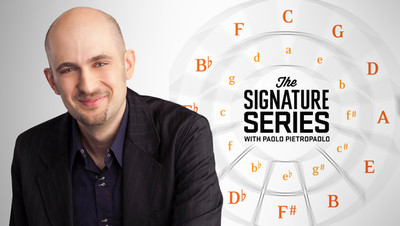
 Welcome to the Signature series on DWR – you will need to go to CBC radio to hear the A major voice-over/musical interpretations.
A major: The Will-o’-the-wisp
Also known as:
The Flibbertigibbet.
The Problem Child.
A majors you might know:
Jane Eyre.
Maria from The Sound of Music.
Veronica from the Archie comics.
The notes: A – B – C♯ – D – E – F♯ – G♯ – A.
Number of sharps: three.
Relative minor: F-sharp minor.
What they said about A major in the 18th century:
“Expression of joy, cheerfulness, dancing. Beautiful Saxon-green, refreshing aroma of lemons.” – J.J.H. Ribock, 1783
“Women and their sweet passions.” – Johann Jakob Heinse, 1795
More A major listening:
The Celebrated Minuet by Luigi Boccherini.
The Kreutzer Sonata by Ludwig van Beethoven.











 bleatmop
 Mystro


 Dead Wild Roses
Your opinions…