
You are currently browsing the tag archive for the ‘China’ tag.
writes in Counterpunch on the US Trade War:
“Those who have lived in Montana will well remember the hot controversy over the miles and miles of sidelined rail cars that appeared during the Great Recession a decade ago. They were stored by the thousands along unused rural tracks. It was so bad they drew a harsh rebuke from the public and elected officials when the ugly yellow cars adorned with urban gang graffiti were moved to the banks of the blue-ribbon section of Montana’s world famous Missouri River downstream from Wolf Creek. To say they were incongruous with Montana’s natural beauty would be a huge understatement and, once enough pressure was applied, they were moved to other areas.
Well, the flatbed cars used to transport the enormous number of containers that come in from China are once again appearing on miles and miles of Montana’s railroad sidetracks. If this canary could talk, it would tell you it’s because the imports from China have fallen so significantly that the railroads now have an oversupply of flatbed cars and have once again taken to storing them in the hinterlands of Montana.
Unfortunately, the news from the canary gets worse. As reported in the Washington Post last week, Montana’s family farm bankruptcies were 50% or higher in 2018 than in 2017. Montana is joined in the flood of family farm bankruptcies by Idaho, North Dakota, Utah, Minnesota, Kansas, Oklahoma, Michigan, Illinois, Alabama, South Caroline, North Carolina, West Virginia, Pennsylvania, Connecticut and New Hampshire. Given that agriculture has long been touted as the leading industry in Montana, that statistic should shiver the timbers of citizens and politicians alike.
In response to Trump’s move to slap on even more tariffs, the Chinese government announced it will now cease to buy American agricultural products. Mind you, that’s not “cut back” on purchases from U.S. farmers and ranchers, it’s “cease.”
The sidelined rail cars and family farm bankruptcies are impossible to see from penthouses atop Manhattan’s skyscrapers or down on the Wall Street where the traders play high-stakes poker with other peoples’ money — but they are certainly visible here in the hinterlands where the canaries are tipping over.
Trump told Americans “trade wars are easy to win.” But that’s coming from a guy who thinks a “trade war” means stiffing the contractors at his failed casinos — not fighting with the most populous nation on the planet and its enormous economy. The signals from the hinterland clearly show we are not winning. It’s past time to get rid of the “fool on the hill” and put our nation back on a sustainable path to a more sane future.”
Is the trade war hurting China? Maybe? But I think more damage is being done on this site of the pond.
The CBC’s reporting on Hong Kong:
“The anti-government protests present one of the biggest challenges facing Chinese President Xi Jinping since he came to power in 2012. And with the ruling Communist Party preparing to mark the 70th anniversary of the founding of the People’s Republic on Oct 1, the crisis in Hong Kong has come at a sensitive time.
Beijing has struck an increasingly strident tone over the protests, accusing foreign countries including the United States of fomenting unrest.
Scenes of Chinese paramilitary troops training at a stadium in the city of Shenzhen, which borders Hong Kong, gave a clear warning that mainland intervention by force is possible.”
These protests are not going to end well.
China is a world power and has the political and economic clout to do whatever the hell it pleases in Hong Kong.
I foresee an abrupt media black out coinciding with the military going into Hong Kong and reestablishing the correct type of order for the area. It will be bloody and ruthless, but necessary from the government of China’s point of view. Real democracy is a threat to the status quo and is intolerable state of being for the elite classes.
The protesters must be prepared for this eventuality and decide whether they are willing to pay the price in blood for their freedom. There is no other way to purchase liberty.
It would seem that a different set of choices were made during the 2008 recession in China than here in the West. I’m having trouble seeing the problem with the economic strategy the Chinese pursued. Of course, it was because the centralized power of China’s government put the needs of the country first, as opposed to the needs of the investor class. China’s growth continues to chug a long while the sclerotic US economy seems unfocused except for the primal urge to grind it’s underclasses into the ground. If as what Clegg says is true about China eclipsing the US in 2030 is true, perhaps a new paradigm might enter our Western consciousness, one that focuses on the welfare of the nation instead of exclusively on the welfare of the wealthy.
“It is clearly hard for any dominant power to accept the need to adjust to a rising power and avoid the ‘Thucydides trap’, but what is all the harder is for the West – the US and its allies – to acknowledge that China’s advance, in contrast to their own sluggish performances, exposes the difference between a system which chooses to bail out the banks and one which sought to bail out the economy; between one that does all it can to boost its financial sector, and one which promoted economic stimulus to boost production; between one which squeezes those poorer in the blind pursuit of profit and one which raises up the poor, organising development in a systematic way; between one that pumps out huge amounts of ‘hot money’ into the world economy to play havoc with other countries’ financial systems and one that offers patient capital to help others manage their financial difficulties to avoid crises.
In the last 10 years, whilst Western economies have endlessly pumped their ‘printed’ money round and round the ether of financial markets in the same exhausted circles, China has become a different country and indeed the world is becoming a different place. Yet the US remains utterly committed to blocking change to keep the world dependent on the American dollar and the American consumer even at the expense of huge trade deficits. And now comes the trade war.
China is on course to overtake the US as the world’s largest economy sometime before 2030, an event which will mark a psychological turning point. However right now, debt levels remain high and a Chinese-style crash is still possible. Can China limit, or failing this, withstand the pressures of a US trade war? In fact, the prospects for the US-economy not that great either – the Trump tax cuts bounce may be short-lived, and the ‘America first’president may have to learn that the US and China need each other.”
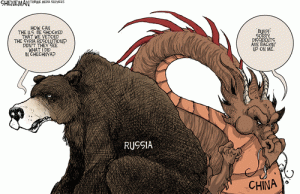 The concluding paragraphs from Michael Klare’s Essay on the Coming Cold War 2.0.
“For those of us residing outside Washington, this choice may appear to have few immediate consequences. The defense budget will rise in either case; troops will, as now, be shuttled desperately around the hot spots of the planet, and so on. Over the long run, however, don’t think for a second that the choice won’t matter.
A stepped-up drive to counter Russia will inevitably produce a grim, unpredictable Cold War-like atmosphere of suspicion, muscle-flexing, and periodic crises. More U.S. troops will be deployed to Europe; American nuclear weapons may return there; and saber rattling, nuclear or otherwise, will increase. (Note that Moscow recently announced a decision to add another 40 intercontinental ballistic missiles to its already impressive nuclear arsenal and recall Senator Cruz’s proposal for deploying U.S. anti-missile batteries in Eastern Europe.) For those of us who can remember the actual Cold War, this is hardly an appealing prospect.
A renewed focus on China would undoubtedly prove no less unnerving. It would involve the deployment of additional U.S. naval and air forces to the Pacific and an attendant risk of armed confrontation over China’s expanded military presence in the East and South China Seas. Cooperation on trade and the climate would be imperiled, along with the health of the global economy, while the flow of ideas and people between East and West would be further constricted. (In a sign of the times, China recently announced new curbs on the operations of foreign nongovernmental organizations.) Although that country possesses far fewer nuclear weapons than Russia, it is modernizing its arsenal and the risk of nuclear confrontation would undoubtedly increase as well.
In short, the options for American global policy, post-2016, might be characterized as either grim and chaotic or even grimmer, if more focused. Most of us will fare equally badly under either of those outcomes, though defense contractors and others in what President Dwight Eisenhower first dubbed the “military-industrial complex” will have a field day. Domestic needs like health, education, infrastructure, and the environment will suffer either way, while prospects for peace and climate stability will recede.
A country without a coherent plan for advancing its national interests is a sorry thing. Worse yet, however, as we may find out in the years to come, would be a country forever on the brink of crisis and conflict with a beleaguered, nuclear-armed rival.”
The geopolitics of the future continue to darken as the interests of the state and corporate elites once again trump the interests of the people of the world. The elephant in the room, of course, is climate change and no one in power seems to care. I imagine, when New York is underwater – action might be considered.
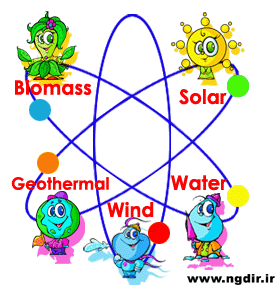 It is encouraging to see capitalism used to actually do something, as opposed to swish money around a hollow economy and proclaim “Profit!” at the end as what has been the North American trend since the 1980’s.
“Researchers in China, the world’s leading provider of wind turbines and solar panels, are working toward making renewable energy cheaper, more efficient and a bigger part of the country’s power grid. But despite China’s rapid leap to being a global leader in the renewable energy field, more government investment is needed for research and development if China is to truly blaze a path toward a clean energy future, researchers say.
Zhao Xingzhong, professor at Wuhan University’s School of Physics and Technology, is researching dye-sensitised solar cells, a low-cost, high-efficiency alternative to more prevalent solid-state semiconductor solar cell technology.”
Go go China. The dependence on fossil fuels will be with us for awhile, but it nice to see some nations actually take the future seriously and begin to plan for it.
“Although Zhao’s team’s research is unique at home and abroad, he says support from the Chinese government is far from enough. He notes that Japan and South Korea have jointly invested about 1.6 billion U.S. dollars on research on third-generation solar technology since 2000. In China, however, Zhao says there have been just five native projects in the solar field in the last decade, with spending of around 4.5 million dollars per project.
“It is difficult to break through the technological bottleneck because of the inadequacy of (financial) input,” Zhao says”
Like most breakthrough products and technologies, renewable power innovation has come through the spending of the state who pays for the R&D of projects and then farms them out to the private sector where they can be made readily available to the public. (Although boo on China for what seems to be, at least in Zhao’s case underfunding his work.) It is one of the great myths of capitalism that private business is the dynamo that runs the economy, it is significant but far from the primary driver. It is the State, through Universities and publicly funded R&D institutes that contribute a great deal to the ‘innovation’ of our economies and societies.
“In recent years, China has become the global leader in renewable energy technology manufacturing, surpassing the United States in terms of both the number of wind turbines and solar panels it makes. The accounting firm Ernst & Young in September named China the best place to invest in renewable energy.
Chinese companies, led by the Jiangsu-based Suntech, have one-quarter of the world’s solar panel production capacity and are rapidly gaining market share by driving down prices using low-cost, large-scale factories. China’s 2009 stimulus package included subsidies for large solar installation projects.
In terms of wind power, home-grown companies have rapidly gained market share in recent years after the government raised local partnership requirements for foreign companies to 70 percent from 40 percent (the government has since removed local partnership requirements) and introduced major new subsidies and other incentives for Chinese wind power companies.”
The day is approaching when solar panels will not be out of range of most people. That will be a good day.
“Critics say China’s interest in renewable energy is essentially a business opportunity – most of what it produces is sold abroad – and that it is less interested in applying the more expensive technology at home. China has not yet caught up to the United States in terms of renewable energy production. The country is the biggest consumer of coal in the world and is expected to burn 4.5 billion tonnes of standard coal by 2020, according to figures from the National Energy Administration.
While coal will still make up two-thirds of China’s energy capacity in 2020, the government has promised to invest billions of dollars into the development of wind, solar and nuclear power. The country’s top legislature, the National People’s Congress, now requires power grid companies buy 100 percent of the electricity produced from renewable energy generators.”
For all the strides China has made in renewable energy, the magnitude of their economy and power needs dictates they well need to rely on coal well into the foreseeable future, as we do in North America. Hopefully, with another major power taking the lead in the development and manufacture of solar panels a renewable energy race might start and really kick things off here in North America where we have both the know how and the consumer base to make renewable energy feasible.
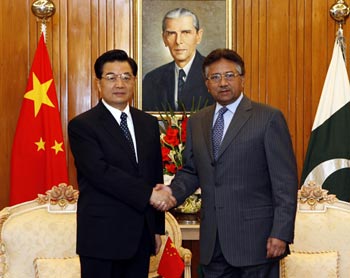 One needs to just to watch the frenzy in the North American media whenever Israel is negatively portrayed. Our institutional blindspots are sacrosanct and should be above reproach. When other countries do this we are understandably peeved, but do we appreciate the irony of the situation? China certainly does.
“When a US delegate once confronted a Chinese diplomat about Beijing’s uncompromising support for Pakistan, the Chinese reportedly responded with a heavily-loaded sarcastic remark: “Pakistan is our Israel”.
But judging by China’s unrelenting support for some of its allies, including North Korea, Burma, Zimbabwe and Sudan, its protective arm around these countries is no different from the US and Western political embrace of Israel – right or wrong.”
Ouch. It really sucks when other people start playing by our rules.
“The New York Times newspaper said on Tuesday that the US administration is facing a “confrontational relationship” with an assertive China and is trying to respond to “a surge of Chinese triumphalism” by strengthening Washington’s relationship with Japan and South Korea.
US President Barack Obama is planning to visit four Asian countries next month – Japan, Indonesia, India and South Korea – while bypassing China.”
China is flexing its international muscle and attempting to use international institutions to do so.
“China sees value in promoting its image as the Security Council member defending the rights of the developing world, and China sees value in relying on the UN to counter US power,” said Linda Jakobson, director of the programme on China and Global Security at the Stockholm International Peace Research Institute (SIPRI).
Jakobson, an in-house China expert at SIPRI, points out that Beijing also sees value in participating in UN peacekeeping operations “both because this enhances the image of China as a responsible power but also because it gives Chinese military experience”.
I wonder when the sudden rush back to the ‘rule of law’ will happen? I imagine when the same unlawful implements/policies the West has been using for decades start getting pointed in the opposite direction.
 Not a single mention of the US or the west in this article. Perhaps a testament to Washington’s waning influence on global affairs?
“Japan has refused to apologise to Beijing for detaining a Chinese boat captain in disputed waters after Tokyo gave ground and released him.
China’s foreign ministry said it was angry at the detention of the captain, arrested by Japan over two weeks ago after his trawler collided with two Japanese patrol boats in waters near islands that both sides claim.
The ministry demanded an apology and compensation and said China’s claim to the islands, which it calls the Diaoyu and Japan calls the Senkaku, was “indisputable”.
These are the words of countries that are not really in the mood for compromise. This small conflict is a microcosm of the generally unsettled relations between Japan and China.
“Everybody knows that China is not a democratic country, but [the latest demand] will make that explicit,” Okada, who is now secretary-general of the ruling Democratic Party of Japan, was quoted as saying.
Zhan Qixiong, a fishing trawler captain, flew out of Japan to the coastal Chinese city of Fuzhou on Saturday after being set free on Friday.
The release follows the detention of four Japanese nationals on suspicion of violating Chinese law regarding the protection of military facilities earlier this week.”
The tensions in the region are growing and we in the West, crippled by our imperial wars have lost much of the ability to influence other nations in the world. This is not necessarily a bad thing, just a new development that must be rather troublesome and unsettling for Western leaders.
“The dispute has underscored the brittleness of ties long troubled by Chinese memories of Japanese wartime occupation and territorial disputes over parts of the East China Sea that could hold rich reserves of gas.”
Once energy resources are involved, it is a guaranteed game changer. I’m very curious to see how this plays out as potential conflict involving the major powers of the region could ensue.











 bleatmop
 Mystro


 Dead Wild Roses
Your opinions…