
You are currently browsing the tag archive for the ‘Conformity’ tag.
Hannah Arendt’s portrait of Adolf Eichmann as a thoughtless bureaucrat lingers as a caution against evil’s mundane guise. Christopher Browning’s Ordinary Men extends this indictment, trading Eichmann’s desk for the blood-soaked forests of Poland, where Reserve Police Battalion 101—500 Hamburg ‘everymen’—executed 39,000 Jews and deported 44,000 more to Treblinka in 1942-43. These were no zealots: middle-aged draftees, family men untouched by Nazi fervor, yet they pulled triggers with grim efficiency. Browning’s forensic reconstruction from postwar trials complements Arendt, illuminating how conformity, not conviction, forges complicity. In an age of ideological silos, their story warns that thoughtlessness scales from individual abdication to collective carnage.
Arendt diagnosed Eichmann’s evil as a failure to think—to judge actions against universal humanity—yielding obedience’s autopilot. Browning operationalizes this in RPB 101’s crucible. On July 13, 1942, in Józefów, Major Trapp’s order to slaughter 1,800 innocents included an opt-out: a dozen stepped forward, fathers haunted by their own children’s faces. The rest? They fired, vomited, and fired again, bound not by hatred but by the group’s inexorable pull. Peer pressure proved the deadliest weapon: to demur meant isolation, whispers of cowardice, or worse—standing alone amid the splatter of brains and pleas. As Browning dissects, “binding factors” like deference to authority and aversion to shame radicalized the reluctant. Initial nausea faded into routine; Jews devolved from neighbors to “bandits,” their deaths logged as quotas met. This mirrors Arendt’s “banality”: not demonic intent, but the quiet erosion of moral agency, where thinking cedes to fitting in.
Browning’s men prefigure Arendt’s broader fear—that totalitarianism thrives on unreflective masses. Unlike Eichmann’s abstracted ledgers, these policemen confronted the visceral: a mother’s wail, a child’s gaze. Yet empathy atrophied through diffusion—blame smeared across the chain of command—and progressive desensitization. A few resisted, sabotaging hunts or feigning illness, their conscience a fragile bulwark against the tide. Most drifted, careerism and alcohol dulling the sting. Browning invokes social experiments like Milgram’s obedience studies, positing such dynamics as human universals, not German pathologies—a riposte to claims of cultural exceptionalism.
This convergence sharpens lessons for our fractured present, where critical constructivism and woke Marxism summon conformity’s specter. Critical constructivism, an epistemological framework that treats knowledge as socially mediated and entwined with power—rejecting empirical objectivity for interpretive lenses shaped by culture and positionality—echoes RPB 101’s euphemisms, recasting dissent as dominance while evidence bows to constructed narratives. Proponents propagate without pause, their deference to “lived experience” a peer-enforced gag on Socratic probe. Woke Marxism, a repackaged Marxism applying class struggle to identity oppressions—framing queer theory as “gender Marxism” and intersectionality as “identity Marxism”—amplifies this through performative allegiance. Its rituals—DEI oaths, cancellation tribunals—demand uncritical adherence, sidelining judgment for allegiance, much as Trapp’s men traded qualms for camaraderie. Ordinary adherents comply, not from malice, but inertia: promotions hinge on nods, ostracism on silence.
Arendt and Browning converge on the antidote: reclaim thinking as defiant praxis. In algorithm-curated echo chambers, where ideologies brook no fracture, epistemic humility—questioning, pluralizing, judging—arrests the slide. Thoughtlessness is choice, not fate; conformity’s shadow lifts only through vigilant reflection. Honor the dead of Józefów not with memorials alone, but by fortifying the ordinary against atrocity’s call. Goodness demands depth; evil preys on the shallow. In choosing to think, we dismantle the battalion within.

References
Arendt, H. (1963). Eichmann in Jerusalem: A Report on the Banality of Evil. New York: Viking Press. (Primary source for the concept of the banality of evil and its philosophical underpinnings.)
Browning, C. R. (1992). Ordinary Men: Reserve Police Battalion 101 and the Final Solution in Poland. New York: HarperCollins. (Core historical analysis based on postwar judicial testimonies, detailing the battalion’s actions and psychological dynamics.)
Dead Wild Roses. (2025, August 25). “Unraveling the Roots—How ‘Woke’ Emerges from Social Construction.” https://deadwildroses.com/2025/08/25/unraveling-the-roots-how-woke-emerges-from-social-construction/. (Defines critical constructivism via Kincheloe’s assumptions, linking it to woke epistemology and power-mediated knowledge.)
Dead Wild Roses. (2022, April 6). “Queer Theory is Gender Marxism – James Lindsay.” https://deadwildroses.com/2022/04/06/20651/. (Critiques woke Marxism as repackaged identity-based Marxism, drawing on Lindsay’s analysis of queer theory and intersectionality.)
Goldhagen, D. J. (1996). Hitler’s Willing Executioners: Ordinary Germans and the Holocaust. New York: Alfred A. Knopf. (Contrasting thesis on German antisemitism, referenced by Browning to highlight universal rather than cultural explanations.)
Hilberg, R. (1961). The Destruction of the European Jews. Chicago: Quadrangle Books. (Foundational Holocaust scholarship on the “short, intense wave of mass murder” in 1942, informing Browning’s timeline.)
Milgram, S. (1963). “Behavioral Study of Obedience.” Journal of Abnormal and Social Psychology, 67(4), 371–378. https://doi.org/10.1037/h0040525. (Seminal experiment on authority compliance, invoked by Browning to explain diffusion of responsibility in RPB 101.)
Trunk, I. (1972). Judenrat: The Jewish Councils in Eastern Europe Under Nazi Occupation. New York: Macmillan. (Contextual background on Jewish councils’ coerced roles, paralleling themes of complicity under duress.)
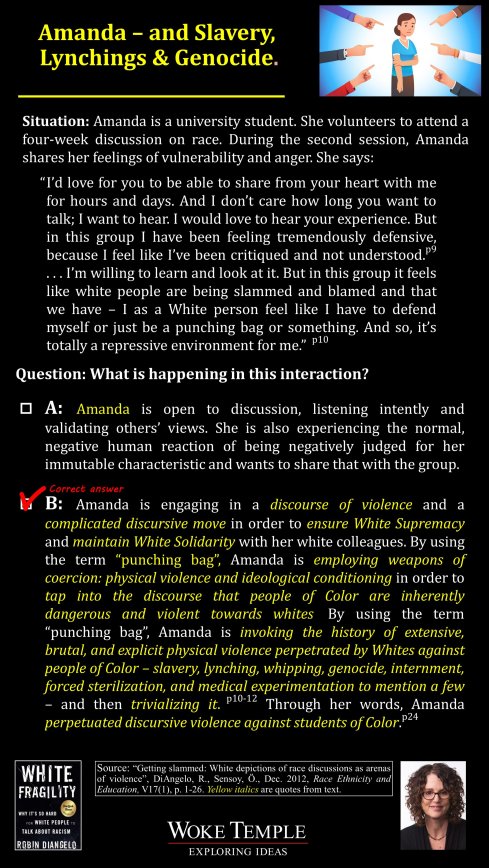
Investigate the two options given. Which one requires a cultural commissar to ensure you’re doing it right? I think most people are still going to pick “A” in private, but due to negative pressure and threat in society might choose “B” in public.
It is only your integrity that is at stake. We are defined by the choices we make and do not make. Too much of stable Western society is a peril for people who believe A, but meekly accept B to think that their actions are somehow ‘right’.
Think of yourself as strong willed? An outlier? I bet you’re not :) The psychology of group interactions is fascinating, and Theramin Trees explores historical and more recent research on the topic.











 bleatmop
 Mystro


 Dead Wild Roses
Your opinions…