
You are currently browsing the tag archive for the ‘Crime’ tag.
Canada’s crime landscape resists neat storytelling. After nearly a decade of steady increases—especially in violent offenses, property thefts, and youth crime—2024 marks a notable pivot downward.
According to Statistics Canada, the overall police-reported crime rate fell 4% to 5,672 incidents per 100,000 people, ending three consecutive years of growth (Statistics Canada). The Crime Severity Index (CSI)—which captures both volume and seriousness—also dipped 4% nationally, with Non-violent CSI down 6% and Violent CSI down 1% (Statistics Canada). Homicide rates slid 4%, from 1.99 to 1.91 victims per 100,000, with eight fewer lives lost than the year before (Global News, Statistics Canada).
Still, narratives of escalating crime haven’t vanished. And it’s not hard to understand why. From 2014 to 2023, Canada saw violent crime rise nearly 30%, with 2023 registering approximately 1,427 incidents per 100,000—up 3.7% from the previous year (X (formerly Twitter)). This contrasts sharply with the U.S., where violent crime grew about 5% and property crime fell 24% over the same decade (X (formerly Twitter), Fraser Institute).
Youth crime follows a similar pattern. Between 2022 and 2023, violent youth crime jumped 10%, with overall youth crime up 13% (Ministère de la Justice). On a regional level, Western provinces—especially Saskatchewan and Manitoba—continue to report some of the highest crime rates, while Ontario and Quebec remain comparatively stable (Government of Nova Scotia, Statistics Canada).
The Takeaway
Crime in Canada isn’t spiraling, nor is it fully under control. The 2024 decline is welcome, but it follows substantial, worrying increases. The story lies between alarm and apathy—calling for careful, evidence-driven policy, not sensational headlines or complacency.

References
- Statistics Canada. “Police-reported crime statistics in Canada, 2024.” Overall crime rate – 5,672 per 100,000; CSI changes. (Statistics Canada)
- Global News (citing StatsCan). Homicide rate down to 1.91 per 100,000 in 2024 (4% decline). (Global News)
- Statistics Canada. Homicide victims – 788 in 2024, eight fewer than in 2023. (Statistics Canada)
- Statistics Canada. 2023 crime stats: 3% rise in crime rate to 5,843/100k; violent incidents up 4%; CSI up 2%. (Statistics Canada)
- Crime comparison data: Violent crime +30% (2014–2023); 2023 rate ~1,427/100k (up 3.71%); Canada vs U.S. trends. (X (formerly Twitter), Fraser Institute)
- Justice Canada. Youth crime: +10% violent youth crime; +13% overall youth crime (2022–2023). (Ministère de la Justice)
- Nova Scotia stats: Regional disparities, highest in Manitoba/Saskatchewan. (Government of Nova Scotia)
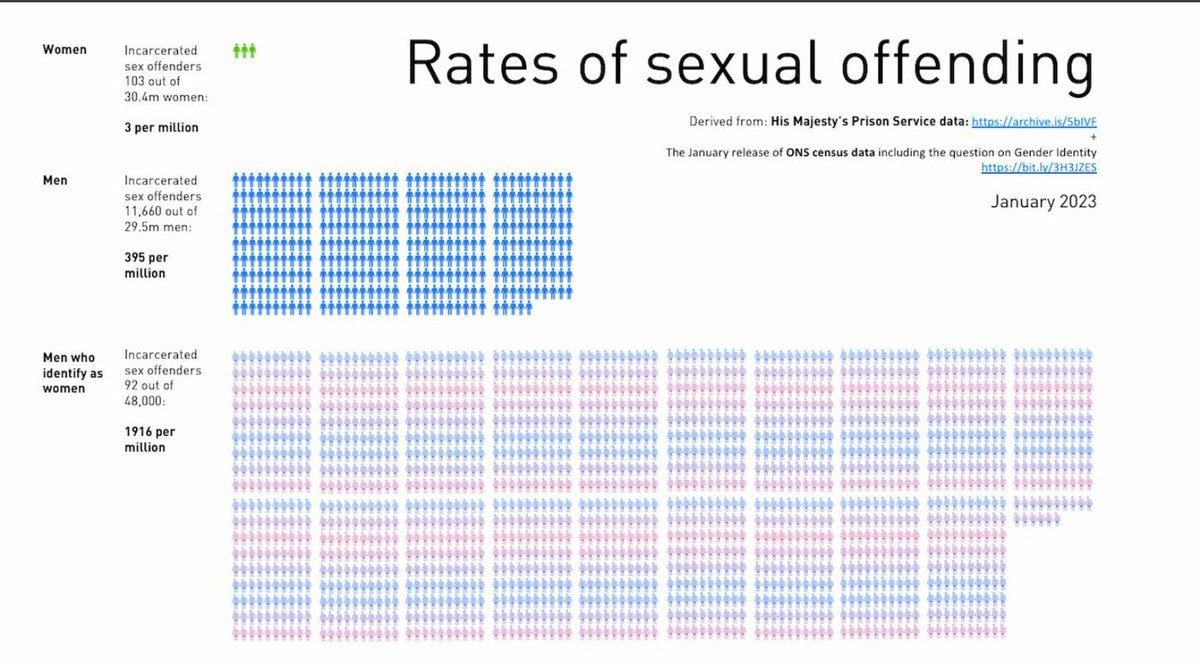
Shocking, that men harbouring delusional beliefs that they are women are more prone to committing sexual offenses.
Sex offending rate of women: 3 per one million
Sex offending rate of men: 395 per million
Sex offending rates of transwomen: 1,916 per million
 Trees on streets and boulevards reduce crime. Do we know the how or why of this particular correlation, nope. But we do know that trees on private lots also tend to reduce criminal activity, with the proviso that they are over 42 feet high. The studies linked are quite fascinating and most definitely worth a read.
But recent research suggests the opposite: trees don’t give burglars and highwaymen a place to hide, rather they may reduce crime in a neighbourhood.
One piece of research from 2001 focused on a public housing project in Chicago, where some buildings had trees out front, others did not. The research found that buildings with fewer trees or barren yards had more crime reports, while buildings with trees had fewer crimes. Because residents of the project were randomly assigned to various apartments, the differences in crime couldn’t be attributed to factors like income.
A more recently published article in the journal Landscape and Urban Planning focused on Cincinnati. The city’s trees were being killed by the Emerald Ash Borer beetle. Researchers took advantage of the spread of the beetle to study the relationship between trees and crime. They found that when a tree is killed and removed, crime in the area tends to go up.
 I saw part of this discussion going on at the Drudge Retort in a thread that I sadly cannot remember. Chalk it up to the fire-hose nature of information here on the web. Anyhow, as I was looking at the thread that shall remain unnamed it turned out that a strong possibility for the lowering of the crime rate in the US was the 1973 Roe vs. Wade Supreme Court decision based on the following wisdom:
“When a woman does not want to have a child, she usually has a good reason…” – Steven D. Levitt and Stephen J.Dubner in Freakonomics p.138 of the paperback edition. (all further quotes from the same authors).
Amazing what happens when you give women the autonomy that they deserve. But the argument is as follows.
“[…] two factors – childhood poverty and a single parent household-are among the strongest predictors that a child will have a criminal future. […] In other words, the very factors that drove millions of American women to have an abortion also seemed to predict that their children, had they been born, would have led unhappy and possibly criminal lives.” – [ibid, 139].
Factor in other sociological factors like the propensity toward of child criminal behaviour in single parent households and the effect of the level of maternal education on children one can conclude that leaving the reproductive choices in the hands of women is the right choice, not only for women, but society as a whole.
“In the early 1990’s, just as the first cohort of children born after Roe vs. Wade was hitting its late teen years-the years during which young men enter their criminal prime- the rate of crime began to fall. What this cohort was missing, of course, were the children who stood the greatest change of becoming criminals. And the crime rate continued to fall as an entire generation came of age minus the children whose mothers had not wanted to bring a child into the world. Legalized abortion led to less unwantedness;unwantedness leads to high crime; legalized abortion, therefore, led to less crime.” (emphasis mine). -(ibid 139-140)
So it would seem, abortion is a good thing and a feature of societies with low crime rates. The funny thing is that in the US at the time the remarkable drop in crime was erroneously attributed several memes that received a lot of play in the media.
 “Innovative policing strategies, increased reliance on prisons, changes in crack and other drug markets, aging of the population, tougher gun control laws, strong economy, increased number of police, and other (capital punishment, concealed weapons laws, gun buybacks…)” – (ibid 119)
The supply of cocaine greatly increased as well as the number of police officers these two factors did play a role in the decline of crime during the 1990’s. The rest as the authors say:
“The others [options], for the most part, figments of someone’s imagination, self-interest or wishful thinking.” – (ibid, 119)
I imagine this sort of correlation must gall the staunch reactionaries that populate the right wing these days. What? Abortion is Tough on CRIME? *head explodes*
 I hear this often enough: “Crime is out of control we need more police on the street… or let’s get tougher on crime… or (insert conservative trope here)”
I wonder how much thinking people who say these sorts of things have actually done about the issues of crime and poverty and how they are interrelated. Whoops! I just used a 5 syllable word that, like it or not, it cuts me off from speaking to people who often hold this opinion, and relegates me to talking past them instead. We do not have a common cultural frame of reference and I am written off as a lefty intellectual egg head socialist (Fear not I am neither smart nor witty enough to qualify to be in the liberal intellectual elite) and largely ignored. Talking past one another is a serious problem for both me and the bumpkins ( My apologies I could not resist) whom I attempt to communicate with.
Crime is a problem. (But then again, criminality is on the decline, we should not let reality intervene… it might force us to reconsider our opinions)
The populist response: We need more police, more prisons, and more courtrooms to punish these malcontents and n’er do wells. Society has gone soft on criminals and we need to ‘toughen up’ on crime to fix things.
Okay, so to toughen up on crime we need to spend more public money on jails and police. Where does the money come from? The pubic purse of course and along with more police and jails/legal infrastructure comes the necessary bureaucratic/managerial superstructure. So really, what they are advocating is more government spending and ‘bigger’ government. Government spending and more government and antithetical to what conservatives and populists claim to believe.
More police and more jails often comes with the rallying cry of cuts to welfare and other methods of social assistance because ‘it makes people lazy’. Check. Never mind the facts of the matter. Only a very small percentage of people who are on social assistance cheat the system, most do not. Social assistance helps people avoid grinding poverty. Poverty is the largest cause of our social ills, crime, violence, drug-use are all tied to impoverished people and conditions. I digress though, as welfare and other forms of wealth distribution are inherently evil and must be abolished. Charity will “fix” the problems of the poor.
My response: Crime overall has been on a decline for decades, it certainly should not be ignored as a social issue, but needs to be framed within the proper non-fear based context. We do not need more police and jail infrastructure. We need more spending on the front lines of social assistance and welfare that directly combats poverty. Poverty is the enemy we need to combat, not crime directly. People who can exist at a modest level within society are less likely to commit crime. If we went after the root cause of crime (poverty) we could stop so much deviancy before it ever started. Improving community supports and schools have measurable paybacks toward the positive health of society.
Yet, I am the bad one because social programs mean taxes. The free ride conservatives give to industry also mean more taxes to pay for the average person as well. In Alberta, the royalty regime is laughably pathetic, with rates at absurdly low values. I digress as I’ve already talked about energy royalties in a previous post.
If you feel crime is getting out of hand in your neighbourhood first ask what can you do as a community to fix the problem. Conservative commentators are forever decrying the lazy welfare state… fine… then lets see these righteous people organizing community watches and ‘take back the night’ campaigns and tackling issues on the community level. Does this happen? Occasionally, but more often, we hear ‘we need to be tough on crime’ and ‘more police’ refrain as if this will actually fix the problem. Forget getting people involved in their community, that smacks of socialism and is a bold assault on self-interest which of course, is at the very core of conservative belief.
So we get more police and build more jails and taxes go up (or more valuable social spending is cut) and government gets bigger.
Populists rarely see this connection and thus are missing out on the sweet irony that laces much of their dogmatism.
I’m not sure if this is a nation wide project, or even if its province wide, but the MP’s from Edmonton and the surrounding area have been periodically sending out mail to all of their constituents. This piece of mail consists of a single sheet of paper with some Conservative Party message on it as well as a piece you can rip off and mail back to the MP with your response to the aforementioned message. I despise them.
 I am actually in favor of governments letting the people know what its doing and why, but this is not what we’re talking about here. These “political messages” are merely propaganda tools. Further (and I find this insulting) they aren’t very good ones. The message I get from the Conservatives is “We don’t have to try that hard to brainwash such a simple minded public, this should suffice.”
Attacks on other parties either focus on especially weak straw men versions of the target party’s policy or they resort to slander and ad hominem attacks, which never present a political reason why they might be a poor choice for voters. Most of these messages could be replaced by the words “People who are not us are bad,” without losing an ounce of actual content.
The letters used to promote themselves are no better. Most are void of any actual policy and only vaguely refer to some ideal that Conservatives like to attach their policies to. No understanding of Conservative policy would be lost if, instead, they just sent out letters that said, “We are good, believe it!” repeatedly.
These propaganda leaflets have bothered me for some time (especially the “free” return postage, as if it is to be paid out of Conservative pockets instead of by our tax dollars, yeah right) but something odd happened that finally convinced me to write on one of these letters. I received one that actually had a piece of specific information regarding the Conservative plan for Canada: they want to repeal the faint hope clause so those who have received a life sentence will not be eligible for parole for at least 25 years. This, they say, will make Canada safer.











 bleatmop
 Mystro
 The Arbourist


 Dead Wild Roses
Your opinions…