
You are currently browsing the tag archive for the ‘Elite Opinion’ tag.
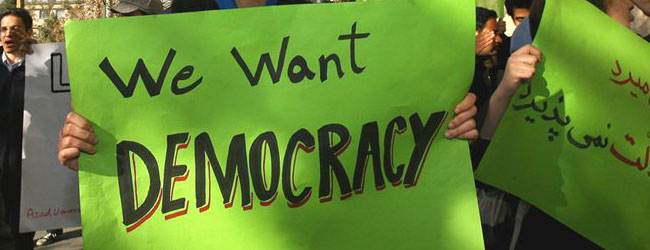 The parallel between the official line for public consumption and the actual realpolitik is quite thin, if you are willing to look. And therein lies the problem, we are not rewarding for looking, for being curious, for wanting to know what our policy actually is in the Middle East. Noam Chomsky discusses our role in the Middle East in a recent article posted at Mother Jones.
“The US and its Western allies are sure to do whatever they can to prevent authentic democracy in the Arab world. To understand why, it is only necessary to look at the studies of Arab opinion conducted by US polling agencies. Though barely reported, they are certainly known to planners. They reveal that by overwhelming majorities, Arabs regard the US and Israel as the major threats they face: the US is so regarded by 90% of Egyptians, in the region generally by over 75%. Some Arabs regard Iran as a threat: 10%. Opposition to US policy is so strong that a majority believes that security would be improved if Iran had nuclear weapons—in Egypt, 80%. Other figures are similar. If public opinion were to influence policy, the US not only would not control the region, but would be expelled from it, along with its allies, undermining fundamental principles of global dominance.”
Whoops, public opinion or what the people want is ignored in our client states, how surprising. The very last thing we want in the Middle East is Democracy.
“Support for democracy is the province of ideologists and propagandists. In the real world, elite dislike of democracy is the norm. The evidence is overwhelming that democracy is supported insofar as it contributes to social and economic objectives, a conclusion reluctantly conceded by the more serious scholarship.
Elite contempt for democracy was revealed dramatically in the reaction to the WikiLeaks exposures. Those that received most attention, with euphoric commentary, were cables reporting that Arabs support the US stand on Iran. The reference was to the ruling dictators. The attitudes of the public were unmentioned. The guiding principle was articulated clearly by Carnegie Endowment Middle East specialist Marwan Muasher, formerly a high official of the Jordanian government: “There is nothing wrong, everything is under control.” In short, if the dictators support us, what else could matter?
The Muasher doctrine is rational and venerable. To mention just one case that is highly relevant today, in internal discussion in 1958, president Eisenhower expressed concern about “the campaign of hatred” against us in the Arab world, not by governments, but by the people. The National Security Council (NSC) explained that there is a perception in the Arab world that the US supports dictatorships and blocks democracy and development so as to ensure control over the resources of the region. Furthermore, the perception is basically accurate, the NSC concluded, and that is what we should be doing, relying on the Muasher doctrine. Pentagon studies conducted after 9/11 confirmed that the same holds today.”
Dig a little deeper, read more about the Middle East and history from a variety of sources. Educate yourself about what you know or think you know about, questioning base assumptions is the all hallmark of the critical thinker and rational citizen.
 One of the most exasperating comments I hear on a fairly regular basis is that the Media has a left wing bias. If you look even a centimeter inside and below official received opinion you can see there is no left wing bias in the mainstream media. If anything, a right wing bias exists. The news we get generally reflects elite opinion on the topic at hand. That is why it is so important to get your news from as many different outlets as possible hopefully with a few of the ‘alternative’ media outlets thrown into the mix. Medialens is an orginization that watches the British press for the veracity of their stories and accuracy of their reporting. As it is with most things, it is better to show than to tell. I have a short blurb to look at illustrating exactly how filtered our ‘independent MSM’ actually is.
On August 26, the Guardian newspaper published an article titled, ‘US takes on Israeli-Palestinian conflict and Iran’s nuclear programme in one massive gamble.’ Julian Borger and Ewen MacAskill told readers:
“The Obama administration’s approach to two of the world’s most intractable and dangerous problems, the Israeli-Palestinian conflict and Iran’s nuclear programme, is to link them together in the search for a solution to both.
“The new US strategy aims to use its Iran policy to gain leverage on Binyamin Netanyahu’s government.”
The “Iran policy” is based on US Secretary of State Hillary Clinton’s threat of “crippling sanctions” against Iran. (BBC online, ‘Israel-US settlement deal “close”’, Analysis by Jeremy Bowen, August 26, 2009; http://news.bbc.co.uk/1/hi/world/middle_east/8221559.stm)
The sanctions threat is to ensure that Iran does “not compromise on uranium enrichment by the end of next month.” The Guardian told its readers that not only are sanctions supposed to pre-empt any Israeli military action against Iran, “they are also a bargaining chip offered in part exchange for a substantial freeze on Jewish settlements in the West Bank.” The paper quoted one official “close to the negotiations”:
“The message is: Iran is an existential threat to Israel; settlements are not.”
So much for Obama’s much-hailed Cairo speech in June 2009 in which he promised a “new beginning between the United States and Muslims around the world.” (‘Obama speech in Cairo’, Huffington Post, June 4, 2009; http://www.huffingtonpost.com/2009/06/04/obama-speech-in-cairo-vid_n_211215.html)
Okay, so we have the original from the Guardian. Now lets look at the objection from David Cromwell at MediaLens which bases its critique of the article on reality instead of received opinion.
The Guardian article presented the US as a valiant peace-seeker:
“The Obama administration is setting out to juggle two potentially explosive global crises, while walking the tightrope of a shaky and nervous global economy. It is not going to be easy, but Washington appears to have decided it has no option but to try.” (Borger and MacAskill, op. cit.)
This is a deeply misleading picture of the US in the Middle East and the wider world, as we have often explained in our books and in media alerts. We are to believe that the world’s number one rogue state is searching for benign solutions to the world’s most “intractable problems”. This fiction is standard in corporate media coverage.
As the independent journalist Jonathan Cook commented to us:
“This analysis in yesterday’s Guardian is almost a masterclass in how the liberal media unthinkingly reflect elite priorities.” (Jonathan Cook, email, August 27, 2009)
Huh. A little different that what you read in the newspapers all the time. It gets better, Cromwell writes a email to the editor of the Guardian for failing to address the issues in the middle east.











 bleatmop
 Mystro
 The Arbourist


 Dead Wild Roses
Your opinions…