
You are currently browsing the tag archive for the ‘Friday Classical Music Interlude’ tag.
Elvira Madigan is the nickname of Mozart’s “Piano Concerto No. 21 in C major,” which he wrote in 1785 within a space of 4 weeks. It is one of Mozart’s most popular piano concertos, and has three movements.
The concerto was penned for a series of Lenten subscription concerts given by Mozart in 1785. However, it was actually premiered at Mozart’s benefit concert at the National Court Theater on March 10 of that year. A handbill for the concert announced that it would include “a new, just finished Forte piano Concerto.”
The slow second movement is the best known part of this piece thanks to its use in Elvira Madigan, a 1967 Swedish film about a tragic tightrope walker, which gave the concerto its name.
The second movement’s title is “Andante in F major.” “Andante” refers to the tempo marking, which in this instance means to be performed at a moderately slow speed. “Andante” is Italian for “a walking pace.”

Thanks to the CBC and Paolo Pietropaolo for hosting the CBC Signature Series. The key de jour is D flat major.
Also known as:
The Flower Child.
The New Age Mystic.
D-flat majors you might know:
Marianne Dashwood from Sense and Sensibility.
Anne of Green Gables.
Phoebe from Friends.
The notes: D♭ – E♭ – F – G♭- A♭ – B♭ – C – D♭.
Number of flats: five.
Relative minor: B-flat minor.
Enharmonic equivalent: C-sharp major.
What they said about D-flat major in the 19th century:
“The pure chord of D-flat major has only to ring out, and the sensitive soul will see itself, as it were, surrounded by pure luminous spiritual creatures, which perceive it in a shape or apprehend it in a form to which the soul, by virtue of its momentary mood, is attracted most of all.” – Gustav Schilling, 1835
More D-flat major listening:
Die Forelle by Franz Schubert.
Hab’ mir’s gelobt from Der Rosenkavalier by Richard Strauss.
Music in D-flat major’s alter-ego, C-sharp major:
Ondine from Gaspard de la nuit by Maurice Ravel.

Amazingly enough, not posted by Paolo Pietropaolo. But hell, lets link there anyways.
Welcome readers to the key of E major, the Signature Series continues and as always you will have to go over to the CBC Radio 2 site to listen to the music and voice-over by Paolo Pietropaolo.
E major: Prince Charming – (by Paolo Pietropalo)
Also known as: – (Also written by Paolo Pietropalo)
The Gentleman. – (Also written by Paolo Pietropalo)
The Wide-eyed Optimist. – (Also written by Paolo Pietropalo)
E majors you might know: – (Also written by Paolo Pietropalo)
The Lone Ranger. –(Also written by Paolo Pietropalo)
Clark Kent. – (Also written by Paolo Pietropalo)
Westley from The Princess Bride. – (Also written by Paolo Pietropalo)
The notes: E – F♯- G♯ – A – B – C♯ – D♯ – E.
Number of sharps: four.
Relative minor: C-sharp minor.
What they said about E major in the 19th century: ( Also written by Paolo Pietropalo but most likely transcribed from “Historical quotes and translations from A History of Key Characteristics in the 18th and Early 19th Centuries, by Rita Steblin, UMI Research Press (1983).” – but most definitely written by Paolo Pietropalo)
“Bright and pellucid; adapted to brilliant subjects.” – William Gardiner, 1817
“Clear as a bell and joyful. Screaming, bright, burning-yellow.” – F.L. Bührlen, 1825
More E major listening: (probably Googled by Paolo Pietropalo, but such hard work should be properly attributed.)
Salut d’Amour by Edward Elgar.
“The Dance of the Hours” by Amilcare Ponchielli.
The Canadian connection:
“Out of the Game” by Rufus Wainwright.
If you missed earlier mention – the stuff in brown is written by Paolo Pietropalo.
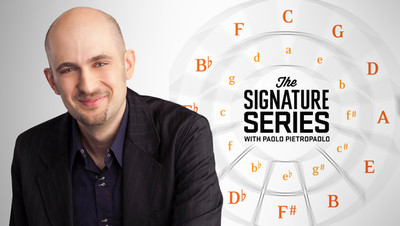
Pictures, just to be on the safe side. Below is Paolo Pietropalo photoshopped onto a picture of with the title of the Signature Series just to make extra sure we all know that Paolo Pietropalo (and the production crew supporting him) is/are responsible for the Signature Series, definitely not ME (aka the Arbourist), host of this particular low-traffic blog.
Unlike The Arbourist, I have very little musical talent. I cannot play any instrument, keep time, or even step in rhythm (my dancing has been described as “dangerous”, and not in a good way). On occasion I fantasize about how awesome it would be were I actually a classic guitar virtuoso, percussion prodigy, or mad-skilled pianist. Once the dream fades, I am left wondering what instrument would actually befit a person like me.
Today I happened upon this delightful little article on the CBC music blog and thought it would be fun to share it. It seems that, depending on my mood on a given day, I ought to take up the Viola, the Timpani, or the Cello.
Perhaps you’d like to start playing a musical instrument, or your five-year-old is begging for lessons. But you’re wondering: With so many musical instruments out there, how do I choose?
It’s simple really. Ask anyone in the music business and they’ll tell you that musicians have personalities matched to the instruments they play. So we’ve come up with a little way to figure out the instrument that’s right for you. (Click the image below to enlarge it.)

CBC article here
The vertical stripes show the rhythmic “grid” — showing the hierarchy of beats. The first beat in a measure is the strongest, followed by the half-measure point, followed by quarter-measure points, etc. This lets you see when a note is “suspended” through a strong beat.
We’ve already featured Beethoven’s 5th, but this new visual makes it a treat to watch/listen to again.
Just finishing up working on a selection from Purcell, this could be my next vocal project. Having been doing a lot of singing in Italian as of late I’ve noticed by french pronunciation has gone to merde. :>
- Date: 1880
- Composer: Claude Debussy
- Period: Post-Romantic (1870-1909)
Review
This is Debussy’s first published work, and shows many of the characteristics
that we see in the mature Debussy–a somewhat melancholy, bittersweet air,
considerable tone-painting with both voice and instruments, and an intense
lyricism. While it is a bit more old-fashioned than Debussy’s later work,
more “hummably” melodic, and a bit more obvious in its craft, it is a strong
and attractive composition.
The refrain, sung three times, translates “Starry night, under your veils,
under your breaths and your scent, sad, sighing lyre, I dream of past loves.”
The verses are less openly melodic, but flow naturally into the simple,
repetitive refrain. The piano accompaniment matches the rippling vocal
lines, and the final product is a perfect example of the sweetly melancholic
French salon music of its times. ~ Anne Feeney, Rovi











 bleatmop
 Mystro
 The Arbourist


 Dead Wild Roses
Your opinions…