
You are currently browsing the tag archive for the ‘gender identity’ tag.
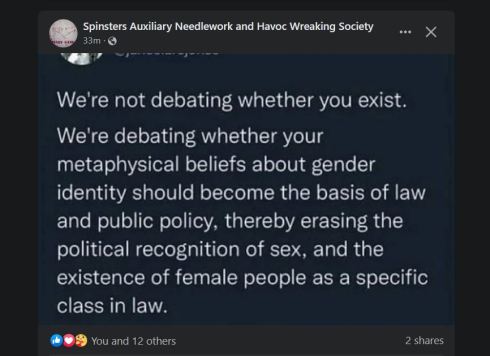
Having established norms and boundaries in society is a good thing. Is the balance between personal freedom and what is good for society perfect?
Of course not.
But the current system which is always under small scale revision, is a reasonable way forward. The basis of this incremental move toward a more just society is the ability of society’s inhabitants to participate freely in the decision making processes. Individual freedom and the individual freedom of expression are two of the main cogs in the machinery of successful society.
The freedom we experience in Western societies such as Canada is not absolute. We have reasonable limits and laws curtailing what citizens can and cannot do within Canadian society. These laws and limits change with society over time and if we proceed carefully we can usually arrive at compromise that ensures our rights and responsibilities remain in a reasonable place for most people.
So, what happens when we forgo discussion and debate about how rights and responsibilities work in society? In the case of Canada we get legislation like Bill C-16 which creates opacity and confusion for many Canadians.
Bill C-16 adds the nebulous idea of ‘gender identity’ to the protected list of rights and freedoms in our Canadian Charter of Rights. Unfortunately, gender identity is quite similar to astrology in terms of having little to no basis in material reality or being able to be empirically measured. Gender identity is completely – utterly – subjective and because of its subjective nature presents many quandaries with regards to the other protected characteristics within the Charter.
Sex is another characteristic that people may not be discriminated against in our Charter – and herein lies the problem – to protect both ‘gender identity’ (astrology) and ‘sex’ (empirical, material reality) is fundamentally untenable. Either women are adult human females, a discrete sex class or they are not. There is not a viable middle position to take.
Our current government seems to have forgotten about Canadian females and the protections granted to them under our Charter of Rights. This is perhaps best illustrated by the inclusion of males who claim to be women (via ‘gender identity’) being housed in female prisons. If we are to stick to reality based discussion – no man can ever become a woman -our distinct physiology is encoded into every cell in our bodies. Yet, because the government is currently prioritizing the gender feelings of males over the physical safety of women in female prisons we have quite a serious rights violation with regards to females in Canada.
This situation will not be easily resolved, but a first step would be the repeal of C-16 as the addition of gender identity into the charter is making society a much less safe place for Canadian females.
Find out exactly what SOGI is and how (if) it is being taught to your children. Huge red flag right off the bat when you visit the website. It states – “Everyone has a sexual orientation and gender identity.” Gender identity is the risible bullshit that the activist Left is attempting to enforce and codify into our society. Gender, simply, are the stereotypes associated with the sexes. Most sex stereotypes (gender) are inaccurate and harmful for those forced to live within their bounds. Get rid of gender and the toxic stereotypes that hurt people. SOGI embraces the exact opposite of this.
From the Substack Woke Watch – Parents Push Back Hard in Western Canada:
“According to Executive Director Reg Krake, SOGI 123 is “a set of tools and resources to help create safer and more inclusive schools for students of all sexual orientations and gender identities. They include policies and procedures, inclusive learning environments, and age-appropriate teaching resources that are aligned to BC’s K-12 curriculum to help educators create a school environment where students feel safe, accepted, respected and welcome.”
From the SOGI resource website the “three essentials for SOGI-Inclusive schools” are laid out:
- Policies & Procedures that explicitly reference SOGI have been proven to reduce discrimination, suicidal ideation, and suicide attempts for all students.
- Inclusive Environments. Inclusive learning environments—including SOGI-inclusive signage, word choices, and extra-curricular opportunities—create a positive and welcoming space for all students.
- Teaching Resources. Lesson plans that teach diversity and respect and include examples of SOGI topics and 2SLGBTQ+ community members reflect the SOGI diversity in students’ lives and society.
The red flags become apparent when you consider that SOGI 123 is designed for K-12 students. The first question I have is why is sexual orientation, sexuality in any form and gender identity something children in grades K-6 are being taught about or exposed to? Why are SOGI 123 approved books which contain age inappropriate sexual content made available to this cohort via school libraries? There are also many questions concerning the appropriateness of material taught or made accessible to students in grades 7-12 as well.”
Find out what is going on in your school with your children. See if the person you have entrusted your children with for 5 hours a day is using age inappropriate materials to adversely affect their cognitive and social development.

With thanks to Jean Hatchet for her feminist documentation and transcription work. This one is for Sally, and all the other women in too vulnerable a position to publicly advocate for single-sex services. Dear Edinburgh Rape Crisis, My name is Claire Heuchan. I’m a survivor of men’s sexual violence. And I’m writing this letter to […]
Open Letter to Edinburgh Rape Crisis Staff and Trustees — Sister Outrider
Thank you We The Females and CaWsbar for composing this letter to the editor regarding the malicious hi-jinks of Bill C-8. Please take the time and and raise awareness of this important issue.
To the Editor:
Something worrisome is happening to gender-confused children in Canada. Every parent should know that Bill C-8, the Conversion Therapy Ban, limits opportunities for children to receive thorough psychological care. Should this bill pass, it will criminalize therapists who help children to accept their natural bodies. In the past, therapists used various methods, including waiting. They discovered that, after puberty, 85% of children became comfortable in their natural bodies, and stopped claiming to be the opposite sex. This cautious approach is now vilified as Conversion Therapy. Counsellors who treat underlying issues, such as depression, anxiety and autism, are now at risk of being charged with a crime. Endocrinologist Dr. Michael Laidlaw warns that the current experimental practice of puberty blockers followed by cross sex hormones leads to sterility. Recently the UK launched a review of this practice. Canada should also pause to think, especially considering the growing number of young people who are detransitioning and reidentifying with their birth sex. Instead of criminalizing Conversion Therapy for children with gender identity issues, we should outlaw the unethical practice of experimenting on children’s bodies. Parents should contact their MPs and tell the government to stay out of the counselling rooms of the nation.
Sincerely,
Your name, address and phone number.
Background Information for the Editor:
Bill C-8 (formerly S-202):
https://www.parl.ca/DocumentViewer/en/43-1/bill/C-8/first-reading
More information on Bill C-8 (formerly S-202):
https://wethefemales.com/action-06-stop-bill-s-202/
85% of Gender Dysphoric Children Desist
https://genderreport.ca/gender-affirming-care-is-changing-the-pathways-to-desistance/
UK Launches Review of Puberty Blockers: 35 Psychologists Resign From Gender Clinic.
https://www.womenarehuman.com/is-do-no-harm-principle-being-ignored-for-gender-questioning-children/
Endocrinologist (Dr. Michael Laidlaw)
https://youtu.be/b3T_QpR4FhUlea


The argument proceeding from clownfish. The argument proceeding from strawberries. The argument proceeding from seahorses. “Intersex people are as common as redheads, so sex does not exist.” “Sex is a spectrum, so males are female.” “Bio-essentialism!” (Is that like thinking horses and carrots exist?) “It’s SO COMPLICATED.” “Thinking women exist is like thinking women […]
Intersectionality is one of the positive additions that heralds from Kimberlé Williams Crenshaw. Her concept of intersectionality is as follows – “The main argument of this black feminist paper is that the experience of being a black woman cannot be understood in terms of being black and of being a woman considered independently, but must include the interactions between the two, which frequently reinforce each other.” Elegant isn’t it? Simply – one must consider the many axis of challenges and oppression that people face and how they interact with each other.
Intersectionality changes though once run through the mill of gender ideology. Intersectionality magically becomes synonymous with being inclusive which is distinctly not what the term means. I cringe when someone says that they are an ‘intersectional feminist’ because inevitably it means that they have gone down the rabbit-hole of regressive politics and now somehow believe that men should be centred in feminism because those men who choose to enact female sex stereotypes suddenly become the most oppressed people in society.
That friends, is grade ‘A’ bullshit. Feminism is necessarily an exclusive category, and it is reserved for those occupying the females sex class. One cannot refuse to be in said sex class, nor can others somehow magically identify into it. Patriarchy, whether you believe it exists or not, defines men and women into correspondingly dominant and subservient roles in society based on the immutable factor of which sex class you happen to be born into.
The embrace of this bastardized intersectionality leads to a great deal of confusion, as Andrew Sullivan illustrates in this excerpt.
“But now I’m confused, and I don’t think I’m alone. Slowly but surely, the term “sex” has slowly drifted in meaning and become muddled with gender. And that has major consequences for what homosexuality actually is, consequences that are only beginning to be properly understood. Take the Equality Act, the bill proposed by the biggest LGBTQ lobby group, the Human Rights Campaign, backed by every single Democratic presidential candidate, and passed by the House last May. Its core idea is to enhance the legal meaning of the word “sex” so it becomes “sex (including sexual orientation and gender identity).”
The Act provides four different ways to understand the word “sex,” only one of which has any reference to biology. Sex means first “a sex stereotype”; secondly “pregnancy, childbirth, or a related condition”; thirdly “sexual orientation or gender identity”; and last “sex characteristics, including intersex traits.” Yes, at the end, we have “sex characteristics” in there — i.e., biological males and females — qualified, as it should be, by the intersex condition. But it’s still vague. “Sex characteristics” can mean biologically male or female, but can also mean secondary sex characteristics, like chest hair, or breasts, which can be the effect of hormone therapy. So in fact, the Act never refers to men and women as almost every human being who has ever existed on Earth understands those terms.
The definition of “gender identity” in the Equality Act is “the gender-related identity, appearance, mannerisms, or other gender-related characteristics of the individual’s designated sex at birth.” Notice that this views “sex” as merely “designated” at birth. It seems to have no deeper meaning than a provisional social label attached by others. (That’s why the current trans-friendly terms for babies are not “male” and “female,” but “AMAB” — assigned male at birth — or “AFAB” — assigned female at birth.) It is as if we have redefined all of humanity around the tiny minority that is trans or intersex, so that the exception no longer proves the rule, but completely redefines it.
For a glimpse of what this means in practice, here’s a Canadian website, Sex-Ed School, relying on the resources of The Sex Information and Education Council of Canada. In this clip from their web series, the sex educators ask the elementary-school kids if “everyone born with a vulva is a girl.” Most of the kids say yes. But they’re wrong. The correct answer is that “our genitals don’t determine our gender and people born with vulvas can be boys.” Gender, the young kids are told, is “how you feel on the inside about whether you’re a boy or a girl, a man or a woman, if you’re nonbinary, feel like neither or both. People can also be fluid, feel more like female, more like a male based on the day or time. It’s all individual.” This is being taught to school kids ages 9 through 12 as fact by people who say they are sex researchers and educators.
And notice how “boy” and “girl” are in the very same category with the very same status as “fluid” and “nonbinary”. In the sex-ed course, the first lesson is not on the differences between men and women and how they make babies, as one might naïvely imagine. No, it’s on consent, not sex, and then there are episodes for gender and orientation, but still no lesson on sex itself, on the natural reproductive differences between boys and girls, which is how humans exist at all. The dolls they use for reference are sex-free, Ginger and Blue. The teacher tells us that one of them uses “they” as a pronoun. One lesson has the kids attaching toy versions of penises, vulvas, boobs, balls, which the kids assign at random. The teachers almost never say “boys” and “girls,” it’s always “people.” So some people have breasts and some people have penises.
In these lesson plans, here’s the definition of homosexuality: “a person’s sexual identity in relation to the gender to which they are attracted.” Homosexuality is thereby redefined as homogenderism. It’s no longer about attraction to the same sex, but to the same gender. I’m no longer homosexual; I’m homogender. But what if the whole point of my being gay is that I’ve always been physically attracted to men? And by men, I mean people with XY chromosomes, formed by natural testosterone, with male genitals, which is what almost every American outside these ideological bubbles means by “men.” I do not mean people with XX chromosomes, formed by estrogen, with female genitals, who have subsequently used testosterone to masculinize their female body — even though I would treat them with the respect and dignity they deserve in every context.”
How can we fight against sexism if we cannot define what a woman is, or what sex is? Reasonable people have to stand up against gender ideology, as it serves only to erode the rights, boundaries, and spaces of women.











 bleatmop
 Mystro


 Dead Wild Roses
Your opinions…