
You are currently browsing the tag archive for the ‘Helpful Hints’ tag.

Compare and contrast with recent events.
“A civilian jet airliner shot down by US Navy surface to air missiles on 3 July 1988 as it flew over the Strait of Hormuz at the end of the Iran–Iraq War. The aircraft, an Airbus A300B2-203 operated by Iran Air, was flying from Bandar Abbas, Iran, to Dubai, United Arab Emirates. While flying in Iranian airspace over Iran’s territorial waters in the Persian Gulf on its usual flight path, it was destroyed by the guided missile cruiser USS Vincennes. All 290 on board, including 66 children and 16 crew, perished.”
The captain of the ship that killed 290 innocent people was given a high military decoration by the United States of America “for exceptionally meritorious conduct in the performance of outstanding service” during his period in command.
[Source:Counterpunch]
That is all.
Ah, friendly readers, behold the surreal world of MRA ‘reality’ compared to what, in fact, is reality.
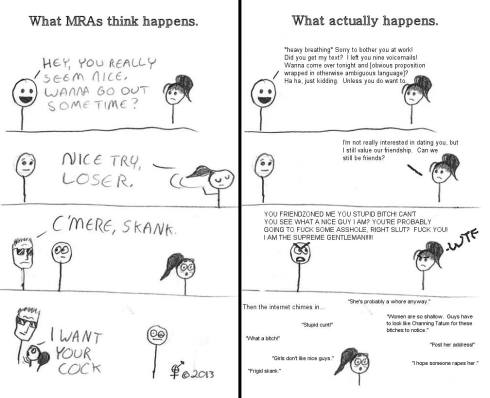
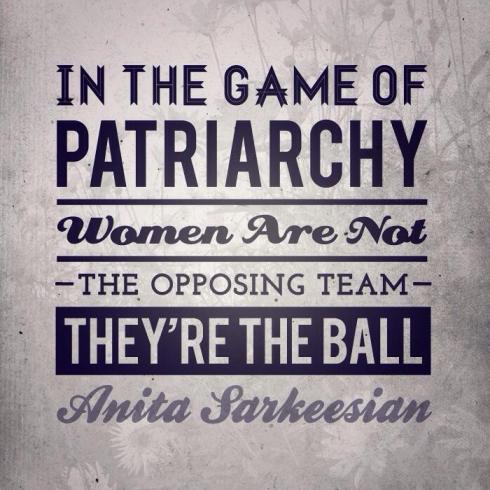
We see you, and just look what you did!

 It doesn’t get made any simpler than this. Yes these are US stats, but do you think it’s really all that different here in Canada? Ya, neither did I.
This information is put together by Laura Bassett at The Enliven Project. Data was pulled by the FBI. Go over to their page of the details.
Not being able to add anything more to the raw power of this, I figured I’d add some tips on how to stop rape. They go as follows:
1. Dudes: Don’t rape
2. Seriously DON’T RAPE
3. Don’t joke about rape.
4. Don’t threaten rape.
5. Don’t defend rapists.
6. If your bro tells you he raped someone, report him to the police.
7. Don’t be friends with rapists. Make sure you tell the rapist that you won’t be friends with him because he is a rapist.
8. Teach your children not to rape.
9. Teach your friends not to rape.
10. DON’T RAPE
I think that about covers it.

 Blueprints for understanding the perspective of the marginalized can often be summarized succinctly as “STFU and listen”. Here is a longer version though just to be extra clear. A big thanks to Shakesville for the summary.
This, then, is a very rudimentary, but also very straightforward, primer for dudes who want to communicate more effectively with female partners, friends, relatives, and colleagues during good faith conversations about feminist issues:
1. Every woman is an expert on her own life and experiences.
2. No woman speaks for all women.
3. No woman speaks for all feminists.
4. Because of the way cultural dominance/privilege works, marginalized people are, by necessity and unavoidability, more knowledgeable about the lives of privileged people than the other way around. Immersion in a culture where male is treated as the Norm (and female a deviation of that Norm), and where masculinity is treated as aspirational (and femininity as undesirable), and where men’s stories are considered the Stories Worth Telling, and where manhood and mankind are so easily used as synonymous with personhood and humankind, and where everything down to the human forms on street signs reinforce the idea of maleness as default humanness, inevitably makes women de facto more conversant in male privilege than men are in female marginalization. That’s the practical reality of any kind of privilege—the dominant group can exist without knowing anything about marginalized group, but the marginalized group cannot safely or effectively exist without knowing something about the privileged group and its norms and values.
5. Which is not to say that men can’t become fluent, with effort. But it is important to remember that it does take effort. Even though men’s and women’s lives can look so similar at first glance, it is shocking how very different they can actually be. (For example.)
6. A woman with intersectional marginalizations cannot wrench herself into parts. Asking a woman to set aside her race, or disability, or sexuality, or body size, or stature, or whatever, in order to discuss a “woman’s issue,” is to fail to understand that one’s womanhood is inextricably linked to the other aspects of one’s identity.
7. It is similarly unfair to ask a woman to leave aside her personal experience and discuss feminist issues in the abstract. You are discussing the stuff of her life. Asking her to “not make it personal” is to ask her to wrench her womanhood from her personhood.
8. You are not objective on women’s issues because you’re not a woman. Your perception is just as subjective as hers is, but for a different reason. Either we stand to be marginalized by privilege or stand to benefit from it. That’s the reality of institutional bias; it compromises us all.
9. Don’t play Devil’s advocate. Seriously. Just don’t.
10. Listen.











 bleatmop
 Mystro
 The Arbourist


 Dead Wild Roses
Your opinions…