
You are currently browsing the tag archive for the ‘How society is construted’ tag.
 The verdict has been in for a long time now, but still the message is not getting through. Harsh sentences and a punitive justice system do not work. “The best way to turn a non-violent person”, says prison psychologist James Glligan, “into a violent one is to send him to prison.”
The official reasons for incarceration and imprisonment are described as the following –
“[…] while imprisonment is generally believed to have four ‘official’ purposes – retribution for crimes committed, deterrence, incapacitation of criminals and the rehabilitation of criminals, in fact three other purposes have shaped America’s rates and conditions of imprisonment. These unofficial purposes are class control – the need to protect honest middle-class citizens from the dangerous criminal underclass; scapegoating – diverting attention away from more serious social problems (the growing inequalities in wealth and income [for example].); and using the threat of the dangerous class for political gain.
-Irwin, John. Federal Bureau of Investigation, Crime in the United States 2006.
Washington, DC:Us Government Printing Office, 2006.
So, when do we wake up and begin to make the connection that punishment does not fix people and begin to structure our penal systems to reflect this fact?
One of the most frustrating parts of attempting to discuss White Male Privilege (WMP) with oh say white males is the  denial of the fact that it exists and it is an intrinsic characteristic woven into the fabric of our society. It is nice when another study is done (adding to the large body of work) to show its existence and how thoroughly embedded it is in our culture. A big hat-tip to Sociological Images for the leg work (which I am reposting it its entirety) in condensing the study originally found on Fairness and Accuracy in Reporting.
In a post at Fairness and Accuracy in Reporting, Steve Rendall and Zachary Tomanelli investigated the racial breakdown of the book reviewers and authors in two important book review venues, the New York Times Book Review and C-SPAN’s After Words. They found that the vast majority of both reviewers and authors were white males.
“Overall, 95% of the authors and 96% of the reviewers were non-Latino white (compared to 65% of the population).
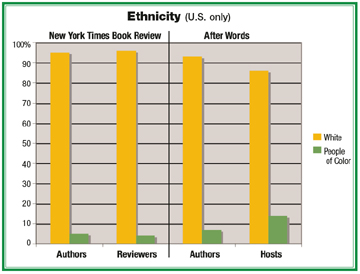
Women accounted for between 13 and 31% of the authors and reviewers:
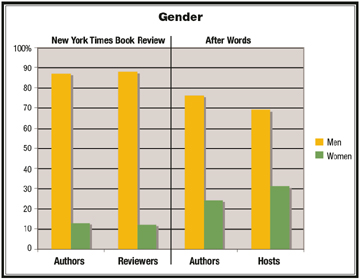
This is some hard data showing that white men’s ideas are made more accessible than the ideas of others, likely translating into greater influence on social discourse and public policy. These individuals certainly don’t all say the same thing, nor do they necessarily articulate ideas that benefit white men, but a greater diversity of perspectives would certainly enrich our discourse.”
It is really hard to argue against the substantive data collected about the influence of WMP on our culture and how it conditions us to think and act. As the quoted material says, just imagine if more people were able to influence our culture how much more rich and diverse our culture would be.











 bleatmop
 Mystro


 Dead Wild Roses
Your opinions…