
You are currently browsing the tag archive for the ‘Inclusion’ tag.
“A celebration of diversity that silences certain voices… is not inclusive—it is ideologically selective.”
The Montreal Pride Parade’s decision to exclude Jewish organizations like Ga’ava and the Centre for Israel and Jewish Affairs (CIJA) reveals the brittle nature of contemporary inclusion. Organizers explained that the festival’s board had “made the decision to deny participation in the Pride Parade to organizations spreading hateful discourse”—widely interpreted as targeting groups perceived to hold Zionist views amid the Israeli-Palestinian conflict (National Post). Yet this rationale exposes a contradiction: a celebration of diversity that silences certain voices based on political affiliation is not inclusive—it is ideologically selective. True inclusion doesn’t retreat under pressure or disqualify those with unpopular views; it endures in the face of discomfort. By barring these organizations, Montreal Pride signals that its version of inclusion functions not as a principle, but as a privilege granted only to those aligned with a narrow ideological consensus.
Considering the Organizers’ Perspective
It’s worth acknowledging why the organizers might have made this decision. They could argue that pro-Israel groups might provoke protests or distress among participants, given the polarized nature of the Israeli-Palestinian conflict. However, without specific, credible threats, this rationale appears more like a preemptive strike against ideological discomfort than a genuine safety measure. Pride has weathered controversy before—its history is one of defiance in the face of societal pushback. To retreat now suggests a prioritization of ideological purity over inclusivity.
Safety as a Pretext for Exclusion
Invoking “physical and mental safety” may appear commendable, but applying it to justify excluding Ga’ava—a Montreal-based LGBTQ+ Jewish organization—and CIJA appears unfounded in concrete threats. Ga’ava’s president characterized the exclusion as “based on flimsy, politically motivated reasons decided behind closed doors under pressure from groups that hate Jews, deny Israel’s existence, and whose members celebrated the atrocities of October 7, 2023” (i24NEWS). Who gets to determine what’s safe? In this case, the organizers prioritized avoiding discomfort among critics of Zionist expression over the dignity of those excluded. This risks prioritizing ideological comfort over genuine safety concerns.
According to CIJA’s director of strategic communications, Julien Corona, the decision represents “a dark day for the LGBTQ+ movement here in Quebec but also in all of Canada” (National Post).
The Perils of Moral Absolutism
Montreal Pride’s actions illustrate how moral certainty, when unchecked, can corrupt even the most noble ideals. By conflating the participation of Jewish organizations with “hateful discourse,” organizers implicitly deemed dissenting political views as unacceptable, suggesting their perspective is immune from challenge (i24NEWS). But in reducing disagreement to danger, they betray their own professed values of inclusion and pluralism. What remains is not a broad tent of solidarity, but a gated enclave of ideological approval.
This episode fits into a broader pattern: similar exclusions have occurred in other Pride contexts—Toronto, Chicago, Washington DC—involving Jewish symbols or groups linked to Israel/Palestine debates (Wikipedia). By excluding Ga’ava and CIJA, Montreal Pride reinforces a troubling trend: replacing complexity of identity with a simplistic tribal test.
Moreover, this isn’t the first time a social movement has been fractured by ideological litmus tests. The feminist movement, for example, has seen bitter divisions over issues like sex work and transgender rights, with some factions excluding others based on perceived ideological impurity. Similarly, the civil rights movement grappled with tensions between integrationist and separatist ideologies. In each case, moral certainty led to splintering rather than solidarity. Montreal Pride risks a similar fate if it continues down this path.
A Forward-Looking Conclusion
If Pride movements hope to sustain moral legitimacy and relevance, they must resist equating disagreement with harm. Exclusion based on political affiliation not only wounds the excluded but weakens the movement itself. Pride must recommit to its radical roots—embracing all marginalized voices, even those that spark debate—or risk losing its soul. The true test of inclusion isn’t welcoming those who agree with us; it’s extending that welcome to those who challenge us. Only then can Pride fulfill its promise as a beacon of diversity and defiance.

Works Cited
- Amador, Marisela. “Montreal Pride excludes Jewish LGBTQ+ group, citing ‘hateful discourse’.” CTV News, July 31, 2025. Link
- Corona, Julien. Quoted in “‘A dark day for the LGBTQ movement’: Montreal Pride Parade organizers bar Jewish groups from march.” National Post, August 1, 2025. Link
- “Montreal’s Pride Parade bans 2 Jewish groups.” i24NEWS, July 31, 2025. Link
- “Pride parade.” Wikipedia. Link
This is how the activist Left abuses polysemy. Polysemy is defined as follows:

So, this is their game. To make their radical propositions seem reasonable they purposefully use words that have a generally accepted meaning, but then at the same time a special transformative meaning for them. The woke activist left does this so they can move the political/social football in a radical direction all the while sounding like they are saying normal, reasonable things.
Let’s take an easy obvious example, let’s look at the word “inclusion”.
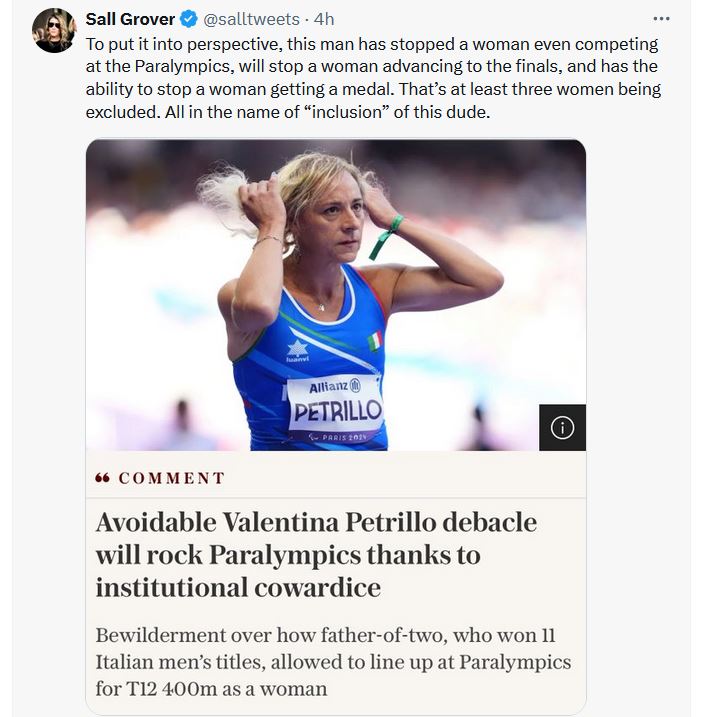
“Inclusion” in this case is doing a great deal of work under the hood. The argument from the activists is this – we should include all types of women in female sports that includes “cis-women”¹ and of course “trans – women”.
The mechanism at work here is “inclusion” means accepting the notion that there are more that one type of females in society that play sports. This is the truth married to a lie in action – the woke argument for inclusion inserts the notion that males who call themselves women are actually women and thus in ‘woke reality’ we should include deluded males in the female category.
This is how they wedge their bullshit into society because when confronted by people who comport with reality woke activists can then smear and attack their reality abiding opponents for not being “inclusive”. To low information people seeing the argument taking place they see one side coming out for inclusion and one side being against inclusion (the bigots, the transphobes, insert your preferred vehicle of social coercion…) – but the definition of inclusion the low information people have in their heads is not the same as the one the activists are implicitly following.
So the low information people working on the non activist definition of inclusion are bamboozled into going along with the activists (and the poison pill contained within) thinking that they are supporting a just, more inclusive society.
Obviously, the exact opposite is true. By including men in female sports female athletes are excluded from participating, winning medals, and getting funding to further their excellence in their own category.
This is dichotomy of terms (dialectical even) is not a mistake, because if they led with a clear unambiguous statement of their inane version of ‘inclusion (including males in the female sport categories)’ they would get zero social traction/support for their society corrosive radical views.
¹ – Just a sidebar this is why it is advisable to never accept the term “cis” in your affairs and society. “Cis” erases the authentic definition of what a woman is. Women are exclusively adult human females, full stop. Including males who think they are women in the category blurs and invalidates the category and destroys the ability for people to make reasonable category discernment in social situations.
Women speaking out against the politics of individual identity and exposing the hypocrisy that lies at the base of much of the liberal objection to radical feminist class based politics.
“i’m so tired of this liberal viewpoint that you have to include everyone at all times when talking about politics or else you’re excluding and harming them. just because someone focuses on certain issues doesn’t mean they don’t care about the people not affected by those issues. if a woman wants to talk about abortion with a sign that says “no uterus, no opinion” or respond to trump with “pussy grabs back” there is nothing wrong with this. this isn’t transphobia, these messages don’t even equate the anatomy with womanhood. this isn’t white feminism, WOC are also affected by abortion and sexual assault. you say we can’t exclude anyone from feminism and then in the same breath try to exclude people that want to talk about major issues facing women today.”











 bleatmop
 Mystro
 The Arbourist


 Dead Wild Roses
Your opinions…