
You are currently browsing the tag archive for the ‘Intersectionality’ tag.
Found on X here.
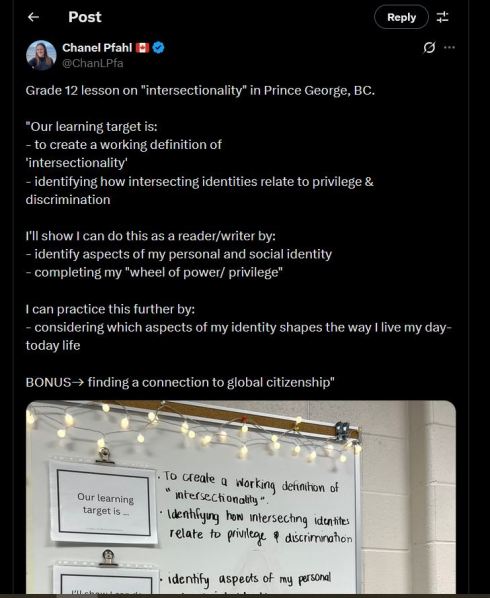
Intersectionality in the Classroom: From Empathy to Indoctrination
Intersectionality, a framework coined by legal scholar Kimberlé Crenshaw in 1989, purports to illuminate how overlapping social categories such as race, gender, class, and sexuality compound experiences of discrimination or privilege. Emerging from Crenshaw’s analysis of Black women’s marginalization within both feminist and civil rights discourses, the term has since evolved into a pervasive lens for examining interlocking systems of power.
In a recent Grade 12 lesson plan from Prince George, British Columbia, students are tasked with crafting personal definitions of intersectionality, mapping their identities onto a “wheel of power/privilege,” and connecting these to daily life and global citizenship. This exercise, ostensibly designed to foster empathy, exemplifies how the theory infiltrates education—reducing multifaceted human experience to a grid of predetermined oppressions and advantages. Yet beneath its academic veneer lies a mechanism for sowing division, one that demands scrutiny for its role in perpetuating grievance over growth.
At its core, intersectionality falters by collapsing the rich tapestry of individual lives into rigid identity matrices, sidelining agency, character, and shared humanity in favor of immutable traits assigned at birth. By framing privilege as an unearned inheritance tied to one’s position on the proverbial wheel, the framework risks breeding resentment among students, who learn to view peers not as collaborators but as bearers of systemic guilt. Empirical observations from social movements underscore this fragmentation: alliances crumble when identity eclipses common purpose, as seen in fractured coalitions where tactical solidarity yields to performative purity tests.
Even within leftist traditions, critics decry how intersectionality dilutes rigorous economic analysis into cultural essentialism, obscuring material inequities under a haze of subjective hierarchies. Far from empowering, this lesson in Prince George transforms the classroom into a theater of suspicion—where adolescents dissect their “intersecting identities” not to build resilience but to catalog wounds, fostering a generation primed for perpetual victimhood rather than principled action.
This pedagogical sleight of hand reveals intersectionality’s deeper allegiance to identity politics, a doctrine that elevates collective affiliation above individual merit and moral accountability. In the lesson’s directive to “identify aspects of my personal and social identity” relative to privilege, students are subtly coerced into prioritizing group-based narratives over personal narratives, echoing a broader cultural shift where loyalty to tribe trumps universal ethics. Such politics, by design, atomizes society into silos of grievance, undermining the Enlightenment ideal of judgment by deeds rather than descent.
The result is not enlightenment but alienation: white students branded as inherent oppressors, marginalized peers cast as eternal victims, all while the lesson’s “bonus” nod to global citizenship rings hollow amid the induced tribalism. Verifiable accounts from educators and observers confirm this corrosive effect, with classrooms devolving into echo chambers of accusation rather than forums for frank exchange.
Worse still, intersectionality’s Marxist undercurrents betray its origins in class warfare, merely repackaging economic antagonism as identitarian strife to sustain endless conflict without resolution. Drawing from dialectical materialism’s emphasis on oppositional forces, the theory substitutes proletariat–bourgeois divides with fluid yet perpetually clashing identity classes—oppressors versus oppressed—fueling a zero-sum battle that mirrors historical agitprop but swaps factories for feelings. Critics within the Marxist canon itself lament this dilution, arguing it retreats from revolutionary class consciousness into liberal fragmentation, where cultural skirmishes supplant systemic overhaul.
In the Prince George curriculum, this manifests as students pondering how their “wheel” positions them in global hierarchies, unwittingly internalizing a narrative of inevitable clash that excuses inaction while justifying radicalism. By promoting such identitarian discord, intersectionality does not liberate; it entrenches a spectral class war, audible in its echoes from the Frankfurt School to contemporary campus upheavals.
In place of this divisive doctrine, educators should pivot to a lesson grounded in universal human rights, drawing from the Enlightenment’s timeless assertion of equality before the law irrespective of ascribed identities. Students might begin by studying the Universal Declaration of Human Rights (1948)—articulating core tenets like dignity and non-discrimination—and then apply them to case studies that transcend identity silos. Group debates could explore how these rights galvanize cooperation in pluralistic societies, extending into civic duties such as community service that bridge divides through shared endeavor.
This alternative, far from ignoring inequities, confronts them through aspirational universality, fostering citizens equipped for concord rather than combat. By centering verifiable principles over subjective grids, such a curriculum honors truth’s pursuit, arming youth against narrative warfare with the unyielding shield of human solidarity.
References
- Crenshaw, Kimberlé. “Demarginalizing the Intersection of Race and Sex.” University of Chicago Legal Forum 1989(1): 139–167.
— Foundational essay introducing intersectionality in the context of Black women’s employment discrimination cases. - Crenshaw, Kimberlé. “Mapping the Margins: Intersectionality, Identity Politics, and Violence against Women of Color.” Stanford Law Review 43, no. 6 (1991): 1241–1299.
— Expanded articulation of intersectional theory applied to social and legal contexts. - Bell, Daniel. The Cultural Contradictions of Capitalism. New York: Basic Books, 1976.
— Influential analysis of how ideological movements replace class analysis with cultural moralism. - Fraser, Nancy. “From Redistribution to Recognition? Dilemmas of Justice in a ‘Post-Socialist’ Age.” New Left Review 212 (1995): 68–93.
— A left-wing critique of intersectionality’s turn toward identity over material class structures. - Marcuse, Herbert. One-Dimensional Man. Boston: Beacon Press, 1964.
— Core Frankfurt School text examining how ideology replaces substantive rationality; relevant to intersectionality’s theoretical lineage. - United Nations. Universal Declaration of Human Rights. Adopted December 10, 1948.
— Primary document grounding an alternative civic and moral education in universalism rather than identity determinism. - Lilla, Mark. The Once and Future Liberal: After Identity Politics. New York: Harper, 2017.
— Liberal critique of identity politics and its corrosive impact on civic cohesion.
Toward the end, the question was asked by Ramaswamy to his opponent – ‘The best way to stop discriminating on the basis of race is to stop discriminating on the basis of race.”
You can see all the identity politic tropes manifest themselves – ‘intersectionality’, oppression narratives, the willful dismissal of the evidence at hand (name a better country for the advancement of all people in the country).
“Intersectionality shows us that everyone could do better; that every attempt at rolling back discrimination could work harder and be more inclusive. But it should also remind us that people themselves are more than a simple label: “white feminist”; “middle-class man”; “posh boy”; “Twitter bully”. Here are some of the things I know that the kind of feminists regularly decried for their privilege have had to deal with, in private: eating disorder relapses; rape; the stalking of their children; redundancy; clinical depression; the sectioning of a family member; an anxiety disorder that made every train ride and theatre trip an agony. (Yes, one of those descriptions is me.)
None of this is to say that feminism shouldn’t be open to criticism. When Caroline Crampton and I got together our bloggers last year for a New Statesman debate about feminism, the response was . . . well, there were two responses. There was criticism that was constructive: for example, the deviously persuasive Karen Ingala Smith managed to parlay her disappointment that we didn’t talk enough about rape into making me join the board of her VAWG charity. And there was criticism that was destructive, aimed at wounding us for not representing every possible permutation of womanhood. (I laughed when one particularly enthusiastic deconstructor, when asked: “Well, how can you possibly make a six-person panel totally representative of half of humanity?”, came back with, “Oh, that’s why I don’t believe in panel discussions.”)”
Intersectionality a useful concept in describing oppression along multiple axis. Let’s cue up Kimberle Crenshaw who coined the term for a little more background.
“The term intersectionality theory was first coined by legal scholar Kimberlé Crenshaw in 1989.[3] In her work, Crenshaw discussed Black feminism, which argues that the experience of being a black woman cannot be understood in terms of being black and of being a woman considered independently, but must include the interactions, which frequently reinforce each other.[19] Crenshaw mentioned that the intersectionality experience within black women is more powerful than the sum of their race and sex, and that any observations that do not take intersectionality into consideration cannot accurately address the manner in which black women are subordinated.”
On to what Carly Thomsen says:
“I recently asked my students in an upper division Gender and Women’s Studies Feminist Engaged Research course—in which all students are Gender and Women’s Studies majors or minors—a question about that day’s reading we were discussing in class. A student responded with: “It’s all about intersectionality.” My initial question is not particularly relevant, as I have found that students will attempt to answer nearly any question by referencing (the need for and value of) “intersectionality.” I followed up to ask: “What is intersectionality?” My students looked at me blankly. All of my students had been exposed to what they would describe as “intersectionality.” Yet, not one had read the original theory of intersectionality. Not one could accurately describe the theory. Not one had a sense of the genealogy of the term. Not one could think of limits to intersectionality. Some thought that the term refers to moments in which activism and scholarship “intersect,” while others insisted that it refers to the moment when any two or more marginalized identities meet within one person’s life. Not one knew its roots in black feminist theory or critical race theory. I raise this point not because these moments gesture toward some type of feminist pedagogical failure—if only the students learned the material properly!—but because these moments point to the hegemony of discourses of “intersectionality” within Gender and Women’s Studies. In these moments, we can see that, as Ahmed (2012a) suggests, “intersectionality can be used as a method of deflection,” as a way of re-directing attention away from race and racism (195)—and, by extension, from whichever form of marginalization one is working to address—by bringing up other forms of social exclusion. The failure here lies with neither an individual instructor nor student but with a field that has produced so little critical reflection on the limits of “intersectionality” that it figures as that which is largely beyond contest.”
“Becoming Radically Undone: Discourses of Identity and Diversity in the Introductory Gender and Women’s Studies Classroom” – -Carly Thomsen
Pay attention when people start throwing the term intersectionality around. Quite often you’ll see intersectionality thrown at feminists who have the utter temerity to want to discuss issues that concern women directly or who want to centre women in their discourse. Silencing women, of course, is the goal.











 bleatmop
 Mystro
 The Arbourist


 Dead Wild Roses
Your opinions…