
You are currently browsing the tag archive for the ‘Israel’ tag.
Iran, American Hegemony, and Western Resolve.
For years, Iran has functioned not as a normal state with normal ambitions, but as a regime that exports pressure through proxies, intimidation, missile programs, and calibrated disorder. Ottawa itself has repeatedly described Iran as “the principal source of instability and terror in the Middle East,” while stressing that Tehran must never be allowed to obtain or develop nuclear weapons. That matters because it cuts through the usual fog. This was not a strike against a harmless status quo. It was a strike against a regime that has spent years making the region more combustible, more violent, and more difficult to govern. (Canada PM)
That does not make war clean. It does not make every target choice wise. It does not make every legal question disappear. But it does clarify the strategic question. If a regime repeatedly funds, arms, and directs forces that destabilize the region, then eventually someone must decide whether deterrence is a word or a policy. The American and Israeli action in Iran is best understood in those terms. Not as a fantasy of moral purity, but as a decision to reimpose costs on a state that had grown used to exporting them. Ottawa’s own language makes that case harder to evade than many critics would like. (Canada PM)
This is the part many Western governments still struggle to say plainly. Order is not maintained by sentiment alone. It is not maintained by declarations, concern, and another exhausted appeal to “the international community.” Canada’s March 3 statement admitted the core reality: years of negotiations, sanctions, international monitoring, and multilateral pressure did not neutralize the Iranian threat. That is a brutal admission, and an important one. It means the soft-language consensus failed on its own stated terms. At some point, if the threat remains, either somebody acts or the speeches become a form of theatre performed over a steadily deteriorating map. (Canada PM)
“American hegemony, however much the word offends refined opinion, has often been the hard outer shell of a wider Western order.”
So yes, there is a case for saying the strikes were good in strategic terms. Iran was not a stabilizing power that got misunderstood by the usual Western moralists. It was a revolutionary regime that helped build and sustain a network of armed clients and auxiliaries across the region. Striking at that centre of gravity carries risks, but so did allowing it to operate under the assumption that the West had become too managerial, too conflict-averse, and too morally confused to act decisively. The risk of action is real. The risk of permanent indulgence was real too, and too often treated as invisible. (Canada PM)
That is why this moment matters beyond Iran. Not because one campaign settles the world. Not because every adversary will instantly become cautious. But because power still communicates. It communicates especially to regimes that have spent years studying the West and concluding that we prefer procedure to force, messaging to punishment, and managed humiliation to escalation. The lesson of Iran may not be that America will always act. It is simpler and more important than that: America still can act, and under some conditions still will. Even the White House’s preferred language of “peace through strength” matters less here as slogan than as signal. Adversaries do not have to admire the wording to understand the demonstration. (Canada PM)
That broader message is where China enters the discussion, but only carefully. It would be too strong, and probably false, to say Beijing has “backed down” because of Iran. Reuters reporting on Chinese military activity around Taiwan points to a narrower and more ambiguous picture: visible Chinese air activity around Taiwan has fallen sharply, but Taiwanese officials and analysts offered multiple possible explanations, including a possible Trump-Xi meeting atmosphere and internal turbulence inside China’s military. They explicitly warned against reading too much into a short lull. So the honest claim is not that China has folded. It is that Beijing is being reminded, in public, that the United States still possesses both the means and, at times, the appetite to use hard power. That is an inference. It is not yet a proved geopolitical shift. (Reuters)
The January Venezuela raid helps make that point, though only in a limited sense. Reuters reported that U.S. officials explicitly framed the operation as a warning to Beijing to keep its distance from the Americas. That does not prove deterrence has been restored, and it does not establish a new global pattern on its own. It does show that the message was sent. In Venezuela and now Iran, Washington has demonstrated that recent American power has not been purely rhetorical. Rivals may draw their own conclusions, but they are being given fresh evidence that the United States still possesses both the means and, at times, the appetite to use hard force. (Reuters)
And that matters because American hegemony, however much the word offends refined opinion, has served for decades as the hard outer shell of a wider Western order. It has not produced a perfect world. It has produced something rarer: a world in which hostile powers, rogue regimes, and ambitious revisionists often had to think twice. That “think twice” space is not everything, but it is a great deal. Lose it, and you do not get peace. You get more tests, more probes, more daring clients, more rulers gambling that the old sheriff now prefers seminars to force. The language may rankle. The reality remains. (Reuters)
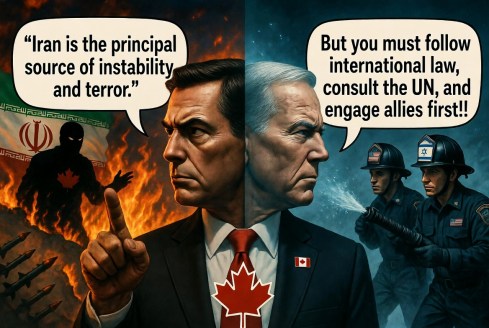
“Ottawa could identify the arsonist, but still felt compelled to lecture the firefighters on process before the building stopped burning.”
And then there is Canada, performing once again its favourite late-imperial routine: saying the truest thing in the room and then rushing to blur it. On March 3, Carney said Iran is the principal source of instability and terror in the Middle East and condemned Iranian violence against civilians. On March 4, he also stressed that the United States and Israel acted without engaging the United Nations or consulting allies, including Canada, and reaffirmed that international law binds all belligerents. In other words, Ottawa could identify the arsonist, but still felt compelled to lecture the firefighters on process before the building stopped burning. (Canada PM)
That is the embarrassment. Not caution as such. Caution can be prudent. The embarrassment is the inability to rank moral and strategic realities in the right order. A serious government can say: Iran is the principal destabilizing force, diplomacy failed, the strikes carry grave risks, and the next task is preventing a wider regional catastrophe. That would at least sound like an adult hierarchy of judgment. What we got instead was a familiar Canadian blend of partial clarity and procedural recoil, as if sounding too decisive might itself be a diplomatic offence. (Canada PM)
The deeper issue is civilizational confidence. A West that cannot impose costs on regimes that menace its allies, fuel regional disorder, and exploit every sign of hesitation will not be admired for its restraint. It will be read as tired. The value of American hegemony, whatever its flaws, has never been that it creates a frictionless world. It is that it has often underwritten a world in which enemies of the West had reason to fear miscalculation. That fear is not barbarism. It is one of the costs of preserving order. Remove it, and you do not get a more humane international system. You get a more predatory one. (Canada PM)
So the case for the strikes is not that war is noble or that consequences will be tidy. It is that deterrence sometimes has to become visible again. Iran built power by betting that the West preferred delay to decision. In this case, that bet was answered with force. Even America’s enemies, and Canada’s evasive political class, may have been reminded of something they had started to forget: strength still speaks, and sometimes it is the only language a revolutionary regime believes. (Canada PM)
References
Prime Minister of Canada. “Statement by Prime Minister Carney on the evolving situation in the Middle East.” March 3, 2026.
Prime Minister of Canada. “Prime Minister Carney delivers remarks to media in Sydney, Australia.” March 4, 2026.
Reuters. “Chinese military flights around Taiwan fall, Trump-Xi meeting may be factor.” March 5, 2026.
Reuters. “With Venezuela raid, US tells China to keep away from the Americas.” January 11, 2026.
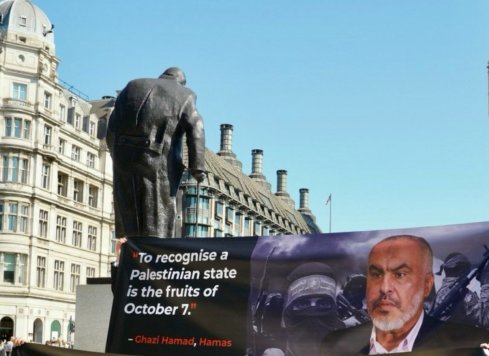
On September 21, 2025, Prime Minister Mark Carney announced that Canada officially recognizes the State of Palestine, aligning with over 140 UN member states. This decision, made ahead of the UN General Assembly, has been met with criticism, particularly from Israel, which views the move as a reward for Hamas and a setback for peace efforts. Carney emphasized that the recognition is contingent upon the Palestinian Authority holding elections in 2026 and excluding Hamas from governance (Reuters).
Critics argue that this recognition overlooks the complexities of the Israeli-Palestinian conflict. They point out that Hamas, which controls the Gaza Strip, has a history of violence and has been designated as a terrorist organization by Canada. The decision to recognize Palestine without addressing Hamas’s role raises questions about the effectiveness of such diplomatic gestures in promoting peace and stability in the region.
Furthermore, some view this move as a political maneuver to distance Canada from its traditional ally, the United States, and to align more closely with European nations that have recognized Palestinian statehood. However, without a comprehensive strategy that includes addressing the influence of Hamas and ensuring the security of all parties involved, this recognition may be seen as a symbolic gesture rather than a step toward a lasting resolution to the conflict.
References
- Reuters: Carney says Canada recognises a Palestinian state
- AP News: Canada joins other countries in recognizing a Palestinian state ahead of UN General Assembly
- New York Post: Canada, UK and Australia all recognize Palestinian state as rebuke to Israel for Gaza war
- Washington Post: U.K., Canada, Australia recognize Palestine as a state, breaking with U.S.
- Al Jazeera: Canada, UK and Australia announce recognition of Palestinian statehood
. The FAFO factor often involves the highest of stakes. The people who support Hamas really ought to give their head a shake because most of their activities place them firmly in the useful idiot category.
These excerpts from Susie Linfield‘s essay on called The Return of the Progressive Atrocity.
“In 1979, leftists who supported the Iranian Revolution had a rude awakening when the mullahs came to power and promptly executed them, along with secularists, union organizers, intellectuals, feminists, and everyone else who fit into the enormously capacious category of a counterrevolutionary. There was a lesson here: Activists have the responsibility to know who and what they support, and to separate themselves—openly and decisively—from programs and regimes that are predicated on violence and repression. Similarly, those who imagine that Hamas’s slaughters may have promoted “liberation,” “justice,” and “freedom” for Palestinians, as the banners demand, have a big surprise in store.
Unlike Iran in 1979, though, there’s no mystery as to what kind of state Hamas (an acronym for the Islamic Resistance Movement) aims to create; we need only look at what it already has created. This time, no one can plead ignorance. There’s little liberation, justice, or freedom to be found in Gaza, where there are no opposition political parties, no elections, and no freedom of religion, the press, or protest. Opponents are arrested, tortured, and sometimes executed. (Yahya Sinwar, a head of Hamas’s armed wing, was known as “the butcher of Khan Younis” for his brutality toward other Palestinians.) Abortion and homosexuality are outlawed (what are those protestors with “Queers for Palestine” signs thinking?); mentioning trans rights would be unwise. It is legal for husbands to beat their wives, and so-called honor killings go unpunished. The ruling clique is notoriously corrupt, and though Gazans are very poor, Hamas is a very rich organization. “I Stand with Palestine!” demonstrators and writers proudly proclaim while lauding Hamas for having “rejuvenated a sense of political possibility” and hastening “the hour of liberation.” But what, exactly, are they standing for? And what kind of liberation will this be? Aside from the Taliban, Hamas has established the least progressive pseudo-state on Earth. The lesson of Iran has apparently not been learned; history is repeating itself not as farce but as tragedy.”
[…]
“Oppression is not a carte blanche for severing heads from bodies, shooting hundreds of young festival-goers, bludgeoning people to death, murdering children in front of parents and vice versa, killing naked women point-blank, and kidnapping babies and the elderly; there is no universe in which these are revolutionary, emancipatory, or anticolonialist acts, much less “beautiful” ones. Sadism and violence are not synonyms. Sexual torture cannot be anti-imperialist—nor is it an understandable, much less inevitable, response to oppression. An eliminationist program is not a freedom charter. History has proved, again and again, that terrorists and freedom fighters aren’t the same, which is why the former never achieve anything approaching either liberation or justice. There is no room for “yes, but.” Why, when it comes to the deaths of Israelis, is this so hard to understand? “
I’m chilled when I see so many members of our intelligentsia support and excuse heinous crimes against humanity. The Left when blinded by power-dynamics can be just as bloodthirsty as the Right.
” But it is overwhelming that Hamas wanted War. This was not the irrepressible angst of the desperate. Who want freedom? Who want better? Nor certainly want anything approximating peace. They wanted the Jews to know that they want them to burn… again.”











 bleatmop
 Mystro
 The Arbourist


 Dead Wild Roses
Your opinions…