
You are currently browsing the tag archive for the ‘Marxism’ tag.
The rule of law, a cornerstone of Western civilization, ensures justice and stability through impartiality, accountability, and restraint on power. Marxism, by contrast, subordinates legality to revolutionary goals and class-based conflict, undermining the very structures that support social cohesion. To preserve civilization, we must uphold the rule of law.
1. The Rule of Law: Civilization’s Bedrock
In 1215, the barons at Runnymede compelled King John to sign the Magna Carta, declaring that even monarchs must be subject to law. This revolutionary idea—the rule of law—would become a cornerstone of Western civilization, evolving through England’s Glorious Revolution (1688) and culminating in modern constitutionalism.
The U.S. Constitution (1789) and France’s Declaration of the Rights of Man and of the Citizen (1789) enshrined this principle globally. By 2020, 90% of democracies had incorporated judicial independence into their constitutional systems.¹ The rule of law, as theorized by thinkers like A.V. Dicey and later F.A. Hayek, restrains power through legal predictability and universality.²
The practical results are clear. Nations scoring above 0.8 on the World Bank’s Rule of Law Index—such as Denmark, Finland, and Canada—also consistently rank high on human development, prosperity, and civic trust.³ The rule of law provides a common legal language for diverse societies, replacing tribal favoritism with equality before the law. Even where the system has historically failed—colonial abuses, slavery, or gender inequality—it has proven self-correcting through reform.⁴
Some critics claim that the rule of law merely entrenches elite power structures. But this critique misrepresents its essence. Far from preserving privilege, impartial law constrains it. It creates a standard by which even the powerful may be held to account. The abolition of slavery, universal suffrage, civil rights protections—all emerged not in spite of legal order, but through it. Civilization thrives when justice prevails.
2. The Shadow Rises: Marxism’s Assault on Legal Order
The rule of law’s strength lies in its impartiality—its power to unify pluralistic societies under shared norms. Yet Marxism offers a fundamentally different vision: one that subordinates legal stability to revolutionary transformation and class struggle.
In The Communist Manifesto (1848), Karl Marx and Friedrich Engels dismissed law as a mere instrument of the bourgeoisie.⁵ Their goal was not reform but abolition—of private property, class, and the legal structures that supported both. This revolutionary posture bore grim fruit: under Stalin’s Great Terror, over 1 million people were executed in the 1930s as law was repurposed into a tool of terror.⁶ Mao Zedong’s Cultural Revolution (1966–76) abandoned legal process entirely, leading to the persecution and death of millions in the name of ideological purification.⁷
Contemporary neo-Marxist frameworks, like Critical Legal Theory, question whether law can ever be neutral. While these critiques raise valid concerns about systemic bias, they often collapse into legal nihilism. “Equity” is increasingly invoked not as a means of fair access to justice but as a demand for redistributive outcomes that override due process.⁸
Seattle’s 2020 “defund the police” policy experiment, influenced by such theories, reduced legal enforcement capacity. According to FBI Uniform Crime Reporting, homicides in the city rose 61% that year.⁹ While correlation does not imply causation, many observers linked the spike to policing reductions and the erosion of legal authority. A Rasmussen survey in 2023 found that 68% of Americans believed defunding policies increased crime.¹⁰
Even more moderate Marxist thinkers, like Antonio Gramsci, viewed legal neutrality as a fiction. His theory of “cultural hegemony” suggested that dominant ideologies—including legal norms—function to maintain ruling class power.¹¹ While Gramsci promoted gradual reform over violent revolution, his intellectual legacy has often been absorbed into radical critiques that pit “justice” against legality.
When the law is treated not as a safeguard of liberty but as an obstacle to progress, impartiality is lost. The result is not liberation but fragmentation. Societies governed by fluctuating ideological mandates rather than stable legal norms revert to “might makes right.” History provides ample warning.
3. The Stakes and a Call to Action
When law bends to ideology, chaos follows. The Soviet gulags and Seattle’s crime spikes are not identical in scale, but they both reflect what happens when legal norms are abandoned in the pursuit of revolutionary or moral goals.
Data again reinforces the case for the rule of law. Nations with Rule of Law Index scores above 0.8 also top global rankings in democracy, trust in institutions, and social resilience.³ Law is not merely procedural; it is a moral and civilizational foundation.
That does not mean we defend unjust systems blindly. We must remain vigilant, pushing for principled reforms: transparent policing (such as California’s 2018 body-camera law, AB 748¹²), judicial independence, and accountability for misconduct. But we must reject efforts to replace law with ideological fiat.
Support for organizations promoting constitutional order—like the Federalist Society—can help anchor legal education in foundational principles. Likewise, defending due process in public discourse reaffirms our shared commitment to equal justice.
Marxism’s critiques of inequality are not without merit. But where they abandon legal impartiality in favor of ideological justice, they endanger the very fabric of civilization. To preserve liberty, we must defend the law—not as an artifact of oppression, but as a guarantor of peace.

References
-
Constitute Project. World Constitutions Database (2020). https://www.constituteproject.org
-
Hayek, F. A. (1960). The Constitution of Liberty. Chicago: University of Chicago Press.
-
World Bank. Rule of Law Index (2022). https://info.worldbank.org/governance/wgi
-
UK Parliament. Slavery Abolition Act (1833); U.S. Congress. 19th Amendment (1920). https://www.parliament.uk | https://www.archives.gov/founding-docs/amendments-11-27
-
Marx, K., & Engels, F. (1848). The Communist Manifesto. https://www.marxists.org/archive/marx/works/1848/communist-manifesto/
-
Conquest, R. (1990). The Great Terror. Oxford: Oxford University Press.
-
Chang, J., & Halliday, J. (2005). Mao: The Unknown Story. New York: Knopf.
-
Delgado, R., & Stefancic, J. (2017). Critical Race Theory: An Introduction (3rd ed.). New York: NYU Press.
-
FBI. Uniform Crime Reporting Program (2021). https://ucr.fbi.gov/crime-in-the-u.s/2021
-
Rasmussen Reports. Crime Concerns and Defund Police (2023). https://www.rasmussenreports.com
-
Gramsci, A. (1971). Selections from the Prison Notebooks. New York: International Publishers.
-
California State Legislature. AB 748: Body-Worn Camera Footage Disclosure (2018). https://leginfo.legislature.ca.gov/faces/billTextClient.xhtml?bill_id=201720180AB748
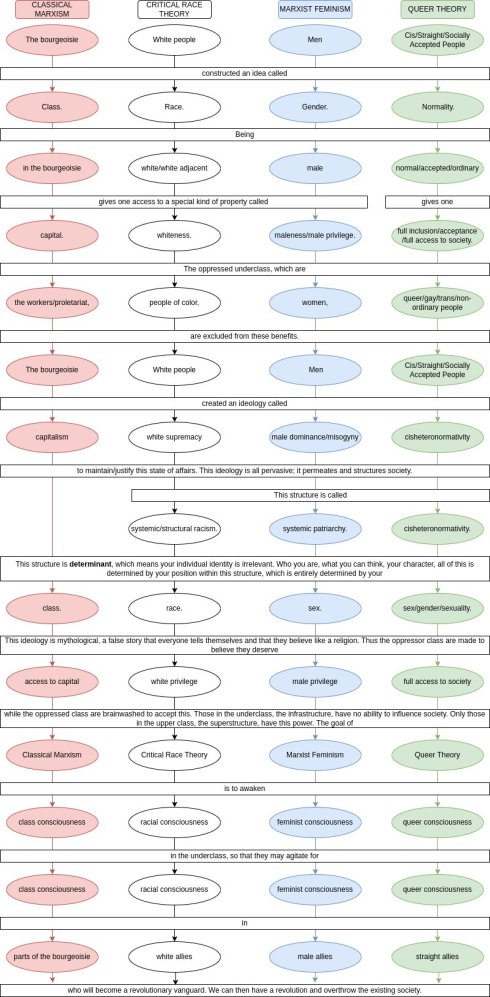
James Lindsay writes about how to recognize the prevalent patterns of Neo-Marxist thought and how to they promulgate in society:
“Take race, for example. If one assumes, as did Cheryl I. Harris in 1993, that “whiteness” defines a special form of property that certain people (“whites”) can treat as exclusive, a complete Marxist theory of race can drop out of the political economy machine. They call it “Critical Race Theory,” and, for reasons that are about to be perfectly clear, I call it “Race Marxism.” Here’s how it works, comparing against classical Marxism with a forward slash between the concepts.
Some people (whites/capitalists) unjustly declare themselves the exclusive possessors of a special form of private property (whiteness/capital), thereby divide society into those who have it and those who don’t, and begin to arrange society such that the power granted through that access increases for those people over time. Those excluded from the resource and thus power by this declaration (people of color/workers) are thereby exploited for their productive capacity that is then turned into surplus value (cultural property/profit) for the advantaged class. Not only are the exploited thereby robbed of what they produce (cultural property/labor value), but they are estranged from who they really are (valid representatives of a culture/producers). More specifically, the product of their work (cultural production/labor) is subsumed into the privileged class (becomes part of white culture/is turned into profit), leaving the exploited (people of color/worker) impoverished (culturally/materially) and unable to recognize himself for who he really is (say, authentically Black/a producer). All this is enabled by the privileged class structuring society at its most fundamental levels for their own benefit (structural or systemic racism/structural classism), justified by the privileged class promulgating an ideology that it’s how things are supposed to be (white supremacy/capitalism and meritocracy). People in this dynamic system can be awakened to the structural “realities” of their lives and become (race/class) conscious activists (antiracists/proletarians) who work to seize the means of production (cultural/material) of their society to make it more fair (equitable/socialist). Eventually, this will be generally understood as the right way to order a society and will, through their praxis inverting into the inversion of praxis and thus socially conditioning people to accept it, become spontaneously fair (socially just/communist).
This extends to other forms of property, construed more abstractly as not just material as in capital and land, but also as social, cultural, and even human capital. This allows for the instantaneous creation of the entire constellation of “Identity Marxist” theories of identity politics with virtually no work (which makes it funny how much work it has taken these people to devise this stuff). Again, technically none of these is a theory (they’re all anthroposophies and/or theosophies). Here’s a quick summary:
Marxism: The bourgeoisie claims access to a special form of property called capital. They create an ideology called capitalism (based on things like meritocracy) to justify this. This allows them to structure society with structural classism that advantages the bourgoisie and exploits, estranges, and disenfranchises the working class. People can be made aware of the Marxist theory of societal production and become class-conscious proletarians or a bourgeois vanguard operating in solidarity on their behalf. If they seize the means of production of society and Man, they will usher in socialism that will eventually ripen into Communism through the inversion of praxis.
Critical Race Theory: The whites (and their adjacents) claims access to a special form of property called whiteness. They create an ideology called white supremacy (based on things like meritocracy and racism) to justify this. This allows them to structure society with structural or systemic racism that advantages whites and exploits, estranges, and disenfranchises people of color. People can be made aware of the Critical Race theory of societal production and become race-conscious antiracists and/or “white allies” operating in solidarity on their behalf. If they seize the means of race-cultural production of society and Man, they will usher in racial equity that will eventually ripen into racial justice (a kind of social justice) through the inversion of praxis.
(Marxian) Feminism: Men claim access to a special form of property called maleness or masculinity. They create an ideology called male supremacy or hegemonic masculinity (based on things like meritocracy and sexism) to justify this. This allows them to structure society with patriarchy and structural or systemic sexism, enforced by misogyny, that advantages men and exploits, estranges, and disenfranchises women, as a class. People can be made aware of the (Marxian) feminist theory of societal production and become feminist-conscious feminists and/or “male allies” operating in solidarity on their behalf. If they seize the means of sex-cultural and material production of society and Man, they will usher in gender equity that will eventually ripen into feminist justice (a kind of social justice) through the inversion of praxis.
Queer Theory: Straight people whose “gender identity” and sex match (and those who pass as such) claim access to a special form of property called normalcy (by declaring themselves the normal ones and defining normalcy to mean like themselves). They create an ideology called normativity (e.g., heteronormativity and cisnormativity) to justify this. This allows them to structure society with structural or systemic homophobia and/or transphobia (or, generally, queer-phobia) that advantages the “normal” and exploits, estranges, and disenfranchises “queers” (anyone different, especially gays, lesbians, bisexuals, the gender non-conforming, transgenders, and the mentally ill). People can be made aware of the Queer Theory theory of societal production and become queer-conscious (“proud”) allies operating in solidarity on their behalf. If they seize the means of normative cultural production of society and Man, they will usher in gender, sexual, and sex equity that will eventually ripen into gender, sexual, and sex justice (a kind of social justice) through the inversion of praxis.
Disability Studies: The able-bodied claim access to a special form of property called “ability.” They create an ideology described from the outside as dis/ableism (based on a belief that it is generally better to be fully able-bodied than not, and further based in ideas like “medicalism”) to justify this. This allows them to structure society with structural or systemic dis/ableism that advantages able-bodied and exploits, estranges, disenfranchises, and disables the disabled or “differently abled.” People can be made aware of the Disability Studies theory of societal production and become disability activists conscious allies operating in solidarity on their behalf. If they seize the means of ability-relevant cultural and material production of society and Man, they will usher in ability-based equity that will eventually ripen into ability-based justice (a kind of social justice) through the inversion of praxis.
Fat Studies: The “thin” (those who are not “fat”) claim access to a special form of property called “normal weight” or even “health.” They create an ideology described from the outside as thinnormativity (based on a belief that it is generally better to be at a healthy weight than not, and further based in ideas like “healthism” and “medicalism”) to justify this. This allows them to structure society with structural or systemic fatphobia that advantages “thin” people and exploits, estranges, and disenfranchises the “fat” (they cannot be called “obese” because that “medicalizes” them or “overweight” because that “unjustly” implies a normal or acceptable weight). People can be made aware of the Fat Studies theory of societal production and become fat activists fat-conscious allies (or fat) operating in solidarity on their behalf. If they seize the means of weight/health-relevant cultural and material production of society and Man, they will usher in fat-based equity that will eventually ripen into fat-based justice (a kind of social justice) through the inversion of praxis.
It’s extremely important to understand Marxism on this general level so that what we’re dealing with around us in the world can be properly understood, called out for what it is, and prevented from achieving its ultimately destructive goal of seizing the means of production of anything, especially Man and History. Understanding these “theories” for what they really are not only allows us to call them out accurately and understand why they must be stopped, but it also allows us to be strategic in our fight against them because it enables us to easily predict their next moves and to delegitimize their manipulations as quickly as they arise. Failure to understand them this way means continually being taken off-guard, losing, and being manipulated, or—more accurately and through the inversion of their praxis—being exploited, estranged, and disenfranchised from our own societies.”
Long read, the rest is under the fold.
“I would like to explain to you the method that the Black Panther Party used to arrive at our ideological position, and more than that, I would like to give to you a framework or a process of thinking that might help us solve the problems and the contradictions that exist today. Before we approach the problem we must get a clear picture of what is really going on; a clear image divorced from the attitudes and emotions that we usually project into a situation. We must be as objective as possible without accepting dogma, letting the facts speak for themselves. But we will not remain totally objective; we will become subjective in the application of the knowledge received from the external world. We will use the scientific method to acquire this knowledge, but we will openly acknowledge our ultimately subjectivity. Once we apply knowledge in order to will a certain outcome our objectivity ends and our subjectivity begins. We call this integrating theory with practice, and this is what the Black Panther Party is all about.
In order to understand a group of forces operating at the same time, science developed what is called the scientific method. One of the characteristics or properties of this method is disinterest. Not uninterest, but disinterest: no special interest in the outcome. In other words, the scientist does not promote an outcome, he just collects the facts. Nevertheless, in acquiring the facts he must begin with a basic premise. Most basic premises stem from a set of assumptions because it is very difficult to test a first premise without these assumptions. After an agreement is reached on certain assumptions, an intelligent argument can follow, for then logic and consistency are all that is required to reach a valid conclusion.
Tonight I ask you to assume that an external world exists. An external world that exists independently of us. The second assumption i would like for you to make is that things are in a constant state of change, transformation, or flux. With agreement on these two assumption we can go on with our discussion.
The scientific method relies heavily on empiricism. But the problem with empiricism is that it tells you very little about the future; it tells you only about the past, about information which you have already discovered through observation and experience. It always refers to past experience.
Long after the rules of empirical knowledge had been ascertained, a man by the name of Karl Marx integrated these rules with a theory developed by Immanuel Kant called rationale. Kant called his process of reasoning pure reason because it did not depend on the external world. Instead it only depended on consistency in manipulating symbols in order to come up with a conclusion based upon reason. For example, in this sentence “If the sky is above my head when I turn my head upwards, I will see the sky” there is nothing wrong with the conclusion. As a matter of fact, it is accurate. But I haven’t said anything about the existence of the sky. I said “if.” With rationale we are not dependent upon the external world. With empiricism we can tell very little about the future. So what will we do? What Marx did. In order to understand what was happening in the world Marx found it necessary to integrate rationale with empiricism. He called his concept dialectical materialism. If, like Marx, we integrate these two concepts or these two ways of thinking, not only are we in touch with the world outside us but we can also explain the constant state of transformation. Therefore, we can also make some predictions about the outcome of certain social phenomena that is not only in constant change but also in conflict.
Marx, as a social scientist, criticized other social scientists for attempting to explain phenomena, or one phenomenon, by taking it out of its environment, isolating it, putting it into a category, and not acknowledging the fact that once it was taken out of its environment the phenomenon was transformed. For example, if in a discipline such as sociology we study the activity of groups–how they hold together and why they fell apart–without understanding everything else related to that group, we may arrive at a false conclusion about the nature of the group. What Marx attempted to do was to develop a way of thinking that would explain phenomena realistically.
In the physical world, when forces collide they are transformed. When atoms collide, in physics, they divide into electrons, protons, and neutrons, if I remember correctly. What happened to the atom? It was transformed. In the social world a similar thing happens. We can apply the same principle. When two cultures collide a process or condition occurs which the sociologists call acculturation: the modification of cultures as a result of their contact with each other. Marx called the collision of social forces or classes a contradiction. In the physical world, when forces collide we sometimes call it just that–a collision. For example, when two cars meet head on, trying to occupy the same space at the same time, both are transformed. Sometimes other things happen. Had those two cars been turned back to back and sped off in opposite directions they would not be a contradiction; they would be contrary, covering different spaces at different times. Sometimes when people meet they argue and misunderstand each other because they think they are having a contradiction when they are only being contrary. For example, I can say the wall is ten feet tall and you can say the wall is red, and we can argue all day thinking we are having a contradiction when actually we are only being contrary. When people argue, when one offers a thesis and the other offers an anti-thesis, we say there is a contradiction and hope that if we argue long enough, provided that we agree on one premise, we can have some kind of synthesis. Tonight, I hope I can have some form of agreement or synthesis with those who have criticized the Black Panther Party.
I think that the mistake is either that some people have taken the apparent as the actual fact in spite of their claims of scholarly research and following the discipline of dialectical materialism. They fail to search deeper, as the scientist is required to do, to get beyond the apparent and come up with the more significant. Let me explain how this relates to the Black Panther Party. The Black Panther Party is a Marxist-Leninist party because we follow the dialectical method and we also integrate theory with practice. We are not mechanical Marxists and we are not historical materialists. Some people think they are Marxists when actually they are following the thoughts of Hegel. Some people think they are Marxist-Leninists but they refuse to be creative, and are, therefore, tied to the past. They are tied to a rhetoric that does not apply to the present set of conditions. They are tied to a set of thoughts that approaches dogma–what we call flunkyism.
Marx attempted to set up a framework which could be applied to a number of conditions. And in applying this framework we cannot be afraid of the outcome because things change and we must be willing to acknowledge that change because we are objective. If we are using the method of dialectical materialism we don’t expect to find anything the same even one minute later because “one minute later” is history. If things are in a constant state of change, we cannot expect them to be the same. Words used to describe old phenomena may be useless to describe the new. And if we use the old words to describe then new events we run the risk of confusing people and misleading them into thinking that things are static.
In case you were unfamiliar. :)
I suggest you go to Counterpunch and read the whole article, but here we see the benefit of Marx’s analysis of capitalism.
“In Stack’s “manifesto”, he quotes Karl Marx. Ironically, Marx is useful here. Explaining how human labor-power is objectified in commodities, which then become realized as social relations once they are put to use, Marx demonstrates how through our labor, which is our dominant mode of social relation, we are all connected. Marx was fond of using linen as an example. A weaver’s social value is realized after a person wears a coat made by the tailor. That is, these heretofore unrelated persons now share a common relationship. If we expand upon this and ask how many people today are involved in producing the coat we wear, from the electricity that powers the sewing machines to the petrol used for delivery, the answer is infinite; the answer is all of us. Marx further explains how once the “universal equivalent”, or money, is supplanted as a metric for our labor, that organization of production tends toward profit rather than collective good.
This is a powerful tool in understanding how we share a common relationship with a destitute Greek worker or an Iraq War veteran suffering from PTSD and/or other psychological disorders. With wages earned from our labor we purchase German goods, exacerbating the economic imbalance between Germany and peripheral countries like Greece, thereby adding to the extreme suffering Greek workers are being forced to endure. It can explain how a solider, upon his or her return home, cannot easily reveal that the jingoist notions of freedom, liberty and security we are all imbued with had no role to play in the killing that we as a society, at least through our taxes, tacitly asked of them. It can further explain how police can criminalize the indigent for their own victimization. As Stack described, the loss of jobs from L.A. caused some Los Angelians to lose their already precarious footing in American society, namely Blacks and Latinos. Combined with systemic, inter-generational poverty and racism, it is all too easy to mistake the symptoms of this malaise for its etiology.”












 bleatmop
 Mystro
 The Arbourist


 Dead Wild Roses
Your opinions…