
You are currently browsing the tag archive for the ‘McGill University’ tag.
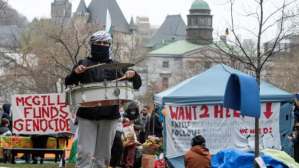 The protests at McGill University in April 2025 and the Trucker Convoy of 2022, while distinct in their scale, context, and authority, offer a compelling lens through which to examine accountability and lawbreaking in Canada. The McGill protests, driven by anti-Israel activists, involved physically blocking lecture halls and disrupting classes, as reported by B’nai Brith Canada, thereby denying students their right to education. In contrast, the Trucker Convoy, a nationwide movement against COVID-19 mandates, paralyzed critical infrastructure like the Ambassador Bridge, causing billions in economic losses and prompting the federal government to invoke the Emergencies Act. The scale of the Trucker Convoy’s impact was far greater, affecting national and international trade, while McGill’s disruptions were localized to a university campus. Additionally, the authority responding differed—McGill’s administration, a private institution, managed the campus protests, whereas the federal government, with its broader legal powers, tackled the Trucker Convoy. These differences in scope and jurisdiction naturally shaped the responses, but they also highlight a shared challenge: ensuring accountability when laws or rules are broken.
Acknowledging the protesters’ perspectives strengthens the case for consistent accountability. At McGill, the activists likely saw their actions as a moral imperative, aiming to pressure the university into divesting from companies linked to Israel’s actions in Gaza, which they framed as complicity in genocide. Similarly, the Trucker Convoy participants believed they were defending personal freedoms against government overreach, with some public support reflecting sympathy for their cause, as noted in historical polling data. Both groups may argue that their lawbreaking was justified by higher ethical goals—whether social justice or individual rights. However, this justification does not negate the harm caused: McGill students were intimidated and denied education, while the Trucker Convoy’s blockades disrupted livelihoods and public safety, with reports of harassment like defecating on lawns, as documented in news coverage from the time. The principle of free expression, a cornerstone of Canadian democracy, does not extend to actions that violate others’ rights or break laws, whether on a university campus or a national border. Recognizing the protesters’ motivations does not absolve them of responsibility; rather, it underscores the need for equitable enforcement to maintain social order and trust in institutions.
 The disparity in official responses to these events reveals a troubling inconsistency in addressing lawbreaking in Canada, fueling perceptions of a two-tier justice system. The Trucker Convoy faced severe consequences—hundreds of arrests, vehicle seizures, and frozen bank accounts under the Emergencies Act, as reported by Globalnews.ca—reflecting the government’s prioritization of economic and public safety. In contrast, McGill’s response was tepid, with the university implementing ID-based access controls only after days of disruption, and no immediate legal consequences like arrests or suspensions for the protesters, despite calls from advocacy groups for decisive action. While the federal government’s authority and the national stakes justified a stronger response to the Trucker Convoy, McGill’s leniency raises questions about institutional accountability on Canadian campuses. This inconsistency—where one group faces significant repercussions while another does not—erodes public confidence in the rule of law, suggesting that the consequences of lawbreaking may depend on the cause, context, or authority involved. Canada must strive for a balanced approach, ensuring that all acts of lawbreaking, regardless of scale or motivation, are met with fair and proportionate accountability to uphold the principles of justice and equality that define the nation.
The recent protests at McGill University, where anti-Israel activists physically blocked access to lecture halls and disrupted classes, represent a troubling departure from the principles of free speech and Canadian values. On April 2, 2025, as reported by B’nai Brith Canada, masked protesters in the Bronfman Building prevented students from attending classes, with chants of “McGill, McGill you can’t hide, you’re complicit in genocide” echoing through the campus. While protest is a protected right, these actions crossed into intimidation and coercion, as students were denied their fundamental right to education. Free speech in Canada is about expressing ideas without fear of retribution, not about obstructing others’ rights or creating a hostile environment. Such behavior is distinctly un-Canadian, as it undermines the nation’s commitment to mutual respect, dialogue, and the rule of law—values that have long defined Canadian society.
McGill University’s response to these protests highlights a glaring abdication of responsibility. Despite the disruptions, which forced some classes online and led to acts of vandalism, the university’s initial reaction was tepid, only implementing ID-based access controls on April 4, 2025, after days of chaos. Advocacy groups like the Canadian Friends of Simon Wiesenthal Center and concerned individuals have called for decisive action, pointing to the hostile environment created for Jewish students and the broader student body. McGill’s failure to swiftly address the physical blockades and ensure safe access to education sends a dangerous message: that the university prioritizes appeasing disruptive activists over protecting the rights of all students. This inaction not only erodes trust in the institution but also sets a precedent for tolerating intimidation under the guise of activism, further emboldening such behavior on Canadian campuses.
The protests at McGill reveal a deeper issue: a two-tier system of justice that is profoundly divisive for Canadian society. While the protesters faced little immediate consequence for their actions, students attempting to attend classes were left to fend for themselves, as seen in videos where individuals were physically blocked from entering lecture halls. This disparity in treatment—where one group’s “right” to protest is elevated above others’ rights to safety and education—creates a fractured campus environment. Jewish students, in particular, have reported feeling unsafe, with advocacy groups framing the protests as antisemitic. Meanwhile, some individuals with differing views supported the protesters, accusing Israel and its supporters of enabling genocide. This polarization reflects a broader societal trend where identity-based grievances are weaponized, pitting groups against each other rather than fostering unity, a core Canadian ideal.
My blog post *The Oblivious Irony of Canada’s Progressive Left* provides a stark illustration of this trend, noting, “The progressive left’s obsession with identity politics has created a hierarchy of victimhood, where certain groups are given carte blanche to act with impunity, while others are silenced or vilified.” This observation captures the essence of the McGill protests, where the activists’ cause—framed as a fight against oppression—seemingly justified their coercive tactics, while the rights of other students were dismissed. Identity politics, as I argue, has become a divisive force in Canada, eroding the shared values of fairness and equality that once united the nation. The McGill protests are a microcosm of this larger societal shift, where the pursuit of “justice” for one group comes at the expense of others, deepening divisions and resentment.
In conclusion, the actions at McGill University are not a legitimate exercise of free speech but a violation of the principles that define Canada as a nation. By allowing protesters to intimidate and obstruct, McGill has failed its students, particularly those who felt targeted or unsafe, and has contributed to a two-tier system of justice that undermines Canadian unity. The divisive impact of identity politics, as highlighted in previously, underscores the urgent need for a return to shared values—respect, dialogue, and equal treatment under the law. Canadian society cannot thrive when one group’s rights are prioritized over another’s, and institutions like McGill must take responsibility to ensure that campuses remain spaces for learning, not coercion. Only by upholding these principles can Canada reclaim its identity as a nation of fairness and inclusion for all.











 bleatmop
 Mystro
 The Arbourist


 Dead Wild Roses
Your opinions…